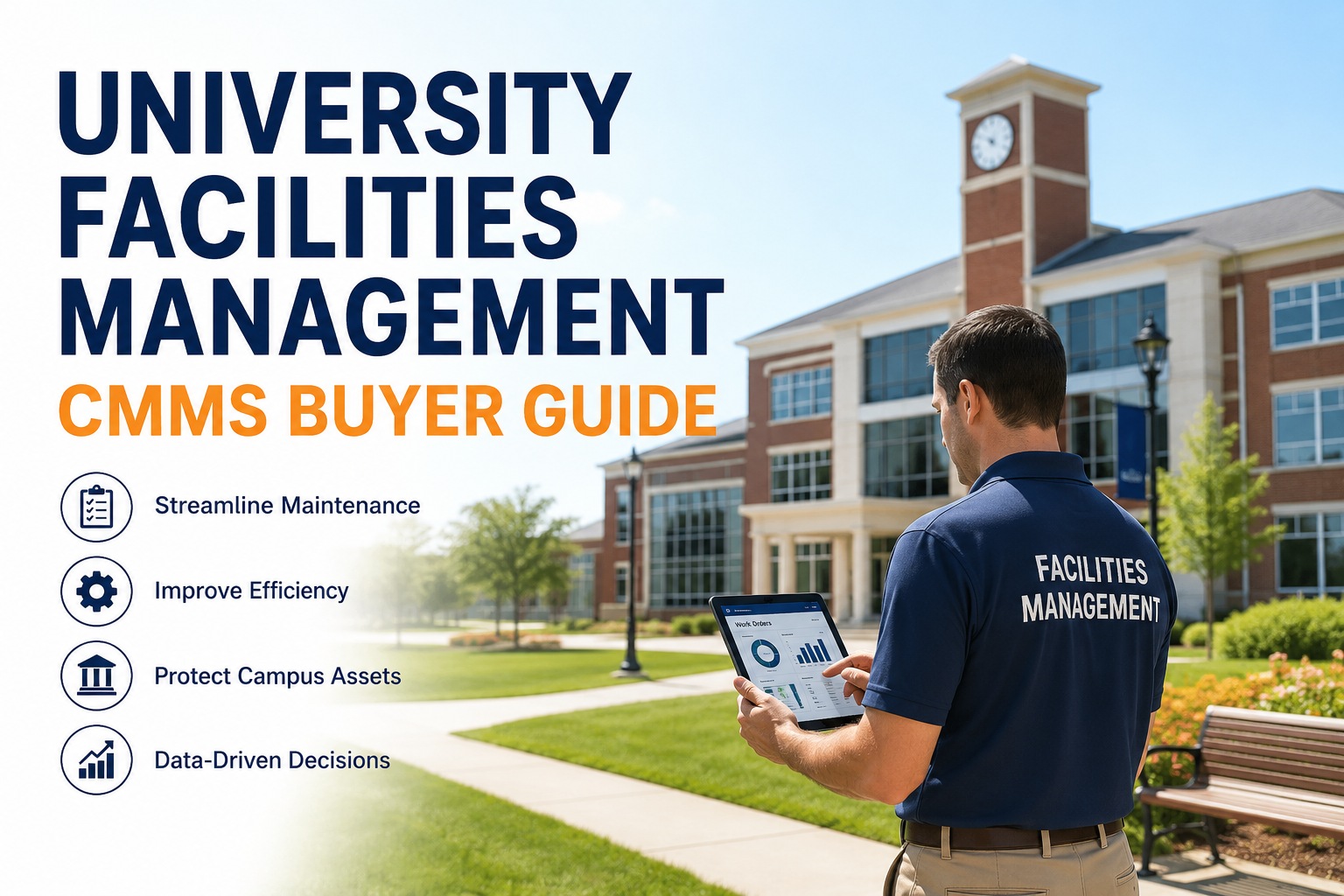
Somewhere on your campus right now, a chiller is degrading, a steam line is thinning, and a roof membrane is nearing end-of-life — and unless it is written down with a cost estimate attached, none of it exists to your board of trustees. That gap between what facilities teams know and what they can prove is the reason U.S. higher education carries a deferred maintenance backlog north of $112 billion, growing by roughly $11.4 million per campus every year. A CMMS is how facilities directors close that gap. But a university is not an office park, and the platform that runs a manufacturing plant was never built for 200 buildings, 150-year-old lecture halls, and BSL-3 labs on the same campus. This guide walks through exactly what to evaluate before you buy. Start a free Oxmaint trial and import your building list to see campus-wide backlog data in days, or book a demo with the Oxmaint higher-ed team for a guided walkthrough of your campus hierarchy.
Higher Education · Facilities Management · CMMS Buyer Guide
The University Facilities Management CMMS Buyer Guide for 2026
How to evaluate campus maintenance software against the requirements a university actually has — multi-building work orders, deferred maintenance tracking, BAS and ERP integration, and audit-ready compliance — before you commit budget.
-
$112B
national higher-education deferred maintenance backlog, and growing
-
61%
of institutions still run without a fully integrated CMMS (APPA 2025)
-
$1.41
cost to fix every $1 of deferred work once it fails versus planned repair
-
62 yrs
average age of a U.S. campus building, with systems nearing end-of-life
Why This Is Different
A Campus Is Not a Commercial Building — and Generic CMMS Knows It Cannot Cope
A single university can span 200 or more structures across residential halls, research labs, athletic venues, central utility plants, and historic buildings — five to fifteen million gross square feet under one facilities department. Meanwhile the 2026 enrollment cliff is squeezing tuition revenue at the exact moment buildings are aging fastest and the skilled-trades workforce is retiring. Facilities is no longer a back-office cost center; campus condition now moves enrollment yield and bond ratings. The buying decision below is really about one question: can this platform turn what your team knows into what your board will fund?
-
Enrollment Cliff
Prospective students notice shuttered buildings and sweltering dorms on campus tours. Facilities condition is now measured in yield, not just comfort.
-
Workforce Crisis
The median skilled-craft worker is 54, and square footage per worker has risen 25% since 2007. Lean teams need software that removes desk work, not adds it.
-
Board Scrutiny
68% of facility directors report they cannot secure capital because they cannot present quantified condition data. Boards fund what they can see documented.
-
Compliance Load
Fire, OSHA, ADA, and EPA findings each carry four-to-six-figure penalties. Every missed inspection is a citation waiting to be written.
The Core Checklist
Eight Capabilities That Separate a University CMMS From Generic Software
These are the requirements a campus platform must meet — the ones generic maintenance tools miss entirely. Use this as your evaluation scorecard. Score each vendor honestly; the gaps are where the pain shows up in year two.
-
01
Deep Asset Hierarchy
Multi-campus portfolios need six or more levels of nesting. Flat structures break down past 50 buildings. Look for unlimited nesting with PM templates inherited at every level — campus, building, floor, room, system, asset.
-
02
Cost-Estimated Deferred Backlog
Every open work order should carry an estimated repair cost, aggregated into live backlog dollars by building, system, age, and priority — with year-over-year trending. This is what turns a vague problem into a fundable capital liability.
-
03
ERP Integration Without Middleware
83% of universities run Banner, PeopleSoft, or Workday. The CMMS must sync purchase requisitions, budget codes, and HR data natively — not through custom integration costing six figures.
-
04
BAS & Building Automation Links
HVAC faults, energy alarms, and equipment trends from the building automation system should generate work orders automatically — closing the gap between a sensor reading and a dispatched technician.
-
05
True Mobile Parity With Offline
Technicians lose 1.5–2.5 hours a day to desktop trips. Full mobile function — plus offline capability for basements, tunnels, and parking structures with no signal — is the difference between adoption and resentment.
-
06
Compliance & Inspection Automation
Fire, OSHA, ADA, and lab safety inspections scheduled as recurring work orders with escalation alerts, timestamped and photo-verified — so audits are answered in seconds, not scrambles.
-
07
Student & Staff Request Portal
Web portals and QR codes that auto-route requests to the right trade, so a leaking dorm radiator becomes a tracked, costed work order instead of an email lost in an inbox.
-
08
Board-Ready Reporting & FCI
Facility Condition Index by building on demand, PM compliance dashboards, and capital-plan modeling — the documented evidence that turns a budget request from anecdote into an investment case.
Deployment Reality
Cloud CMMS vs Legacy IWMS — The Implementation Gap
One of the biggest buying mistakes in higher ed is confusing the biggest platform with the best fit. The traditional enterprise systems can take a year or more to go live; a cloud-native platform gets pilot buildings running in weeks. The fastest path to results is the CMMS your technicians will actually use.
| Evaluation Dimension | Legacy Enterprise IWMS | Cloud-Native CMMS (Oxmaint) |
|---|---|---|
| Time to First Value | 6–18 months to go live | Pilot buildings live in 1–2 weeks |
| Full Campus Rollout | Year-plus with migration & training | 8–10 weeks across the portfolio |
| IT Infrastructure | Servers to provision, software to install | Cloud-based, no servers, minimal IT load |
| Technician Adoption | Desktop-bound, low field usage | Mobile-first with offline, GPS, barcode |
| ERP & BAS Integration | Custom middleware, six-figure add-on | Native API sync to Banner / Workday / BAS |
| Total Cost of Ownership | High licensing plus services overhead | Fraction of the cost and time to value |
Follow the Money
How the Right CMMS Pays for Itself
The business case is not abstract. Deferred items compound at 7–15% per year, and boards approve documented requests at far higher rates than anecdotal ones. Here is where a purpose-built university CMMS returns its cost — every figure sourced from higher-ed facilities research.
-
60–75%
Emergency Failures Prevented
Automated PM scheduling stops the majority of emergency failures within the first year of deployment — the most immediate, easily documented ROI line.
-
40–60%
Higher Capital Approval Rates
Institutions presenting CMMS-documented, cost-estimated capital requests win funding far more often than those relying on departmental estimates.
-
31%
Better PM Compliance
Universities on purpose-built platforms report a 31% lift in PM compliance and a 24% cut in emergency work orders after deployment.
-
5–15%
Insurance Premium Reduction
Carriers increasingly discount property insurance for institutions with documented digital maintenance records — a direct budget line, not a soft benefit.
The Real Cost of Waiting
The Institutions on Spreadsheets Will Be Explaining Why the Chiller Failed During Finals Week
The $112 billion backlog grows every year, and the enrollment cliff is removing the budget headroom that let campuses defer the problem. The teams that started two years ago already have their data. The ones starting now will have it before the cliff peaks. A CMMS does not fix every building at once — but it gives you the one thing that changes every board conversation: evidence.
Your Buying Path
A Five-Step Evaluation Process for FM Teams
You do not need a year-long procurement cycle to make a confident decision. This is the sequence that gets FM directors from shortlist to campus-wide rollout without the false starts.
-
Map Your Building Hierarchy
List every campus, building, and major system. This is your test: any platform that cannot model your real hierarchy in a demo will not scale to your portfolio.
-
Score Against the Eight Capabilities
Run every shortlisted vendor through the checklist above. Weight deferred-backlog costing, ERP sync, and mobile parity most heavily — those are the year-two dealbreakers.
-
Request a Campus-Specific Demo
Generic demos hide the gaps. Insist the vendor map your actual building list and one real workflow — a dorm work order from student request to closed ticket.
-
Pilot One or Two Buildings
A cloud platform lets you run a live pilot in one to two weeks. Measure technician adoption and time saved before committing the whole campus.
-
Roll Out and Report to the Board
Expand across the portfolio in 8–10 weeks, then bring the board its first data-driven FCI and backlog report. That report is what funds the next cycle.
Start a free Oxmaint trial and import your building list to run a live pilot on your own campus, or book a demo to see your building hierarchy and a real work-order workflow mapped by the higher-ed team.
Frequently Asked
University CMMS Buyer Questions
How is a university CMMS different from a generic maintenance tool?
Campuses need deep multi-level asset hierarchies, cost-estimated deferred-backlog tracking, native ERP and building-automation integration, and board-ready Facility Condition Index reporting. Generic tools built for a single plant or office park flatten out past 50 buildings and cannot produce the capital-planning evidence a board of trustees requires. Sign up for Oxmaint to model your full campus hierarchy and see building-level backlog dashboards.
How long does implementation actually take?
Cloud-native platforms get pilot buildings operational in one to two weeks, with full campus rollout in eight to ten weeks. Traditional enterprise IWMS systems typically need six to eighteen months including data migration and training. Starting cloud-first for immediate impact is often the smartest path for a lean FM team.
Will it integrate with our Banner or Workday ERP and our BAS?
A purpose-built university CMMS syncs purchase requisitions, budget codes, and HR data with the major ERPs natively, plus SSO/SAML authentication and building-automation feeds — without the custom middleware that legacy platforms bill six figures for. Book a demo to see Oxmaint sync with your ERP and building automation system live.
Can a CMMS really help us win capital funding?
Yes — this is the highest-value use case. By capturing a repair cost on every work order and aggregating it into a prioritized, condition-rated backlog register with FCI scores, the system turns "we need money" into a documented capital plan. Institutions presenting that evidence report substantially higher approval rates than those relying on anecdote. Sign up for Oxmaint to build a board-ready deferred maintenance and capital plan from real asset data.
Evaluate · Pilot · Fund
Give Your Board the Data They Need to Fund the Campus You Actually Run
Oxmaint gives university facilities directors the deep hierarchy, deferred-backlog costing, compliance automation, ERP integration, and mobile capability that campus operations demand — at a fraction of the cost and implementation time of legacy higher-ed platforms. Map your buildings, run a pilot, and walk into your next budget meeting with evidence instead of estimates.

.png)

