A vibration sensor on a bearing crosses its fault threshold. If that reading has to travel to the cloud, get processed, and travel back before anyone's notified, the round-trip can take longer than the equipment has left to run. But if every sensor only ever looks at itself, nobody ever notices that the same fault pattern is showing up on six similar machines across three different sites. The real question isn't "cloud or edge" it's which workload belongs where. OXMAINT AI maintenance management software runs time-critical detection at the edge and fleet-wide pattern analysis in the cloud, and routes alerts from both into the same work order queue. This guide breaks down how to decide which processing layer a given predictive maintenance workload actually needs, using OXMAINT AI's AI-powered CMMS.
Predictive Maintenance Architecture · Cloud vs Edge Computing
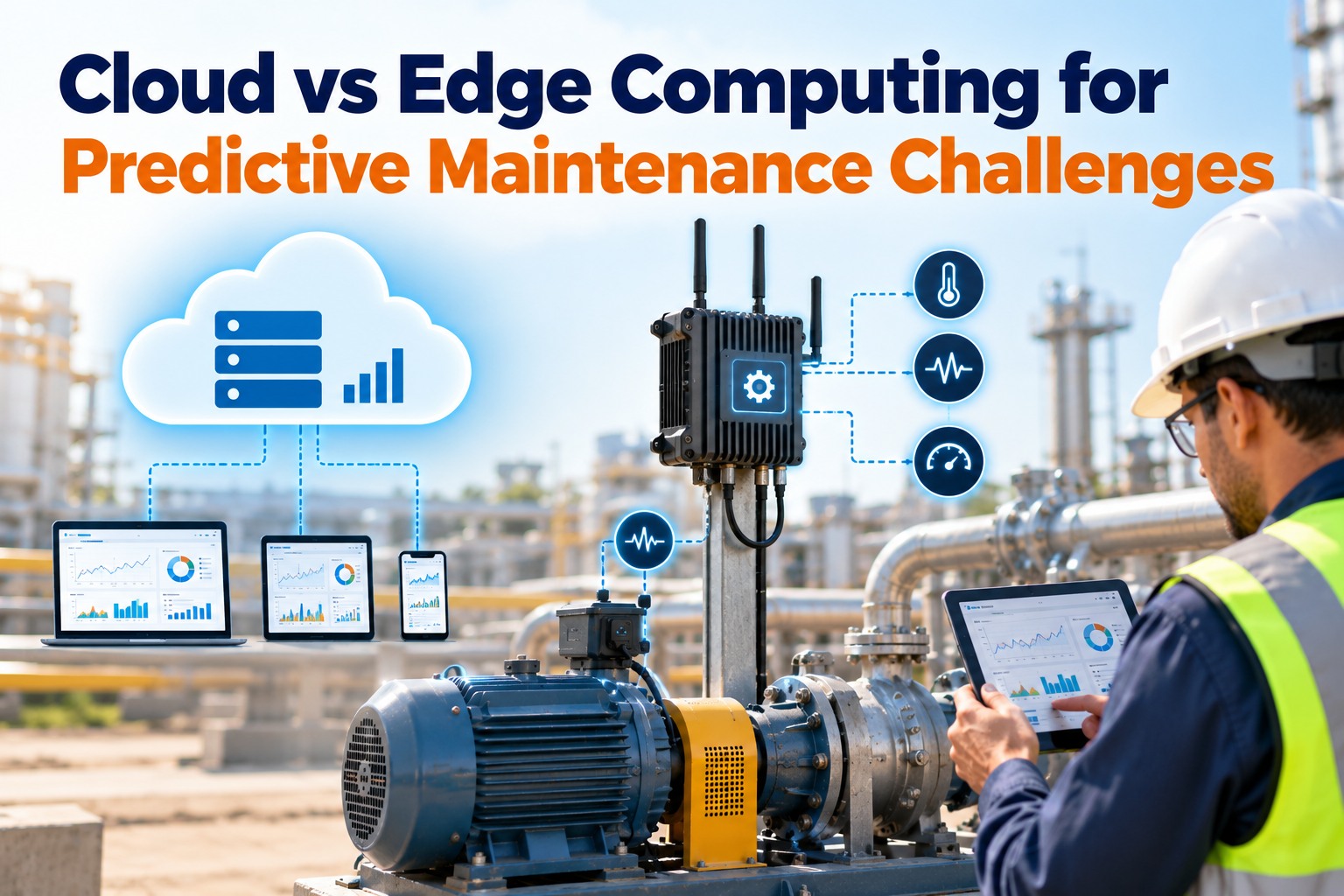
Cloud vs Edge Computing for Predictive Maintenance Challenges
A sensor reading needs a decision — process it locally for an instant alert, or send it to the cloud for context across the fleet. OxMaint's AI-powered CMMS runs both: edge-level detection for faults that can't wait on a network round-trip, and cloud-level analysis for patterns only visible across many assets and sites. Start a free trial to map your own workloads, or book a demo to walk through a hybrid architecture for your fleet.
Edge-Level Instant Alerts
Cloud-Level Fleet Analytics
Hybrid Architecture Ready
2 Processing Layers
edge and cloud, working together rather than instead of each other
1 Decision Framework
which workload belongs where, evaluated asset by asset
1 Work Order Queue
alerts from either layer land in the same place
1 Architecture
scales from a single site to a multi-site fleet without a redesign
The 3 Questions That Decide Cloud vs Edge
Most cloud-vs-edge debates skip straight to hardware. The better starting point is the workload itself — what it needs to detect, how fast, and with how much context. OXMAINT AI's platform routes each workload to the layer that question actually points to. Sign up free and map your own workloads today.
LATENCY TOLERANCE
How Fast Does It Need To React
Drives: Whether a fault needs a near-instant response or can wait minutes
Logic: If a delayed alert risks equipment damage, process at the edge
Why: A cloud round-trip adds network and queueing time a local inference avoids
Risk if wrong: A cloud-dependent alert arrives after the failure already happened
BANDWIDTH & CONNECTIVITY
How Much Data Can The Site Send
Drives: How much raw sensor data a site can realistically transmit
Logic: Filter and summarize at the edge when connectivity or volume is limited
Why: Streaming raw data from hundreds of sensors isn't realistic on most site links
Risk if wrong: A bandwidth bottleneck, or a blind site when connectivity drops
CROSS-ASSET PATTERNS
Does It Need The Wider Picture
Drives: Faults only visible by comparing many assets or many sites
Logic: Edge sees one asset in isolation; cloud sees the whole fleet's history
Why: A slow degradation trend often only shows up across a wider dataset
Risk if wrong: A systemic issue goes undetected because each site watches only itself
5 Workloads And Where They Actually Belong
In practice, the cloud-vs-edge decision isn't made once for a whole programme — it's made per workload. These five cover most of what a predictive maintenance programme needs to place correctly. Book a demo to see workload routing in action.
V
Vibration & Bearing Fault Detection
Needs a near-instant response before a developing fault becomes a failure
Belongs at: the edge
T
Temperature & Pressure Trending
Local summarization catches a spike instantly; the cloud trends it over time
Belongs at: the edge for alerts, the cloud for trends
F
Fleet-Wide Reliability Benchmarking
Only meaningful when comparing many assets and sites against each other
Belongs at: the cloud
E
Energy & Load Pattern Analysis
Depends on long historical baselines no single edge device holds on its own
Belongs at: the cloud
S
Safety-Critical Shutdown Triggers
Cannot depend on a network connection being available at the moment it matters
Belongs at: the edge
The Hybrid Processing Chain — How A Reading Becomes A Work Order
A hybrid architecture isn't two separate systems bolted together — it's one chain where edge and cloud each do the part they're suited for. OXMAINT AI connects both ends automatically, so a fault opens the same work order regardless of where it was first detected. Start free and build your hybrid chain today.
01 · Sense
Sensor Captures Raw Data
Vibration, temperature, pressure, or current data streams off the asset continuously
▼
02 · Edge Filter
Local Processing Flags Anomalies Instantly
A local device evaluates the reading against known thresholds without waiting on the network
▼
03 · Cloud Sync
Summarized Data Syncs For Fleet Context
Filtered summaries, not raw streams, sync to the cloud as connectivity allows
▼
04 · Correlate
Cloud Compares Against Fleet History
The reading is checked against this asset's history and against similar assets elsewhere
▼
05 · Decide
Combined Signal Confirms The Fault
The edge's immediate flag and the cloud's wider context combine into one confirmed finding
▼
06 · Dispatch
Work Order Opened, Wherever The Signal Originated
A technician gets one work order, regardless of whether edge or cloud caught the fault
Workload Placement Guide
A quick reference is more useful than a rule of thumb. OXMAINT AI's software applies this same placement logic automatically as new sensors and asset types are added to a site. Book a demo to see your own placement guide.
Where Common Predictive Maintenance Workloads Belong
EDGE
Bearing & Vibration Fault Detection
Sub-second response needed to prevent damage from propagating further
EDGE
Temperature & Pressure Threshold Alarms
Local response avoids a dependency on network availability for a basic alarm
CLOUD
Fleet Reliability Trending
Requires cross-site historical data no single edge device has access to
CLOUD
Energy & Load Forecasting
Requires long historical baselines built up over months or years
EDGE
Safety Interlocks & Shutdown Triggers
Must function correctly even during a full network outage
CLOUD
Capital Planning Analytics
Requires portfolio-wide aggregation across every site in the organization
Every Workload. The Right Layer. One Queue.
OXMAINT AI's maintenance management software routes time-critical detection to the edge and fleet-wide analysis to the cloud, then brings every confirmed fault into the same work order queue.
Edge Coverage Panel — Which Site Still Depends On The Network For Critical Alerts
A site that routes every time-critical alert through the cloud is exposed the moment connectivity drops. OXMAINT AI's software trends what share of critical workloads are already running at the edge, per site. Sign up free and see your edge coverage live.
Illustrative Edge Coverage Panel
Production Line 1
HEALTHY
Cold Storage Facility
HEALTHY
Remote Pumping Station
WATCH
HQ Mechanical Room
HEALTHY
Low-Connectivity Site
ACTION
Green = critical workloads fully edge-covered · Amber = partial edge coverage · Red = still cloud-dependent for critical alerts · updated as devices are deployed
What OXMAINT AI's Maintenance Management Software Gives A Predictive Maintenance Team
Purpose-built to support both processing layers — one software platform that runs edge-level detection where speed matters and cloud-level analysis where fleet context matters. Start free and map your architecture in OXMAINT AI.
Edge-Level Anomaly Detection
Local processing flags threshold breaches instantly, without waiting on a network round-trip.
Cloud-Level Fleet Analytics
Cross-site trends and benchmarks computed from the full history across every asset.
Hybrid Architecture Support
Edge and cloud work as one system, not two separate tools to maintain and reconcile.
Automatic Workload Routing
New sensors and asset types route to the right processing layer by default, per workload type.
Offline-Resilient Alerts
Edge-processed alerts continue to function during a network outage and sync once restored.
Unified Work Order Queue
A fault detected at the edge or in the cloud lands in the same queue for the same technician.
"
We spent a year arguing about whether to go all-in on edge devices or build everything in the cloud, and the argument itself was the wrong framing. Once we started asking which workload actually needed which layer, most of the decision made itself — the safety interlocks never belonged in the cloud to begin with, and the fleet benchmarking never belonged at the edge.
Reliability Engineering Manager · Multi-Site Industrial Operator
Frequently Asked Questions
Do we have to choose one architecture, or can edge and cloud run together?
They're meant to run together — edge handles time-critical detection locally, while the cloud handles fleet-wide context and trending, and both route into the same work order system.
Sign up free and set up a hybrid workflow.
What happens to edge-detected alerts if the site loses its network connection?
How much local hardware is required to run edge processing at a site?
Requirements vary by the number of sensors and the workload's complexity — a small gateway device is often enough for threshold-based alerts, while more complex pattern detection may need additional local compute.
Start free and discuss your site's requirements.
Can cloud-level trend data improve the accuracy of edge-level detection over time?
How long does a hybrid cloud/edge rollout typically take?
Most teams start with edge coverage for their highest-risk, most time-critical assets within a few weeks, then extend cloud-level analytics and additional edge coverage over the following months.
Sign up free and start with your critical assets.
Stop Choosing Sides. Start Routing Workloads.
Build your predictive maintenance architecture on OXMAINT AI's maintenance management software — edge-level instant detection, cloud-level fleet analytics, and one unified work order queue, whichever layer catches the fault first.