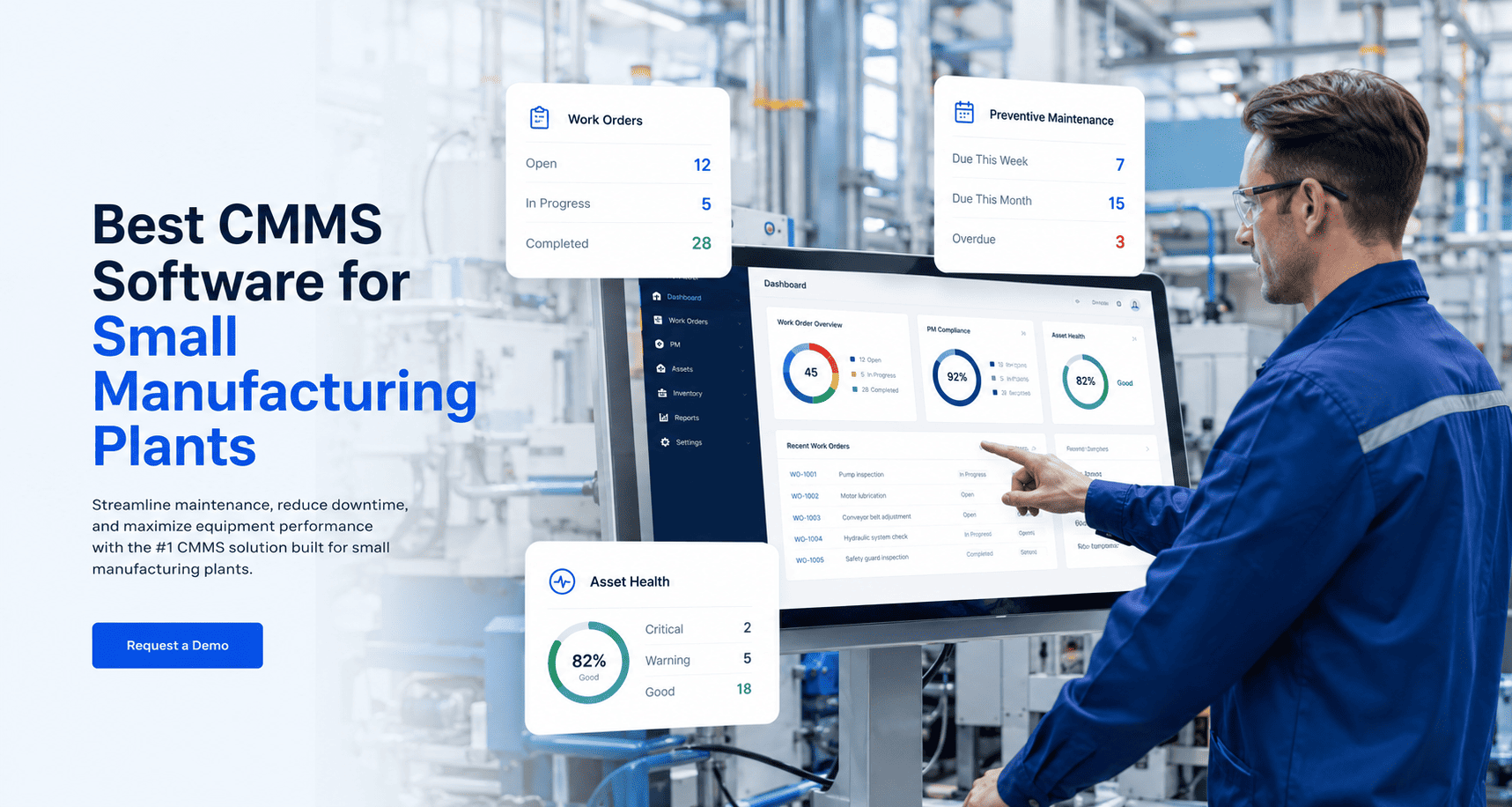
Manufacturing plants often operate on the edge of "break-fix" cycles where a single motor failure can halt an entire production line. When unplanned downtime strikes, it isn't just a repair cost; it is lost throughput, wasted labor, and missed delivery deadlines. Implementing a CMMS (Computerized Maintenance Management System) shifts the focus from emergency repairs to high-reliability manufacturing. By centralizing work orders and automating preventive schedules, plants can reduce unplanned downtime by up to 30%. Start your free trial to optimize your production line maintenance today.
30%Average reduction in unplanned downtime via automated PM schedules
20%Increase in Overall Equipment Effectiveness (OEE) metrics
MTBFMean Time Between Failures: Optimized through data-driven RCA
100%Visibility into spare parts inventory and maintenance history
Core Features of a Manufacturing-Focused CMMS
In a high-speed factory environment, maintenance teams need more than a digital clipboard. A robust CMMS provides the technical infrastructure to manage complex machinery, synchronize with production schedules, and maintain safety compliance across the plant floor.
High
Work Order Management
The heartbeat of plant operations. Standardize how work is requested, assigned, and tracked. Capture downtime duration, parts used, and labor hours in real-time via mobile devices.
Benefit: Eliminates verbal requests and paper trails.
Priority
Preventive Maintenance (PM)
Schedule recurring tasks based on usage (cycles/hours) or calendar intervals. Automated triggers ensure that lubrication, inspections, and belt changes never fall through the cracks.
Benefit: Extends equipment life and prevents sudden failures.
Critical
Inventory & Parts Control
Track critical spares like bearings, sensors, and motors. Set low-stock alerts and link parts directly to specific assets to ensure you have what you need when a machine goes down.
Benefit: Reduces "Out of Stock" delays during emergencies.
Quality
Predictive Maintenance (PdM)
Integrate with IoT sensors to monitor vibration, temperature, and acoustics. Move from "scheduled" maintenance to "condition-based" maintenance to optimize labor.
Benefit: Identifies failures weeks before they become catastrophic.
The 6-Step Implementation Workflow for Plants
Transitioning to a digital maintenance strategy requires a systematic approach. By following this workflow, manufacturing plants can ensure high user adoption and immediate ROI on equipment uptime.
Phase
Action
CMMS Tool
Outcome
1. Asset Hierarchy
Map all line equipment
Asset Registry
Asset Visibility
2. PM Scheduling
Set OEM intervals
PM Scheduler
Lower Downtime
3. Work Flow
Digitize work requests
Mobile App
Faster Response
4. Parts Linkage
Assign spares to assets
Inventory Module
Stock Accuracy
5. Data Analysis
Identify "Bad Actors"
MTTR/MTBF Reports
RCA Insights
6. Optimization
Refine PM frequency
AI Insights
Max Efficiency
Eliminate Production Bottlenecks Today
Don't wait for the next line stoppage. OxMaint provides the industrial-grade tools needed to manage work orders, spare parts, and reliability metrics in one place.
Real-World Impact: Cutting Downtime by 30%
Scenario 1
The Recurring Conveyor Jam
Problem: Line 4 jams twice weekly. CMMS Solution: Work order history shows "bearing failure" as the root cause. A weekly lubrication PM is added, reducing jams by 90% and saving $2k/month in labor.
Reduced Labor Cost
↓
Scenario 2
Emergency Motor Replacements
Problem: Critical motors failing without notice. CMMS Solution: Implementation of vibration monitoring triggers a work order when thresholds are met. Motors are replaced during planned shutdowns instead of midday failures.
Protected Output
↓
Scenario 3
Spare Parts Scavenger Hunts
Problem: Repairs taking 4 hours due to missing parts. CMMS Solution: QR codes on bins allow instant inventory checks. Automated reordering ensures critical PLC modules are always on the shelf.
Improved MTTR
A CMMS transforms maintenance from a cost center into a competitive advantage by stabilizing production reliability.
ROI: The Financial Case for Plant CMMS
Investing in a CMMS pays for itself by preventing just one or two major unplanned outages. By quantifying risk and focusing on asset health, managers can prove the value of maintenance to the front office. Book a demo to calculate your plant's potential ROI.
30%
Unplanned Downtime Reduction
Direct savings from increased production uptime and reduced emergency contractor fees.
20%
Spare Parts Inventory Optimization
Eliminating overstock and rush shipping costs for emergency components.
25%
Maintenance Labor Productivity
Improved wrench time through digital work orders and pre-attached SOPs.
Estimated Annual Impact
$150k - $500k+
ROI is typically achieved within the first 6 months of full implementation
Ready to Modernize Your Plant?
Join the world's most efficient manufacturing plants. OxMaint offers the scalability and reliability required to keep your production lines moving without interruption.
Frequently Asked Questions
Can a CMMS integrate with our existing ERP or SCADA systems?
Yes. Modern CMMS solutions like OxMaint offer API integrations that allow data to flow between maintenance, production, and finance. For example, SCADA can trigger a work order automatically when a machine's temperature exceeds a safe limit.
How does a CMMS specifically help reduce downtime?
By shifting from reactive to preventive maintenance. Instead of waiting for a part to break (causing a line stop), the CMMS schedules a replacement during a planned shutdown based on actual run-time hours or cycles.
Is a CMMS difficult for floor technicians to use?
Not if it's mobile-first. Modern systems use simple interfaces and QR codes. A technician can scan a machine, see the maintenance history, and complete a work order in seconds without ever touching a piece of paper.
What is the most important KPI to track in a manufacturing plant?
While OEE is popular, from a maintenance perspective, Unplanned Downtime % and Mean Time To Repair (MTTR) are critical. These tell you how reliable your machines are and how quickly your team can get them back online.