A 500 MW coal-fired boiler carries more than 50,000 linear feet of tube across four heat sections, each running at a different temperature, made of a different alloy, and failing in a different way. When one of those tubes lets go at 3 AM, the plant loses roughly $2.4 million in generation across the next 96 hours while the crew locates spares, qualifies weld metal, and cuts scaffolding to a leak that started weeks earlier as a wall-thickness reading nobody trended. This is the reality behind the NETL number: boiler tube failures cause 52% of forced outages across the coal fleet, and every one of them was catchable in the outage before it. Oxmaint is the CMMS software built for coal power plants — with tube-level asset hierarchy down to the row, PM templates for every boiler section, and failure-mode tracking that stops the same tube failing twice in three campaigns. Start a free Oxmaint trial to run boiler PM and tube failure tracking on the software, or book a demo to see the CMMS mapped to your unit's four heat sections.
Power Plant · Coal Fleet · Boiler Reliability Software
Coal-Fired Boiler Maintenance Checklist & PM Schedule — The 2026 Guide
Every boiler section, every tube failure mode, every outage interval — and the CMMS-based tracking that turns tube failures from a leading forced-outage cause into a manageable, trended risk.
-
52%
of coal plant forced outages caused by boiler tube failures (NETL)
-
$2.4M
typical lost generation on a 500 MW waterwall rupture — 96 hours offline
-
50,000+ ft
of tube circuit in a typical 500 MW coal boiler — four sections, four alloys
-
67%
forced outage hour reduction from AI-based tube monitoring inside 18 months (EPRI)
The 52% Problem
Why Boiler Tubes Dominate the Forced-Outage List
Turbines age gracefully. Generators fail rarely. Balance-of-plant equipment fails in isolated, low-consequence ways. The boiler tubes fail more often than everything else combined because a coal-fired boiler is 50,000 feet of exposed metal absorbing heat from combustion gases, ash abrasion, and thermal cycling, day after day, across a 25 to 40-year service life. Understanding why the failures cluster where they do is the starting point for a real PM program.
-
01
Four Sections, Four Alloys
Carbon steel in the economizer and waterwalls. Low-alloy to 9-chrome grades like T22 and T91 in superheater and reheater. Each grade fails differently — a spare inventory that ignores this distinction guarantees delay.
-
02
Slow Damage, Sudden Failure
Flow-accelerated corrosion thins a 6 mm waterwall tube to 2.5 mm across 24 to 36 months. Fireside corrosion runs at 0.5 to 2.0 mm/year. The wall loss is silent until the rupture.
-
03
Signals Weeks Before the Leak
Ultrasonic acoustic emission, thermal anomalies, sodium tracers rising by parts per billion. Every rupture leaves a trail. The problem is not the signal — it is that no operator can watch thousands of channels at once.
-
04
Repeat Failures at the Same Spot
Without root-cause tracking, the plant fixes the tube and installs the same failure back into the same weld joint. The next campaign fails at the same elevation. The CMMS record is what breaks the repeat cycle.
Boiler Section Anatomy
The Six Sections Every PM Program Must Cover
The boiler moves gas top to bottom, water bottom to top. Every PM template maps to one of six discrete sections — furnace, superheater, reheater, economizer, air preheater, and auxiliaries. Below is the anatomy in flow order with the operating temperature band, dominant alloy, and defining failure signature per section.
-
1
Furnace & Waterwalls
Carbon steel · Fireside gas 1,200–1,600°C
The combustion chamber and the tubes lining it. Highest heat flux, highest failure share (~40% of all tube leaks). Fireside erosion, hydrogen damage, and caustic gouging dominate.
-
2
Superheater
Low-alloy to T91 · Steam 540–600°C
Raises steam temperature above saturation. Second superheater and first reheater carry the second-highest failure share. Long-term overheating, fly-ash erosion, thermal fatigue.
-
3
Reheater
Low-alloy to T91 · Steam 500–580°C
Reheats steam between HP and IP turbine stages. Load cycling drives thermal fatigue and stress cracking. Creep is the dominant long-term life limit.
-
4
Economizer
Carbon steel · Feedwater 200–320°C
Preheats feedwater with flue gas exit heat. Low-temperature acid dew-point corrosion at the exit. Fly-ash erosion at bend and fin locations.
-
5
Air Preheater
Regenerative or tubular
Recovers heat from exit gas to combustion air. Seal wear, basket fouling, gas-side leakage. Every 1% leakage adds significant fan power and derates the unit.
-
6
Auxiliaries
Fans · Mills · Sootblowers · BFPs
FD, ID, and PA fans, coal pulverizers, sootblower networks, and boiler feed pumps. Failures here derate the unit even if the pressure parts are healthy.
Where the Failures Actually Land
The Zone Distribution of Coal Boiler Tube Failures
Failure data across the fleet converges on the same distribution: waterwalls carry roughly 40% of tube failures, with the balance split across the second superheater, first reheater, first superheater, and economizer. Getting this ranked in the CMMS is what tells the reliability team where to concentrate inspection hours and how to stock the tube warehouse.
-
40%
Waterwalls
Fireside erosion, hydrogen damage, caustic gouging. Highest heat flux zone in the boiler.
-
20%
Second Superheater
Long-term overheating, fly-ash erosion, alkali-salt fouling at pendant tubes.
-
15%
First Reheater
Thermal fatigue from load cycling, dissimilar-metal weld cracking at material transitions.
-
13%
First Superheater
Sootblower erosion at the entry rows, oxidation on the ID surface, creep at bend radii.
-
12%
Economizer & Others
Acid dew-point corrosion at gas exit, fly-ash erosion at bends, low-temperature attack.
The Six Failure Modes
Every Coal Boiler Tube Fails One of These Six Ways
NETL and EPRI classifications converge on the same shortlist. Six mechanisms account for the majority of coal boiler tube failures, and every one leaves a specific signature that a CMMS can hold against the tube record. Once the plant is tracking failure mode as a data field — not just "leak location" — the repeat cycle breaks.
-
M1
Fly Ash Erosion
Abrasive coal ash particles impact tube surfaces at bend radii and pendant entry rows. Cumulative wall thickness loss shows in UT trending.
Where: economizer bends, superheater entry rows
-
M2
Sootblower Erosion
High-pressure steam or water blast during ash removal wears tubes directly opposite the blower. Wall loss concentrated in a narrow radial band.
Where: tubes directly opposite retractable and wall blowers
-
M3
Thermal Fatigue
Repeated startup and shutdown cycles crack tube walls. Each 10°C above design metal temperature roughly halves remaining creep life.
Where: superheater and reheater bends, load-cycling units
-
M4
Welding Flaws
Original construction defects and repair-weld cracking. Common in dissimilar-metal welds between carbon steel and alloy sections.
Where: pressure-part weld joints, previous repair locations
-
M5
Creep & Long-Term Overheat
Sustained operation above design metal temperature deforms tubes slowly, ends in bulging and stress rupture.
Where: superheater outlet legs, reheater pendants, aged units
-
M6
Hydrogen Damage & Corrosion
Feedwater chemistry excursions — caustic concentration events, sodium tracers — initiate internal wall damage that ruptures weeks later.
Where: waterwalls in high heat-flux zones, deposit-heavy regions
The Root-Cause Discipline
If Failure Mode Is Not a Data Field, the Same Tube Fails Every Campaign
Every plant that measurably reduces boiler tube failures does it by holding failure mode, location, root cause, and repair method as structured CMMS fields. Oxmaint captures all four on every tube failure and trends them against the boiler asset — so the reliability engineer walks into every outage knowing exactly which zones need thickness readings.
The Outage-Based PM Cadence
Every Task Fires On One of Six Cadence Tiers
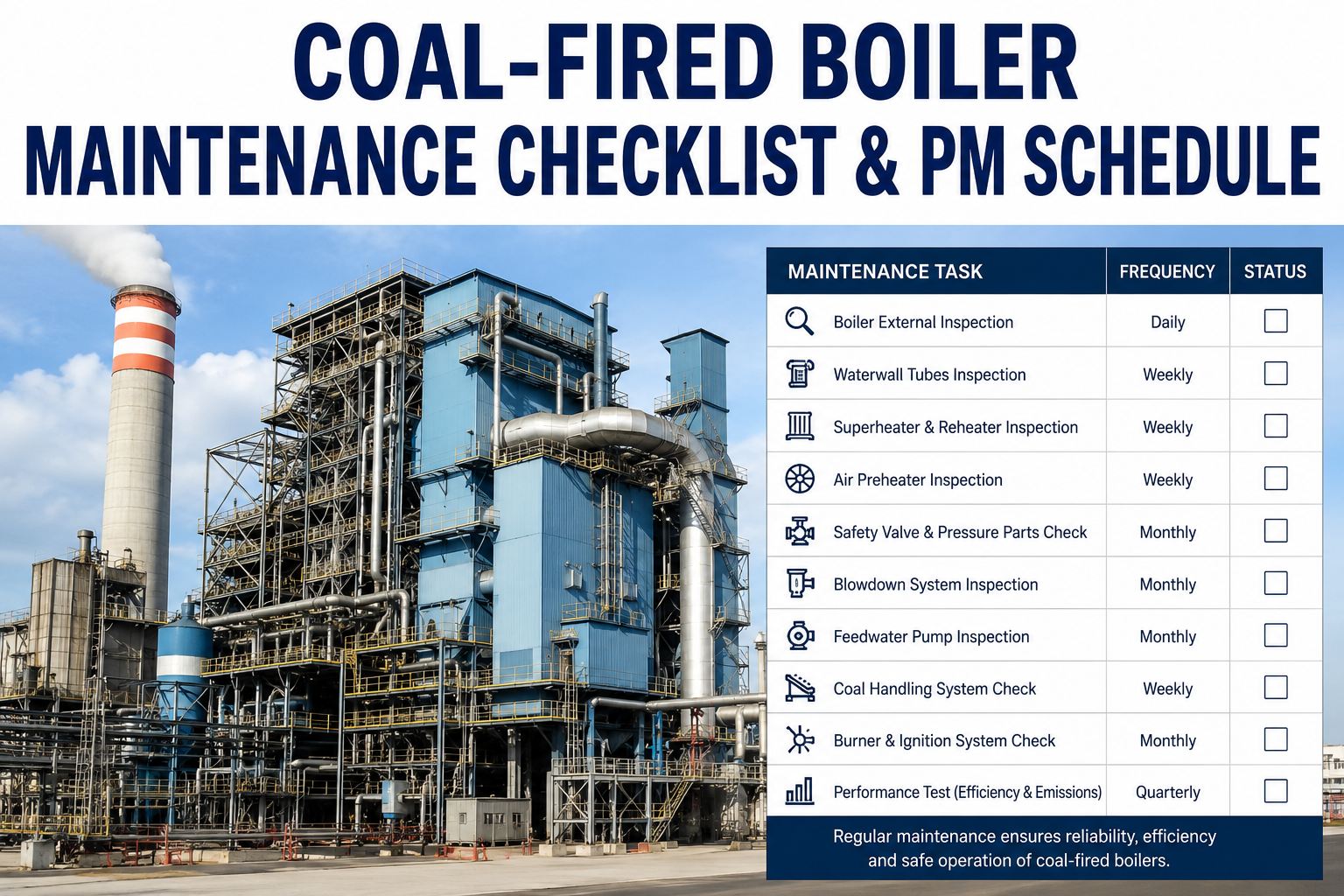
A coal boiler PM program runs on six different clocks in parallel — from daily operator rounds through the major overhaul every 4 to 6 years. Below is the working cadence tier matrix that Oxmaint schedules automatically against every boiler asset, with the primary scope at each tier.
| Cadence Tier | Frequency | Primary Scope | Trigger |
|---|---|---|---|
| Operator Rounds | Every shift | Water level, drum pressures, fan currents, sootblower cycles | Calendar |
| Weekly Walks | Weekly | External inspection, gauge trending, valve position audit | Calendar |
| Monthly Systems | Monthly | Safety valve testing, alarm system checks, chemistry review | Calendar |
| Quarterly PMs | Quarterly | Air preheater performance, boiler efficiency, mill inspection | Calendar |
| Minor Outage | 6–12 months | Waterwall spot UT, superheater visual, sootblower rebuild | Planned |
| Major Overhaul | 4–6 years | Full tube UT survey, air heater basket, mill overhaul, refractory | Planned |
Section-by-Section Checklist
The Actual PM Items by Boiler Section
Below is the working item-level checklist by boiler section — the field-usable list that runs on the mobile Oxmaint app during outage inspections. Every check is logged against the specific asset (row-level for tubes), photo-tagged, and generates a work order on any finding.
Waterwalls · Furnace
- Ultrasonic thickness readings at grid points on front, rear, and side walls
- Visual inspection for hydrogen damage windows and caustic gouging in high-heat zones
- Fireside deposit sampling for chemistry analysis
- Refractory condition at burner throats and sootblower penetrations
- Corner and bottom-slope tube condition — highest wastage zones
Superheater
- Full pendant visual inspection — bulging, alignment, spacer condition
- UT thickness at bends and sootblower opposite locations
- Dissimilar-metal weld inspection at material transitions
- Fireside deposit removal and sample for corrosive alkali salts
- Steam-side oxide scale sampling for creep-life assessment
Reheater
- Bend radius inspection for cracking from thermal fatigue
- Support and hanger condition — sagging pendants transfer load to weld joints
- Load-cycling history review against tube design life
- Metallurgical replicas at critical weld joints on aged units
Economizer
- UT thickness at bends and gas-turn locations
- Acid dew-point corrosion inspection at cold-end tubes
- Finned tube condition — deposit accumulation and fin loss
- Header and inlet-nozzle weld condition
Air Preheater
- Seal wear measurement — hot end, cold end, and axial seals
- Basket fouling and plate condition inspection
- Gas-side leakage calculation via oxygen traverse
- Drive motor, gearbox, and support bearing inspection
- Soot blower and washing system condition
Auxiliaries
- FD, ID, and PA fan bearings — vibration signature, oil analysis
- Coal pulverizer roll and bowl condition, journal wear
- Sootblower network — retractable, wall, and IK blower cycles and condition
- Boiler feed pump vibration, seal condition, thrust bearing
- Safety valve testing per ASME Section I
Tube Failure Tracking
The Five Data Fields Every Tube Failure Record Must Carry
A tube failure log that only records "waterwall leak at elevation 45" is useless three campaigns later. The record needs to hold five structured data fields — the same five every reliability engineer uses to spot repeat patterns. Oxmaint stores all five as required fields on every failure, keeping the trend visible without a spreadsheet.
-
Field 01
Precise Location
Section, wall, row, elevation, tube number. Not "waterwall" — front wall row 12, elevation 45 ft. Only precise locations reveal repeat spots.
-
Field 02
Failure Mode
One of the six modes — erosion, sootblower, fatigue, weld flaw, creep, hydrogen damage. Categorical field, not free text.
-
Field 03
Root Cause
Why the mode was active. Chemistry excursion, sootblower misalignment, undetected wall thinning, missed thickness reading last outage.
-
Field 04
Repair Method
Pad weld, tube replacement, dutchman, window patch. Structured field enabling repair-life analysis and warranty follow-up.
-
Field 05
Remaining Life Estimate
Post-repair UT reading and projected wall-loss rate. Drives when the next inspection cycle should hit this exact location.
Built for Coal Plants
How Oxmaint Software Runs Coal Boiler Maintenance
-
Row-Level Assets
Every Tube Row as Its Own Asset in the Hierarchy
Boiler > Waterwall > Front Wall > Row 12. Nominal thickness, retirement thickness, erosion rate stored per row. Every UT reading updates the record.
-
Failure Tracking
All Five Data Fields Structured
Location, failure mode, root cause, repair method, remaining life — every tube failure record carries all five. Reports surface repeat zones automatically.
-
Six-Tier Cadence
Operator to Major Overhaul on One Schedule
Every cadence tier from shift rounds to 5-year major overhaul runs on the Oxmaint calendar. No coordinator manages six separate schedules by hand.
-
Tube Inventory
Emergency Repair Kits Pre-Staged by Grade
Carbon steel for waterwall, T22 or T91 for superheater and reheater — held by diameter and wall thickness, kitted with the correct weld metal, ready for the 3 AM call.
-
Outage Package
Findings Feed the Next Outage Automatically
Every deficiency flagged during operation, weekly rounds, or monthly PMs flows into the next planned outage scope inside Oxmaint. No handwritten deficiency lists.
-
ASME Compliance
ASME Section I & NBIC Records Preserved
Safety valve tests, NDT records, repair documentation stored to code requirements. Jurisdictional inspector walks in and the records are in the software.
Measured Outcomes
What Coal Plants Gain When Oxmaint Runs the Boiler
-
67%
Fewer Forced Outage Hours
EPRI-measured reduction in boiler-related forced outage hours inside 18 months of structured tube monitoring deployment.
-
Weeks
Early Warning
Ultrasonic, thermal, and chemistry signals flag a developing tube failure weeks before the leak — turning a rupture into a planned repair.
-
Zero
Repeat Failures
Failure-mode and root-cause tracking breaks the repeat cycle — the same tube in the same weld does not fail across three consecutive campaigns.
-
14 mo
Software Payback
Payback under 14 months at plants with annual boiler repair costs above $400K, driven by avoided forced outages alone.
Frequently Asked
Coal Boiler PM & CMMS Questions
How often should tube thickness readings be taken?
Spot readings during every minor outage (6–12 months) at high-risk zones — sootblower opposite, bends, and repeat-failure locations. Full UT survey during major overhaul (4–6 years). For tubes running at fireside corrosion rates of 0.5–2.0 mm/year, longer intervals allow wall loss to progress past retirement thickness undetected. Sign up for Oxmaint to trend thickness readings at row level across every outage.
What tube grades should be stocked for emergency repair?
Carbon steel for waterwall and economizer, low-alloy through T22 for early superheater/reheater rows, T91 for high-temperature superheater and reheater sections — held in the specific diameters and wall thicknesses your boiler carries, kitted with the correct weld metal. Stocking the wrong grade guarantees a two-week scramble instead of a two-day repair.
Does Oxmaint track ASME Section I and NBIC documentation?
Yes. Safety valve testing records, NDT documentation, repair records, and jurisdictional inspection sign-offs all live inside the software against the boiler asset. Records surface on demand for state boiler inspector reviews and insurance renewals. Book a demo to see ASME-compliant record keeping in Oxmaint.
How does Oxmaint break the repeat-failure cycle?
Every tube failure carries five structured fields — precise location, failure mode, root cause, repair method, remaining life estimate. Reports surface repeat zones automatically. The reliability engineer walks into every outage knowing exactly which sections need extra attention — before the same tube fails again. Sign up for Oxmaint to structure failure tracking on your boiler asset today.
Inspect · Track · Sustain
Every Boiler Tube Failure Left a Signal Weeks Before the Rupture
Wall thickness. Acoustic emission. Metal temperature drift. Chemistry excursion. The signals were there — but no operator can watch thousands of channels or remember every UT reading from the last outage. Oxmaint is the maintenance software that holds the record, trends the data, and turns the leading cause of forced outages into a managed reliability program.