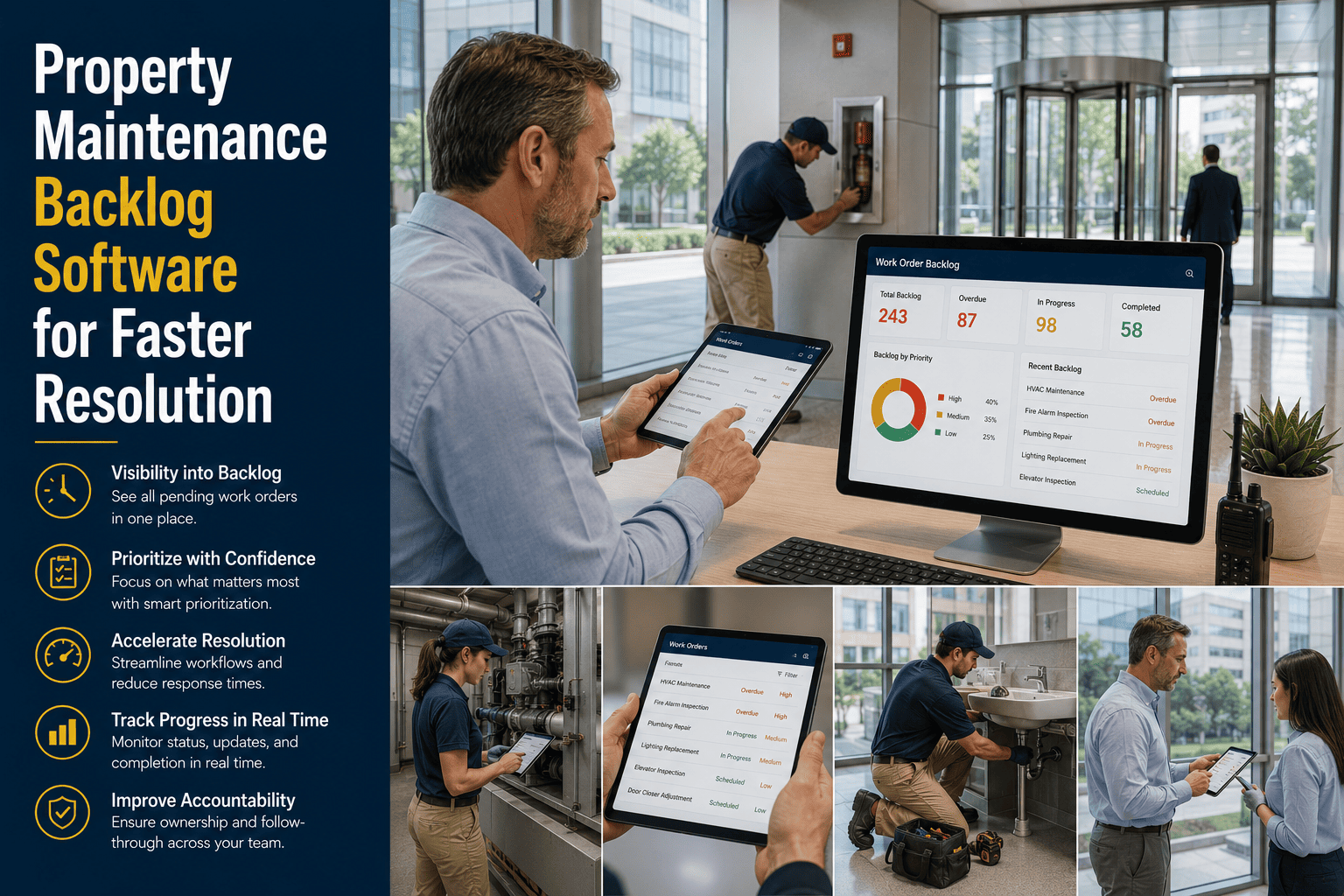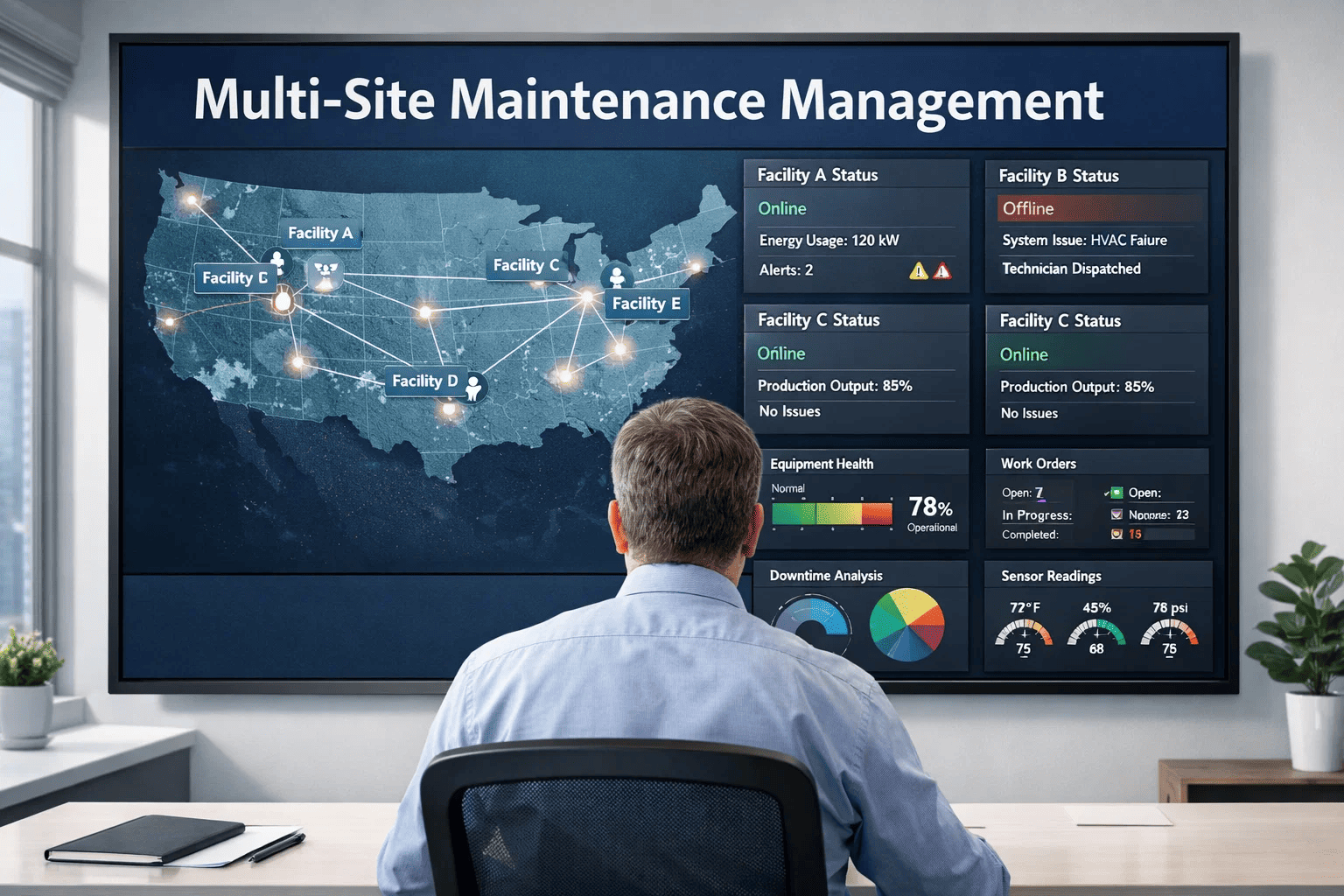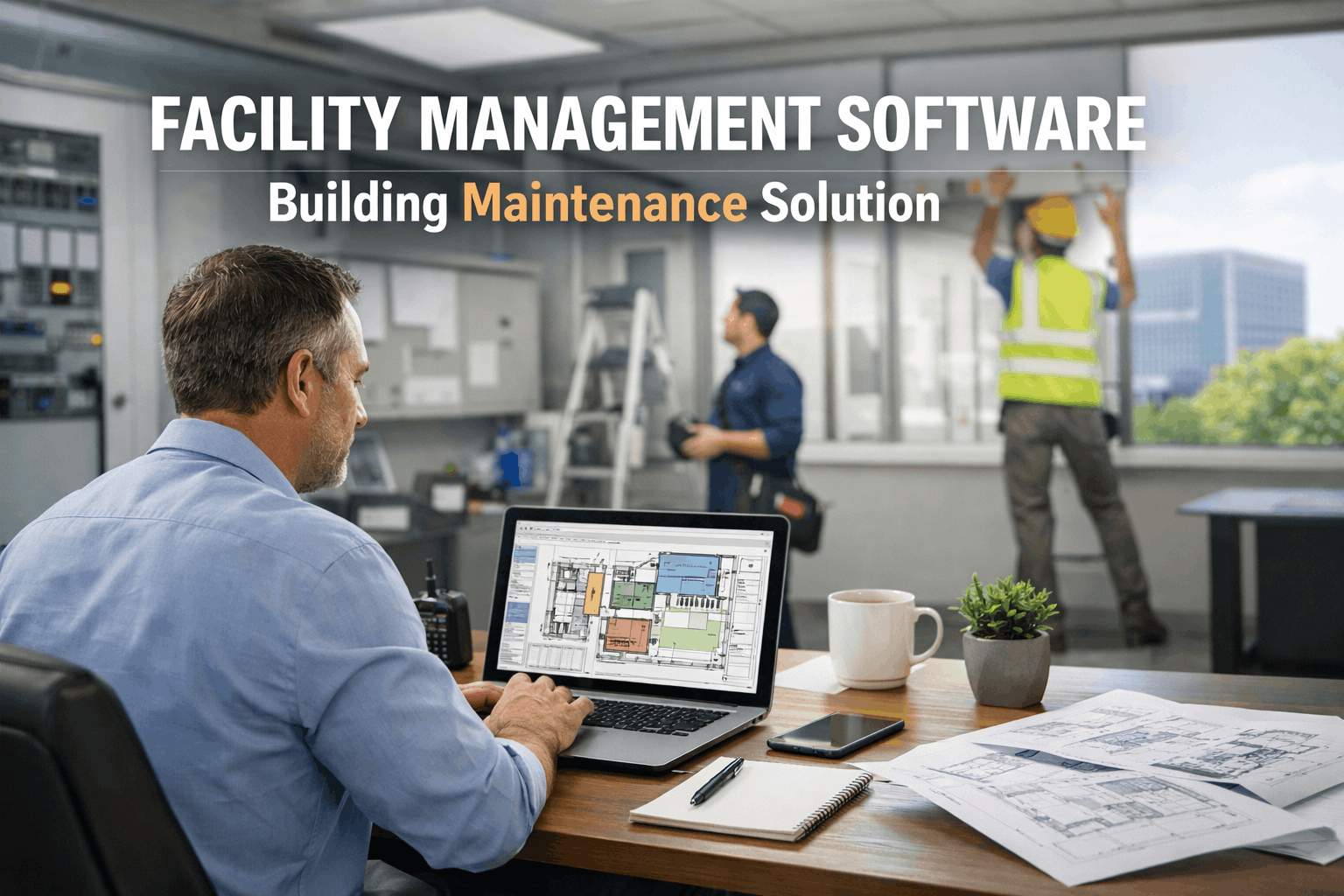
Commercial real estate maintenance is the discipline of keeping multi-tenant buildings safe, compliant and profitable — and the fastest way to control it across a portfolio is a property maintenance CMMS that ties tenant work orders, lease-defined responsibilities and common-area preventive maintenance into one system. In CRE facilities management, every work order has a financial dimension: who requested it, whose lease covers it, whether it's billable, and how it affects tenant satisfaction and renewal rates. This guide breaks down how commercial property CMMS software handles tenant maintenance management, chargeback workflows, CAM reconciliation and portfolio-level KPI reporting — and where spreadsheets and email threads quietly cost property managers thousands per month. If you're ready to see this running on your own buildings, Start Free Trial and import your first property in minutes.
Who pays for that work order — the tenant, the lease, or your NOI?
In multi-tenant commercial buildings, 60–70% of maintenance requests carry a billing question. A commercial property CMMS answers it automatically — routing work by lease terms, logging billable labor, and giving every tenant a documented service record.
Why commercial real estate maintenance breaks down without a CMMS
A 12-tenant, 90,000 sq ft office building generates roughly 40–70 maintenance requests per month. Handled through email, phone calls and a shared spreadsheet, here's where the money leaks:
Tenant-responsible repairs (in-suite HVAC, fixture damage, after-hours HVAC requests) get completed but never charged back because there's no audit trail tying labor and parts to the lease clause.
Requests arrive by phone, email and hallway conversation. Without a single queue with priority rules, urgent life-safety issues wait behind cosmetic ones — and tenants notice.
Industry tenant-experience surveys consistently rank maintenance responsiveness among the top three renewal factors. Slow, undocumented service directly erodes occupancy and NOI.
The average commercial property loses $18,000–$45,000 per year to unbilled tenant work, missed PM on common-area assets, and emergency callout premiums that a preventive schedule would have avoided.
How to run tenant work orders with lease-defined responsibilities
The core of CRE FM software is a work order that knows who pays. Every request should flow through four gates before a technician is dispatched:
Tenant submits via portal or QR code in the suite. The request is auto-tagged by location, asset type and trade — no more "the AC is broken" emails with no suite number.
The CMMS matches the asset and location against the tenant's lease matrix: landlord-responsible (base building, common area), tenant-responsible (in-suite), or shared (pro-rata). This is where most manual processes fail.
Priority rules set response targets — emergency 1 hour, urgent 4 hours, routine 24–48 hours. Technicians see the full asset history, manuals and past fixes on their phone before they arrive.
Labor hours, parts and photos attach to the work order. Billable items flow to a chargeback report for monthly tenant invoicing; CAM items accumulate for year-end reconciliation.
A property management firm running 6 buildings, 480,000 sq ft, 74 tenants logged 3,900 work orders in a year. After tagging each against lease responsibility, they found 22% were tenant-billable — averaging $310 each. That's $265,000 in recoverable revenue that had previously been absorbed as operating expense. The CMMS paid for itself 14x over in year one.
Common-area PM schedules that protect asset value and CAM budgets
Base-building systems — HVAC, elevators, roofing, fire/life safety, plumbing risers, parking structures — represent 70–80% of a commercial building's maintenance budget. A calendar-driven PM program cuts emergency repairs 30–50% and extends asset life 20–40%.
| Asset / System | Key PM Tasks | Frequency | Skip It & Pay |
|---|---|---|---|
| RTUs / AHUs / chillers | Filters, belts, coils, refrigerant, vibration check | Quarterly | Compressor failure: $8K–$25K + tenant discomfort |
| Elevators | Code inspection, lubrication, door operator test | Monthly + annual | Entrapment liability, $4K+ emergency callouts |
| Fire & life safety | Alarm test, sprinkler inspection, extinguisher tags | Monthly / annual | Failed AHJ inspection, insurance exposure |
| Roof & envelope | Membrane inspection, drain clearing, sealant check | Semi-annual | Leak damage: $15K–$60K per event + mold claims |
| Backflow / plumbing risers | Backflow certification, valve exercise, leak scan | Annual | Water damage claims, code fines |
| Parking structure | Concrete/spall survey, striping, lighting, drainage | Annual | Structural degradation, trip-and-fall liability |
Every completed PM feeds the CAM pool with timestamped documentation — the audit trail owners and tenants' lease auditors expect during reconciliation season.
How OxMaint runs commercial property maintenance end-to-end
OxMaint is an AI-powered CMMS + EAM platform built for multi-tenant, multi-building operations. Four capabilities map directly to the CRE problems above:
Tenants submit and track requests from any device; managers triage one queue across the whole portfolio. Result: response times cut 40–60%, zero lost requests.
Labor, parts and vendor costs attach to every work order with billable flags and lease-responsibility tags. Result: recover the 18–25% of tenant-billable work that spreadsheets lose.
Calendar- and meter-based PM templates for every base-building asset, auto-assigned with mobile checklists and photo proof. Result: 30–50% fewer emergency callouts, audit-ready compliance records.
Cost per sq ft, SLA compliance, PM completion and tenant satisfaction by building, region or portfolio. Result: owner-ready reporting in one click, not a week of spreadsheet assembly.
The 6 KPIs every CRE facility manager should report monthly
Institutional owners and asset managers judge FM performance on numbers. These six metrics — all native to a commercial building maintenance software dashboard — tell the whole story:
Book a 30-minute demo — we'll map OxMaint to your lease structure and portfolio
Bring one building's tenant list and PM schedule. We'll show you tenant work orders, chargeback reporting and portfolio dashboards configured for commercial real estate — not a generic factory demo.
Commercial real estate CMMS — answered
A commercial real estate CMMS is property maintenance software that manages tenant work orders, preventive maintenance on base-building systems, asset histories and vendor costs across one or many buildings. Unlike generic tools, a CRE CMMS adds lease-responsibility tagging, chargeback reporting and portfolio-level KPIs that property managers and owners need.
Each work order is matched against a lease matrix that defines responsibility by asset type and location — in-suite fixtures to the tenant, base-building HVAC to the landlord, shared systems pro-rata. Billable labor and parts roll into a chargeback report for monthly invoicing, while landlord costs accumulate for CAM reconciliation. Book a Demo to see this workflow configured on a sample property.
Yes. Tenants submit requests through a branded portal or QR code in their suite, attach photos, and see real-time status updates — no phone calls or email chains. Property managers keep one triage queue across all buildings, with automatic SLA timers and escalation rules by priority.
Most CRE CMMS platforms price per user or per building, typically $30–$80 per user per month. Against a single recovered chargeback stream — the average property loses $18K–$45K annually to unbilled tenant work and emergency premiums — payback usually lands inside the first quarter. You can Start Free Trial and measure it on your own work orders.
A single building can go live in days: import the asset list, load PM templates for HVAC, elevators and life safety, and invite tenants to the portal. Multi-property portfolios typically roll out building-by-building over 2–6 weeks. OxMaint's onboarding team migrates your existing spreadsheets and vendor lists so no maintenance history is lost.
Every work order tracked. Every billable dollar recovered. Every building on one dashboard.
Join CRE facility teams using OxMaint to cut response times, automate chargebacks and deliver institutional-grade maintenance reporting to owners and tenants.