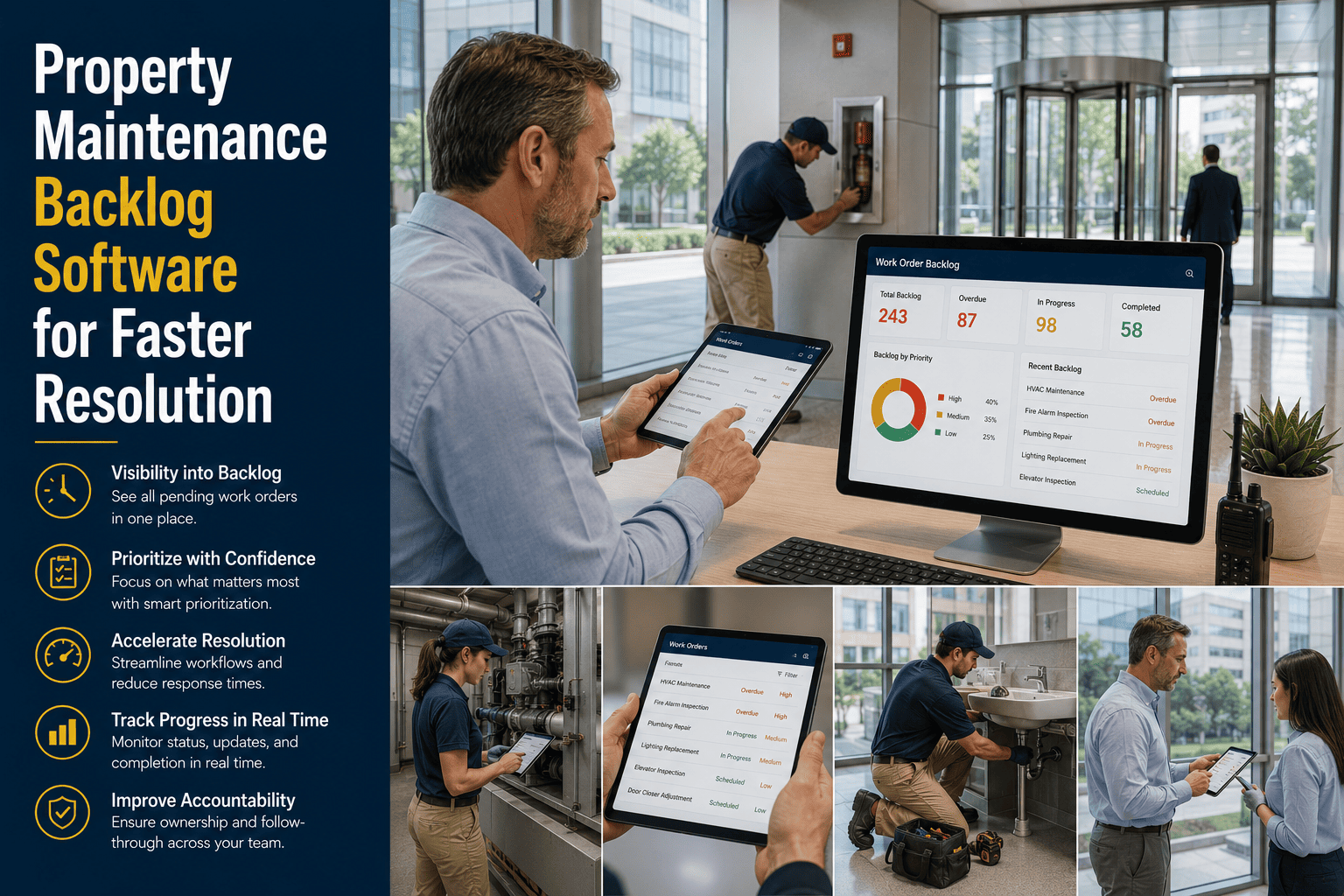
Maintenance backlogs are not just a scheduling inconvenience — they are a financial liability that compounds daily. When aging work orders pile up unaddressed, facilities shift from planned maintenance into reactive firefighting, and emergency repairs cost 4.8 times more than scheduled ones. Across commercial property portfolios, the average facility carries 60–120 days of deferred maintenance at any given time, eroding asset condition, tenant satisfaction, and CapEx predictability simultaneously. The difference between a portfolio that controls its backlog and one that chases it comes down to one thing: visibility — and that is exactly what Oxmaint's CMMS platform delivers from day one.
Property Maintenance Backlog Software for Faster Resolution
Prioritize maintenance backlogs, eliminate aging work orders, and restore control across every property site — with real-time visibility and automated scheduling built for portfolio operations.
What Is Property Maintenance Backlog Software
Property maintenance backlog software is a specialized CMMS module — or a complete platform — that captures every open work order, deferred repair, and pending inspection in a single prioritized queue. Unlike generic task management tools, backlog software assigns condition scores, urgency flags, and CapEx thresholds to each item so that property teams can triage rationally rather than by whoever complained loudest.
A true backlog management system connects directly to your asset registry, meaning every work order is tied to a specific component, system, or property in your hierarchy. This linkage makes it possible to answer questions that paper-based or spreadsheet workflows simply cannot: How old is this issue? What does it cost if deferred another 90 days? Which properties have the highest unresolved backlog value? Teams that move to dedicated backlog software typically clear 30–45% of aging items within the first quarter because prioritization becomes data-driven, not intuitive — start a free trial to see Oxmaint's backlog dashboard configured for your portfolio, or book a demo and we will walk through your specific asset structure.
Key Concepts in Backlog Management
Effective backlog management is not just about having a list — it is about understanding the six dimensions that determine resolution urgency and financial risk for every open item.
Work orders are categorized by age — 0–30, 31–90, 90+ days — with escalating priority rules applied automatically to items crossing age thresholds.
Asset condition scores (1–5) from inspections feed directly into backlog priority calculations — critical-condition assets always surface to the top of the queue.
Each backlog item carries a deferral cost multiplier — showing how the repair cost grows if deferred 30, 60, or 90 additional days based on asset class and failure mode.
Drag-and-drop queue management lets supervisors reassign, bundle, and reschedule open work orders across technicians without losing status history or audit trail.
Items that exceed repair cost thresholds automatically escalate to CapEx proposals — connecting operational backlog directly to 5–10 year capital forecasting models.
Portfolio-level dashboards rank properties by total backlog value, average work order age, and resolution velocity — enabling resource allocation decisions across sites.
Industry Pain Points Driving Backlog Growth
Backlogs do not appear overnight. They accumulate through four structural failures that are endemic to property maintenance operations — and each one compounds the others. Teams that experience these recognize them immediately.
Property managers cannot see total backlog by site, system, or age without manually pulling spreadsheets. Work orders sit unresolved for weeks because nobody has a real-time view of what is overdue — and escalating items disappear into email threads.
Without condition scores or deferral cost models, teams prioritize whoever complains the loudest. This means low-visibility, high-risk items — aging HVAC, roof membranes, elevators — sit in the backlog until they fail, costing 4.8 times more to repair.
Without queue visibility, technicians self-select work by proximity or preference. High-value, time-sensitive backlog items remain unassigned while lower-priority tickets get serviced repeatedly. Supervisor oversight requires manual check-ins.
When backlog items are not escalated to CapEx planning on time, minor repairs become full asset replacements. A $4,000 chiller repair deferred twice becomes a $180,000 emergency replacement — with no audit trail explaining how the failure was missed.
Operations teams that resolve these four failures see backlog reduction rates of 35–50% within six months — start a free trial to see how Oxmaint structures this shift for your property portfolio, or book a demo to walk through the backlog dashboard live.
How Oxmaint Solves Backlog Management
Oxmaint is built around a single truth: every backlog item has a cost, a condition context, and a resolution path. The platform makes all three visible across your entire portfolio — without spreadsheets, status calls, or manual reporting.
Every open work order displays age, condition score, and estimated deferral cost in one view. Items crossing 30, 60, and 90-day thresholds are automatically flagged and escalated to supervisors — no manual monitoring required.
Every backlog item connects to a specific asset in the hierarchy: Portfolio > Property > System > Asset > Component. Full service history, condition score, and warranty status are visible from the work order — enabling faster, better-informed decisions.
Technicians receive, update, and close work orders from any device without returning to the office. Photo uploads, checklists, and parts requests attach directly to the work order — eliminating data-entry lag and incomplete records.
Configurable cost thresholds automatically elevate high-value backlog items to CapEx proposals — feeding directly into Oxmaint's rolling 5–10 year capital forecasting models so nothing falls through the gap between maintenance and capital planning.
Portfolio managers see total backlog value, average work order age, and resolution velocity across every property in a single view. Site rankings by backlog severity enable targeted resource allocation decisions across the portfolio.
Preventive maintenance schedules auto-generate work orders before assets degrade — cutting the volume of reactive items entering the backlog. OEE dashboards measure PM compliance vs. reactive ratio month-over-month to track progress.
Reactive Maintenance vs. Planned Maintenance — The Full Comparison
The financial and operational gap between reactive and planned maintenance is not subtle. Below is a full side-by-side comparison of how each approach performs across the metrics that matter to property managers, VPs of Operations, and portfolio directors.
| Dimension | Reactive Maintenance | Planned Maintenance with Oxmaint |
|---|---|---|
| Repair Cost | 4.8x higher per incident — emergency labor premiums, expedited parts, unplanned contractor rates | Scheduled at standard labor rates with parts pre-ordered — 60–70% lower per repair event |
| Backlog Visibility | Scattered across emails, phone calls, and disconnected spreadsheets — no single source of truth | Real-time unified queue with age flags, condition scores, and deferral cost displayed per item |
| Asset Lifespan | 15–40% shorter — deferred maintenance accelerates degradation curves and triggers premature replacement | Extended to design life through condition-based scheduling and early intervention on degradation signals |
| CapEx Predictability | Budget surprises every quarter — no model linking current backlog to future replacement events | Rolling 5–10yr CapEx model auto-populated from backlog escalation and condition scoring data |
| Technician Utilization | 30–40% time lost to unplanned emergency responses — planned work constantly pre-empted by crises | 80%+ scheduled work ratio — technicians execute planned routes with minimal emergency interruption |
| Compliance / Audit Trail | Incomplete records — cannot demonstrate inspection history, fail regulatory audits without manual reconstruction | Full digital audit trail per asset — every inspection, work order, and photo timestamped and searchable |
| Tenant Satisfaction | Recurring complaints, unresolved tickets, and failed service commitments erode tenant retention | SLA compliance tracking and closed-loop work orders improve resolution times and tenant communication |
| Portfolio Reporting | No standardized data across sites — each property reports differently, making portfolio decisions guesswork | Standardized KPIs across all sites — backlog value, PM compliance, and resolution velocity compared in real time |
ROI and Results — What Backlog Software Delivers
Property management teams that deploy structured backlog software consistently report measurable financial and operational improvements within the first two quarters. These are industry-documented outcomes, not projections.
Operations teams that implement Oxmaint see measurable backlog reductions within the first 30 days — start a free trial to quantify the cost savings available in your portfolio, or book a demo to review backlog ROI calculations on your own asset data.
Frequently Asked Questions
What is a maintenance backlog and how do you measure it
How does backlog software differ from a standard CMMS or work order system
Can Oxmaint handle backlog management across multiple properties simultaneously
How quickly can a property management team get started with Oxmaint backlog software
Stop Losing Millions to Reactive Maintenance
Turn every asset into a predictable, trackable system with Oxmaint. See how much cost you can eliminate from reactive maintenance in your facility — and get your portfolio backlog under control in the first 30 days.
.png)


