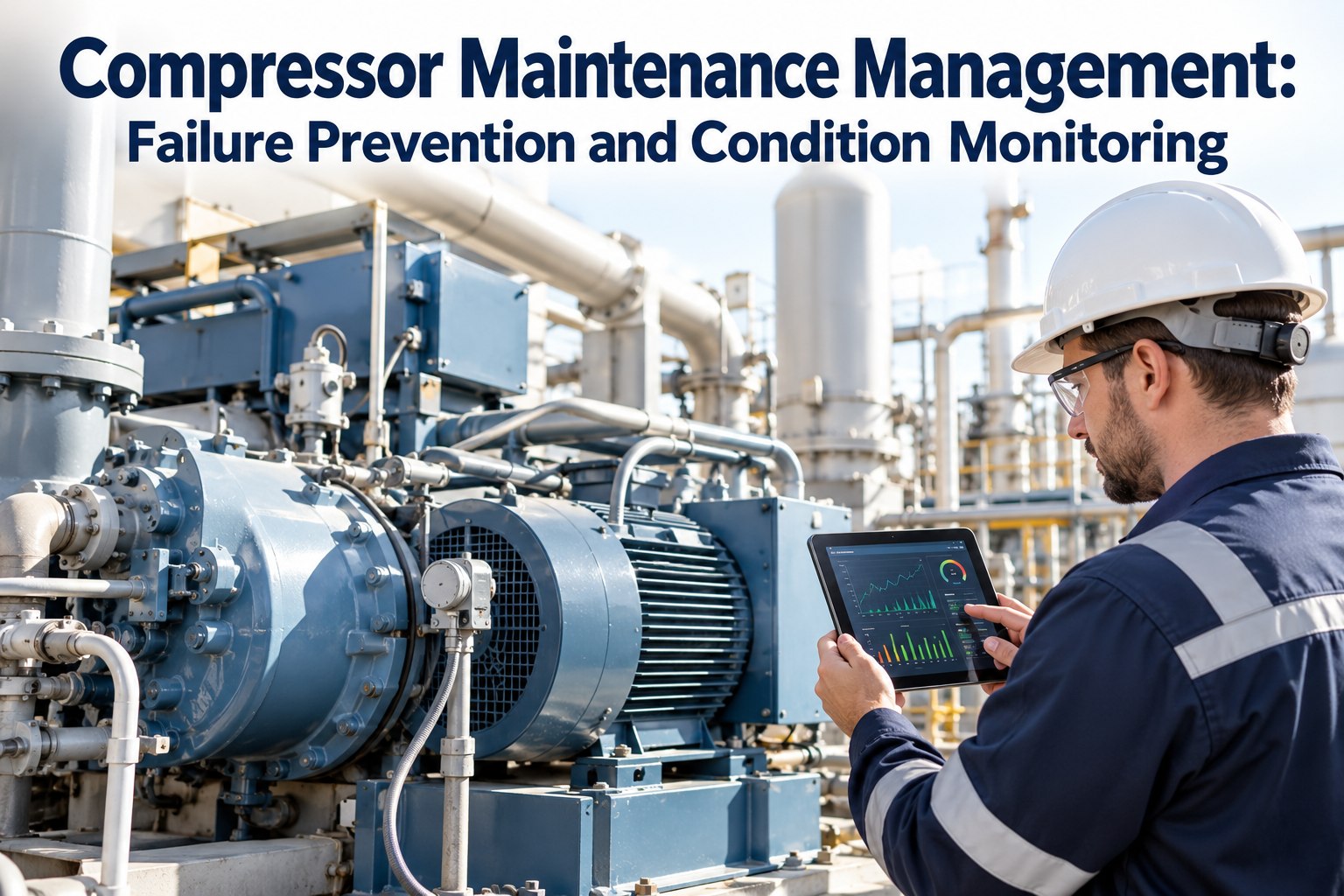
A compressor rarely dies without warning — it tells you weeks ahead, in a bearing that runs a little warmer, a valve that leaks a little more, an oil sample carrying a little more metal. The failures that take a plant's air offline are almost always the ones nobody was listening for. That's the whole case for condition monitoring: instead of waiting for the breakdown or servicing on a fixed calendar whether the machine needs it or not, you watch the handful of signals that reveal a developing fault and act while it's still a scheduled repair. Each monitoring method catches a different failure mode, and each gives a different warning window — knowing which to watch, and turning a reading into a work order, is what separates a managed compressor fleet from a reactive one. OxMaint AI trends the signals against each compressor and raises the work order while there's still time to plan it.
Compressor Maintenance Management: Failure Prevention and Condition Monitoring
Most compressor failures announce themselves weeks early — in vibration, temperature, oil, and current. Condition monitoring is watching those signals so a developing fault becomes a planned repair instead of a plant-wide air loss. This guide maps the failure modes by compressor type, the monitoring methods and what each detects, and the warning window each one buys you. OxMaint trends the signals per machine and turns a breach into a diagnosed, prioritized work order.
Prevention Is Reading the Warning, Not Waiting for It
Run-to-failure means an unplanned air loss that can idle a whole line; fixed-calendar servicing means replacing good parts and still missing the fault that develops between intervals. Condition-based maintenance threads the needle — it acts on the actual state of the machine, catching the developing failure early enough to schedule the fix around production instead of around a breakdown. Start free and move compressors to condition-based maintenance in OxMaint AI.
The Monitoring Signals — and What Each One Catches
No single signal sees everything. Each monitoring method is strongest at a particular failure mode, and each buys a different warning window before failure. Book a demo to trend all of these per compressor in OxMaint.
| Monitoring method | What it catches first | Typical warning window |
|---|---|---|
| Vibration analysis | Bearing wear, imbalance, misalignment, looseness | 2–6 weeks |
| Discharge temperature | Valve leaks, cooler fouling, low oil, overloading | 1–3 weeks |
| Oil pressure & temperature | Oil-pump wear, filter clogging, bearing distress | 2–4 weeks |
| Motor current (MCSA) | Rotor/stator faults, load shifts, mechanical binding | 4–10 weeks |
| Oil analysis | Wear metals, contamination, oil degradation | 6–12 weeks |
| Ultrasonic emissions | Valve leakage, bearing crackling, internal blow-by | 2–5 weeks |
| Specific power (kW/cfm) | Overall degradation, valve blow-by, system leaks | 4–8 weeks |
The longest-lead signals — oil analysis and motor-current — spot the slow decline; the shortest — discharge temperature and pressure — catch the fast-moving fault. Watching them together is what gives both depth and speed. Start free and combine the signals on one asset in OxMaint.
Failure Modes by Compressor Type
A screw, a reciprocating, and a centrifugal compressor fail in different ways — monitoring has to target the modes that machine actually suffers. Book a demo to tailor monitoring to your compressor types in OxMaint.
The Compressor That Took the Plant Down Was Warning You for a Month.
Almost every catastrophic compressor failure leaves a trail — a vibration trend climbing, a discharge temperature creeping, wear metal rising in the oil. The failure isn't that the machine broke; it's that nobody was watching the signal that said it would. Condition monitoring turns that month of warning into a work order you schedule, not a breakdown you react to.
From Signal to Work Order
Monitoring only prevents failure when a reading becomes action. Here's the loop that turns a raw signal into a planned, diagnosed repair. Start free and run this loop on your compressors in OxMaint.
The Preventive Layer That Still Matters
Condition monitoring doesn't replace basic preventive care — it focuses it. These fundamentals keep the baseline healthy so the monitoring signals stay meaningful. Book a demo to schedule compressor PM in OxMaint.
Reliability and Energy Are One Signal
A degrading compressor doesn't just edge toward failure — it wastes energy the whole way there. A leaking valve, a fouled cooler, or unnecessary discharge pressure all push specific power (kW per cfm) up long before anything trips. Watching specific power alongside vibration and temperature gives a double reason to act: the reliability risk and the energy cost point at the same repair. Start free and track reliability and energy together in OxMaint.
How OxMaint Manages Compressor Reliability
Signal trending, fault diagnosis, work-order generation, and the preventive schedule all live in one CMMS — so monitoring data drives maintenance instead of sitting in a dashboard. Start free and turn compressor monitoring into managed reliability.
Frequently Asked Questions
Hear the Warning. Fix It on Your Schedule.
A compressor gives weeks of notice before it fails — in vibration, temperature, oil, and power. The fleets that stay up are the ones watching those signals and acting while the repair is still a plan. OxMaint trends every signal per machine, diagnoses the fault, and raises the work order in time to schedule it — so a developing failure never becomes a plant-wide air loss.