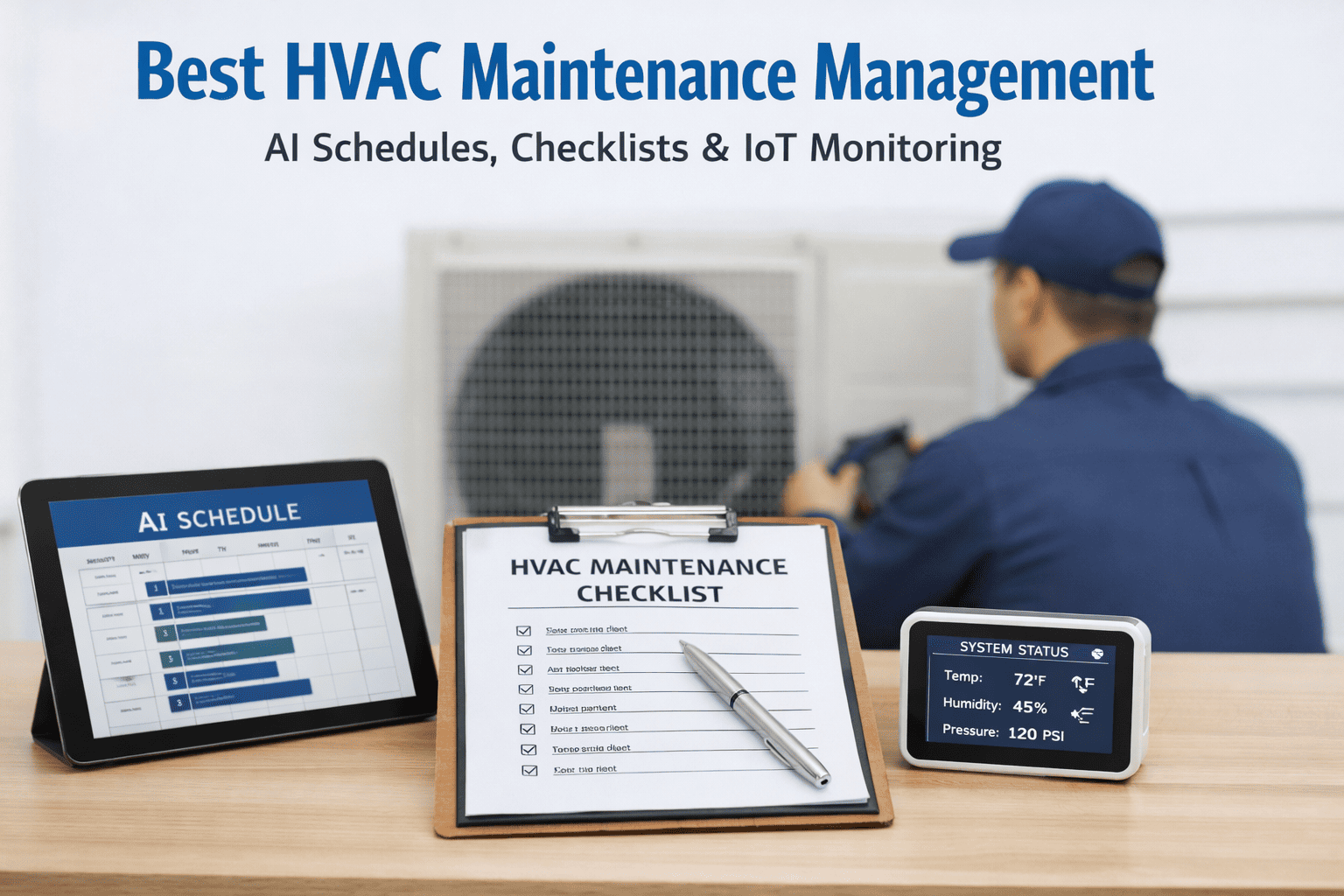
Every facility manager knows the dread of a 2 AM emergency call: the chiller failed, the server room is overheating, and your tenants are furious. What most don't realize is that 75% of those catastrophic HVAC failures showed early warning signs weeks before they happened—signs that a smart maintenance system would have caught automatically. With AI-driven scheduling, IoT condition monitoring, and mobile digital checklists, modern HVAC maintenance management eliminates the guesswork and replaces firefighting with foresight. Schedule a free demo to see how Oxmaint detects HVAC failures before they disrupt your facility.
What Makes HVAC Systems So Expensive to Maintain Reactively
HVAC represents the single largest energy expense in commercial buildings—consuming roughly 40% of total energy—yet the industry still relies heavily on outdated maintenance approaches. The financial gap between reactive and proactive HVAC management is staggering, and most facility teams underestimate how much they lose to invisible inefficiency every month.
$50B
Annual U.S. losses from unplanned equipment downtime across commercial facilities
3-5x
Higher cost of reactive HVAC repairs compared to planned preventive maintenance
30%
Extra energy consumed by poorly maintained HVAC systems per NIST research findings
The root cause is visibility. Without continuous monitoring, you cannot know which compressor is drawing excess amperage, which air handler has a clogged coil degrading airflow, or which rooftop unit is quietly losing refrigerant charge. By the time a tenant complains or a system trips offline, the damage—and the repair bill—has already multiplied. Sign up for Oxmaint free to start tracking every HVAC asset's real-time health from a single dashboard.
How AI Scheduling Replaces Guesswork with Precision
Traditional HVAC maintenance runs on fixed calendars: change filters every 90 days, inspect chillers every quarter, tune up rooftop units before summer. The problem is that calendars don't account for actual equipment condition, weather extremes, occupancy changes, or the unique aging patterns of individual units. AI scheduling analyzes real-time sensor data alongside historical performance to determine exactly when each piece of equipment actually needs attention.
Fixed Calendar Scheduling
01
Over-maintenance waste — Servicing healthy equipment on schedule burns technician hours and parts inventory that could be deployed elsewhere
02
Under-maintenance risk — Equipment degrading faster than the calendar expects goes unserviced until failure occurs
03
No condition awareness — A filter in a dusty warehouse and a filter in a clean office get replaced on the same schedule
AI Condition-Based Scheduling
01
Right-time maintenance — Each unit gets serviced when sensor data indicates actual need, not arbitrary intervals
02
Predictive failure alerts — AI detects compressor degradation, refrigerant loss, and bearing wear 2-4 weeks before breakdown
03
Dynamic prioritization — Work orders auto-rank by urgency, energy impact, and technician proximity for optimal resource deployment
Your HVAC units are aging differently—your maintenance schedule should reflect that. Sign up for Oxmaint free and let AI build condition-based schedules from your equipment data, so every technician hour goes where it actually matters.
IoT Monitoring: What Your HVAC Equipment Is Trying to Tell You
Every HVAC component generates signals about its health long before it fails. A compressor drawing 15% more current than its baseline is heading toward seizure. A rooftop unit with rising discharge temperatures has a fouled condenser coil. A chiller with increasing approach temperatures needs tube cleaning. IoT sensors translate these silent signals into actionable intelligence that your maintenance team can act on immediately.
Temperature Differentials
Monitors: Supply/return air delta-T, discharge temp, superheat and subcooling values
Detects: Clogged filters, collapsed ducts, stuck dampers, fan belt slippage, coil blockage
Want to see how a failing compressor looks on an IoT dashboard before it breaks down? Book a free demo and our team will walk you through live sensor dashboards, automated alerts, and how work orders get created the moment anomalies are detected.
Paper checklists and clipboard inspections create two critical problems: inconsistency and invisibility. One technician checks 15 items thoroughly while another skips half. Neither inspection creates a searchable record that ties back to the asset's maintenance history. Digital checklists solve both problems while adding capabilities that paper simply cannot match—photo documentation, sensor reading capture, conditional logic, and automatic compliance reporting.
Smart Checklist Capabilities That Drive Accountability
01
Mandatory Photo Capture
Require timestamped photos at critical inspection points—coil condition, belt wear, electrical panel state—creating visual proof that work was completed correctly and enabling remote quality verification.
02
Sensor Reading Integration
Auto-populate checklist fields with live IoT sensor data—refrigerant pressures, amp draws, temperature readings—eliminating manual entry errors and creating trend data that feeds AI prediction models.
03
Conditional Branching Logic
If a technician marks "abnormal vibration detected," the checklist automatically expands to include bearing inspection steps, measurement capture, and a follow-up work order recommendation.
04
Compliance Auto-Documentation
Every completed checklist generates audit-ready records with technician ID, timestamps, GPS location, and all captured data—satisfying warranty requirements, regulatory standards, and insurance documentation needs.
05
Equipment-Specific Templates
Different HVAC assets get different checklists. A chiller inspection checklist includes tube approach temperatures and oil analysis; a rooftop unit checklist covers economizer operation and belt tension. Each template matches manufacturer recommendations.
Seasonal HVAC Maintenance Planning with AI Automation
HVAC maintenance demand shifts dramatically with the seasons—cooling equipment needs pre-summer preparation, heating systems require fall startup procedures, and transition seasons create windows for deep maintenance on equipment that's temporarily offline. AI automation builds intelligent seasonal plans that account for weather forecasts, occupancy schedules, and equipment priority rankings.
Spring Prep
Cooling Season Readiness
Chiller startup and performance testingCondenser coil cleaning and inspectionRefrigerant charge verificationCooling tower water treatment and fill inspectionEconomizer damper calibration
AI schedules these tasks 4-6 weeks before projected first cooling day based on 10-year weather data and building thermal mass
Peak Summer
Maximum Load Monitoring
Continuous IoT performance monitoringFilter replacement on differential pressure triggersCompressor amp draw trendingDemand response coordinationHot-spot zone balancing
IoT sensors detect efficiency degradation in real-time, triggering condition-based maintenance before comfort complaints arrive
Fall Transition
Heating Changeover
Boiler startup and combustion analysisHeat exchanger inspection and cleaningSafety control testing and certificationSteam trap inspection and replacementChiller winterization procedures
AI identifies the optimal changeover window where both heating and cooling equipment can be serviced with minimal tenant impact
Winter Operations
Heating Reliability Focus
Freeze protection system verificationCombustion efficiency monitoringIndoor air quality and humidity trackingBackup heating system readinessEnergy consumption optimization
Predictive models monitor boiler performance against outdoor temperature curves to detect efficiency losses before energy bills spike
Stop Seasonal HVAC Surprises Before They Start
Oxmaint builds AI-powered seasonal maintenance plans that adapt to your climate zone, building type, and equipment fleet—automatically generating and prioritizing work orders so your team always stays ahead of the next season's demands.
Measuring HVAC Maintenance ROI: The Numbers That Matter
Switching from reactive to AI-powered preventive HVAC maintenance delivers compounding returns across multiple financial dimensions. The savings aren't just theoretical—they're documented across thousands of commercial facilities that have made the transition from spreadsheets and fixed schedules to intelligent, condition-based management.
5-20%
Annual energy bill reduction
Properly maintained HVAC systems operate at peak efficiency. The U.S. Department of Energy confirms organizations save 5-20% on energy through proper maintenance practices alone.
40-50%
Maintenance cost reduction
Predictive analytics eliminate emergency repair premiums—overtime labor, expedited parts shipping, and collateral damage that makes reactive repairs 3-5x more expensive than planned work.
70-90%
Fewer catastrophic failures
Continuous IoT monitoring catches degradation patterns weeks before breakdown. Facilities using predictive monitoring report near-elimination of surprise equipment failures across their HVAC portfolio.
5-7 yrs
Extended equipment lifespan
Well-maintained HVAC systems last 15-20 years versus 10 years for neglected ones. With average replacement costs of $5,000-$10,000 per unit, lifespan extension delivers massive capital avoidance savings.
HVAC Maintenance Requirements by Facility Type
Different building categories carry different HVAC complexity, compliance burdens, and failure consequences. A hospital losing cooling to its operating rooms faces life-safety implications that a retail store does not. AI maintenance platforms adapt their monitoring intensity, checklist depth, and alert thresholds to match each facility type's specific risk profile.
Student health issues, class disruption, parental complaints
HVAC systems are the heartbeat of every commercial building, yet most organizations manage them with less sophistication than they use to track office supplies. When you shift from calendar-based maintenance to AI-driven condition monitoring, you don't just prevent breakdowns—you unlock an entirely new level of operational intelligence about your buildings.
— Senior Facilities Operations Director, Commercial Real Estate
Make Every HVAC Dollar Work Harder with Oxmaint
Your maintenance team deserves better than clipboard inspections and surprise breakdowns. Oxmaint's AI-powered platform combines predictive scheduling, IoT condition monitoring, and smart digital checklists into a single system—giving you the intelligence to prevent failures, cut energy waste, and extend equipment life across your entire HVAC fleet.
How fast does AI-powered HVAC maintenance start delivering measurable savings?
Most facilities identify significant energy waste and deferred maintenance issues within the first 30 days of deploying IoT sensors and connecting them to Oxmaint's AI engine. Quick wins from anomaly detection—catching a refrigerant leak, identifying an oversized unit cycling excessively, or discovering a stuck economizer damper—often pay for the entire first year of platform costs within the first quarter. The savings compound as AI models learn your specific equipment behavior patterns and seasonal demand cycles. Schedule a free demo and our team will calculate projected savings based on your building size and HVAC inventory.
Do we need to rip out our existing BMS to use AI maintenance features?
Absolutely not. Oxmaint is designed to layer on top of your existing building management system, not replace it. The platform integrates with major BMS protocols including BACnet, Modbus, and LonWorks, pulling data from sensors you already have installed. Where gaps exist, targeted IoT sensor additions on high-priority equipment deliver the most value-per-dollar. Many facilities start by connecting existing BMS data streams and adding sensors only to their highest-consumption or most failure-prone units first.
What specific HVAC failures can predictive analytics actually catch before they happen?
AI models trained on HVAC performance data excel at detecting gradual degradation patterns: compressor bearing wear showing up as changed vibration signatures, slow refrigerant leaks revealed by trending superheat values, fan belt deterioration visible in motor amp draw changes, and electrical connections loosening over time through contact resistance increases. These patterns typically appear 2-4 weeks before catastrophic failure, giving your maintenance team ample runway to plan and execute corrective work. Sign up for a free account to set up predictive alerts on your most critical HVAC equipment today.
How do digital checklists improve inspection quality compared to paper forms?
Digital checklists enforce standardized inspection procedures that paper cannot—mandatory photo documentation at critical inspection points, auto-populated sensor readings that eliminate manual entry errors, conditional branching that adapts the checklist based on findings, and GPS-verified completion timestamps. Every inspection creates a searchable, auditable record tied to the specific asset, satisfying warranty requirements, regulatory standards, and insurance documentation needs simultaneously. Book a demo and we'll build a sample checklist for your exact HVAC equipment during the walkthrough.
Can Oxmaint handle multi-site HVAC portfolios with different equipment brands and ages?
Yes—portfolio-wide management is a core strength. Oxmaint's asset registry accommodates any combination of equipment manufacturers, models, and ages across unlimited locations. AI models build individual performance baselines for each unit, accounting for brand-specific characteristics and equipment age. This means a 15-year-old Trane chiller and a 3-year-old Carrier rooftop unit each get appropriately calibrated monitoring thresholds and maintenance recommendations, all visible from a single portfolio dashboard.
By oxmaint
✨
Experience Oxmaint's Power
Take a personalized tour with our product expert to see how OXmaint can help you streamline your maintenance operations and minimize downtime.