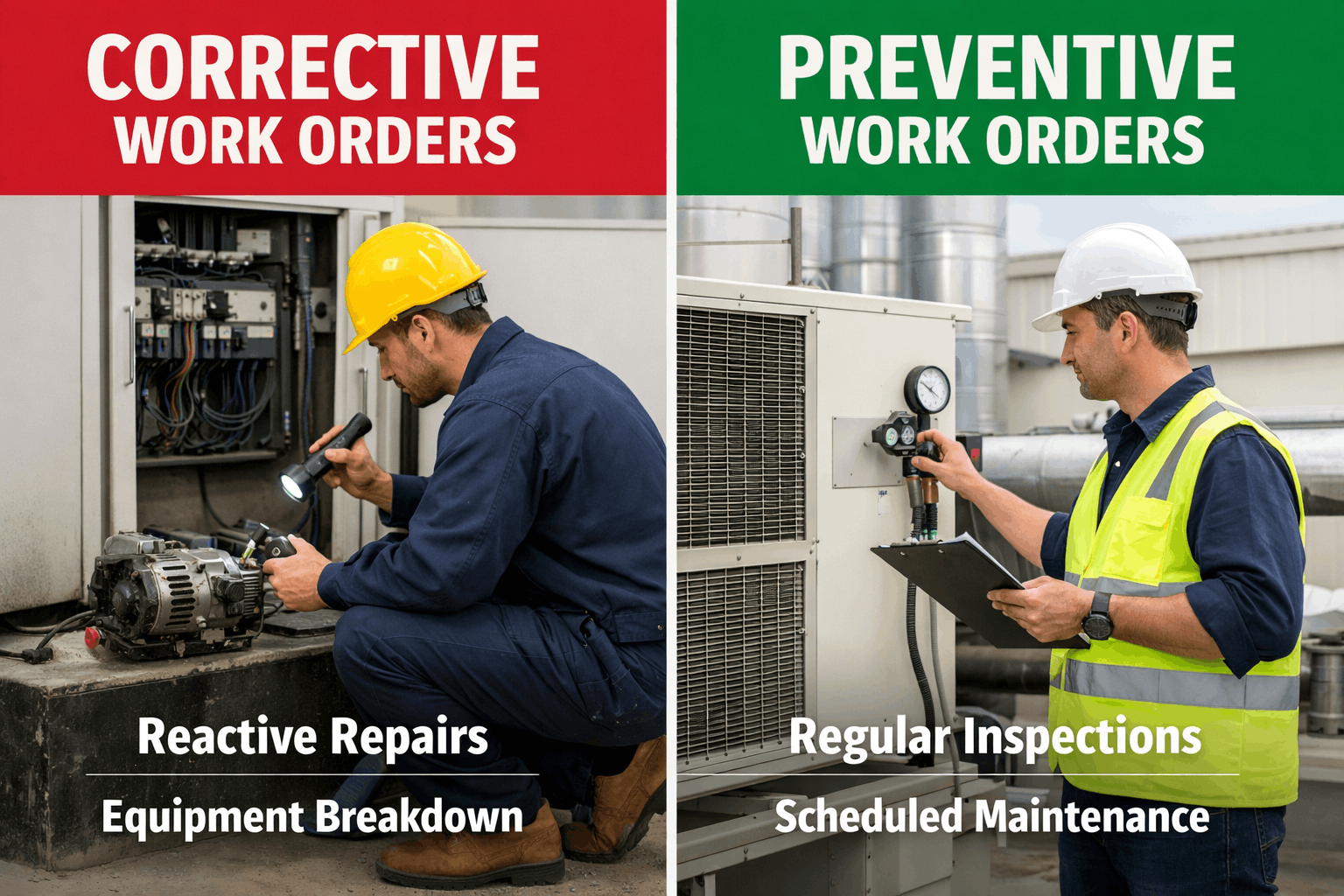
A food processing plant runs two identical packaging lines. Line A operates under a corrective maintenance strategy — the team repairs equipment when it breaks. Line B operates under a preventive maintenance program managed through a CMMS. After 18 months, the numbers are not close. Line A has experienced 47 unplanned breakdowns, $1.4M in emergency repair costs, 312 hours of lost production, and one FDA observation triggered by a conveyor failure that contaminated product. Line B has experienced 6 unplanned breakdowns, $380K in total maintenance costs (including all PM labor and parts), 28 hours of lost production, and zero compliance findings. Same equipment. Same operators. Same environment. The only difference is the work order strategy: corrective reacts to failure; preventive schedules work before failure occurs. Neither strategy is always right for every asset. The question is which assets deserve which approach — and how to build the decision framework that allocates your maintenance budget for maximum return. Book a free demo to see how Oxmaint manages both corrective and preventive work orders in one unified platform.
Corrective vs. Preventive: What Each Work Order Type Actually Means
The terms are used loosely in most maintenance organizations, and that looseness causes real problems — technicians logging preventive work as corrective, planners miscategorizing emergency repairs as planned work, and KPI dashboards showing ratios that do not reflect reality. Clear definitions are the foundation of any work order strategy.
Corrective
Work performed after a failure or deficiency has been identified. The asset has already degraded or stopped functioning. The work order restores it.
Preventive
Work performed before failure occurs, based on time, usage, or condition triggers. The asset is still functional. The work order maintains that state.
Critical Distinction
Not all corrective work is emergency work, and not all preventive work prevents failures. A corrective work order triggered by an inspection finding (“belt showing wear, replace before failure”) is planned corrective — different from an emergency breakdown. A preventive work order that replaces a component with 80% remaining life is wasted spend. The strategy is about matching the right type to each asset’s risk profile.
The Four Subtypes of Maintenance Work Orders
Reactive
Emergency Corrective
Asset has failed. Production is stopped or safety is at risk. Work order generated after the event. Highest cost per repair: 3–5× planned rates through overtime labor, expedited parts, and collateral damage.
Planned
Planned Corrective
Deficiency identified through inspection or monitoring but asset still operational. Work order scheduled for the next available window. Standard labor rates, pre-ordered parts, minimal disruption.
Scheduled
Time-Based Preventive
Work order auto-generated by CMMS at fixed intervals: every 90 days, every 500 run hours, every 10,000 cycles. Replaces components before expected end of life regardless of actual condition.
Condition
Condition-Based Preventive
Work order triggered by sensor data or inspection findings indicating actual degradation. Replaces components when condition warrants — not before. Highest precision, lowest waste.
The Cost Comparison: Why the Strategy Matters
The financial difference between corrective and preventive maintenance is not marginal — it is structural. Emergency corrective work costs 3–5× more than the same repair performed as planned preventive work because of overtime labor, expedited parts, collateral damage to adjacent equipment, and lost production during unplanned downtime. These multipliers compound across every asset in the facility.
3–5×
Cost multiplier for emergency corrective repairs vs. the same work performed as planned preventive maintenance
30–40%
Of PM-replaced components still have half their useful life remaining — pure waste from over-conservative schedules
45%
Average emergency work ratio in facilities without structured PM programs — nearly half of all work is unplanned
Under 15%
Target emergency ratio achievable with CMMS-managed PM programs — 85%+ of work becomes planned and optimized
The goal is not zero corrective work. It is the right mix. Oxmaint manages both corrective and preventive work orders in one platform — with analytics that reveal which assets need which strategy.
Side-by-Side Comparison: Eight Dimensions That Determine Your Strategy
The corrective vs. preventive decision is not binary — it is a spectrum that varies by asset, by failure mode, and by consequence. Here are the eight dimensions that matter most, with clear guidance on where each approach wins.
01
Cost Per Repair Event
Corrective: Emergency repairs cost 3–5× planned rates. Overtime labor ($85–$150/hr vs. $45–$75/hr standard), expedited parts (40–80% premium), and collateral damage to adjacent equipment add up. A bearing replacement that costs $1,200 as a PM costs $4,800–$8,500 as an emergency.
Preventive wins on every asset where failure cost exceeds PM cost by 2× or more
02
Downtime Impact
Corrective: Unplanned downtime averages $260K/hour across manufacturing. The failure determines the timing — always at the worst possible moment. Preventive: PM is scheduled for planned downtime windows, breaks, or low-production periods. Zero unplanned production impact.
Preventive wins on production-critical assets. Corrective acceptable on redundant or non-production assets.
03
Safety Risk
Corrective: Failures on safety-critical equipment create injury risk. Arc flash from deferred electrical maintenance, crane failure over personnel areas, pressure vessel rupture from missed inspections. Preventive: Scheduled inspections and replacements eliminate the failure that creates the hazard.
Preventive mandatory on all safety-critical and life-safety equipment. Corrective is not an acceptable strategy.
04
Regulatory Compliance
Corrective: Regulators do not accept “we’ll fix it when it breaks” for OSHA, NFPA, FDA, or EPA-mandated equipment. Citations range from $15.6K to $161K per violation. Preventive: CMMS auto-schedules inspections at required frequencies and generates audit-ready documentation proving compliance.
Preventive mandatory on all regulated equipment. Corrective approach guarantees citation exposure.
05
Failure Predictability
For predictable degradation (bearings, belts, filters, seals): Preventive PM at condition-based or time-based intervals catches wear before failure. For random failures (electronic faults, sudden fractures, external impacts): PM cannot prevent what it cannot predict. Redundancy and fast corrective response are the correct strategies.
Preventive wins on gradual degradation. Corrective + redundancy wins on random failure modes.
06
Asset Replacement Cost
High-value assets ($50K–$5M+): Every dollar of monitoring and PM is justified because a single failure costs 10–50× the PM program. Low-value assets (under $500): The cost of monitoring and scheduled PM exceeds the cost of replacement. Stock spares and replace on failure.
Preventive wins on high-value assets. Run-to-failure (corrective) wins on low-cost, high-population items.
07
Asset Population Size
Small population (1–5 units, no redundancy): Failure of any single unit is consequential. PM justified. Large population (60+ identical units, high redundancy): Individual failure is inconsequential. Monitoring 60 units costs more than replacing the 2–3 that fail annually.
Preventive wins on small, critical populations. Corrective wins on large, redundant populations.
08
PM-Induced Failure Risk
10–15% of equipment failures are caused by the maintenance intervention itself: contamination during reassembly, misalignment after bearing replacement, seal damage during inspection. Every unnecessary PM touchpoint on a healthy asset introduces failure risk that would not exist if the equipment were left alone.
Condition-based PM wins over calendar PM by eliminating unnecessary interventions on healthy equipment.
The Decision Matrix: Which Assets Get Which Strategy
Two questions determine the correct strategy for any asset: How bad is failure? How predictable is degradation? Map every asset against these two axes and the strategy assigns itself.
Asset Strategy Decision Matrix
High Criticality + Predictable Degradation → Condition-Based PM
Maximum ROI. Every $1 in monitoring returns $10–$50 in avoided failures. Main drives, compressors, gearboxes, chillers, boilers, transformers. Sensor-monitored with predictive work orders 3–6 weeks before failure. This is the 35% of your asset base that carries 80% of your downtime risk.
High Criticality + Random Failure → Time-Based PM + Redundancy
Conservative PM intervals, backup systems, and strategic spare inventory. Contactors, safety interlocks, protection relays, emergency generators. You cannot predict random electronic failures, but you can ensure redundancy exists and PM catches wear-related secondary failures.
Calendar PM schedules refined by periodic condition checks. Auxiliary pumps, HVAC units, secondary drives, conveyor components. If the midpoint condition check shows the asset is healthy, extend the PM interval. If degraded, advance the PM. Best of both approaches at moderate cost.
Low Criticality + Random Failure → Run to Failure (Corrective)
Replace when broken. Stock spares. No monitoring cost. Lighting, redundant sensors, consumable components, low-cost accessories. The cost of any PM program exceeds the cost of replacement. Corrective is the optimal economic strategy for this quadrant.
Condition-based predictive PM on 100–200 critical assets. 80% of downtime risk lives here. Highest ROI per dollar spent.
20%
Hybrid PM: calendar schedules refined by condition data. 150–300 medium-criticality assets. 40–60% of PdM value at lower cost.
30%
Time-based calendar PM on 300–500 standard assets. Simple, reliable, cost-effective for regulatory and routine maintenance.
15%
Run-to-failure corrective on 2,000+ low-cost items. Stock spares, replace when broken. Cheaper than any scheduled program.
How CMMS Manages Both Strategies in One Platform
The practical challenge is not choosing between corrective and preventive — it is managing both simultaneously across thousands of assets with different strategies, different frequencies, and different skill requirements. A CMMS is the system that makes this manageable at scale.
PM
Preventive Scheduling
The CMMS auto-generates PM work orders at configured intervals: calendar time, run hours, meter readings, or condition triggers. Each PM includes the checklist, required parts, estimated labor, and assigned trade. Work orders appear in the schedule before they are due — giving planners time to coordinate parts, contractors, and production windows.
95%+ PM on-time completion achievable with CMMS automation vs. 55–65% with manual tracking
CM
Corrective Workflow
When equipment fails or a deficiency is reported, the CMMS captures the request, classifies type and priority, matches to the right technician by skill and location, and dispatches via mobile push notification in seconds. Full asset history travels with the work order — so the technician arrives knowing what failed before, what parts were used, and what the likely root cause is.
Under 24 hrs average response time with CMMS dispatch vs. 3–6 days with manual assignment
AI
Strategy Optimization
The analytics engine reviews every closed work order to determine whether the current strategy is working for each asset. Assets with PM that still fail frequently need strategy redesign. Assets on run-to-failure that generate expensive emergencies need PM. The CMMS recommends strategy changes based on actual cost and failure data — not assumptions.
Continuous strategy refinement as the CMMS accumulates 6–12 months of operational data
Financial Impact: What the Right Mix Saves
$800K–$2M
Annual emergency failure prevention through PM compliance and predictive maintenance on critical assets
25–40%
Reduction in premature part replacements by moving from calendar PM to condition-based intervals
20–40%
Equipment lifespan extension through condition-based maintenance timed to actual degradation, not calendar estimates
100%
Compliance audit readiness with CMMS-documented PM records, inspection logs, and corrective action tracking
Getting Started: 30 Days to an Optimized Work Order Strategy
Transitioning from an ad hoc maintenance approach to a structured corrective-preventive strategy does not require a multi-year project. With a cloud-based CMMS, the first phase delivers measurable results within the first month.
Week 1
Asset Classification and Strategy Assignment
Import your asset registry into the CMMS. Classify each asset by criticality (high, medium, low) and failure predictability (gradual degradation vs. random). Assign the strategy: condition-based PM, calendar PM, hybrid, or run-to-failure. The decision matrix makes this a 2-question exercise per asset.
Week 2
PM Schedule Activation and Corrective Workflow Deployment
Configure PM schedules for all preventive assets: intervals, checklists, required parts, and assigned trades. Deploy the mobile work order app for corrective requests. Every new maintenance need — planned or unplanned — now flows through the CMMS with full tracking and documentation.
Week 3
Parts Linking and Compliance Calendar
Link spare parts to specific assets and work order types. Set minimum stock levels for critical PM parts. Activate the compliance calendar for OSHA, NFPA, FDA, or industry-specific regulatory inspections. No more missed inspection windows or emergency parts orders.
Week 4
KPI Baseline and Strategy Monitoring
Activate dashboards tracking the five KPIs that measure strategy effectiveness: emergency work ratio, PM compliance rate, first-time fix rate, mean time between failures per asset, and cost per work order by type. By day 30, you have the data foundation to continuously refine which assets need which strategy.
The Right Work Order Strategy Is Worth Millions. The Wrong One Costs Millions.
Oxmaint manages corrective and preventive work orders in one platform — with AI that classifies each request, automates PM scheduling, dispatches corrective work in seconds, and continuously recommends which assets should shift strategies based on actual failure data and cost outcomes. Start free. Deploy in 30 days. ROI from month one.
No. Corrective maintenance is the correct strategy for low-cost, high-population, redundant assets where the cost of any PM program exceeds the cost of replacement on failure. Most facilities land at 30–50% preventive (condition-based and calendar), 15–20% hybrid, and 15% intentional run-to-failure. The goal is not zero corrective work — it is zero unplanned corrective work on critical assets. Emergency repairs on non-critical assets are an acceptable, economically rational choice. Start free and use the asset classification tools to map your portfolio to the optimal strategy mix.
How do we know if our PM program is actually preventing failures?
Track two metrics per asset: failure rate before PM implementation and failure rate after. If an asset with quarterly PM still fails quarterly, the PM is not addressing the actual failure mode — it needs redesign (different tasks, different interval, or different strategy entirely). The CMMS generates this comparison automatically from work order history. Assets where PM spend exceeds the cost of occasional corrective repair should be re-evaluated for hybrid or run-to-failure strategies.
What is a healthy ratio of preventive to corrective work orders?
World-class maintenance operations target 80–85% planned work (preventive + planned corrective) and under 15% emergency corrective. Most facilities start at 40–60% emergency corrective. Moving from 60% emergency to 15% typically takes 6–12 months of disciplined PM execution, and the financial impact is dramatic: every percentage point shifted from emergency to planned work saves 3–5× per repair event on the affected assets.
Can condition-based PM completely replace calendar-based PM?
For assets with monitorable degradation patterns (bearings, motors, compressors, HVAC systems), condition-based PM is superior because it replaces components at the optimal point — not too early (wasting parts life) and not too late (causing failure). However, condition monitoring requires sensors, data infrastructure, and analytics capability. Calendar PM remains the correct strategy for assets where monitoring costs exceed the value of precision timing, for regulatory inspections with fixed frequency requirements, and for simple components where calendar intervals adequately approximate degradation. Book a demo to see how Oxmaint manages both calendar and condition-based PM triggers from a single scheduling engine.
How quickly will we see results from shifting our work order strategy?
Week 1 delivers immediate value: the CMMS eliminates lost work orders, auto-classifies priority, and dispatches corrective work in seconds instead of hours. Week 2–4 activates PM scheduling, which prevents the first round of failures that would have become emergencies. By day 60, the emergency work ratio begins declining measurably. By day 90, most facilities see 25–40% reduction in emergency corrective work — which translates directly to 25–40% reduction in emergency labor cost, parts expediting premium, and unplanned downtime.
By Jennie
✨
Experience Oxmaint's Power
Take a personalized tour with our product expert to see how OXmaint can help you streamline your maintenance operations and minimize downtime.