Your organization manages 15 facilities across 4 states. Each site runs its own maintenance operation — different spreadsheets, different naming conventions, different vendors, different definitions of "preventive maintenance." When corporate asks "what's our average response time?" the answer takes two weeks to assemble and no one trusts the number. When a VP asks "which site has the highest maintenance cost per square foot?" the answer is "we don't know — the data isn't comparable." When an auditor asks for inspection records at Site 7, the facilities manager drives to the building to check the filing cabinet. This is what maintenance looks like without enterprise-level CMMS — and it's costing your organization millions in redundant processes, missed efficiencies, and invisible compliance gaps. The CMMS market was valued at $1.29 billion in 2024 and is projected to reach $2.41 billion by 2030, with large enterprises accounting for 61% of market share — driven by the need for centralized governance, standardized KPIs, and real-time visibility across multi-site portfolios. OxMaint scales from a single building to hundreds of facilities — with the same platform, the same data structure, and the same real-time dashboards at every level.
Enterprise Platform · Multi-Site Operations · 2026
One Platform. Every Facility. Complete Visibility. Zero Data Silos.
Enterprise CMMS is not a bigger version of single-site software. It's an architecture decision — standardized taxonomies, harmonized KPIs, role-based access, multi-site benchmarking, and centralized governance that lets corporate see everything while site managers control their own operations. OxMaint is built for this from the ground up.
Avg. PM Compliance (All Sites)
Why Multi-Site Organizations Outgrow Single-Site CMMS
A single-site CMMS tracks work orders and assets. An enterprise CMMS governs maintenance operations across your entire organization — standardizing how work is classified, how performance is measured, and how decisions are made. The difference is not a feature list. It's an architecture that makes data comparable, processes consistent, and performance visible at every level.
What Happens Without Enterprise CMMS
Each site names assets differently — "AHU-1" vs "Air Handler Unit 1" vs "Rooftop Unit"
KPIs are calculated differently at each location — apples to oranges
Best practices at one site stay invisible to every other site
Corporate reporting takes weeks to assemble from disconnected systems
Compliance status unknown until an auditor arrives at a specific site
Siloed data. Inconsistent processes. Invisible performance. Unmanageable risk.
What Enterprise CMMS Delivers
Standardized asset taxonomy across all sites — one language, one structure
Harmonized KPIs calculated identically at every location
Cross-site benchmarking identifies best practices and underperformers
Real-time corporate dashboards with drill-down to any site, building, or asset
Compliance status visible portfolio-wide at all times
Unified data. Consistent execution. Comparable performance. Manageable scale.
The 8 Pillars of Enterprise CMMS Architecture
Scaling maintenance across multiple facilities requires eight architectural capabilities that single-site systems simply do not provide. Each pillar solves a specific multi-site challenge — and together they create the centralized governance framework that enterprise operations require.
Data Architecture Pillars
How you structure data determines whether multi-site comparison is possible
01
Standardized Asset Taxonomy
One naming convention. One hierarchy. Every site.
Without:Data incomparable across sites
With OxMaint:Instant cross-site analysis
When Site A calls it "AHU-1" and Site B calls it "Rooftop 3," you cannot compare maintenance costs, failure rates, or performance across sites. Standardized taxonomies — enforced at the platform level — make every data query meaningful across the entire portfolio.
02
Harmonized KPI Definitions
Same formula. Same calculation. Same benchmark. Every site.
Without:Each site defines "response time" differently
With OxMaint:One definition, auto-calculated
If Site A measures response time from request submission and Site B measures from technician dispatch, their "response times" are not comparable — and any benchmarking is fiction. OxMaint enforces a single definition for every KPI across every site.
Governance Pillars
How you control access and standardize processes across distributed teams
03
Role-Based Access Control
Corporate sees everything. Site managers see their sites. Technicians see their work.
Levels:Corporate → Region → Site → Building → Trade
Result:Right data to right person at right level
The VP of Operations sees a portfolio dashboard with KPIs across all 15 sites. The regional manager sees their 5 sites. The site facilities manager sees their buildings. The technician sees their assigned work orders. Same platform. Different views. Configurable by role.
04
Standardized SOPs and PM Templates
Create once at corporate. Deploy to every site. Update globally.
Without:Each site builds its own checklists
With OxMaint:Gold-standard templates pushed to all sites
When your best site has an excellent PM checklist for HVAC quarterly inspections, that checklist should be replicated at every site — not reinvented 15 times with 15 different quality levels. Enterprise CMMS enables template governance: create at corporate, deploy everywhere, update once.
Visibility Pillars
How you see performance, compare sites, and identify improvement opportunities
05
Cross-Site Benchmarking
Compare any metric across any combination of sites in real time.
Example:"Site 3 PM compliance is 67% — all others are 85%+"
Action:Immediate investigation and corrective action
Benchmarking is only possible when data is standardized. With harmonized KPIs and consistent taxonomies, you can rank sites by response time, compare cost per square foot, identify which location has the highest reactive maintenance ratio, and export the comparison in one click for leadership review.
06
Real-Time Portfolio Dashboards
Every site. Every KPI. One screen. Live.
Without:2–4 weeks to compile monthly report
With OxMaint:Real-time, always current, drill-down enabled
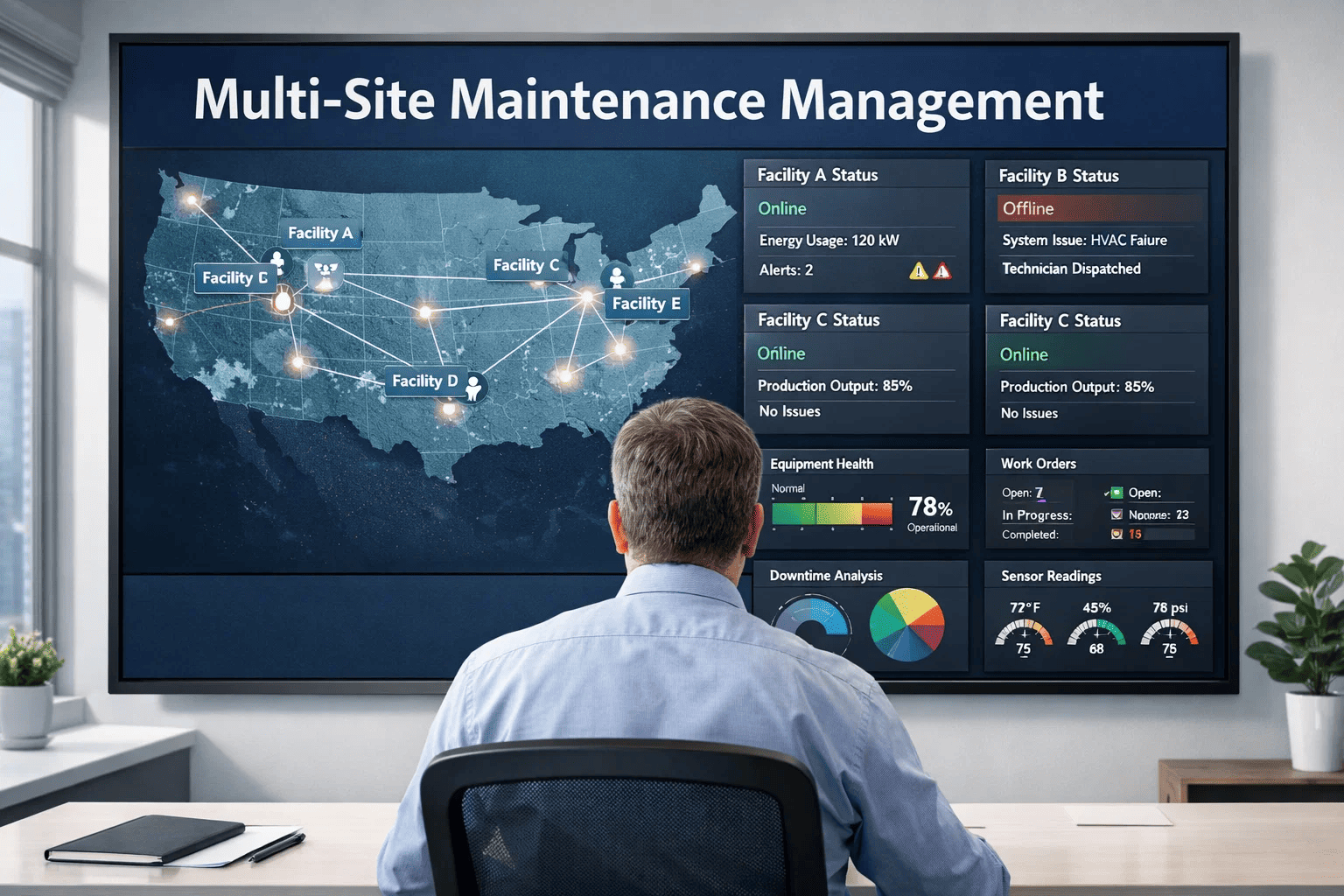
Corporate leadership should never wait for a monthly report. The portfolio dashboard shows open work orders, PM compliance, response times, compliance status, and cost trending — across all sites, with one-click drill-down to any individual facility, building, or asset.
Integration Pillars
How the CMMS connects to your existing enterprise technology stack
07
ERP and Financial System Integration
Maintenance costs flow into enterprise financial reporting automatically.
Systems:SAP, Oracle, Banner, Workday, PeopleSoft
Method:Bidirectional REST API sync
When purchase orders, invoices, and labor costs sync bidirectionally between OxMaint and your ERP, maintenance spending appears in financial reports automatically. No manual data transfer. No reconciliation errors. Budget codes, fund sources, and cost centers are configurable per organization.
08
BAS, IoT, and SCADA Connectivity
Equipment faults trigger work orders without human intervention.
Protocols:BACnet, Modbus, OPC-UA, MQTT, REST
Result:Condition-based work orders from sensor data
For sites with building automation or industrial controls, OxMaint connects to BAS, SCADA, and IoT platforms to receive equipment fault data and performance metrics. Threshold crossings generate work orders automatically — no manual alert triage, no missed notifications, no delay between detection and dispatch.
One Platform. Every Facility. Deployed in Weeks.
OxMaint's enterprise architecture delivers standardized data, harmonized KPIs, role-based access, and real-time cross-site visibility — without the 6–12 month implementation timelines of legacy enterprise systems. Start with one site, scale to hundreds.
The Enterprise Maturity Ladder: Where Is Your Organization?
Multi-site maintenance organizations fall into five maturity levels. Most sit at Level 2 — managing individual sites adequately but unable to compare, standardize, or optimize across the portfolio. The jump from each level to the next delivers compounding returns.
Level 5
Autonomous Optimization
AI automatically reallocates resources across sites based on real-time demand. Predictive models schedule maintenance by condition, not calendar. The system self-optimizes — each site benefits from learnings across the entire portfolio.
All 8 pillars active. Cross-site resource sharing. AI-driven scheduling. Continuous improvement loop.
Level 4
Predictive Enterprise
IoT and BAS data feeds condition-based work orders. Cross-site benchmarking drives continuous improvement. Corporate sets targets, sites execute with local autonomy. Best practices propagate systematically.
Portfolio dashboards live. Benchmarking active. PM compliance 90%+. Reactive work under 20%.
Level 3
Standardized Multi-Site
Single CMMS platform deployed across all sites. Standardized taxonomies, PM templates, and KPI definitions. Corporate reporting automated. Role-based access configured. Sites comparable for the first time.
Unified platform. Standardized data. Automated reporting. PM compliance 80%+. Benchmarking beginning.
Level 2
Disconnected Digital (Most Organizations)
Some sites have CMMS, others use spreadsheets. No common taxonomy. No comparable KPIs. Corporate visibility requires manual report compilation. Each site is a data island.
Mixed systems. Incomparable data. Manual reporting. No cross-site benchmarking. Compliance gaps invisible.
Level 1
Reactive and Fragmented
Paper logs, phone-based dispatching, and tribal knowledge at every site. Corporate has no visibility. Compliance is managed by hope. Maintenance performance is unmeasured and unmanaged.
No system. No data. No visibility. No benchmarking. Maximum risk exposure.
Building Your Enterprise Dashboard: What Each Role Needs
Total maintenance spend by site · Cost per square foot ranking · Compliance status portfolio-wide · Unplanned downtime trending · Capital replacement forecasts
Why these: Connects maintenance to financial outcomes and risk exposure. Answers "which sites are underperforming and how much is it costing us?"
PM compliance by site · Response time by site · Open work order aging · Reactive vs. planned ratio · Vendor performance across sites · Staffing utilization
Why these: Identifies which sites need attention and which are executing well. Enables resource sharing and best-practice transfer between locations.
Open work orders by priority · Technician workload · PM schedule and compliance · Asset condition scores · Inventory stock levels · Compliance inspection calendar
Why these: Manages daily operations at the facility level. Sees what needs to happen today, what is overdue, and what is coming next week — without waiting for reports from above.
Proven Enterprise Results
MTTR Reduction
70%
After enterprise standardization
MTBF Improvement
+20%
Cross-site visibility
Unplanned Downtime
-25%
With enterprise CMMS
Report Compilation
Weeks → Minutes
Real-time dashboards
Compliance Visibility
0% → 100%
Portfolio-wide, real-time
Implementation
Weeks
Not months. Not years.
Stop Managing Sites. Start Managing a Portfolio.
OxMaint's enterprise CMMS gives you standardized data, harmonized KPIs, cross-site benchmarking, and real-time portfolio dashboards — deployed in weeks, not the 6–12 months that legacy enterprise systems require. Unlimited users. No per-site fees. Scale from 1 building to 500.
Frequently Asked Questions
How is enterprise CMMS different from deploying the same single-site CMMS at multiple locations?
Deploying the same software at 15 sites does not make it an enterprise system. Without standardized taxonomies, harmonized KPI definitions, centralized template governance, and role-based hierarchical access, each site becomes a data island — producing numbers that cannot be compared, processes that cannot be benchmarked, and reports that cannot be consolidated. OxMaint is architected for multi-site from the foundation — not retrofitted after the fact.
How long does enterprise deployment take with OxMaint?
A pilot site can be live within 2–4 weeks. The "gold standard" site — with standardized taxonomies, PM templates, KPI configurations, and role-based access — becomes the template for all subsequent sites. Rolling out to additional sites takes 1–2 weeks each because the data structure, templates, and configurations are already defined. A 15-site organization can typically be fully deployed within 3–4 months. This is fundamentally different from legacy enterprise systems that require 6–18 months.
Can site managers customize OxMaint for their local needs?
Yes — within the governance framework. Site managers can create local work orders, manage their technician schedules, and add site-specific assets. They cannot change the standardized taxonomy, modify KPI definitions, or alter corporate PM templates. This balance of local autonomy with corporate governance ensures that sites can operate independently while producing data that is comparable and consolidatable at the enterprise level.
Does OxMaint integrate with our existing ERP?
Yes. OxMaint connects to SAP, Oracle, Banner, Workday, PeopleSoft, and other enterprise systems via standard REST APIs. Work order costs, purchase orders, and labor data sync bidirectionally — ensuring maintenance spending flows into financial reports without manual transfer. Budget codes, cost centers, and approval workflows are configurable per organization.
What does pricing look like for enterprise deployment?
OxMaint offers unlimited user accounts — so cost stays predictable as you add sites, technicians, and requestors. There are no per-site license fees. Enterprise pricing is based on feature tier and deployment scope, not headcount. This model eliminates the escalating per-user costs that make legacy enterprise CMMS prohibitively expensive as organizations scale. Start with the free tier and expand as needed.