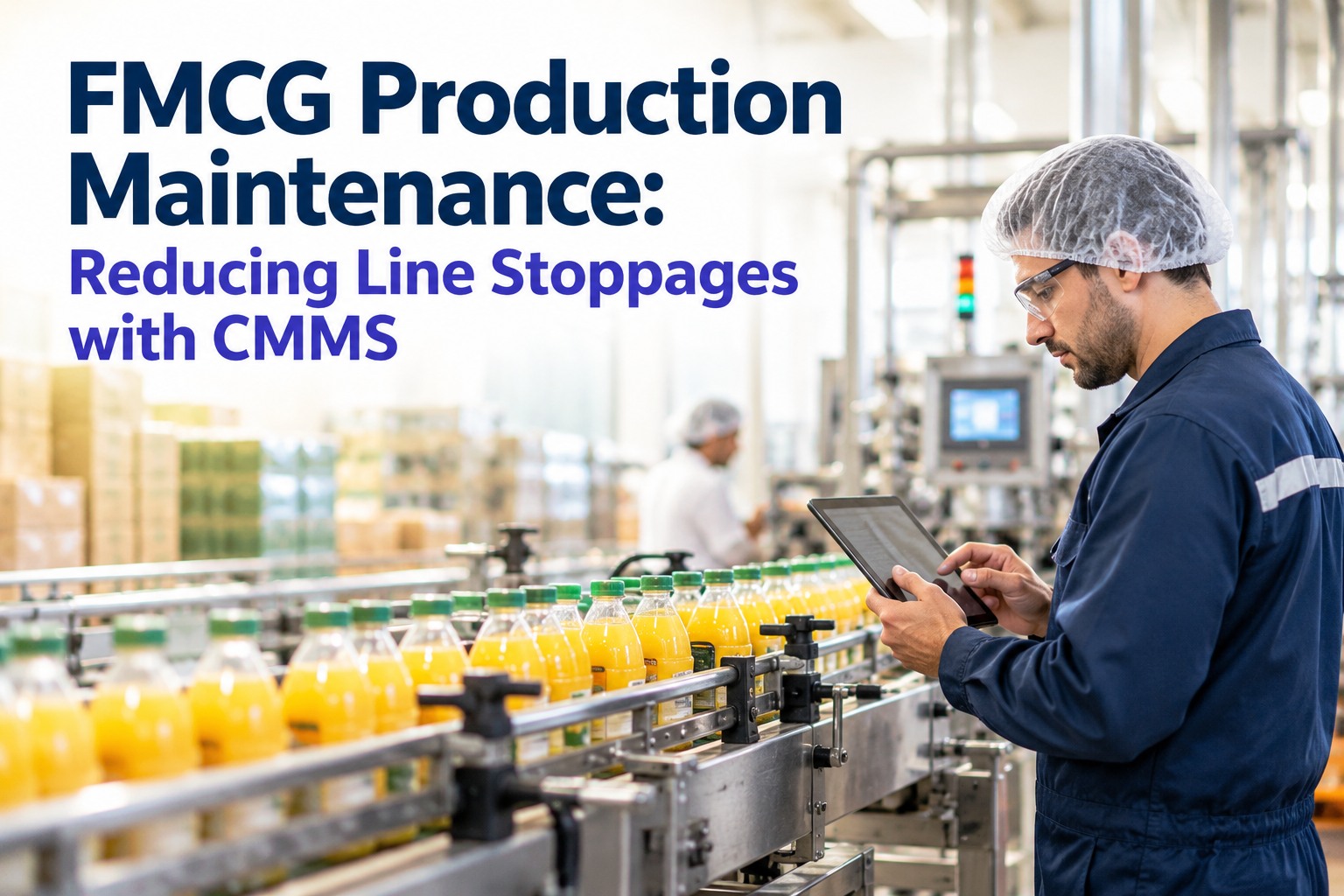
A filler that jams for eight seconds, a capper torque that quietly drifts, a changeover that runs twenty minutes long, a conveyor starved because the station upstream blocked — none of it trips an alarm, and all of it bleeds throughput off a high-speed FMCG line shift after shift. The fix isn't more firefighting; it's capturing every stoppage by reason, ranking the real driver, and running equipment-specific PM before the wear becomes a reject. This guide shows how to cut line stoppages by cause, and how OXMAINT AI, the AI-powered CMMS for FMCG plants, runs the capture-rank-act loop and the per-machine PM that keeps the line moving.
FMCG Production Maintenance: Reducing Line Stoppages with CMMS
Micro-stops that never alarm, changeovers that overrun, a bearing nobody trended, a line starved because the station before it blocked — that is where FMCG throughput goes. OXMAINT AI, the AI-powered CMMS and maintenance management software, logs every stoppage by reason code, ranks the biggest driver by Pareto, and schedules equipment-specific PM per machine — so the wear is caught as a work order, not a reject.
Stoppages Hide Because Nobody Logs Why
The reason unplanned downtime stays invisible is that an eight-second micro-stop never gets written down, and a reactive culture only records the breakdowns big enough to notice. Without asset-level history, root-cause work is guesswork — you cannot fix the driver you never measured. The first move is logging every stoppage by reason code at the moment it happens, per machine, not reconstructed at end of shift, and you can book a demo to see reason-code capture in OXMAINT AI.
Equipment-Specific PM Beats a Shared Checklist
Applying one PM interval across every machine over-maintains some assets and dangerously under-maintains others. A filler, a capper, a labeler and a cartoner fail in entirely different ways and wear on different cycle counts, so each needs its own template, tolerances and cadence. The reference below sets the baseline — always confirm against OEM specs and the machine's own history — and you can start free and load per-machine PM templates in OXMAINT AI.
| Machine | Primary failure mode | Key wear parts | Core PM checks & tolerance | Cadence |
|---|---|---|---|---|
| Filler | Fill-head seal wear & nozzle fouling | Head seals, springs, level sensors, nozzles | Fill weight sample ±1.5%; seal torque; level-sensor calibration (re-cal above 2 mm drift); CIP validation | Shift / daily / weekly; seal change near ~500K cycles |
| Capper | Chuck torque drift & stripped threads | Chuck inserts, spindle bearings, starwheels, guide rails | Torque on 10-unit sample ±5%; chuck wear go/no-go (0.3 mm limit); spindle bearing lube & play | Shift / daily / weekly; chuck change near ~800K cycles |
| Labeler | Placement drift & web-tension loss | Drive rollers, peel plates, registration sensors, ribbons | Placement ±1.5 mm centerline; web tension ±10%; sensor contrast; peel-plate groove 0.1 mm limit | Shift / daily / weekly / monthly |
| Cartoner | Glue temperature loss & blade misalignment | Tucker fingers, folding blades, glue nozzles, flight bars | Glue temp/pressure (escalate above 5°C or 5 PSI deviation); seal pull-test; blade tip wear 0.4 mm limit | Shift / daily / weekly; blade check monthly |
| Conveyor & sync | Starved / blocked & drive wear | Belts, chains, drive bearings, photo-eyes | Chain tension & lubrication; photo-eye alignment; starve/block reason logging per station | Daily / weekly |
Intervals are typical references — set the real cadence from OEM data and each machine's trend. Scroll sideways on mobile to see every column.
The Torque Was Already Drifting Before Anyone Saw a Bad Cap.
Capper torque can lose 8–12% before chuck wear is visible, and a cartoner glue head cooling even a few degrees weakens every seal on the run. Caught on a tolerance check logged against the machine, it's a work order. Caught at the reject station, it's scrapped product and a stopped line.
Changeover: The Most Fixable Hour of the Day
Changeover overrun is process-driven, not equipment-driven, which makes it the category you can shrink fastest. Lines running six or more format switches a day carry far higher first-hour reject rates when there's no format-specific verification — fill-head height, capper torque target, labeler placement spec — locked in before the line restarts. A changeover-triggered work order that lists those checks per SKU turns a chaotic restart into a confirmed one.
How OXMAINT AI Runs the Line
A reason-code loop and per-machine PM only hold if they live in one system that trends compliance against results. OXMAINT AI ties every stoppage, task and measurement to the specific asset and surfaces the driver automatically, and you can book a demo to see line reliability tracking in OXMAINT AI.
We used to blame ‘the line’ for lost output, because that's all our records said. Once every stoppage was logged by reason against the actual machine, the Pareto was blunt — two thirds of our losses were filler micro-stops and changeover overruns, not the big breakdowns we kept chasing. Equipment-specific PM on the fillers and a per-SKU changeover checklist did more for throughput in a quarter than a year of reactive repairs.
Frequently Asked Questions
Stop Blaming The Line. Measure It, Then Fix The Driver.
Run FMCG production maintenance on the OXMAINT AI maintenance management software — reason-code downtime capture with Pareto ranking, equipment-specific PM for every filler, capper, labeler and cartoner, changeover-triggered verification, and reject-to-PM correlation. Turn invisible stoppages into a ranked, fixable list and keep the line running.