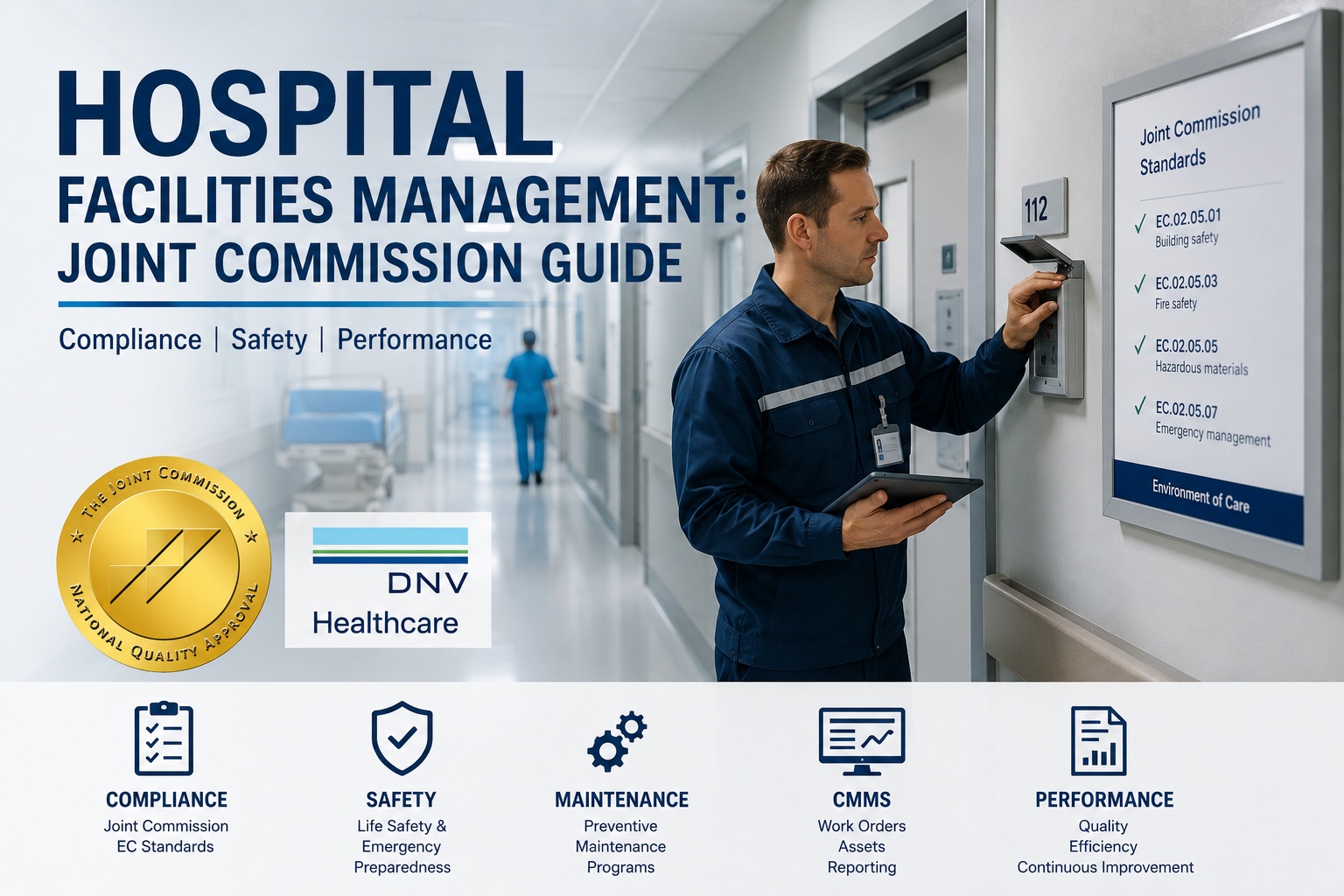
Every hospital facility director has the same recurring anxiety: the day the Joint Commission surveyor walks through the front door unannounced. That day arrives on a schedule the hospital does not control, inside a window of 18 to 39 months, and the surveyor arrives ready to trace maintenance execution against every applicable Physical Environment standard the facility must meet. The material question is not whether the policies exist — every accredited hospital has policies. The material question is whether the timestamped, technician-signed, asset-linked evidence exists to prove those policies are being executed continuously. Effective January 1, 2026, the Joint Commission consolidated the historical Environment of Care (EC) and Life Safety (LS) chapters into a single unified Physical Environment (PE) chapter under its Accreditation 360 framework — reducing 396 elements of performance to 63 while intensifying the focus on outcome-based evidence rather than paper compliance. This guide walks through what changed, what documentation now matters most, and how OxMaint operationalizes the survey-ready evidence layer that separates hospitals that pass with commendation from hospitals that receive Requirements for Improvement they scramble to close before their next survey window. Book a free demo to see hospital facilities management inside OxMaint.
Before · Pre-2026
Environment of Care (EC)
Multiple standards · hundreds of EPs
+
Life Safety (LS)
Separate chapter · overlapping evidence requirements
44 standards · 396 elements of performance
After · Effective January 1, 2026
Physical Environment (PE)
Unified chapter aligned with CMS Conditions of Participation · outcome-based verification
63 elements of performance · 714 requirements removed
Ambulatory care, nursing care centers, and behavioral health settings continue using the original EC and LS chapters · consolidation applies to hospitals and critical access hospitals only
4,500+
US hospitals accredited by the Joint Commission — approximately 82% of all hospitals and 92% of hospital beds
18-39 mo
unannounced survey window · the surveyor arrives on a schedule the facility never controls
48%
reduction in Elements of Performance under the 2026 restructuring — outcome-based verification replaces volume
The Six Physical Environment Domains
Beneath the standard renumbering, the substance of what surveyors evaluate has not changed. The six historical Environment of Care domains remain the operating framework for hospital facilities management — and each domain generates its own inspection cadence, documentation requirements, and citation risk profile. Understanding which domain owns which asset, and which asset owns which risk, is the map every facilities director works against. OxMaint's healthcare asset tree pre-maps every hospital asset to its correct PE domain so PM cadence, competency requirements, and evidence packages flow from a single classification.
The Six Domains of the Physical Environment Program
01
Safety Management
Facility-wide safety, environmental rounds, hazard identification, corrective action tracking
Legacy: EC.02.01.01
02
Security Management
Access control, infant protection, workplace violence prevention, emergency lockdown
Legacy: EC.02.01.01 EPs
03
Hazardous Materials
HazMat inventory, waste segregation, chemical safety, radiation, medical gas
Legacy: EC.02.02.01
04
Fire & Life Safety
Fire alarm, sprinklers, extinguishers, egress, smoke barriers, ILSM · NFPA 25, 72, 101
Legacy: EC.02.03 · LS.02
05
Medical Equipment
Biomed inventory, PM per manufacturer IFU, incident tracking, competency
Legacy: EC.02.04.01
06
Utility Systems
HVAC, medical gas, emergency power, water systems, life safety branch · ASHRAE 170, NFPA 99, 110
Legacy: EC.02.05
The Documentation Evidence Hierarchy — What Surveyors Actually Want
The 2026 standards revision represents a philosophical shift more than a mechanical one. Surveyors are no longer looking primarily for policies filed in binders — they are looking for outcome-based evidence that the policies are actually executed continuously. A documented policy without matching timestamped execution records now creates more citation risk than no policy at all, because it demonstrates the facility knows what it should be doing and is not doing it. The evidence hierarchy below reflects what a modern tracer methodology surveyor actually values from weakest to strongest proof.
Evidence Hierarchy · Weakest to Strongest Proof
Level 1 · Weakest
Written Policies Alone
Binder documents describing what the facility intends to do · no proof of execution · minimal survey credit under 2026 model
Level 2
Procedures & PM Schedules
Documented procedures and scheduled intervals · shows planning discipline · still no proof of execution
Level 3
Completed Work Orders
Work orders showing completion status · closer to evidence · but signature and timestamp discipline determines survey value
Level 4 · Strongest
Timestamped Technician-Signed Records with Asset Linkage
Each execution captured with time, technician ID, competency verification, asset reference, and result · the modern surveyor's target evidence
OxMaint produces Level 4 evidence as a byproduct of routine work — every task completion generates timestamped, signed, asset-linked records automatically
The Maintenance Management Program (MMP) — Now a Mandatory Framework
Among the most consequential changes in the 2026 standards is the elevation of the Maintenance Management Program (MMP) from best practice to mandatory documented framework. Under the revised standards, every hospital must be able to produce evidence of a formalized MMP containing five specific documented components — and the absence of any one of these creates immediate citation risk. The MMP is now the primary artifact surveyors request when opening the tracer for a maintenance-related standard.
The MMP · Five Required Documented Components
01
Complete Equipment Inventory
Every asset subject to maintenance management — not just life-safety equipment — cataloged with location, criticality, and responsible party
02
Defined PM Frequencies
Preventive maintenance intervals per manufacturer IFU or evidence-based alternative equipment maintenance program with justification
03
Risk Classifications
Each asset assigned a criticality tier reflecting patient safety impact of failure — drives testing rigor and inspection cadence
04
Competency Verification
Documented evidence that maintenance staff are trained and competent for the specific tasks assigned — matched to work order dispatch
05
Performance Monitoring
Ongoing measurement of PM compliance rates, corrective action closure times, and program effectiveness reported to leadership
Every OxMaint hospital deployment produces the MMP evidence package as a single exportable report — asset inventory, PM cadence, criticality classifications, technician competency records, and performance metrics against every applicable standard
Get Survey-Ready Documentation Running in Weeks
OxMaint's hospital deployment produces MMP-compliant evidence packages, timestamped work order records, and tracer-ready documentation from day one. See it against your facility's asset base in a 30-minute walkthrough.
The Survey Readiness Cycle — 18 to 39 Months of Continuous Preparation
Because the Joint Commission survey is unannounced within a defined window, survey readiness is not a project — it is a continuous state. Mature hospital facilities programs run a defined multi-month cycle that keeps the facility perpetually within citation-free posture. The cycle below reflects the operational rhythm of facilities departments that consistently pass with commendation rather than remediation.
The Continuous Survey Readiness Cycle
Weekly
Environmental rounds by trained staff · corrective action logging within 24-72 hours · fire drill compliance verification
Monthly
MMP PM compliance rate report to safety committee · ILSM tracking for active construction · utility system trending review
Quarterly
Focused mock survey by internal strike team · proactive risk assessment update · leadership report on program health
Annual
Full MMP evaluation · management plan refresh · staff competency recertification · full mock survey with external consultant
Continuous
Every PM completion recorded with timestamp, signature, and asset reference in OxMaint · evidence package always current
The facilities director who cannot produce PM completion records for the last 90 days within one hour is not survey-ready — regardless of what the policies say
Utility Systems — Where Failure Meets Patient Safety
Utility system standards concentrate the highest patient safety consequence of any Physical Environment domain. When the emergency power system fails during a power outage, when medical gas pressure drops during surgery, when the HVAC serving an OR falls out of positive pressure — the patient is at immediate risk. The three-branch electrical hierarchy below reflects the regulatory framework every hospital operates against, and the testing cadence is not negotiable.
Emergency Electrical Distribution · Three-Branch Hierarchy
Life Safety Branch
Egress lighting · fire alarm · emergency communication · smoke evacuation · illumination for exits
Monthly load test · annual 4-hour continuous · NFPA 110
Failure impact: evacuation compromised in an emergency
Critical Branch
Task illumination · patient care areas · nurse call · selected receptacles · life support
Monthly load test · annual 4-hour continuous · NFPA 99
Failure impact: direct patient care interrupted during outage
Equipment Branch
Elevators · HVAC in critical areas · sterilizers · medical air compressors · vacuum systems
Monthly load test · verify sequenced restart · NFPA 99
Failure impact: infrastructure supporting patient care lost
Every generator test, every branch load verification, every ATS transfer event stored in OxMaint against the specific equipment record — the exact evidence surveyors trace during utility system standards review
Executive Perspective · The Facility Is the Evidence
The single greatest shift in hospital accreditation over the past decade is the collapse of the distinction between the maintenance program and the compliance program. Ten years ago, we ran a maintenance department that did its work, and separately, we ran a compliance function that prepared documentation for surveys. Under the 2026 Physical Environment framework, those are the same function. The evidence surveyors want is produced automatically when maintenance execution is done correctly the first time. That has been transformative for how we structure our facilities operations. Every task performed by a technician on the floor generates the exact documentation the next surveyor will want. We no longer prepare for surveys — we exist in a state of perpetual readiness because the operational system produces the compliance artifact as a byproduct of doing the work. Once leadership understands that the facility itself is the evidence, the entire conversation about survey readiness changes.
Execution Is the Evidence
OxMaint captures every PM completion with timestamp, signature, and asset linkage — the exact Level 4 evidence surveyors trace.
MMP as a Living Report
Every OxMaint hospital deployment produces the mandatory MMP evidence package as an on-demand exportable report.
Continuous Beats Cyclical
Perpetual readiness through operational discipline outperforms pre-survey cramming every accreditation cycle.
Move Your Facility to Perpetual Survey Readiness
If your facility's evidence layer still lives in spreadsheets, paper logs, and personal knowledge, the 2026 standards restructuring has raised your citation risk materially. See what OxMaint — a maintenance management platform built for hospital facilities compliance — looks like against your asset base.
Frequently Asked Questions
What changed in Joint Commission Environment of Care standards in 2026?
The Joint Commission's Accreditation 360 initiative, effective January 1, 2026, consolidated the historical Environment of Care (EC) and Life Safety (LS) chapters into a single unified Physical Environment (PE) chapter for hospitals and critical access hospitals. The consolidation reduced 396 elements of performance to 63, removed 714 requirements, and aligned Joint Commission standards more directly with CMS Conditions of Participation. The core substance of the requirements remains intact — the change is structural and shifts focus toward outcome-based verification. Ambulatory care, nursing care, and behavioral health settings continue using the original EC and LS chapters.
What is the Maintenance Management Program (MMP) and what does it require?
The MMP is a formalized documented framework now mandatory for every accredited hospital. It must contain five documented components: a complete equipment inventory covering all assets subject to maintenance management, defined PM frequencies aligned to manufacturer IFU or evidence-based alternative programs, risk classifications assigning criticality per asset, competency verification for maintenance staff, and performance monitoring reporting to leadership. OxMaint produces the MMP evidence package as a single exportable report per facility.
What documentation do Joint Commission surveyors actually want?
Under the 2026 outcome-based verification model, surveyors want Level 4 evidence: timestamped, technician-signed work order records with asset linkage and competency verification — captured as a byproduct of routine execution rather than reconstructed for the survey. Policies alone are the weakest evidence tier. Completed work orders without signature and timestamp discipline provide limited protection. OxMaint produces Level 4 evidence automatically for every completed task, PM cycle, and inspection round.
How often does a hospital get surveyed?
Joint Commission accreditation surveys occur unannounced within an 18-39 month window depending on the facility's specific accreditation cycle. Because the survey window is unpredictable, hospitals must maintain continuous readiness rather than preparing for a specific date. DNV GL, the other major hospital accreditation body, surveys annually under its NIAHO framework. Both approaches require the same underlying operational discipline — perpetual, documented execution of the maintenance and compliance program.
What is the difference between Joint Commission and DNV GL for hospital accreditation?
Both are CMS-approved national accrediting organizations serving as agents for Medicare certification. Joint Commission (TJC) is the larger of the two, accrediting approximately 82% of US hospitals under its Physical Environment standards effective 2026. DNV GL uses the NIAHO (National Integrated Accreditation for Healthcare Organizations) framework built around ISO 9001 continuous improvement principles and surveys annually rather than triennially. From a facilities management perspective, the underlying regulatory backbone — NFPA 99, NFPA 101, ASHRAE 170, CMS CoPs — is the same across both accreditors.
Can OxMaint produce survey-ready evidence for both Joint Commission and DNV GL?
Yes. OxMaint's hospital module pre-maps every asset to the applicable regulatory standard — Joint Commission PE standards, DNV GL NIAHO chapters, CMS Conditions of Participation, and applicable NFPA and ASHRAE references. Evidence packages generate on-demand in the format each accreditor's surveyor expects. Facilities preparing for either accreditation cycle work from the same underlying execution layer with different output formats — the operational discipline is identical, and OxMaint handles the reporting translation automatically.