The average US manufacturer has between $1.1 and $1.3 in spare parts inventory for every dollar of equipment value. That means if you have $10 million in equipment, you're likely sitting on over $11 million in spare parts.
Even worse? Studies show that 40% of that inventory is either obsolete, overstocked, or for equipment you no longer own. That's millions of dollars gathering dust on warehouse shelves while you scramble to find critical parts when equipment actually breaks down.
The good news is that modern tracking methods and smart inventory strategies can slash your spare parts waste by 40% or more while actually improving equipment uptime. Let's dive into exactly how to make that happen.
The Hidden Cost of Poor Spare Parts Management
Before we explore solutions, let's quantify the problem. Poor spare parts management impacts your bottom line in ways you might not even realize:
The True Cost of Inventory Mismanagement:
- Carrying costs: 25-30% of inventory value annually (storage, insurance, depreciation)
- Obsolescence: 10-20% of parts become obsolete each year
- Emergency purchases: 50-100% premium for expedited parts
- Production downtime: $50,000 per hour average in lost production
- Working capital drain: Money tied up in excess inventory can't be invested elsewhere
One automotive parts manufacturer in Michigan discovered they had $3.2 million in spare parts for equipment they'd decommissioned five years earlier. Another food processing plant in Iowa found they were reordering parts monthly that they already had 10 years' worth of supply sitting in storage.
The Foundation: Accurate Parts Identification and Cataloging
You can't manage what you can't measure, and you can't measure what you can't identify. The first step in reducing inventory waste is creating a comprehensive, accurate catalog of your spare parts.
1. Standardize Your Naming Convention
The same bearing might be listed as "Bearing, Ball, 6205", "6205 Ball Bearing", or "BB-6205" in different systems. This duplication leads to overordering and makes it impossible to track true inventory levels.
Implement a standardized naming system that includes:
- Part category (bearing, seal, motor, etc.)
- Manufacturer name
- Manufacturer part number
- Critical specifications
- Equipment association
2. Create a Master Parts Database
Consolidate all parts information into a single source of truth. This database should include:
- Complete part specifications
- Cross-reference information for equivalent parts
- Supplier information and lead times
- Min/max stocking levels
- Storage location
- Associated equipment and criticality rating
3. Implement Barcode or RFID Tracking
Manual tracking is prone to errors and time-consuming. Modern barcode or RFID systems can:
- Track parts movement in real-time
- Automatically update inventory counts
- Prevent duplicate ordering
- Enable quick physical inventory audits
- Provide usage history for better forecasting
Smart Stocking Strategies: The Art of Having Just Enough
Once you know what you have, the next challenge is determining what you should have. Smart stocking strategies balance the risk of stockouts against the cost of excess inventory.
ABC Analysis: Focus on What Matters Most
Not all spare parts are created equal. ABC analysis helps you categorize parts based on their impact on operations:
| Category | Characteristics | Stocking Strategy | % of Parts |
|---|---|---|---|
| A Parts | Critical, high-value, long lead time | Always in stock, multiple suppliers | 10-20% |
| B Parts | Important, moderate value/lead time | Minimum stock levels, regular review | 30-40% |
| C Parts | Low criticality, readily available | Order as needed, minimal stock | 40-60% |
Calculate Optimal Reorder Points
Use this formula to determine when to reorder:
Reorder Point = (Average Daily Usage × Lead Time) + Safety Stock
Where Safety Stock = (Maximum Daily Usage × Maximum Lead Time) - (Average Daily Usage × Average Lead Time)
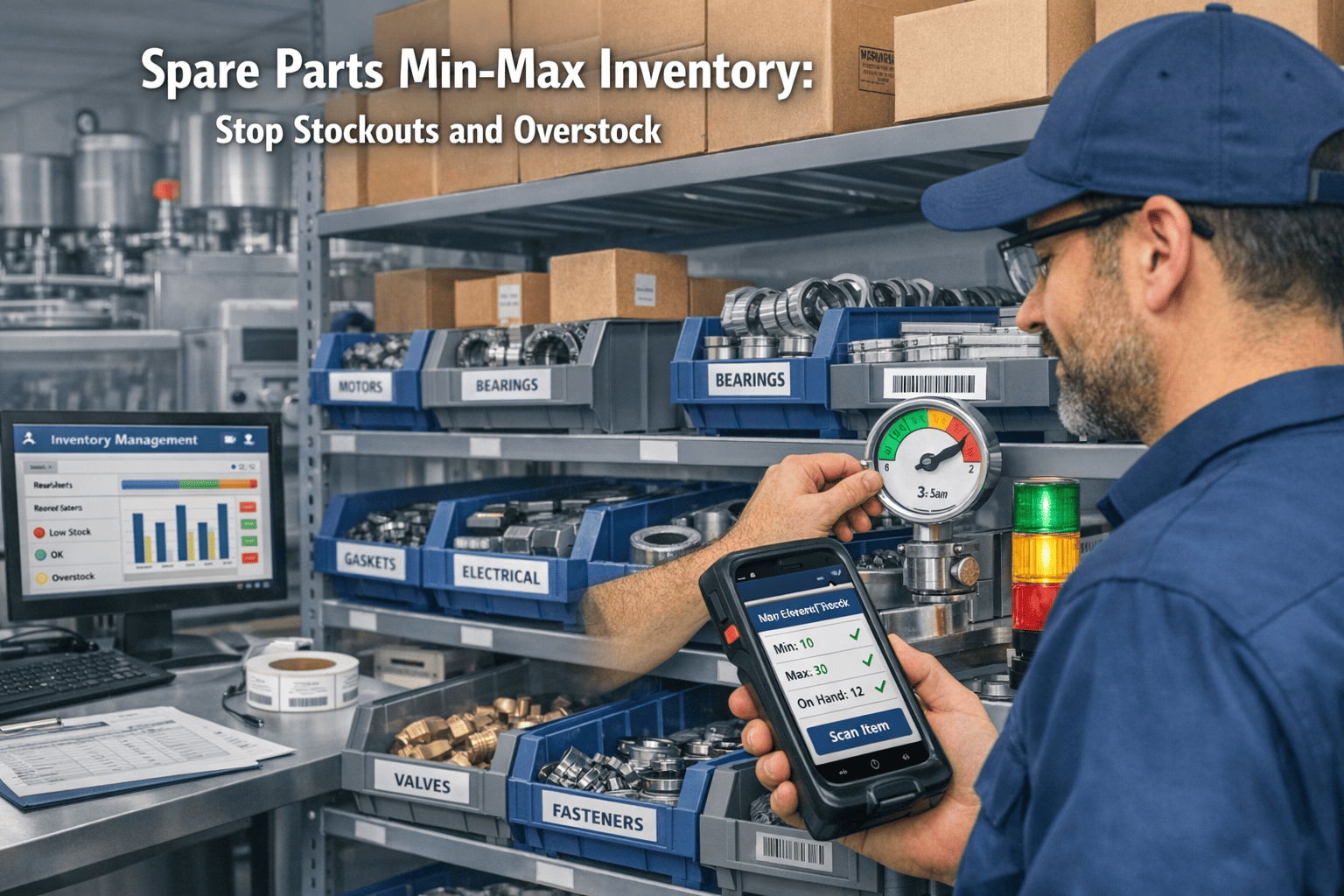
Implement Min/Max Levels
Set minimum and maximum inventory levels for each part based on:
- Historical usage patterns
- Equipment criticality
- Supplier lead times
- Storage costs
- Part shelf life
Ready to Optimize Your Spare Parts Inventory?
See how leading manufacturers are reducing inventory waste by 40% while improving equipment uptime. Get a personalized demo showing potential savings for your operation.
Getting StartedBook a Demo
Technology Solutions: From Spreadsheets to Smart Systems
While Excel spreadsheets might work for small operations, growing manufacturers need robust systems to effectively manage spare parts inventory. Here's how technology can transform your parts management:
Computerized Maintenance Management Systems (CMMS)
Modern CMMS platforms offer integrated spare parts management features:
- Automatic reorder notifications based on min/max levels
- Parts usage tracking linked to work orders
- Vendor management and price comparison
- Barcode scanning integration
- Predictive stocking recommendations based on maintenance schedules
IoT and Predictive Analytics
Advanced systems use equipment sensor data to predict parts failures:
- Order parts before failures occur
- Reduce emergency stock requirements
- Optimize inventory based on actual equipment condition
- Eliminate parts for equipment scheduled for replacement
Mobile Solutions for Real-Time Updates
Equip technicians with mobile devices to:
- Check parts availability before starting jobs
- Update inventory immediately upon parts usage
- Request parts transfers between locations
- Capture photos of parts for visual identification
Best Practices from Industry Leaders
After analyzing spare parts management across hundreds of US manufacturing facilities, here are the practices that separate the best from the rest:
1. Regular Inventory Audits
Conduct physical counts at least quarterly, focusing on high-value items. One pharmaceutical manufacturer reduced inventory discrepancies by 92% through monthly cycle counts of A-category parts.
2. Vendor-Managed Inventory (VMI)
For high-usage, low-value parts, let suppliers manage inventory. A Texas chemical plant reduced C-parts inventory by 60% while improving availability through VMI agreements.
3. Parts Standardization
Reduce variety by standardizing on common parts across equipment. One food processor reduced unique SKUs by 35% by standardizing bearings, seals, and motors across their facility.
4. Obsolescence Management
Create a formal process for identifying and disposing of obsolete parts:
- Review slow-moving inventory quarterly
- Flag parts for decommissioned equipment
- Sell or trade excess inventory through parts networks
- Write off truly obsolete parts to free up space and capital
Success Story: A steel mill in Pennsylvania implemented these practices and achieved:
- 42% reduction in spare parts inventory value
- $2.3 million in freed working capital
- 18% improvement in parts availability
- 65% reduction in emergency parts purchases
Common Pitfalls and How to Avoid Them
Even well-intentioned spare parts initiatives can fail. Here are the most common mistakes and how to avoid them:
Pitfall 1: Over-relying on Maintenance Experience
While maintenance expertise is valuable, "gut feeling" inventory management leads to overstocking. Solution: Combine experience with data-driven decision making.
Pitfall 2: Ignoring Total Cost of Ownership
Focusing only on purchase price ignores carrying costs. Solution: Calculate total cost including storage, obsolescence risk, and capital costs.
Pitfall 3: Poor Communication Between Departments
Purchasing, maintenance, and operations working in silos creates inefficiency. Solution: Implement cross-functional inventory review meetings.
Pitfall 4: Neglecting Training
New systems fail without proper user adoption. Solution: Invest in comprehensive training and create inventory management champions.
Transform Your Spare Parts Management Today
Join hundreds of manufacturers who've slashed inventory waste while improving equipment reliability. See exactly how much you could save with smarter spare parts tracking.
Getting StartedBook a Demo
Conclusion: Your Roadmap to Spare Parts Excellence
Effective spare parts management isn't about having every possible part in stock—it's about having the right parts at the right time while minimizing waste. By implementing proper tracking systems, smart stocking strategies, and modern technology solutions, you can reduce inventory costs by 40% or more while actually improving equipment availability.
Start with these immediate actions:
- Week 1: Audit your current inventory and identify obvious excess
- Week 2-4: Implement standardized naming conventions
- Month 2: Conduct ABC analysis and set min/max levels for A-parts
- Month 3: Deploy technology solutions for automated tracking
- Ongoing: Monitor metrics and continuously optimize
Remember, every dollar saved in unnecessary inventory is a dollar that can be invested in growing your business. The time to act is now—your competitors are already optimizing their spare parts management. Don't let inefficient inventory practices hold your operation back.
The Bottom Line: Manufacturers who master spare parts management enjoy 20-40% lower inventory costs, 50% fewer stockouts, and significantly improved equipment uptime. The question isn't whether you can afford to optimize your spare parts tracking—it's whether you can afford not to.
Frequently Asked Questions
1. How do I determine which spare parts are actually critical to stock?
Start by analyzing equipment criticality and failure history. Parts for equipment that directly impacts production, have long lead times, or high failure rates should be stocked. Use criteria like: Does failure stop production? Is lead time > 24 hours? Is it a wear part? Would failure create safety issues? Parts meeting multiple criteria are critical to stock. Most facilities find only 15-20% of parts are truly critical to have on hand.
2. What's the typical ROI for implementing a spare parts tracking system?
Most manufacturers see ROI within 6-12 months through reduced inventory carrying costs, fewer emergency purchases, and decreased downtime. Typical savings include: 20-40% reduction in inventory value, 50-70% fewer stockouts, 30-50% reduction in emergency orders, and 15-25% improvement in wrench time. A mid-sized manufacturer with $5M in spare parts inventory typically saves $300K-$500K annually through better tracking and management.
3. Should we centralize spare parts storage or keep parts near equipment?
The best approach usually combines both strategies. Keep high-usage, low-value parts (like common fasteners, fittings) near equipment for efficiency. Centralize expensive, slow-moving, or critical spares for better control and security. Use satellite storage for large facilities, but maintain visibility through a central tracking system. The key is balancing accessibility with inventory control.
4. How often should we review and adjust min/max inventory levels?
Review levels quarterly for A-parts, semi-annually for B-parts, and annually for C-parts. However, adjust immediately when: equipment is added or removed, production volumes change significantly, supplier lead times change, or usage patterns shift notably. Set up automated alerts for parts consistently hitting min or max levels, as these indicate a need for adjustment. Regular reviews prevent both stockouts and excess inventory.
5. What should we do with obsolete spare parts?
First, verify parts are truly obsolete by confirming equipment is permanently out of service and parts have no cross-reference applications. Then explore options in this order: sell to parts brokers or through online marketplaces, trade with other facilities in your network, offer to equipment manufacturers as buy-back, donate to technical schools for tax benefits, or properly dispose of/recycle as last resort. Document disposal for accounting purposes and to prevent reordering.