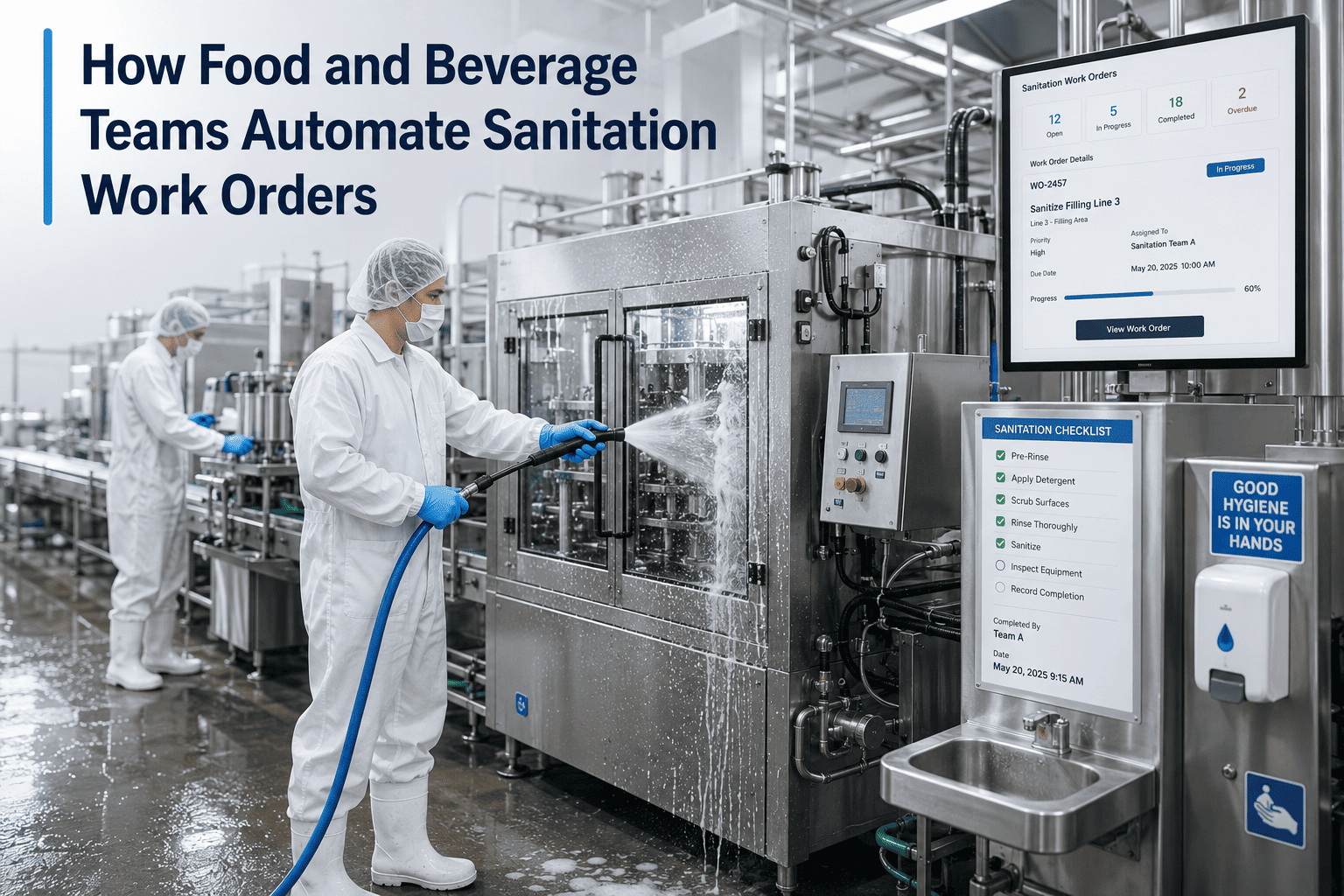
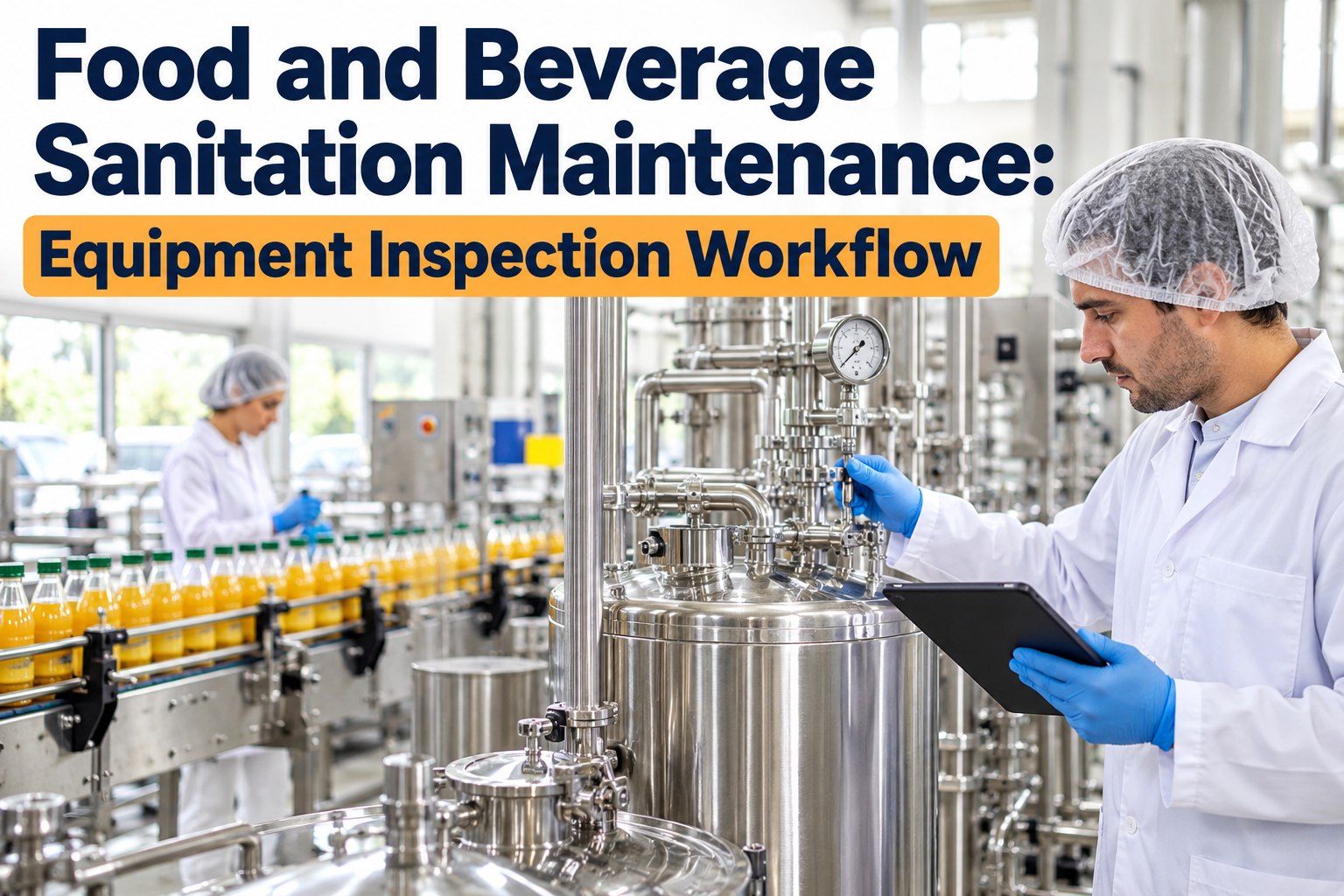
Food and beverage plants live or die on sanitation discipline. The FSMA Preventive Controls for Human Food rule under 21 CFR 117 requires every facility to operate a written Sanitation Standard Operating Procedure program and to prove execution with records. HACCP plans under 9 CFR 417 demand documented pre-operational and operational sanitation checks. The FDA's Food Safety Modernization Act inspector walks the plant looking for two things — gaps in the sanitation schedule and gaps in the records that prove it ran. Manual paper SSOPs, whiteboard schedules, and emailed cleaning logs are how plants fail audits. F&B operations leaders moving to a CMMS-driven sanitation program start a free trial on the highest-risk line first, validate the SSOP cadence and pre-op record, then extend the system across the rest of the facility.
Food & Beverage Sanitation Brief
Automated Sanitation Work Orders for Food and Beverage Plants — FSMA, HACCP, and SSOP Compliance
SSOP scheduling, pre-operational verification, ATP swab logging, allergen changeover validation, sanitizer concentration records, and CMMS-tracked sanitation trails that survive FDA, USDA, SQF, BRC, and FSSC 22000 audits.
21 CFR 117 FSMA
9 CFR 417 HACCP
SQF Edition 9
BRCGS Issue 9
FSSC 22000 v6
73%
FDA Form 483 observations tied to sanitation or pest control gaps in food facilities
$10M+
Average direct cost of a single allergen or Listeria recall in F&B manufacturing
21 CFR
FSMA Part 117 mandates written SSOP programs with verifiable execution records
68%
Cut in sanitation overruns reported by plants on CMMS-driven SSOP scheduling
What is Automated Sanitation Work Order Management
Automated sanitation work order management is the integrated CMMS program that takes the plant's written SSOP, breaks it into asset-level cleaning tasks, schedules them at the right cadence, dispatches them to the right operator with mobile sign-off, captures verification readings, and holds the complete trail for FSMA, HACCP, and third-party audit. It covers daily pre-operational cleaning, mid-shift sanitation checks, post-operational deep cleans, allergen changeover validation, periodic master sanitation, and the corrective actions that close out any failure.
Done well, it removes sanitation from the list of plant risks — no missed cycles, no unsigned logs, no whiteboard schedules, no FDA findings on documentation gaps. Done badly, it sits at the top of the recall risk list and dictates plant insurability. F&B leaders ready to take sanitation off the risk register book a demo and see the SSOP model built on their own plant hierarchy.
A single missed pre-operational sanitation record is what turns a routine FDA inspection into a 483 observation that lands in the public database.
The Six Sanitation Disciplines That Define FSMA Compliance
A food and beverage sanitation program is not one task — it is six interlocking disciplines that together produce a clean plant and a defensible record. Map them all into the CMMS as separate cadences on each asset, and sanitation becomes a tracked, auditable, predictable program instead of a binder no one reads until the inspector arrives.
01
Pre-Operational Sanitation and Pre-Op Verification
Every line starts the shift with a documented pre-op inspection — visual cleanliness, ATP swabs, sanitizer concentration, water temperature. The CMMS dispatches the checklist to the QA tech, captures the readings, and only releases the line to production if every check passes.
02
Master Sanitation Schedule and Periodic Deep Cleans
Weekly, monthly, quarterly, and annual sanitation tasks for hard-to-reach zones, drains, ceilings, conveyors, and overheads. The CMMS holds the master sanitation schedule as recurring PMs against each asset and tracks completion rates by zone.
03
Allergen Changeover Validation Between Production Runs
When the line moves from peanut to non-peanut, dairy to dairy-free, or gluten to gluten-free, the changeover sanitation must be validated with ATP, allergen swab, or visual sign-off. The CMMS locks the run sequence behind the validation record — no validation, no next run.
04
Sanitizer Concentration and Water Temperature Records
Chlorine ppm, quat ppm, peracetic acid concentration, and CIP water temperature must be in spec at every cycle. The CMMS captures the reading on the mobile form at the point of use and flags any drift outside the SSOP-defined range.
05
Environmental Monitoring and Listeria Swab Programs
Zone 1, 2, 3, and 4 environmental swab schedules drive Listeria, Salmonella, and indicator organism testing. The CMMS schedules the swab routes, holds the lab results against the swab site, and triggers corrective action work orders on any presumptive positive.
06
Corrective Action and Root Cause on Sanitation Failures
A failed pre-op, an out-of-spec sanitizer, a positive environmental swab — each one needs a documented corrective action with root cause, retraining record, and effectiveness check. The CMMS holds the whole chain from finding to closure on one work order trail.
A sanitation program running all six disciplines on one CMMS is one ready for any audit — FDA, USDA, SQF, BRC, FSSC 22000, or the customer quality team doing the supplier walk-through. F&B directors building toward that readiness start a free trial on the highest-risk line and validate the SSOP model before scaling.
Where Food and Beverage Sanitation Programs Break Down
When F&B plants take a sanitation hit — a 483, a customer complaint, a recall, a downgraded audit score — the trace-back almost always lands in one of six places. None of them are surprises. They are the failures that show up in FDA observation summaries year after year.
Pre-op records signed off without being executed
Whiteboards and clipboards get initialed at shift start to keep the line moving. The actual swab, reading, or check never happens. The audit trail says the program ran. The contamination event proves it didn't.
Master sanitation schedule slipping without anyone noticing
Quarterly deep cleans on overhead conveyors, monthly drain sanitation, weekly ceiling spot checks — each one quietly slides past its due date until a Listeria swab returns positive and the trace-back lands on the skipped cycle.
Allergen changeover validations done on memory not record
The line lead remembers the changeover sanitation ran. There is no ATP record, no swab, no sign-off. One customer complaint with an allergen detection becomes a multi-million-dollar recall the plant cannot defend.
Sanitizer concentration drift no one catches
Chlorine in the dump tank drops below 50 ppm, quat in the foot bath fades, peracetic in the CIP cycle runs short — each one quietly out of spec until a microbiological finding traces back to the sanitizer that should have killed it.
Environmental swab results disconnected from corrective action
The lab returns a Zone 2 presumptive positive. The QA manager emails the sanitation supervisor. The corrective action — if it happens — lives in a separate spreadsheet. The audit trail from finding to closure cannot be reconstructed under inspector pressure.
Sanitation crew training and certification expiry untracked
SSOPs require trained personnel. Allergen handling requires retraining. Chemical handling requires expiry-dated certifications. When the inspector asks for the training matrix, the plant produces a three-year-old binder with missing signatures.
Each one of these is a finding the CMMS removes from the risk register by holding cadence, evidence, and corrective action trail on one record. F&B plants ready to take these off their 483 risk book a demo to map the SSOP into the system.
A single allergen cross-contact recall costs more than a decade of CMMS-driven sanitation discipline.
How OxMaint Automates Food and Beverage Sanitation
OxMaint maps the plant's SSOP into the same Portfolio > Property > System > Asset > Component hierarchy used across the rest of the facility. Lines, fillers, conveyors, CIP skids, drains, environmental swab sites, and sanitation crews all live as tracked elements with their own cadence, history, and audit trail.
A
Pre-Op Checklist Dispatched to Mobile
Every line gets its pre-op checklist on a tablet at shift start. QA tech captures ATP, sanitizer ppm, water temp, visual sign-off, photo evidence — all against the asset before the line releases.
B
Master Sanitation Schedule as Recurring PMs
Weekly, monthly, quarterly, annual sanitation tasks load as recurring PMs against each asset. Completion rates trend by zone. Overdue cycles surface on the plant dashboard before they become a finding.
C
Allergen Changeover Lock
The CMMS holds the line in a locked state until the changeover sanitation work order is signed and the ATP or allergen swab result is logged. No record, no run.
D
Sanitizer and Water Reading Capture
Chlorine, quat, peracetic, water temp readings captured on mobile at the point of use. Out-of-spec values flag in real time and trigger corrective action work orders against the asset.
E
Environmental Swab Route and Result Linkage
Zone 1-4 swab sites loaded as assets with route schedules. Lab results attach to the swab site record. Presumptive positives trigger immediate corrective action work orders with retest tracking.
F
Crew Training and Certification Tracking
SSOP training, allergen handling certification, and chemical handling credentials tracked against each crew member with expiry alerts. Audit-ready training matrix exports in minutes, not days.
For F&B plant managers in the USA under FSMA and USDA, in Canada under SFCR and CFIA, in the UK under FSA and SALSA, in the EU under EC 852/2004 and FIC, in Australia under FSANZ, or in the UAE under ESMA — the CMMS structure is the same and the audit trail travels with it. Start a free trial and connect sanitation to the rest of the plant.
Paper SSOP vs CMMS-Automated Sanitation — Side by Side
The difference between a paper sanitation program and a CMMS-automated one is not opinion — it is FDA 483 frequency, it is recall exposure, it is third-party audit score. The table maps the differences across the disciplines that define an F&B sanitation program.
| Sanitation Discipline | Paper / Whiteboard Program | CMMS-Automated Program |
|---|
| Pre-op verification |
Clipboard initialed at shift start, no proof of execution |
Mobile checklist signed at the line, ATP and ppm captured on the asset record |
| Master sanitation schedule |
Wall calendar with quarterly cycles tracked by memory |
Recurring PMs on each asset with overdue alerts on the plant dashboard |
| Allergen changeover |
Verbal handover, no swab record, no validation trail |
Line locked until ATP or allergen swab logged against the changeover work order |
| Sanitizer concentration |
Tested when remembered, written on a sheet that goes missing |
Captured at point of use, out-of-spec flagged in real time, corrective action auto-created |
| Environmental swab program |
Swab route on paper, lab results in email, corrective action in a spreadsheet |
Swab site as asset, result attached to site, corrective action and retest on one trail |
| Corrective action |
Tracked in three systems, closure proof scattered across emails |
Root cause, retraining, effectiveness check held on one CMMS work order |
| Training and certification |
Three-year-old binder, missing signatures, expired credentials |
Crew records with expiry alerts and audit-ready training matrix export |
| FDA / SQF / BRC audit readiness |
Two-week scramble before the inspector arrives |
Dashboard export with full trail pulled in minutes |
The CMMS is what moves a sanitation program from the left column to the right — and the F&B operations leaders ready to make that shift book a demo to see the SSOP built on their own plant hierarchy.
ROI and Compliance Outcomes Reported on F&B Sanitation CMMS Programs
These are the numbers F&B plants report after their first full year of CMMS-driven sanitation work order automation. Variance comes from starting condition, but the direction is consistent across dairy, meat, beverage, bakery, and ready-meal categories.
68%
Cut in sanitation cycle overruns within first 12 months of CMMS deployment
92%
Reduction in audit preparation hours through dashboard export of full SSOP trail
47%
Lower environmental swab positivity rate after master sanitation cadence enforcement
6 mo
Typical payback period on CMMS sanitation investment for mid-size F&B plants
100%
Pre-op verification coverage once mobile checklists are deployed on the line
31%
Improvement in third-party audit scores across SQF, BRC, and FSSC 22000 programs
F&B directors stacking these gains across multiple plants in their portfolio start a free trial on the highest-risk line and use first-year results to fund rollout across the network.
Frequently Asked Questions on Sanitation Work Order Automation
How does OxMaint handle FSMA 21 CFR 117 sanitation recordkeeping
FSMA Preventive Controls require written SSOPs and verifiable execution records. OxMaint holds the SSOP as recurring work orders against each asset with mobile sign-off, ATP and ppm captures on the record, and full export to PDF or CSV for inspector requests. The records meet the FSMA verification requirement and the corrective action requirement on a single trail.
Can the CMMS lock the line until allergen changeover validation is complete
Yes. The next production run is held in a locked state until the changeover sanitation work order is signed and the ATP or allergen swab result is logged. The line cannot release without the validation record, which closes the gap that drives most allergen cross-contact recalls.
Does OxMaint integrate environmental swab results from external labs
Yes. Swab sites load as assets and lab results attach to each site record through manual entry, CSV import, or lab integration. Presumptive positives trigger immediate corrective action work orders with retest scheduling. The complete trail from swab to closure lives on one record for FDA, SQF, and BRC audit.
How does the CMMS track sanitation crew training and certification
Each crew member has a training record with SSOP modules, allergen handling, chemical handling, and any plant-specific certifications. Expiry alerts fire ahead of due dates. The audit-ready training matrix exports in minutes when the SQF or BRC auditor asks for it, instead of being assembled from binders and HR records.
Sanitation Off the 483 Risk List
Stop Letting Paper SSOPs Drive Your F&B Plant's Recall Risk
Every F&B quality director knows sanitation is the single biggest 483 and recall risk on the plant. OxMaint takes it off the risk list by holding every pre-op check, every master sanitation cycle, every changeover validation, every swab result, every corrective action on one asset hierarchy that survives any audit. Build the SSOP model first, then scale outward to the rest of the plant.
FSMA, HACCP, SQF, BRC, and FSSC 22000 audit trail in one asset hierarchy
Allergen changeover line lock with validation record before next run
Environmental swab to corrective action closed-loop tracking
Used across multi-plant F&B portfolios
Live in days, not months
No heavy onboarding
Mobile pre-op sign-off