Fouled AHU coils reduce heat transfer efficiency by 15-30% and force compressors to work an average of 27% harder before anyone notices — because the traditional way to catch it is a quarterly manual walkaround with a flashlight, and by then the coil is already choked. Camera vision inspection changes that. A fixed camera on the coil face plus a trained model can classify fouling severity in seconds, and the same rig can catch refrigerant frosting, airflow obstructions on cooling tower fills, and biological growth on wetted surfaces that a human inspector would need a microscope and 20 minutes per unit to assess. The technology is mature enough now that current-generation platforms hit false-positive rates below 12% in controlled deployments, low enough that the alerts get acted on without specialist validation. But cameras only pay back if the findings become work orders — and that's where most vision programs stall: images stack up in a folder while the coil keeps fouling. This guide covers HVAC camera vision inspection the way modern facility teams actually deploy it — the four coil fouling severity classes, camera placement and model training, false-positive management, and how OxMaint CMMS turns every vision detection into a tracked, verified work order. Start free or book a demo to see vision-to-work-order automation live.
HVAC · Vision Inspection · Coil Fouling · CMMS 2026
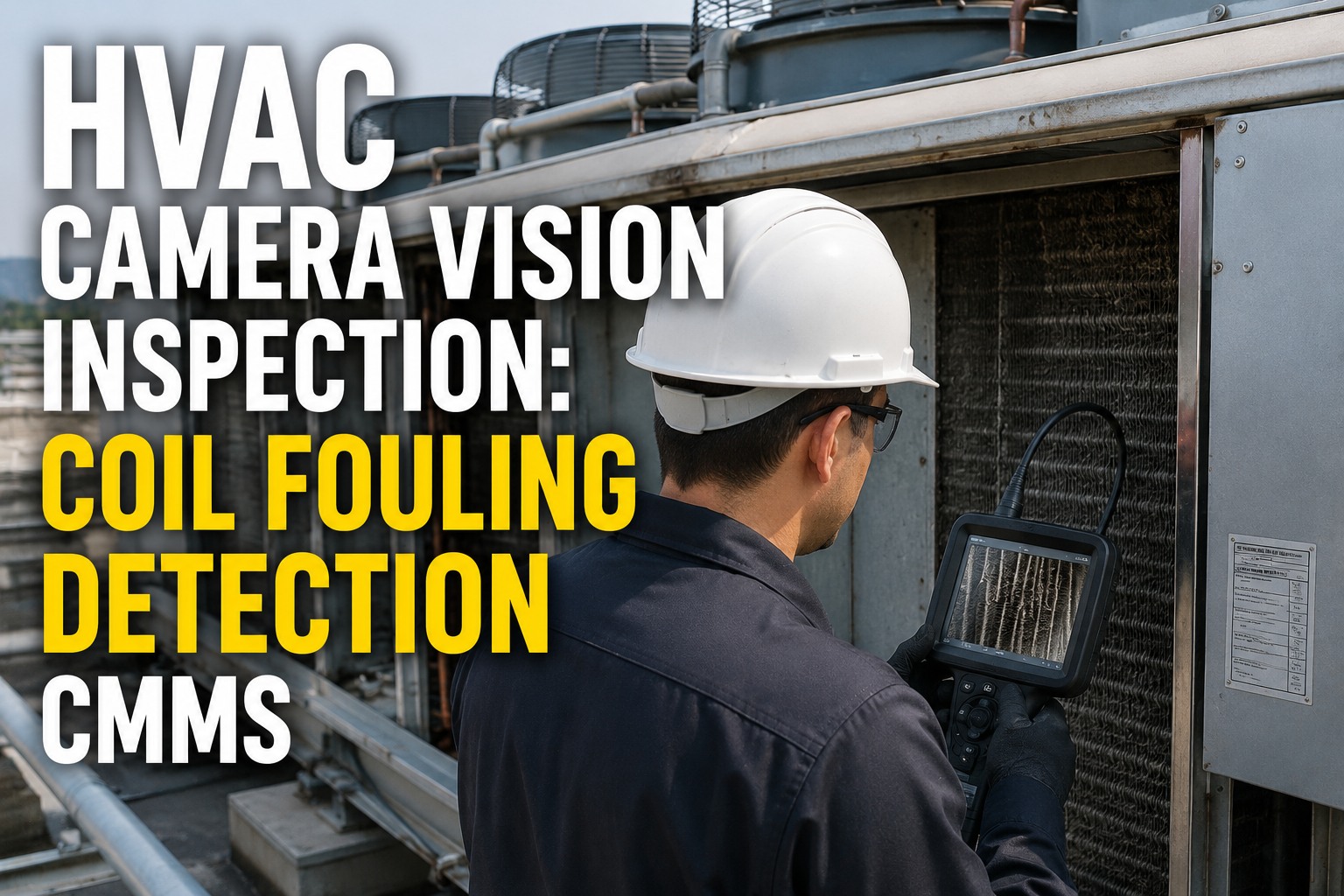
HVAC Camera Vision Inspection: Coil Fouling Detection CMMS
Camera and vision inspection guide for HVAC: AHU coil surface imaging, cooling tower fill biological growth detection, and quantified condition assessment that scales across dozens of RTUs and AHUs without adding manual inspection labour.
15-30%
Heat-transfer efficiency loss from fouled AHU coils
27%
Average energy penalty from degraded coils & fans
<12%
False-positive rate in mature multivariate vision platforms
10% Blockage
ASHRAE 180 cleaning trigger for fin surface fouling
The 4 Coil Fouling Severity Classes — How Vision Models Actually Grade
A vision model doesn't just say "dirty." It classifies coil condition into distinct severity bands, and each band maps to a specific corrective action — from "keep observing" through "schedule cleaning" to "immediate service required." Below is the classification scheme trained models work against, aligned to ASHRAE 180 thresholds. Sign up free and OxMaint's HVAC library ships with the 4-class severity taxonomy pre-configured — every vision detection maps to a work-order priority the moment it comes in, no manual triage needed.
CLASS 1
CLEAN
< 5% fin blockage
No action. Continue monitoring cadence. Approach temp within design.
CLASS 2
EARLY FOULING
5-15% fin blockage
Schedule inspection PM. Increase capture cadence. Approach temp rising.
CLASS 3
CLEANING REQUIRED
15-35% fin blockage
Auto-generate cleaning work order. Priority within 2 weeks. Efficiency loss quantifiable.
CLASS 4
CRITICAL
> 35% fin blockage
Emergency WO. Compressor at risk. Comfort/IAQ impact imminent.
Camera Placement — Getting the Image Right the First Time
Model accuracy depends more on camera placement than on model sophistication. A well-placed camera on a mediocre model beats a poorly placed camera on a state-of-the-art model — every time. Below is the placement discipline that separates deployments that scale from deployments that die in pilot. Book a 30-minute demo and an OxMaint HVAC specialist will walk camera placement decisions against your specific AHU, RTU, and cooling tower fleet — you'll leave with a placement plan sized to your existing asset base before you open a trial.
A
AHU Coil Face — Downstream of Filter Bank
Fixed camera 12-18" off coil face, lens perpendicular to fin surface. Downstream of filters isolates coil-only fouling from upstream particulate load. LED ring light for consistent exposure.
B
RTU Condenser Coil — Side Access Panel
Small footprint camera mounted through service panel with weatherproof housing. Captures cottonwood seed, leaf debris, and cottonwood-like biological load common in rooftop deployments.
C
Cooling Tower Fill — Above Water Distribution
Downward-facing camera above fill pack captures biological growth (slime, algae) that reduces thermal contact area. Pairs with basin water quality tests for full picture.
D
Evaporator Coil — Frosting & Refrigerant Signature
Thermal-imaging camera (not visible-light) captures frost pattern and cold-spot distribution. Non-uniform frosting = low charge, restriction, or airflow imbalance — visible before superheat/subcool alarm fires.
Model Training & False-Positive Management — Where Vision Programs Live or Die
A vision model is only as good as its training data, and the first six weeks of any deployment are all about labelling. Get labelling wrong and you spend the next 12 months with technicians ignoring alerts because the model cried wolf too many times. Below is the discipline that keeps false-positive rates below the 12% threshold at which technician trust holds. Sign up free and OxMaint's vision workflow lets your technicians label detections directly from the mobile work-order — every field verification becomes training data, and the model tightens with every closed WO.
01
Baseline Image Library Per Asset
Capture 20-30 known-good images per coil at commissioning. Different lighting, different times of day. This is the "clean" reference the model measures every future capture against.
02
Multivariate Validation
Never trust one signal. Cross-check vision detection against approach temperature, differential pressure, and fan current. When 2+ signals agree, alert fires. When only vision fires alone, log for review.
03
Technician Feedback Loop
Every field verification (true positive, false positive, near miss) captured on the mobile WO. This is the model's continuous training data — labelling done by the people who actually cleaned the coil.
04
Seasonal & Load Context
Fouling appearance changes with humidity, ambient temp, and load. Model retrained quarterly with seasonal data. Skip this and false-positive rates climb every shoulder season.
A Detection That Doesn't Become a Work Order Is Wasted Camera Money.
Vision programs stall at the same point every time — the images capture fine, the classifications land fine, but no work order gets generated, and three weeks later the coil is at Class 4. OxMaint closes the loop the moment a Class 3 or Class 4 detection lands: WO auto-generated, priority set by class, technician dispatched with the pre/post capture attached to the record.
The 5 Failure Modes Vision Catches That Manual Walkarounds Miss
Manual quarterly inspection isn't just slower than vision — it misses failure modes entirely. Vision catches conditions that a flashlight walk simply can't quantify, and does so at capture cadences a human inspector could never sustain. Below is the coverage gap. Book a scoping call — an OxMaint HVAC engineer will map your specific fleet's failure history against these five vision-catchable modes and give you a payback estimate per asset class before you commit to a trial.
01
Progressive Coil Fouling (weeks/months)
Slow buildup between quarterly inspections. Vision cadence (daily/weekly) catches trend early. Human inspection catches it only at the scheduled walk — often at Class 3 already.
02
Non-Uniform Evaporator Frosting
Thermal camera reveals cold-spot patterns pointing to low charge, restriction, or airflow imbalance. Human walkaround sees "some frost" — vision sees the pattern.
03
Cooling Tower Biological Growth
Slime and algae on fill pack reduce thermal transfer area. Almost impossible to quantify by eye — vision measures coverage percentage against baseline.
04
Airflow Obstructions (bird nests, debris, panels)
RTU intake blocked by seasonal debris or nesting activity. Camera catches at Day 1; manual walk catches at Day 90 — after 3 months of degraded airflow and elevated energy consumption.
05
Fin Damage from Hail, Impact, Cleaning Errors
Bent fins reduce airflow through affected section. Vision quantifies affected fin area; human inspection typically misses partial damage unless catastrophic.
Manual Walkaround vs. OxMaint Vision-to-Work-Order Loop
The gap between manual inspection and vision-driven CMMS isn't a small workflow tweak — it's the difference between catching fouling at Class 2 and catching it at Class 4. Here's what changes when the camera feeds OxMaint. Start free — no credit card, unlimited users, and the HVAC library ships with vision detection templates pre-mapped to work-order priorities, so day-one setup takes a shift, not a project.
Facility teams that put cameras on the coils and route detections through OxMaint typically see full ROI in 8-14 months — one avoided chiller compressor emergency ($40K-$200K) pays for years of platform cost. Start your free forever workspace to configure your first vision-driven work order this week, or book a demo to see a working vision-to-WO loop from a live customer facility before you commit.
"
We manage 84 RTUs and 22 AHUs across a Class A office portfolio. Quarterly manual inspection meant we were catching most coils at Class 3 or worse, and losing about $60K annually to compressor short-cycling and one or two emergency chiller service calls per year. We deployed fixed cameras on the coil faces of the top 40 highest-energy units, and connected the detections into OxMaint. First 90 days flagged 11 Class 3 coils we didn't know we had — cleaned all of them, watched approach temperature drop 3-5°F across the group, and cut compressor cycling by roughly 20% on the worst offenders. The false positive rate settled at around 9% after the technician feedback loop kicked in. Payback landed around month 11.
Chief Engineer · 1.2M sqft Class A Office Portfolio · Midwest US
Frequently Asked Questions
How much energy does a fouled coil actually waste?
A moderately fouled coil (Class 2-3 in the severity taxonomy above) reduces heat transfer efficiency 15-30% and forces the compressor to work approximately 27% harder to hit the same setpoint. On a typical 40-ton commercial RTU that translates to $1,500-$4,000 in wasted annual energy per unit, before you count the reliability impact on the compressor itself. Catching fouling at Class 2 vs Class 4 is often the difference between a $400 cleaning and a $40,000 compressor.
Does vision inspection replace ASHRAE 180 quarterly inspections?
Vision complements ASHRAE 180 rather than replacing it — the standard still requires documented inspection cadence, and vision provides that documentation with quantified severity and image evidence that a paper form cannot. The 10% fin blockage cleaning trigger in ASHRAE 180 maps directly onto Class 3 in the vision severity taxonomy, so the standard is enforceable via vision rather than manual measurement.
Sign up free to configure ASHRAE-aligned vision workflows.
What's a realistic false-positive rate for HVAC vision inspection?
Mature multivariate vision platforms — those that cross-validate against approach temperature, differential pressure, and fan current — achieve false-positive rates below 12% in controlled deployments. Vision-only systems without multivariate validation tend to run 20-30% false positives, which is high enough that technicians stop trusting the alerts. Multivariate validation plus a technician feedback loop is what keeps trust intact.
Can OxMaint work with our existing camera hardware?
Yes. OxMaint is hardware-agnostic — the vision workflow accepts image feeds from fixed cameras, portable inspection cameras, thermal imagers (FLIR, Fluke, InfraTec), and even mobile-phone captures during technician rounds. Detections are graded consistently regardless of source. No rip-and-replace of existing cameras, no vendor lock-in.
How does the model handle seasonal variation in fouling appearance?
The vision model retrains quarterly with fresh seasonal data — spring cottonwood, summer humidity load, autumn leaf debris, winter frost patterns. Without this seasonal retraining, false-positive rates climb during shoulder seasons because the model interprets seasonal load as fouling. OxMaint's workflow automates the retraining data collection from routine captures and technician verifications.
Book a demo to see the seasonal retraining loop.
What's the typical ROI timeline for HVAC vision inspection?
Most OxMaint HVAC vision customers achieve full ROI in 8-14 months. Primary value drivers are avoided emergency repair costs ($40K-$200K per avoided major failure), energy savings from early fouling detection (typically 10-20% of HVAC energy spend), and reduced reactive labour premiums. A single avoided chiller compressor failure on a 500-ton unit recovers $35K-$80K — often more than a full year of platform cost across a mid-size portfolio.
Is a credit card or CAPEX approval needed to start?
No. OxMaint's free forever plan requires no credit card, no CAPEX request, and no consulting engagement — you can
sign up in under 2 minutes and configure your first vision-to-work-order workflow the same shift. HVAC asset templates ship pre-built for AHUs, RTUs, chillers, and cooling towers, so day-one deployment is minutes.
Turn Every Camera Capture Into a Verified Work Order.
OxMaint attaches every vision detection to the asset record, classifies severity into 4 quantified bands, auto-generates the corrective WO, and captures pre/post evidence — with your existing camera or thermal imaging hardware. Start free — no credit card, unlimited users, forever. Or book a demo for a fleet-specific vision inspection walkthrough.