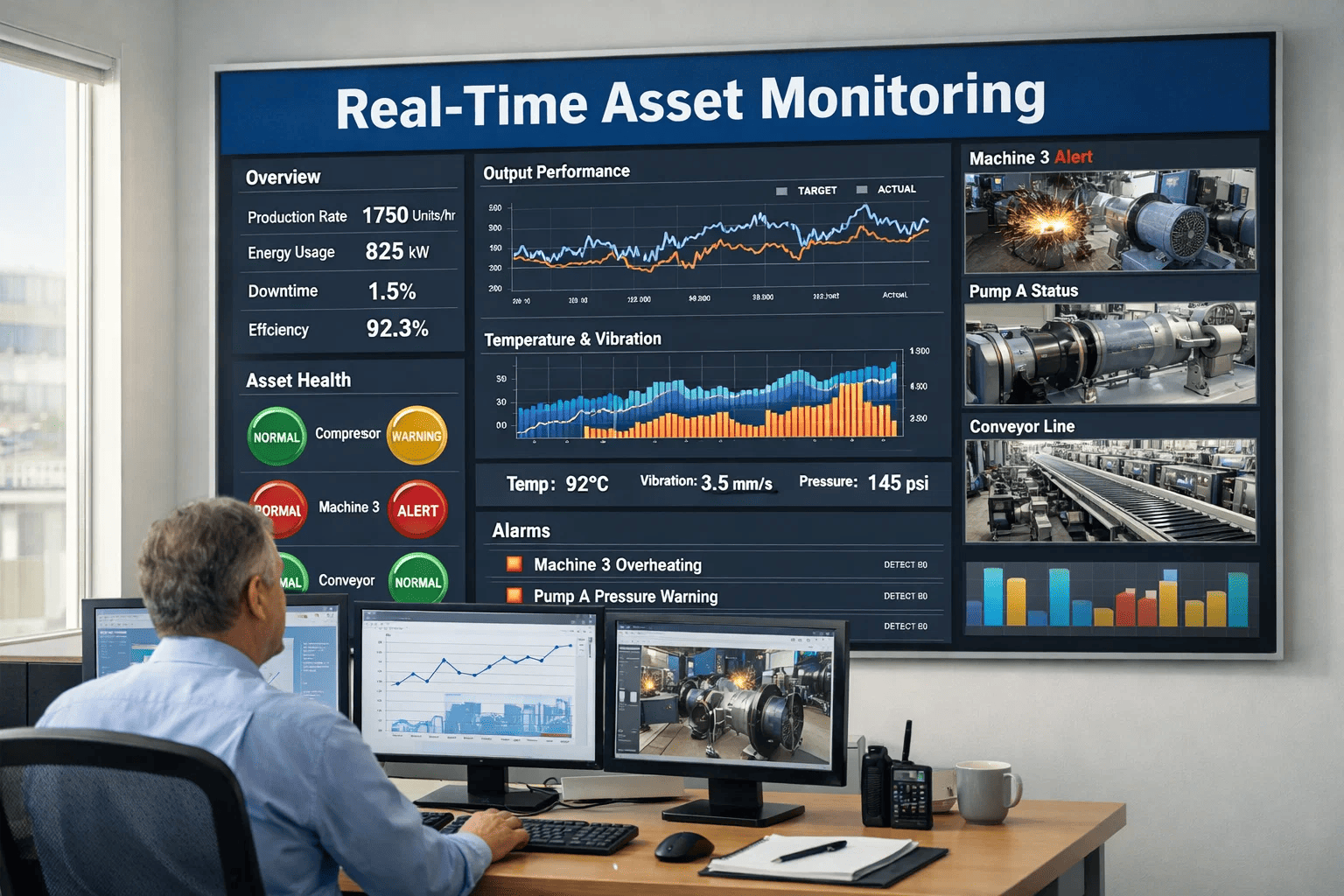
In most industrial facilities, a PLC fault code appears on a SCADA screen, gets acknowledged by an operator, and disappears — generating no work order, no technician dispatch, and no maintenance record. Three shifts later, the line is down for 14 hours. The data existed. The industrial IoT gateway is what closes that gap permanently. See how Oxmaint connects your machines — start free.
Industrial IoT Gateway: Connect Legacy Machines to CMMS — Without Replacing a Single PLC
PLCs, SCADA systems, and field sensors already generate everything your maintenance team needs to prevent failures. An industrial IoT gateway delivers that data to Oxmaint — turning machine signals into automated work orders, condition scores, and CapEx forecasts in real time.
90%of factory machines worldwide generate zero usable data stream for maintenance teams
$22Kaverage cost per minute of unplanned industrial downtime across manufacturing sectors
35–50%downtime reduction consistently achieved with IoT-connected predictive maintenance
26.7%CAGR of industrial IoT gateway market through 2030 — adoption accelerating
Definition
What Is an Industrial IoT Gateway?
An industrial IoT gateway is a hardware and software bridge positioned between your operational technology — PLCs, SCADA panels, sensors, drives, actuators — and your IT management layer, including your CMMS, cloud analytics, and ERP systems. It reads the language of your machines and translates it into structured data that maintenance platforms can act on automatically.
No Equipment Replacement
A Siemens PLC from 2005, a Rockwell controller, a Modbus RTU device from the 1990s — all connectable via protocol conversion at the gateway. Replacement is optional, never mandatory.
Real-Time Data Flow
Machine signals — torque, temperature, fault codes, cycle counts — stream continuously to Oxmaint at sub-second latency. No manual data entry, no batch uploads, no lag between machine event and CMMS record.
Automated Maintenance Triggers
When a threshold is crossed — motor torque spike, temperature exceedance, fault code — Oxmaint generates a classified work order instantly. No human relay. No missed alarms. No manual dispatch decision.
Multi-Site Capable
Gateway data from dozens of sites normalizes into one Oxmaint portfolio view. Each site runs its own protocol stack. The CMMS presents a unified asset condition picture across every facility in real time.
The average facility has only 15–25% of critical assets connected to any monitoring system — meaning 75–85% of your most expensive equipment is generating failure data that nobody sees until the machine stops. Want to close that gap on your own floor? Start a free trial and explore the integration setup, or book a demo with a specialist who knows your PLC environment.
Core Protocols
The Four Protocols Your Machines Already Speak
Industrial equipment communicates through standardized protocols. Your gateway must handle all of them — and Oxmaint connects natively to each one. Here is what each protocol does and where it lives in your facility.
OPC-UA
Modern Standard
The Universal Integration Protocol
Platform-independent, secure, and semantically rich — OPC UA transmits not just values but context about what those values mean. Supported by Siemens, Rockwell, ABB, and Schneider. Adoption grew 40% between 2023 and 2025. Oxmaint connects natively via OPC UA endpoints on port 4840.
Best for: Modern PLC-to-CMMS integration
MQTT
IIoT Native
The Lightweight Real-Time Streamer
Publish-subscribe protocol designed for high-frequency sensor data and alarm event streaming. Relays PLC telemetry to Oxmaint at sub-second latency with minimal bandwidth overhead. Default communication layer for IIoT gateways feeding cloud CMMS platforms.
Best for: Continuous sensor feeds and live alerts
Modbus TCP
Since 1979
The Legacy Machine Workhorse
Supported by virtually every industrial controller ever manufactured. Modern edge gateways read Modbus RTU over RS-485 serial and bridge data forward — no PLC firmware changes required. The US manufacturing fleet averages 15–20 years in age. Modbus connects all of it.
Best for: Equipment older than 15 years
EtherNet/IP
Rockwell Standard
The Allen-Bradley Environment
Dominant protocol in Allen-Bradley and Rockwell Automation environments. Enables direct register-level reading of PLC data through industrial gateways without additional middleware. Covers ControlLogix, CompactLogix, and MicroLogix families completely.
Best for: Rockwell / Allen-Bradley facilities
The Problem
Why the IT/OT Gap Is Costing You Right Now
Control systems on your plant floor generate rich machine health data 24 hours a day. In most facilities, none of it reaches the maintenance platform. The gap between your OT layer and your CMMS is not a technology gap — it is a connection gap. Here is what it costs in practice.
Alarms Acknowledged, Never Acted On
A fault code appears on a SCADA screen for 6 seconds. An operator acknowledges it. Production resumes. No work order. No notification. Three shifts later, the drive fails for 14 hours. The data existed and was dismissed — because there was no bridge to the CMMS.
PM on Calendar, Not on Condition
Preventive maintenance scheduled by the calendar ignores actual machine runtime, load, and wear state. A conveyor running three shifts gets the same PM interval as one running one. Both schedules are wrong — neither reflects actual asset condition or usage.
Technicians Dispatched on Instinct
Without live machine data, dispatch decisions are based on complaints and gut feel — not condition signals. By the time a technician is on-site, the window for low-cost intervention has closed. Emergency repairs cost 4.8x more than planned maintenance.
Zero Cross-Site Asset Visibility
Multi-site portfolios face this at scale. Each facility has its own SCADA, its own historian, its own data — and no shared health view across the portfolio. CapEx decisions get made on instinct, and ownership has no real picture of asset condition.
70–85%of unexpected downtime events are preventable with real-time condition monitoring in place
$50Blost annually across industrial manufacturers from unplanned equipment failures
4.8×more expensive — the cost multiplier of emergency reactive repair vs. planned maintenance
Architecture
How the Data Moves — From Sensor to Work Order
Data flows from machine signal to maintenance action through a defined industrial stack. Each layer has a specific role. Understanding the architecture prevents integration failures before deployment — and makes the ROI case clear before a single gateway is installed.
01
Field Devices — The Source
Sensors, PLCs, drives, and actuators on the machine floor measure vibration, temperature, speed, torque, cycle counts, and fault states — continuously and automatically. This layer already exists in every industrial facility. The data is there. It just has nowhere useful to go without a gateway.
02
IoT Gateway — The Translator
The gateway reads PLC registers via Modbus, OPC UA, or EtherNet/IP and translates raw protocol data into standardized payloads. Edge processing filters noise locally — only meaningful signals are forwarded upstream. Industrial-grade gateways cache up to 2GB locally during network interruptions and resume transmission automatically on reconnect.
03
OPC UA / MQTT Broker — The Router
A standardized communication layer routes data from multiple gateways to cloud or on-premise endpoints. MQTT delivers sub-second latency for alarm events. OPC UA carries rich semantic context for asset condition data. Dual-link redundancy — industrial Ethernet primary plus 4G/5G cellular backup — with automatic switchover in under 500ms.
04
Oxmaint CMMS — The Response
Machine signals arrive in Oxmaint as structured asset events. Threshold breaches auto-generate classified work orders, assign technicians, and log the triggering data against the asset record — closing the loop from fault to fix. Fault response time in facilities using this full stack drops from 45 minutes to under 8 minutes.
How Oxmaint Solves It
What Oxmaint Does With Your Machine Data
Connecting a gateway to a CMMS that does nothing intelligent with the data is not a solution. Oxmaint is built to act on machine signals — not just receive them. Here is what that looks like across your maintenance operation.
Auto Work Orders
Signal to Work Order in Seconds
When a PLC fault code or sensor threshold fires, Oxmaint creates a classified work order instantly — with fault data, asset record, priority level, and technician assignment all linked from the first second. No manual relay. No lost alarms. No three-shift lag.
Production-Based PM
PM Triggered by Runtime, Not the Calendar
PM tasks in Oxmaint are tied to OEE counters and production meters from your IoT gateway — hours run, units produced, cycle count. A machine running three shifts gets PM at three-shift frequency. Calendar intervals are replaced by actual usage data from the machine itself.
Condition Scoring
Live Health Score Per Asset
IoT data streams into Oxmaint's asset registry and updates condition scores continuously. Facility managers see a ranked list of asset health across every site — not a wall of unfiltered SCADA alarms. The worst-condition assets surface automatically for prioritized intervention.
CapEx Intelligence
Forecast Replacements From Real Degradation
Condition data accumulated over time feeds Oxmaint's 5–10 year CapEx forecasting model. Replacement cycles are predicted from actual wear patterns — not manufacturer averages. Ownership gets investor-grade CapEx reporting built directly from machine condition data.
Portfolio OEE
Line-Level OEE Across Every Site
Real-time OEE dashboards aggregate production data from every connected line across every site. Portfolio directors see performance without spreadsheet consolidation. Individual lines with OEE below threshold surface automatically and trigger maintenance review workflows.
Audit Documentation
Every Event Backed by Machine Data
Work orders generated from IoT signals carry the originating machine data as evidence — fault code, sensor reading, timestamp. OSHA, GMP, and safety audits get a complete, unbroken chain from machine signal to maintenance decision to close-out signature with digital verification.
See all six capabilities running on your asset mix — start a free trial or book a demo with a specialist who will configure the platform to your protocols before the call.
Your PLCs already know what will fail next. Does your CMMS?Oxmaint connects your existing control systems to automated maintenance workflows — live in days, not months, with no PLC replacement required.
Connected vs Disconnected — The Real Operational Difference
Without IoT Gateway + CMMS Integration
Fault codes acknowledged on SCADA, no work order created
PM scheduled by calendar, not by actual machine runtime
45+ minute fault-to-technician response time on average
Emergency repairs costing 4.8x more than planned work
Siloed SCADA data per site, no cross-portfolio health view
CapEx decisions based on manufacturer specs or past failures
Audit documentation manually assembled before every inspection
OEE reported weekly via spreadsheet consolidation
With Oxmaint + IoT Gateway Connected
Fault codes auto-generate classified work orders in seconds
PM triggered by actual hours run, cycles, and production units
Under 8-minute fault-to-technician response with auto-routing
25–40% reduction in total maintenance spend within 12–18 months
Live condition scores per asset across every site and facility
5–10 year CapEx forecasts built from actual degradation data
Every work order backed by machine-generated data and timestamp
Real-time OEE dashboards at line, site, and portfolio level
All integration templates and threshold configurations pre-loaded in Oxmaint. Access free.
Results
What Connected Maintenance Delivers — Measured
7.2 mo
Average payback period for brownfield IoT retrofit targeting critical asset downtime prevention
295%
Average 3-year ROI reported by facilities using event-driven integrated maintenance architecture
20%+
Production efficiency gain at automotive plants using 5G-connected gateways with digital twin feeds
35%
Downtime reduction consistently documented over 3 years with disciplined IoT-CMMS implementation
The fault that cost us 14 hours of downtime in January would have been a 30-minute planned repair in March. Same machine. Same fault code. The only difference was that in March, the gateway sent it to Oxmaint before the drive failed. That is the entire value proposition right there.
Plant Engineering Manager · Packaging Manufacturer, Midwest US
Results like these begin with connecting your first critical assets. Start a free trial and see how quickly your first machines can be live in Oxmaint, or book a demo to walk through a facility-specific ROI estimate.
FAQs
Frequently Asked Questions
Do we need to replace our PLCs or SCADA systems to use an IoT gateway with Oxmaint?
No — this is the primary value of the gateway layer. It sits between your existing control systems and Oxmaint without requiring any changes to PLC firmware, SCADA configuration, or machine hardware. Modbus RTU, in use since 1979, is supported by virtually every industrial controller ever manufactured. A gateway reads your PLC registers, converts data to a standardized format, and forwards it to Oxmaint. Your machines stay exactly as they are. Book a demo to walk through your specific PLC environment with an integration specialist.
How quickly can we go from zero to live machine data appearing in Oxmaint?
Physical gateway installation for a pilot group of 5–10 machines typically takes one working day per machine group. Protocol configuration — setting up OPC UA endpoints or Modbus register maps — adds 2–4 hours depending on PLC documentation quality. Most facilities see live data in Oxmaint within a single working day of gateway installation. Full pilot scope is operational within 6–8 weeks following a structured rollout: audit, design, cable prep, installation, validation, and go-live. Plants that start with 5–10 machines and prove ROI before scaling succeed over 70% of the time.
What happens to gateway data if the network connection drops?
Industrial-grade gateways include onboard storage — typically 2GB or more — that caches all data during network interruptions. When connectivity restores, the gateway resumes transmission from the breakpoint automatically and no data is lost. Oxmaint timestamps all incoming data at the point of generation, not reception, so historical records fill accurately when the connection recovers. For critical sites, dual-network configurations — primary industrial Ethernet plus 4G/5G cellular backup — are standard practice with automatic switchover in under 500ms.
How does Oxmaint handle different protocols across multiple sites with different PLC vendors?
Oxmaint's asset hierarchy — Portfolio, Property, System, Asset, Component — maps directly to multi-site industrial environments. Each site can run different gateway types, different protocols, and different PLC manufacturers. At the Oxmaint layer, all incoming machine data is normalized against the asset record it belongs to. A plant manager sees their site's condition data. A portfolio director sees all sites in a unified real-time dashboard. The protocol complexity of the OT layer is abstracted entirely at the CMMS level. Start a free trial to explore multi-site configuration.
Trusted by Industrial and Facilities Teams Across 40+ Countries
Stop Reacting to Failures. Start Preventing Them.
Join industrial operations achieving 35–50% downtime reduction and 295% 3-year ROI by connecting their machines to Oxmaint — live in days, not months, with no PLC replacement required.
Gateway Connected
All protocols — OPC-UA, MQTT, Modbus, EtherNet/IP
+
AI-Triggered
Auto work orders from every machine signal
+
Audit-Ready
Every event documented with machine evidence
=
Measured Result
295%
3-year ROI. 35–50% less downtime. 8-min fault response.