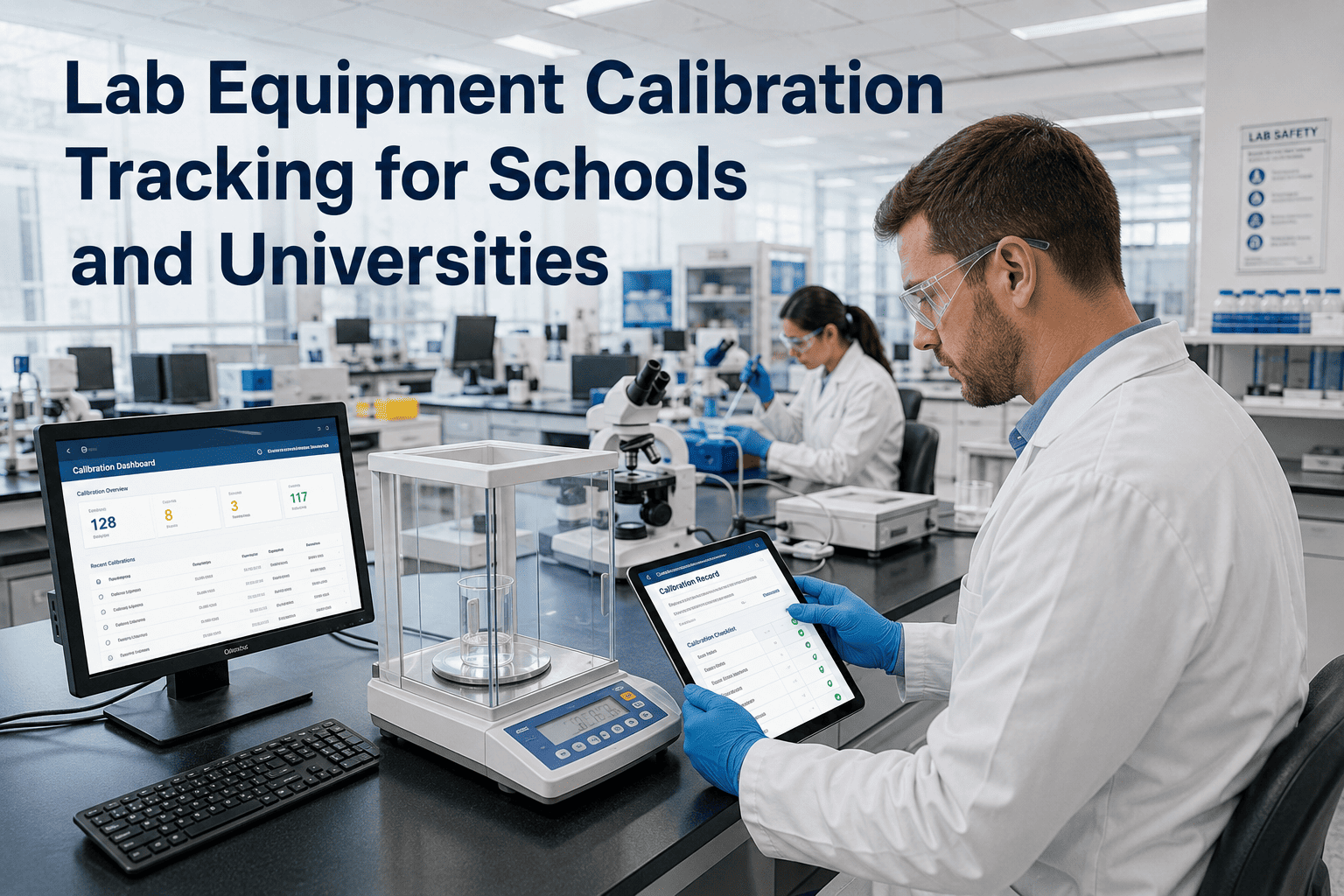
Laboratory equipment calibration is not a routine administrative task — it is a regulatory obligation with direct consequences for research validity, accreditation status, and institutional liability. Schools, colleges, and universities operating research labs, teaching labs, and clinical facilities must maintain documented calibration records for thousands of instruments across multiple buildings, each with different standards bodies, certificate expiry windows, and audit requirements. When a single calibration record is missing, outdated, or unverifiable, the consequences range from retracted research to accreditation suspension to FDA enforcement action — none of which are recoverable quickly or cheaply. Lab equipment calibration tracking software replaces paper logs, spreadsheet calendars, and folder-based certificate storage with a centralized digital system that automates calibration scheduling, stores certificates with version control, sends expiry alerts before deadlines, and generates audit-ready compliance reports in minutes. Start a free trial to see how Oxmaint tracks calibration compliance across your entire lab portfolio, or book a demo and walk through your specific lab structure and compliance requirements with our team.
Lab Equipment Calibration Tracking for Schools and Universities
Automate calibration schedules, store certificates with full traceability, receive deadline alerts, and generate audit-ready compliance reports — across every research lab, teaching lab, and clinical facility in your institution.
- ✔ Centralized calibration certificate storage with full audit trail
- ✔ Automated alerts before calibration deadlines expire
- ✔ Multi-lab, multi-building portfolio compliance visibility
See how much compliance risk and audit preparation time you can eliminate — in 30 minutes.
No heavy implementation required · Live in days, not months · Works across multi-site lab portfolios · GMP-compliant inspection workflows
What Is Lab Equipment Calibration Tracking Software?
Laboratory calibration tracking software is a CMMS and compliance management platform that centralizes calibration schedules, certificate records, and inspection histories for all laboratory instruments in a school or university's portfolio. Unlike generic spreadsheet tracking or paper-based systems, purpose-built calibration software links each instrument to its specific calibration standard, certificate expiry date, responsible technician, and regulatory requirement — creating an unbroken audit trail from purchase to decommission.
For universities and schools operating multiple lab environments — research labs, teaching labs, chemistry suites, clinical simulation facilities, and engineering workshops — calibration compliance becomes a portfolio management challenge, not a per-instrument task. A single institution may need to track calibration status for thousands of instruments under ISO 17025, GMP, NIST traceability, OSHA, and local accreditation requirements simultaneously, across buildings that may be managed by different departments with different record-keeping practices.
Centralizing calibration tracking eliminates the risk of expired certificates going unnoticed, prevents audit failures caused by missing documentation, and reduces the compliance staff time spent preparing for regulatory inspections from weeks to hours. Institutions with 500+ instruments in scope typically achieve full audit readiness within 30 days of CMMS deployment — start a free trial to see how Oxmaint builds that audit trail automatically from day one.
Six Components of Effective Lab Calibration Tracking
Automated calibration schedules set by instrument type, usage frequency, and standard requirements. Upcoming calibrations queued automatically — no manual calendar management or missed expiry dates.
Digital calibration certificates stored with version history, technician sign-off, and instrument ID linkage. Certificates searchable, shareable, and exportable for audit submission in under 60 seconds.
Immutable record of every calibration event: who performed it, when, which standard was used, pass/fail result, and corrective action taken. Satisfies ISO 17025, GMP, and FDA 21 CFR Part 11 documentation requirements.
Full asset register for all lab instruments — model, serial number, location, manufacturer, purchase date, warranty, assigned lab, and calibration history. Single source of truth for every piece of equipment.
Automated email and mobile alerts to lab managers, technicians, and compliance officers before calibration deadlines expire — configurable at 90, 60, and 30-day intervals by instrument criticality.
Institution-wide compliance dashboard showing calibration status across every lab, department, and building. Instantly identify which instruments are overdue, which are at risk, and which are compliant by location.
Four Calibration Compliance Failures That Expose Universities to Serious Risk
Paper calibration logs get misplaced, water-damaged, or never completed in the first place. When an accreditation body or regulatory agency requests calibration certificates for a specific instrument, a multi-day search through filing cabinets is not an acceptable response — and a missing certificate is treated as non-compliance regardless of whether calibration actually occurred.
Research data collected with an instrument operating outside its calibration window may be invalid — regardless of the volume of data, the duration of the study, or the cost of the project. If calibration expiry is discovered post-publication, the institution faces retraction exposure, grant repayment risk, and reputational damage that takes years to recover from.
Labs managed by different departments track calibration in different systems — or no system at all. A compliance officer preparing for an institutional audit must manually collect records from chemistry, biology, engineering, clinical, and teaching labs with no automated consolidation. Preparation time for a typical university-wide audit runs 3–6 weeks under paper-based processes.
Accreditation bodies including ABET, WASC, and laboratory-specific bodies routinely inspect calibration records as part of their review process. Gaps discovered during these visits — not before — result in conditional accreditation, remediation requirements, and public reporting that affects student recruitment and research funding. Book a demo to see how Oxmaint surfaces calibration gaps before auditors do.
How Oxmaint Manages Lab Calibration Compliance Across Your Institution
Calibration frequencies set per instrument type, regulatory standard, and usage intensity. Upcoming calibrations auto-queued and assigned to responsible technicians — no manual calendar management required.
All calibration certificates stored digitally with instrument linkage, version history, and technician sign-off. Retrieve any certificate for any instrument in seconds — not days of archive searching.
Configurable alerts notify lab managers and compliance officers 90, 60, and 30 days before calibration expires. Priority escalation for critical instruments ensures high-risk deadlines are never missed.
Digital inspection forms with mandatory field validation, photo capture, and technician e-signature. Forms meet ISO 17025, GMP, and FDA 21 CFR Part 11 documentation requirements out of the box.
Live view of calibration status across all labs, buildings, and departments. Filter by compliance status, instrument type, or location. Generate audit-ready PDF reports in one click — no manual compilation.
Track instruments under ISO 17025, NIST traceability, GMP, OSHA, and institutional standards simultaneously. Each instrument linked to its specific applicable standards with separate tracking workflows.
Paper-Based Calibration Tracking vs Digital Management with Oxmaint
| Dimension | Paper-Based Approach | Digital with Oxmaint |
|---|---|---|
| Calibration Scheduling | Manual calendar entries, spreadsheet reminders — missed when staff change or equipment is added | Auto-scheduled by instrument type and standard — calibrations queued, assigned, and tracked automatically |
| Certificate Storage | Paper files, shared drives, email attachments — unstructured, no version control, lost in file searches | Centralized digital repository linked to instrument ID — searchable, version-controlled, instantly retrievable |
| Deadline Alerts | Relies on individual staff memory or ad-hoc spreadsheet checks — deadlines missed when staff are absent | Automated multi-level alerts at 90, 60, 30 days — sent to managers, technicians, and compliance officers |
| Audit Preparation | 3–6 week manual compilation from multiple departments, files, and email threads | Audit-ready compliance report generated in one click — complete certificate trail for every instrument |
| Multi-Lab Visibility | Compliance officer must contact each lab individually — no consolidated institution-wide status view | Live dashboard showing compliance status across all labs, buildings, and departments in real time |
| Regulatory Traceability | No immutable audit trail — records can be altered, lost, or are simply absent for older instruments | Immutable audit trail for every calibration event — meets ISO 17025, GMP, FDA 21 CFR Part 11 |
| Research Data Risk | Calibration expiry discovered post-study — research potentially invalid, retraction and grant risk | Instruments flagged before expiry — research conducted only on compliant, in-calibration equipment |
What Universities and Schools Achieve with Oxmaint Calibration Tracking
Research institutions managing 500+ instruments achieve full audit readiness within 30 days of Oxmaint deployment — start a free trial to see your calibration compliance status in real time from day one, or book a demo to walk through your lab portfolio and compliance requirements with our team.
Lab Calibration Tracking — Common Questions
Does Oxmaint support multiple calibration standards such as ISO 17025, GMP, and NIST traceability simultaneously?
Yes. Oxmaint allows each instrument to be assigned to one or multiple regulatory standards, each with its own calibration interval, certificate template, and documentation requirements. A single mass spectrometer, for example, can be tracked under both NIST traceability requirements and institutional GMP protocols simultaneously — with separate alert timelines and certificate workflows for each standard. This multi-standard architecture is particularly valuable for university labs operating across both research and regulated clinical environments within the same building portfolio.
Can Oxmaint track calibration certificates for thousands of instruments across multiple labs and buildings?
Yes. Oxmaint's asset hierarchy — Portfolio > Property > System > Asset > Component — maps directly to how university lab portfolios are structured, from institution level down to individual instrument. Certificates are stored at the asset level with version history and linked to calibration events, making retrieval instant regardless of how many instruments are in scope. Institutions managing 5,000+ instruments across 50+ lab spaces operate Oxmaint without any performance degradation in search, reporting, or alert delivery.
How does Oxmaint alert us before calibration deadlines expire, and who receives those alerts?
Oxmaint sends automated alerts via email and mobile push notification at configurable intervals before each calibration expiry date — typically 90, 60, and 30 days. Alert recipients are set per instrument, lab, or department and can include lab managers, responsible technicians, department compliance officers, and institutional facility directors. For high-criticality instruments — those used in regulated research or clinical simulation — escalation rules can trigger supervisor notification if a deadline passes without a calibration work order being created, ensuring no lapse goes unnoticed.
Is Oxmaint suitable for FDA 21 CFR Part 11 compliance requirements?
Oxmaint's inspection and calibration workflows include the core requirements for 21 CFR Part 11 compliance: electronic signatures with audit trail, timestamped record creation and modification logs, controlled access by user role, and immutable record retention. Calibration certificates completed in Oxmaint carry a digital technician signature and cannot be retroactively altered without creating a visible audit record. Institutions subject to FDA inspection should review Oxmaint's compliance documentation with their regulatory affairs team to confirm fit against their specific validation requirements before deployment in clinical environments.
Stop Managing Calibration Risk With Spreadsheets and Paper Records
Turn every lab instrument into a traceable, compliant, audit-ready asset with Oxmaint — and eliminate the compliance gaps that put your accreditation and research at risk.
- ✔ Automated calibration scheduling and deadline alerts
- ✔ Digital certificate storage with full regulatory traceability
- ✔ Institution-wide compliance visibility in real time
Used by compliance teams managing thousands of instruments across multi-building campuses · Audit-ready in days, not weeks
No heavy implementation required · Live in days, not months · Works across multi-site lab portfolios