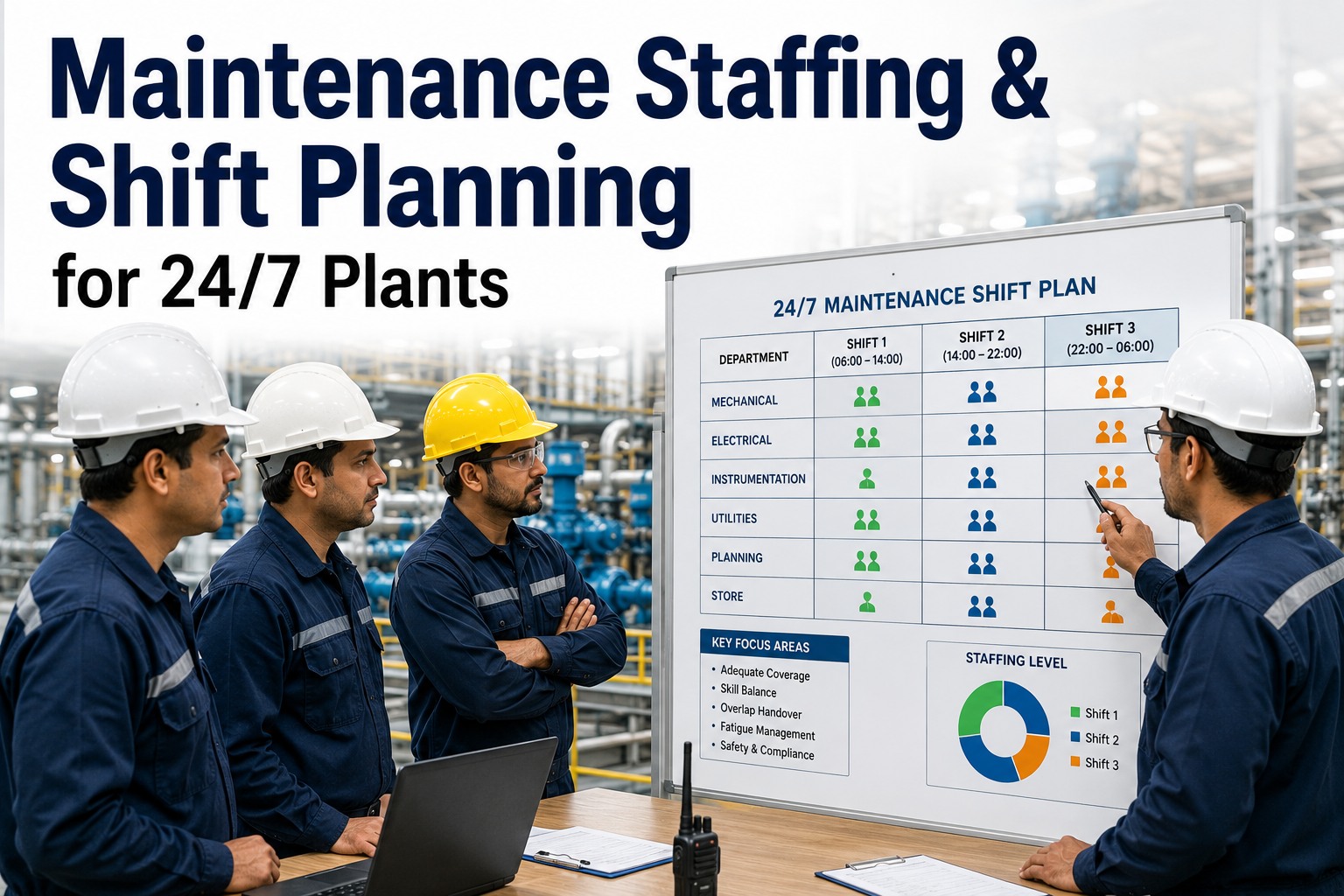
Staffing a maintenance team across three rotating shifts is the single most leveraged decision a 24/7 plant makes — yet most sites still plan coverage by headcount alone, ignoring PM volume, skill distribution, and historical breakdown load. When coverage doesn't track real workload, one shift ends up buried while another sits idle, and the same five technicians carry every fire. OxMaint gives maintenance managers a workload-driven staffing and shift-planning model that translates CMMS work-order history into a defensible coverage plan, skill-by-skill, shift-by-shift. If you're tired of guessing at the roster and losing technicians to burnout, Start Free Trial and build the model from your own data.
How many technicians does each shift actually need?
A workload-driven coverage model turns PM demand, breakdown history, and skill gaps into a defensible 24/7 roster — so reliability gets the people it needs instead of inheriting whoever is left at 2 a.m.
The four inputs that decide whether your roster is right
A defensible maintenance staffing plan isn't built from headcount targets — it's built from the actual volume and type of work each shift must absorb. Four measurable inputs drive the entire model, and OxMaint pulls every one of them directly from your CMMS work-order history and PM schedule.
Planned Maintenance Load
Total PM hours scheduled per shift per week — generated automatically from the active PM calendar, including lubrication routes, inspections, calibrations, and condition-based tasks triggered by sensor thresholds.
Reactive Work Volume
Rolling 12-week average of breakdown and corrective work-order hours by shift, segmented by asset criticality so a catastrophic line stoppage isn't averaged in with a faulty light fixture.
Skill Matrix Coverage
For each shift, the minimum certified skill set required — electrical, mechanical, PLC, welding, rigging — mapped against the technicians actually rostered, with gaps flagged in red before the shift begins.
Response-Time Targets
SLA-driven targets for critical-asset response (e.g., under 15 minutes on a continuous process line), which set the minimum simultaneous coverage needed so one technician isn't stretched across two simultaneous A-priority failures.
A 180-asset plant moves from guesswork to a workload-based roster
Consider a mid-sized food-processing facility running 24/5 production with a skeleton weekend crew. They maintained a flat roster of 4 technicians per shift across all three shifts, but reactive downtime clustered on nights and weekends, and PM compliance sat at 71%. Here's how a workload-based model — built inside OxMaint from 18 months of work-order history — restructured the coverage.
Baseline & data audit
Pulled 18 months of closed work orders into OxMaint, tagged every asset with criticality (A/B/C), and quantified average reactive hours per shift. Day shift carried 6.2 reactive hours; night shift carried 11.8 — almost double — with identical staffing.
PM load redistribution
Re-allocated 34% of routine PMs from day shift to night and swing, where technicians had idle windows between reactive calls. PM compliance climbed from 71% to 88% within four weeks without adding a single headcount.
Skill-gap reshuffle
Identified that night shift had zero PLC-certified technicians. Moved one cross-trained tech onto nights and backed the gap with an on-call escalation contract. Critical-asset response time dropped from 42 minutes to 16.
Rebalanced roster live
Final roster: 3 on day (PM-heavy), 5 on swing (mixed), 4 on night (reactive-heavy with on-call PLC backup). Same total headcount of 12, but weekend downtime fell 38% and overtime spend dropped $4,100/month.
The formula that tells you exactly how many techs per shift
Instead of copying last year's roster, the model calculates required coverage from the bottom up. The formula is straightforward — and OxMaint runs it automatically against your live CMMS data every time a PM schedule changes or a new asset is commissioned.
Run the numbers for the night shift at the example plant: PM hours of 9.5, reactive average of 11.8, buffer of 6.0, effective hours of 5.5, and a skill factor of 1.2 (PLC and electrical certifications required). That gives (9.5 + 11.8 + 6.0) ÷ (5.5 × 1.2) = 4.1 technicians — which is exactly why four was the right number once the skill mix was corrected. Before the rebalance, that shift ran with four generalists and no PLC coverage, and the formula explains why it broke down.
Shift-by-shift skill coverage, before the shift starts
Coverage isn't just headcount — it's having the right certifications on the floor at 3 a.m. OxMaint's skill matrix pulls each technician's qualifications and maps them against the minimum required skill set for every shift, so gaps surface during planning, not during a breakdown.
| Certified Skill | Day Shift | Swing Shift | Night Shift | Min. Required |
|---|---|---|---|---|
| Mechanical (Level 2+) | 3 | 4 | 3 | 2 |
| Electrical (NFPA 70E) | 2 | 2 | 1 | 2 |
| PLC / Controls | 2 | 1 | 0 | 1 |
| Welding (Certified) | 1 | 1 | 0 | 1 |
| Rigging / Crane | 2 | 1 | 1 | 1 |
Two gaps jump out immediately: night shift has zero PLC/controls coverage and zero certified welder. In the example plant, that's exactly what drove the Month 3 reshuffle — one cross-trained technician was moved to nights, backed by an on-call controls escalation contract until a second tech completes PLC certification.
The price of an under-planned 24/7 maintenance roster
The math is uncomfortable: a single 4-hour line stoppage at 2 a.m., with no PLC-certified technician on site, can cost more than an entire technician's annual salary. Plants that run flat rosters — the same number of bodies on every shift regardless of work volume — are paying for coverage they don't need on day shift while starving the shifts that actually carry the load.
Build your 24/7 coverage plan from real work-order data
Stop copying last year's roster. OxMaint turns your CMMS history into a shift-by-shift staffing model in under a week.
Maintenance staffing & shift planning, answered
How does OxMaint calculate the right number of technicians per shift?
It aggregates planned maintenance hours from your active PM schedule, adds a rolling 12-week average of reactive work-order hours, applies a buffer for SLA-driven breakdown response, and divides by the effective available hours per technician (accounting for breaks, handovers, and admin). The result is a defensible per-shift headcount grounded in your actual work volume — not a benchmark copied from another plant. You can Start Free Trial and run the calculation against your own CMMS data in the first session.
What if my technicians aren't cross-trained across all skills?
That's exactly what the skill matrix integration handles. OxMaint maps each technician's certifications against the minimum required skill set per shift and applies a skill-coverage factor to the staffing formula — so a shift that needs PLC and electrical coverage gets a higher required headcount than one staffed entirely by cross-trained generalists. Gaps are flagged before the shift begins, not discovered during a breakdown.
Can the model handle rotating shifts and on-call coverage?
Yes. OxMaint supports fixed, rotating, DuPont, 2-2-3, and custom shift patterns, and treats on-call escalation as a coverage layer in the model. When a skill gap can't be filled by a rostered technician — say, PLC coverage on night shift — the system factors in the on-call contract response time and adjusts the buffer accordingly, so the SLA remains defensible.
How long does it take to build a workload-based staffing model from existing CMMS data?
For a plant with 12–18 months of clean work-order history, the baseline model — PM load by shift, reactive averages, skill matrix, and the per-shift headcount formula — is typically built in three to five working days. Plants with sparse or inconsistent work-order data can still run the model but should expect a data-cleanup pass first; Book a Demo and we'll assess your data readiness in 30 minutes.
Does this work for plants that aren't fully 24/7?
Absolutely. The same workload-driven approach applies to 24/5, 16/7, or single-shift operations — the formula simply runs against fewer shifts. Many plants use the model to decide whether extending to a second or third shift is justified by actual PM and reactive volume, rather than by gut feel or production pressure alone.
Coverage that matches the work, not the calendar
Give every shift the technicians and skills it actually needs. OxMaint builds the model from your CMMS data — PM load, reactive history, skill matrix, and SLA targets — in days, not months.
Free 14-day trial · No credit card