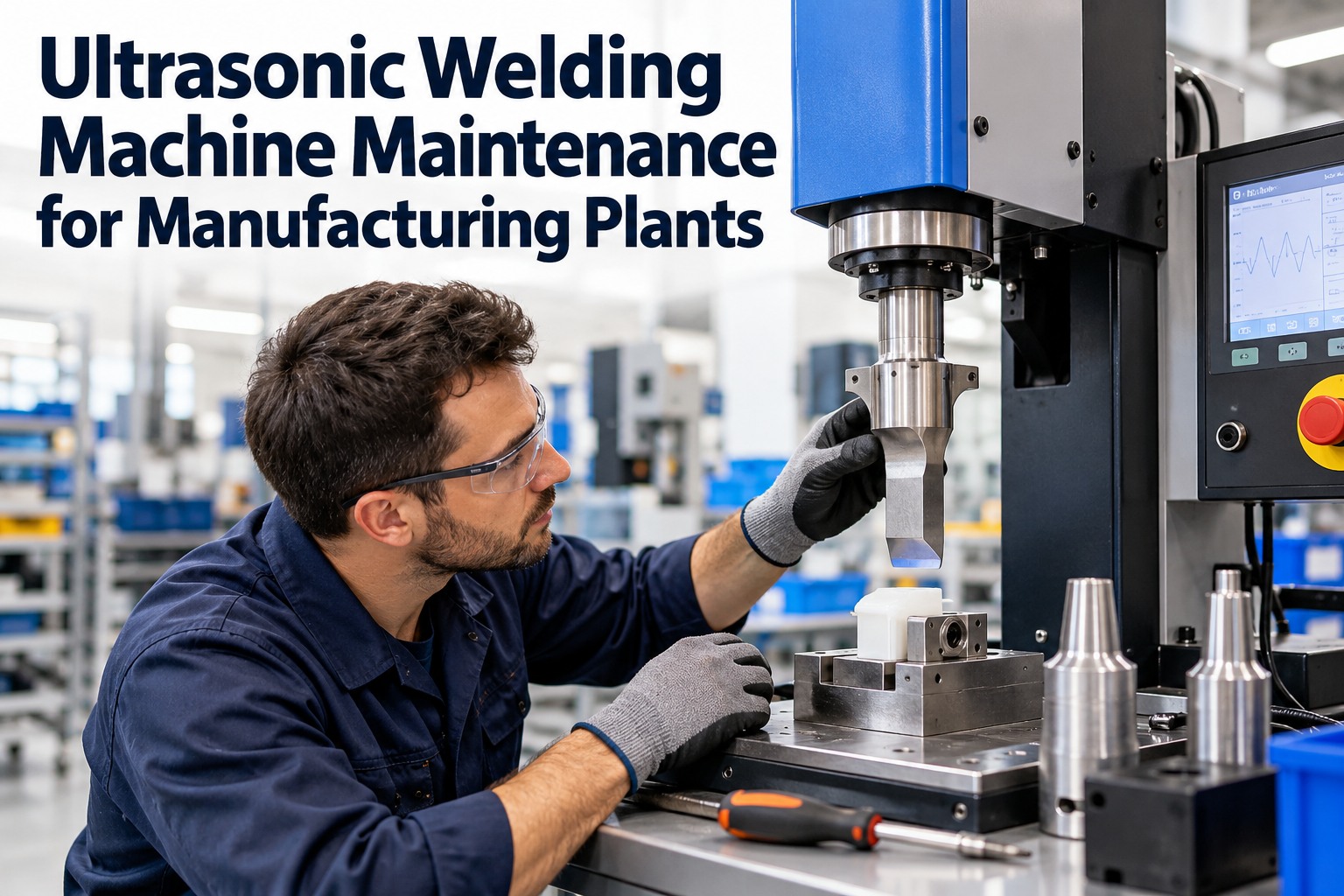
An ultrasonic welder looks simple from the outside: a horn comes down, the plastic joins, the cycle repeats. Inside, a converter, booster and horn must stay tight, flat, crack-free and in tune for every one of those cycles. When they drift, welds weaken long before the machine stops. This guide covers ultrasonic welding machine maintenance, repair and service for plastic assembly lines, and how to catch drift from your own weld data. OXMAINT AI is the AI-powered maintenance management software that schedules the checks and logs the readings.
Ultrasonic Welding Machine Maintenance for Manufacturing Plants
Every weld depends on one vibrating stack. Inspect the horn and booster, tighten to the manufacturer's torque, confirm the tuning and watch the generator readings. That keeps plastic weld quality consistent from shift to shift. OXMAINT AI, the AI-powered maintenance management software, ties each check to the machine.
How an Ultrasonic Welding Machine Works
The generator sends high-frequency electrical power to the converter, which turns it into tiny mechanical vibration. The booster adjusts the amplitude, and the horn focuses it on the part. Understanding the chain tells you where to look when a weld goes wrong. Start free and model each welder as a stack of assets.
Stack Service: Torque, Flatness and Cleaning
A loose or uneven stack wastes energy and can damage the converter. One manufacturer's reconditioning guide gives the assembly torques below. Always use the values for your own equipment, because they differ by make and model. Book a demo to attach torque specs to every stack.
The same guide says to wipe the mating surfaces clean, and to lap them lightly on fine emery cloth on a flat plate if needed. It sets flatness limits of 0.0005 in. for converters and 0.0010 in. for horns at 20 and 40 kHz, and says to replace worn studs only with the manufacturer's parts, since ordinary steel set screws aren't properly heat treated. Pitting is usually minor, but crowned or cupped surfaces need an ultrasonics specialist.
A Stack Is Only As Good As Its Last Check.
OXMAINT AI schedules stack inspections by weld count or hours and records what each check found.
Inspect the Horn and Booster
Nicks and gouges concentrate stress, and metal-to-metal contact can start a crack. A cracked horn may ring at a high pitch or draw more wattage, and it stresses the converter, so stop using it. A quick test is to spray the horn with foaming cleaner and fire a short burst. Cleaner trapped in a crack turns blackish. Start free and make this a routine inspection.
Catch Drift With Your Own Weld Data
Most welders report values such as power and weld time for each cycle. Plot them as a run chart, set limits from your own good production, and investigate when readings trend toward a limit. A trade article lists rising wattage, more flash and weaker welds as warning signs. Book a demo to trend weld readings per station.
Symptom to First Check
When quality slips, work through the likely causes in order, cheapest first. This matrix follows checks from the trade article and the stack guide. Start free and turn each check into a task.
Choosing a Welder You Can Maintain
We don't rank brands, because the best ultrasonic welding machine for plastic is the one your team can keep in tune. Judge any machine on four points. Book a demo to compare maintenance data across lines.
The torque, flatness and test values on this page come from published guidance and vary by manufacturer, frequency and horn material. Follow your welder's manual, replace cracked horns rather than reusing them, and have damaged mating surfaces assessed by an ultrasonics specialist.
Frequently Asked Questions
Keep Every Weld in Tune.
Schedule stack inspections, log torque and crack tests and trend weld power in OXMAINT AI, so drift is caught before it reaches your customers.