A food manufacturing plant's maintenance technician stood on top of a 40-foot packaging tower with both hands gripping a safety rail, watching a belt tensioner degrade in real time. He needed to create a work order immediately — before the next shift started and this observation was forgotten. Under the old system, he would climb down, walk to the maintenance office, log into the desktop CMMS, navigate four dropdown menus, and type the description from memory 25 minutes later — by which time the urgency had faded and the details had blurred. Instead, he said: "Create a priority-two work order for the packaging tower belt tensioner — excessive slack on the drive side, estimated 48 hours to failure, need replacement belt part number BT-4420." The CMMS created the work order in 3.2 seconds — correctly classified the asset, assigned priority 2, linked the part number to inventory (confirming 4 in stock), and routed it to the mechanical team lead's mobile queue. The technician never moved his hands from the safety rail. Natural language processing in CMMS is not a convenience feature. It is the technology that eliminates the 15–25 minute gap between observing a problem and documenting it — the gap where critical maintenance intelligence is lost to distraction, forgetfulness, and the friction of typing on small screens with gloved hands in noisy environments. Schedule a demo to see voice-activated work order creation and AI chatbot queries running in OxMaint.
15% — Formally Documented
Observations that survive the walk back to office, login, menu navigation, and typing
↓ Documentation friction eliminates 85% ↓
35% — Verbally Reported
Mentioned to a supervisor in passing — may or may not become a formal record
↓ "I'll remember to log that later" ↓
100% — Observed by Technicians
Loose belts, unusual sounds, oil seepage, vibration changes, hot spots — seen daily
The Intelligence Gap: Technicians observe far more than they document
The NLP Solution: When a technician can speak a work order into existence in 3 seconds without stopping work, the documentation rate jumps from 15% to 85%+. Voice-activated CMMS captures the intelligence that keyboard-based systems lose.
Five NLP Capabilities Transforming Maintenance in 2026
Natural language processing in CMMS is not a single feature — it is five distinct capabilities that each eliminate a specific friction point in maintenance communication. Together, they transform how technicians, operators, and managers interact with maintenance data. Sign up free and see all five NLP capabilities active in OxMaint from day one.
Voice-Activated Work Orders
How it works: Technician speaks a natural description — "Pump 7 has a seal leak on the discharge side, needs a mechanical seal replacement, priority 3." AI parses: asset, failure mode, action, parts, and priority in under 3 seconds.
Without NLP: 15–25 min delay between observation and documentation. Technician must climb down, remove gloves, navigate menus, and type on a small screen. 85% of field observations never become work orders.
With NLP: Work order created in 3 seconds, hands-free, at the point of observation. Asset auto-identified, parts linked to inventory, priority set, and routed to the correct team instantly.
Conversational Data Queries
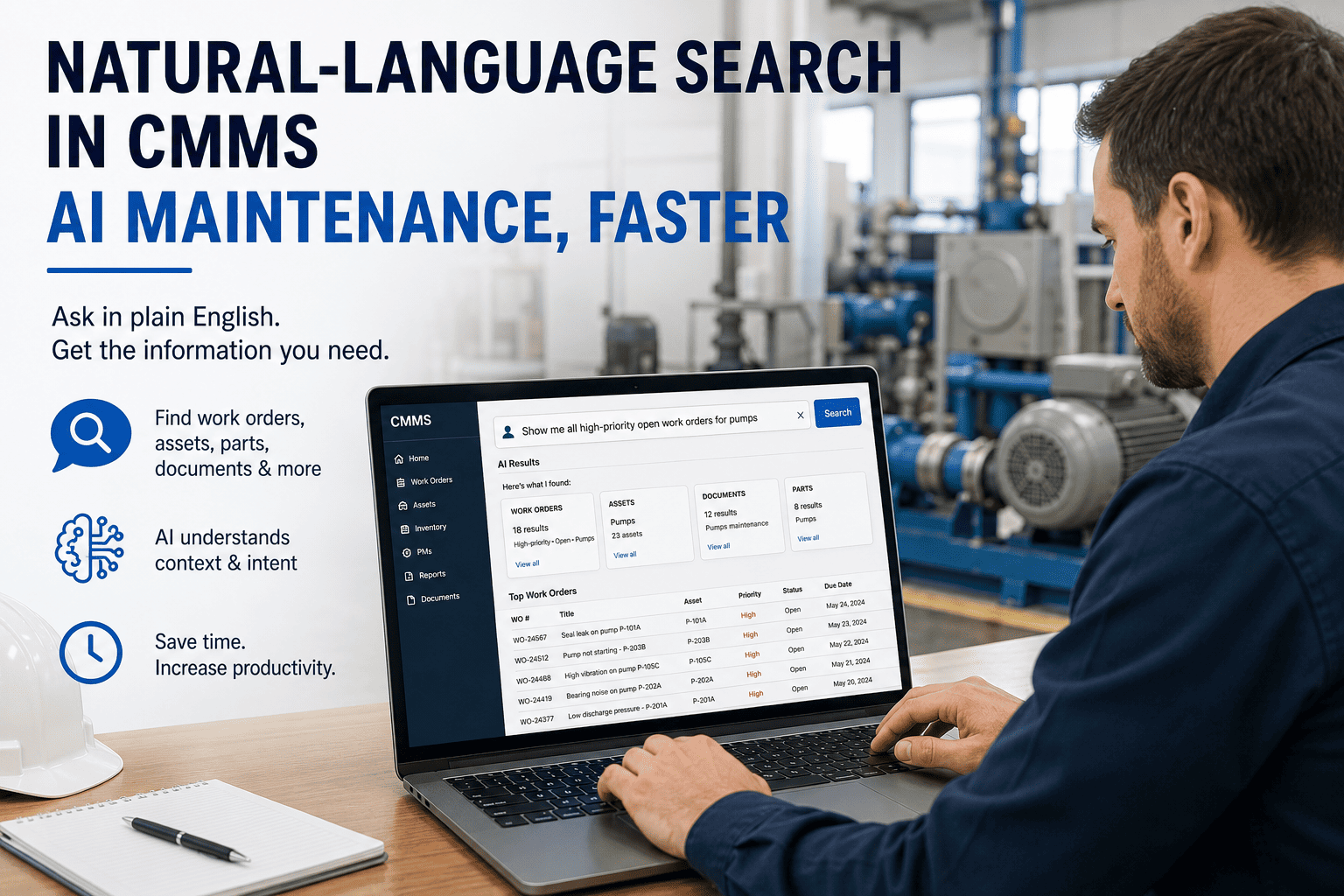
How it works: Manager asks: "What was the total downtime on Line 3 last month?" or "Which assets have overdue PMs?" The AI chatbot queries the database and returns structured answers in natural language — no report building required.
Without NLP: Generating a custom report takes 10–30 minutes of filter configuration, date range selection, and export formatting. Managers ask fewer questions because each answer costs too much time.
With NLP: Any question answered in under 5 seconds. Managers ask 10× more questions, discover patterns faster, and make data-driven decisions without waiting for analysts to build reports.
Smart Request Classification
How it works: Building occupants or operators submit requests in plain language — "Room 204 is too hot" or "there's a weird noise from the compressor." NLP identifies the asset, classifies the work type, assigns priority, and routes to the optimal technician.
Without NLP: Requestors struggle with asset ID lookups, work type dropdowns, and priority selections. 40% of submitted requests are misclassified, causing routing delays and rework.
With NLP: Zero dropdown menus. Plain-language descriptions auto-classify with 92% accuracy. Duplicate detection prevents multiple tickets for the same issue. Technicians receive correctly categorized, prioritized work orders.
AI Kiosk for Self-Service Maintenance
How it works: Touchscreen or voice-activated kiosks in common areas allow anyone to report issues — "The elevator on the 3rd floor is making a grinding noise." The kiosk confirms the request, shows expected response time, and provides a tracking number.
Without NLP: Maintenance requests go through email, phone calls, or sticky notes on the supervisor's desk. Response tracking is impossible. Requestors don't know if their issue was received, prioritized, or scheduled.
With NLP: Self-service kiosks capture 3× more maintenance requests than phone/email. Every request is classified, prioritized, and trackable. Requestor satisfaction increases 40%+ from transparency alone.
How NLP Processes Maintenance Language
Step 1
Speech-to-Text Conversion
Voice input converted to text with 97% accuracy using industrial-trained speech models that recognize maintenance terminology, part numbers, and equipment nomenclature in noisy environments.
Input: "Pump 7 has a seal leak on the discharge side, needs mechanical seal, priority 3"
↓
Step 2
Entity Extraction
NLP identifies maintenance-specific entities from the text: asset name, failure mode, affected component, required action, parts, and priority level.
Extracted: Asset=Pump 7 | Component=Discharge seal | Failure=Leak | Action=Replace | Part=Mechanical seal | Priority=3
↓
Step 3
CMMS Record Matching
Extracted entities matched against the CMMS database — "Pump 7" resolves to asset ID PMP-007, mechanical seal maps to part SKU MS-220, and the assigned team is verified as available.
Matched: Asset PMP-007 | Part MS-220 (4 in stock) | Team: Mechanical | Technician: Available
↓
Step 4
Work Order Created and Routed
Complete work order generated with all fields populated — asset, failure mode, parts, priority, and technician assignment. Push notification sent to the team lead's mobile device. Total elapsed time: 3.2 seconds.
Output: WO-24891 created | Priority 3 | Mechanical team notified | Part MS-220 reserved from inventory
The Result:
The technician never removed his hands from the equipment. The work order is more accurate than a manually typed entry because it was created at the moment of observation — not 25 minutes later from memory. Parts are pre-staged before the repair technician arrives.
Speak It. The AI Documents It. The CMMS Acts On It.
OxMaint's NLP engine understands maintenance language — asset names, failure modes, part numbers, and priority levels — in noisy industrial environments. Voice-activated work orders, conversational queries, and smart request classification eliminate the documentation friction that kills maintenance intelligence.
Business Impact: What NLP Changes in Maintenance Operations
85%+
Observation Capture Rate
Up from 15% — technicians document 5× more issues when voice eliminates typing
92%
Auto-Classification Accuracy
NLP correctly classifies work type, priority, and routing without human intervention
3 sec
Work Order Creation
Down from 15–25 minutes — voice to structured work order at the point of observation
10×
More Data Queries
Managers ask 10× more questions when answers take 5 seconds instead of 30 minutes
Impact Timeline:
Week 1
Voice Work Orders Active
Technicians create work orders hands-free from the field immediately
Week 2–3
Smart Classification Live
Plain-language requests auto-classify with 90%+ accuracy, routing improves
Month 2
Data Quality Transformation
5× more observations documented, predictive models receive richer data streams
Month 3+
Intelligence Compounding
AI learns site-specific language, accuracy exceeds 95%, failure prediction improves
NLP for Every User Role in Maintenance
Technicians (Field Execution)
Voice Work Orders
Hands-free creation while on ladders, in confined spaces, or wearing gloves
Voice Queries
"What's the repair history on this motor?" — answered while holding a flashlight
Voice Close-Out
Dictate repair notes, hours, and parts used without typing on a small screen
Impact: 35% increase in wrench time from eliminating administrative tasks
Planners and Supervisors (Operations)
Chatbot Reporting
"Show me all overdue PMs for Building A" — instant results, no report builder
Schedule Queries
"Who's available for a P2 electrical job tomorrow?" — team visibility in seconds
KPI Summaries
"What's our PM compliance this quarter?" — executive metrics on demand
Impact: 70% reduction in time spent generating reports and searching for data
Building Occupants and Operators (Requestors)
Plain-Language Requests
"Room 204 is too hot" — auto-classified, no asset IDs or dropdowns needed
AI Kiosks
Touchscreen/voice stations in lobbies capture issues from anyone walking by
Status Tracking
"What's the status of my request?" — instant update without calling maintenance
Impact: 3× more maintenance requests captured, 40% improvement in requestor satisfaction
Key Insight: NLP doesn't add a new system — it adds a new interface to the existing CMMS. The same work orders, asset records, and reports are accessible through voice and text conversation instead of menus and forms. Adoption is immediate because the interface is the language people already speak.
Expert Perspective: Why Voice Changes Everything
The CMMS industry spent 20 years building increasingly powerful databases and then gating them behind increasingly complex menu structures. Technicians who can diagnose a compressor failure by ear cannot navigate five dropdown menus to document it. The result: the most valuable maintenance intelligence — observations from experienced technicians in the field — never reaches the database. NLP doesn't make CMMS "easier." It makes CMMS match how maintenance workers actually communicate. Speaking a work order into existence at the top of a ladder is not a convenience. It is the only way that observation will ever be documented.
Voice Captures What Keyboards Lose
A technician observing a developing failure while performing another task will speak a 15-second work order. That same technician will not walk 10 minutes to a computer to type it. The observation dies in the gap between seeing and typing. Voice closes that gap permanently.
Chatbots Democratize Maintenance Data
When any manager can ask "which 10 assets cost us the most last quarter?" and get an answer in 5 seconds, maintenance data stops being a specialist resource and becomes organizational intelligence. Decisions improve because data access improves.
AI Classification Eliminates Routing Errors
When a requestor says "the lights in Conference Room B are flickering," NLP knows that is an electrical work order for Conference Room B, priority 3, routing to the electrical team. No misclassification. No wrong team dispatched. No wasted first response.
Organizations deploying NLP-enabled CMMS report that the volume of documented maintenance intelligence increases 5× within the first 60 days — not because more problems exist, but because the documentation friction that previously killed 85% of observations has been eliminated. The predictive maintenance models fed by this richer data stream improve accuracy 15–20% within 90 days. Start free with OxMaint and activate voice work orders, chatbot queries, and smart classification on your maintenance data today.
Your Technicians See More Than They Document. NLP Fixes That.
OxMaint's NLP engine turns spoken observations into structured work orders, plain-language requests into classified tickets, and conversational questions into instant answers. Your CMMS data quality transforms when the interface matches how your team actually communicates.
Frequently Asked Questions
Does voice recognition work reliably in noisy industrial environments?
Yes. OxMaint's speech-to-text models are trained specifically on industrial audio environments — factory floors, mechanical rooms, rooftops, and plant areas with background noise levels up to 85 dB. Noise-canceling algorithms isolate the speaker's voice from equipment noise. In standard industrial environments, voice recognition achieves 95–97% accuracy. For extremely loud areas (90+ dB), directional microphone headsets push accuracy above 97%. The system also learns each user's speech patterns over time, improving accuracy with continued use.
What languages does the NLP system support?
OxMaint's NLP engine supports English, Spanish, French, German, Portuguese, and Mandarin for voice input and chatbot interaction — covering the primary languages used in global industrial operations. The system handles code-switching (mixing languages in a single utterance) and recognizes industry-specific terminology in each language. Maintenance-specific vocabulary — part numbers, asset nomenclature, failure mode descriptions — is trained across all supported languages.
Book a demo to see multilingual NLP in action with your maintenance vocabulary.
How does the chatbot handle questions it cannot answer?
When the AI chatbot cannot answer a query with confidence, it tells the user what it cannot find rather than guessing. It then suggests reformulated questions that might retrieve the desired information, or escalates the query to a human administrator with the conversation context attached. The system tracks unanswered queries — patterns of questions the chatbot cannot handle trigger training data updates that expand its capability over the following weeks. Within 90 days, the unanswered query rate drops below 5% for site-specific questions.
Can NLP work with our existing asset naming conventions?
Yes. During deployment, the NLP engine ingests your asset registry — learning your specific naming conventions, abbreviations, nicknames, and location codes. If technicians call a pump "Big Blue" instead of "PMP-007," the system learns that association and maps it correctly. This is critical for adoption — technicians should speak naturally using the names they already use, not be forced to remember formal asset IDs. The system also learns vendor names, part number shortcuts, and team member names from actual usage.
What is the realistic ROI for deploying NLP in CMMS?
ROI comes from three sources: labor productivity (35% wrench time increase from eliminating administrative tasks = $50K–$200K annual value per team), data quality improvement (5× more observations feeding predictive models = 15–20% improvement in failure prediction accuracy), and request handling efficiency (92% auto-classification eliminates 70% of dispatcher administrative time). Most facilities achieve full ROI within 90 days from labor productivity alone. The compounding value from improved data quality and predictive accuracy delivers 3–5× returns over 12 months.
Start free and deploy voice work orders on your maintenance team this week.