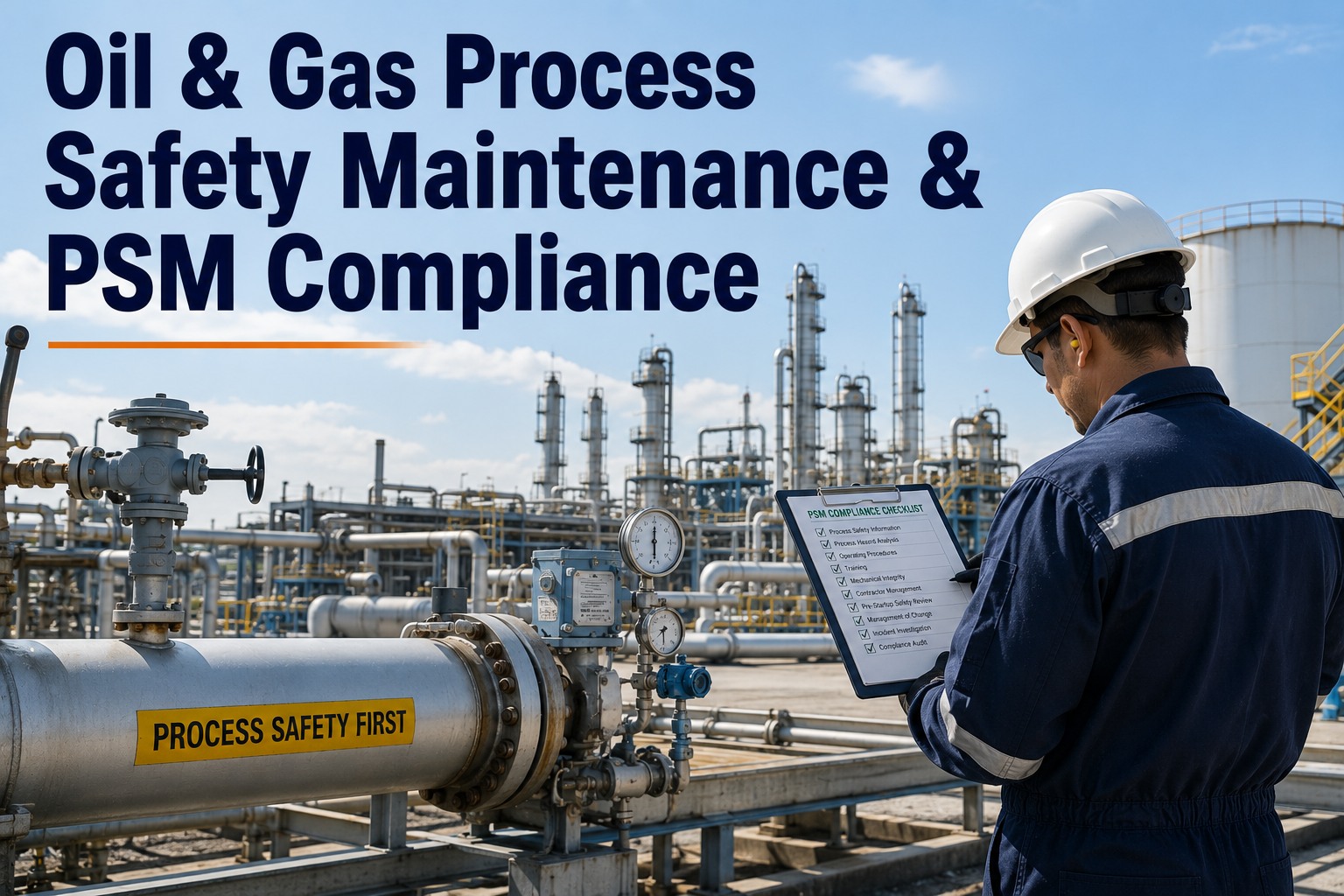
Oil and gas PSM compliance under OSHA 29 CFR 1910.119 is one of the most heavily regulated maintenance environments in industry, with mechanical integrity as the critical PSM Element 5. Process safety maintenance for oil and gas facilities demands rigorous mechanical integrity workflows, SIL verification, PHA-driven maintenance priorities, and a defensible CMMS compliance structure — failures here mean catastrophic incidents, multi-million-dollar OSHA fines, and lost production. OxMaint maintenance management software helps oil and gas maintenance and safety teams meet PSM requirements with auditable work orders, SIS maintenance tracking, and predictive analytics that keep safety-critical assets reliable. You can Start Free Trial or book a personalized demo to see the mechanical integrity workflows built for PSM compliance.
PSM Element 5 · Mechanical Integrity
Is your mechanical integrity program audit-ready — or one inspection away from a finding?
OSHA PSM compliance for oil and gas facilities hinges on documented, defensible mechanical integrity. OxMaint turns scattered inspection records and spreadsheet tracking into a continuous, audit-ready PSM maintenance program.
The Compliance Gap
Why oil and gas PSM compliance breaks down without the right CMMS
Over 60% of OSHA PSM citations relate to mechanical integrity deficiencies — missed inspections, undocumented repairs, and no traceable work order history on safety-critical equipment.
U.S. process industries lose over $50B annually to equipment failures that PSM mechanical integrity programs are designed to prevent.
Nearly two-thirds of OSHA 1910.119 violations cite Element 5 — mechanical integrity — making it the most fined PSM element.
PSM compliance requires retaining mechanical integrity documentation for 5+ years, often beyond the lifespan of the CMMS used to store them.
Roughly 40% of mid-tier oil and gas operators still rely on spreadsheets or paper for mechanical integrity tracking — a direct audit liability.
Mechanical Integrity Checklist
PSM mechanical integrity checklist for oil and gas facilities
A defensible mechanical integrity program under OSHA PSM Element 5 requires documented inspection frequencies, qualified personnel, deficiency resolution, and quality assurance — all traceable in a process safety CMMS.
- API 510 inspection intervals documented and scheduled
- Thickness monitoring (UTM) points mapped per vessel
- Corrosion rate calculations and remaining life tracked
- Repairs logged with R-stamp welder qualifications
- Deficiency remediation work orders with closure evidence
- API 570 piping inspection circuits defined
- PSV/PRVD pop-test intervals enforced automatically
- Relief device set pressures verified against PHA assumptions
- CML (condition monitoring location) data trended
- Replacement triggers based on MAWP analysis
- SIL verification records linked to each SIF loop
- Proof-test intervals per IEC 61511 maintained
- Bypass logs with authorization and duration tracking
- Failure mode data fed back into PHA revalidation
- Spare sensor availability verified for critical loops
- Vibration analysis routes aligned with ISO 10816
- Lubrication schedules with sampling tied to oil analysis
- Seal gas system checks on compressors documented
- Bearing temperature trends integrated into CMMS alerts
- Change-out history accessible for reliability analysis
Comparison
Spreadsheet tracking vs OxMaint process safety CMMS
A midstream operator with 180 safety-critical assets was spending $42K annually on manual MI compilation — and still received three PSM findings in their last audit. Here is how a purpose-built mechanical integrity CMMS changes the equation.
| PSM Requirement | Spreadsheets & Paper | OxMaint CMMS |
|---|---|---|
| Inspection Scheduling | Manual calendar reminders; 15–20% missed | Auto-generated work orders with escalations |
| Deficiency Tracking | Email chains; no closure verification | Forced-resolution workflow with photo evidence |
| PHA Integration | Static PDFs; outdated within months | Live PHA-to-asset linking with revalidation triggers |
| SIS Proof Testing | Separate SIL log; manual cross-reference | SIL-verified test procedures per SIF loop |
| Audit Readiness | 2–3 weeks of compilation per audit cycle | One-click compliance report; 0 days to prepare |
| Record Retention | Shared drives; version conflicts | Immutable 5+ year history per asset |
| Annual Cost | $42K+ in labor + audit finding risk | Single platform subscription; findings eliminated |
How OxMaint Helps
How OxMaint powers your PSM maintenance program
OxMaint is an AI-powered CMMS and EAM platform engineered for maintenance and reliability teams in high-hazard environments. These four capabilities directly address the most common PSM mechanical integrity failures.
MI Workflow Automation
Auto-generate inspection and preventive maintenance work orders based on API 510/570 intervals, equipment criticality, and PHA recommendations. Ensures zero missed inspections and cuts unplanned downtime 30–50%.
SIS & SIL Maintenance
Link safety instrumented function loops to IEC 61511 proof-test procedures, track SIL verification records, and auto-trigger bypass authorization logs. Reduces SIS failure events by ensuring test intervals are never missed.
PHA-Driven Prioritization
Connect PHA action items directly to asset records so maintenance priorities reflect real process hazard ratings. When a PHA revalidates, OxMaint updates inspection frequencies automatically — no stale procedures.
Predictive Analytics & Audit Trail
AI-driven vibration and temperature trend analysis predicts safety-critical failures before they happen. Every work order, inspection, and repair is timestamped and immutable — producing a one-click compliance report for any OSHA audit.
A 180-asset midstream gas plant spending $42K/yr on manual MI compilation and facing three OSHA findings deployed OxMaint in under 30 days. Within one audit cycle, they eliminated all open findings, cut MI preparation time from 3 weeks to zero, and reduced unplanned safety-critical downtime by 38% — with a complete, defensible record for every pressure vessel, PSV, and SIS loop on site.
ROI Breakdown
What is the cost of PSM compliance without a CMMS?
For a typical 180-asset oil and gas facility, the annual cost of maintaining PSM compliance manually — plus the risk of an OSHA finding — far exceeds the investment in a purpose-built CMMS. Here is the breakdown.
| Metric | Manual / Spreadsheet | With OxMaint | Annual Savings |
|---|---|---|---|
| MI Labor Hours | 1,400 hrs/yr | 520 hrs/yr | $27,000 |
| Audit Prep Time | 3 weeks | 0 days (one-click) | $15,000 |
| Finding Risk Exposure | $28K probability-weighted | Eliminated | $28,000 |
| Unplanned Downtime | $67K exposure | 38% reduction | $25,460 |
| Total Annual Value | — | — | $95,460 |
See OxMaint on your safety-critical assets
Book a 30-minute demo and we will walk you through mechanical integrity workflows, SIS maintenance tracking, and the one-click audit report that makes PSM compliance defensible.
FAQ
Oil and gas PSM compliance and maintenance — your questions answered
What is PSM Element 5 mechanical integrity and why does it matter for oil and gas?
PSM Element 5 — mechanical integrity — under OSHA 29 CFR 1910.119 requires oil and gas facilities to inspect, test, and maintain equipment used to process highly hazardous chemicals. It matters because equipment degradation is the leading cause of catastrophic releases, and OSHA cites this element more than any other. A mechanical integrity CMMS like OxMaint ensures inspection intervals, deficiency corrections, and quality assurance records are documented and defensible.
How does a CMMS support OSHA PSM oil and gas compliance?
A process safety CMMS supports OSHA PSM compliance by automating inspection scheduling, enforcing deficiency resolution workflows, retaining immutable work-order histories, and linking PHA action items to specific assets. OxMaint generates one-click compliance reports so that any OSHA auditor can immediately verify that mechanical integrity requirements are being met for every safety-critical asset. You can explore this directly — Start Free Trial to see the audit trail in action.
What is the difference between SIL maintenance and SIS maintenance?
SIL (Safety Integrity Level) maintenance refers to verifying and maintaining the designed risk-reduction level of a safety instrumented function, typically per IEC 61511. SIS (Safety Instrumented System) maintenance is the broader practice of inspecting, testing, and repairing the physical components — sensors, logic solvers, and final elements — that make up those systems. OxMaint manages both by linking SIL verification records to SIS proof-test procedures and tracking bypass authorization for each SIF loop.
How often should PHA recommendations update maintenance priorities?
PHA (Process Hazard Analysis) recommendations should update maintenance priorities at every PHA revalidation — typically every 5 years — and whenever a management-of-change (MOC) event alters process conditions. OxMaint connects PHA action items directly to asset records so that when a revalidation changes an equipment's risk rating, inspection frequencies and preventive maintenance tasks update automatically without manual reprogramming.
Can OxMaint track mechanical integrity for both onshore and offshore oil and gas facilities?
Yes. OxMaint supports multi-site asset hierarchies so that onshore refineries, offshore platforms, and midstream pipeline stations can all be managed under a single CMMS instance with site-specific inspection codes, regulatory frameworks (OSHA PSM, BSEE, API), and role-based access. To see how it maps to your facility's structure, Book a Demo and we will configure a live walkthrough.
Make PSM compliance your competitive advantage
Stop spending weeks preparing for audits and risking OSHA findings. OxMaint gives your maintenance and reliability team the mechanical integrity workflows, SIS maintenance tracking, and predictive analytics that keep oil and gas facilities safe, compliant, and profitable.
Free 14-day trial · No credit card