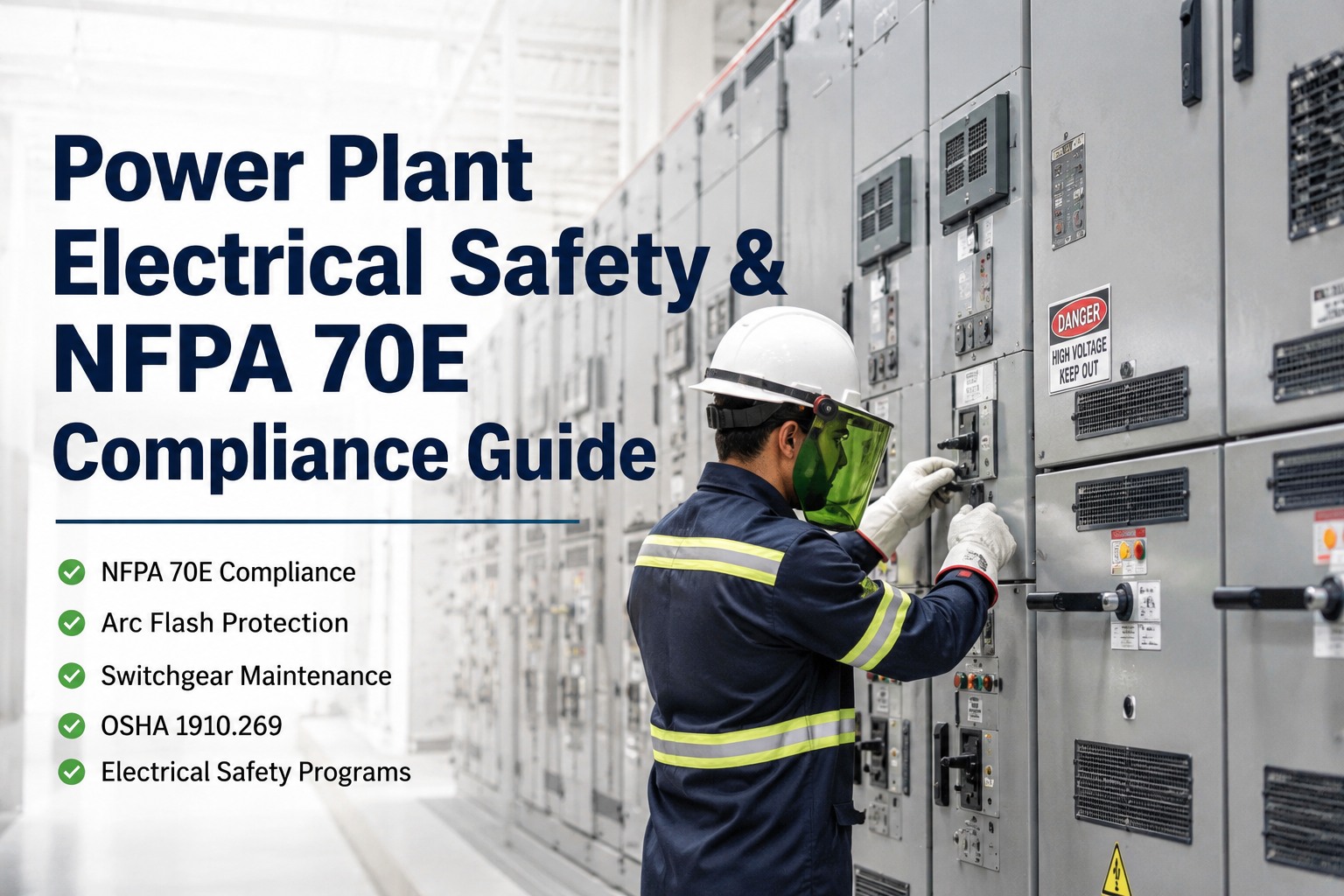
An arc flash releases energy equivalent to several sticks of dynamite, and it can be triggered by something as small as a slipped tool or a film of dust on switchgear. In October 2023, an electrician troubleshooting a motor control center made contact with live equipment, an arc flash occurred, and he died of electrocution, burns, and smoke inhalation — one of the roughly 300 electrocutions and 4,000 electrical injuries that happen in U.S. workplaces every year. For an EHS manager in a power plant, electrical safety is not a paperwork exercise. It is the difference between a technician going home and an OSHA fatality investigation. This guide lays out how NFPA 70E, OSHA 1910.269, and a disciplined maintenance program fit together — and how a CMMS keeps every study, test, and LOTO record audit-ready. Start a free Oxmaint trial to schedule electrical PM and store every compliance record in one place, or book a demo to see arc flash and LOTO tracking built for audits.
Power Plant · EHS · Electrical Safety Compliance
Power Plant Electrical Safety & NFPA 70E Compliance
Arc flash analysis, switchgear PM, relay testing, and LOTO procedure management — how EHS managers keep energized-work programs compliant with NFPA 70E and OSHA 1910.269, and audit-ready every day of the year.
The Rulebook
How the Four Standards Fit Together
Electrical safety compliance is not one regulation — it is a stack of four that reference each other. OSHA has the legal authority to cite; NFPA and NETA supply the technical benchmarks OSHA enforces against. An EHS program has to satisfy all four at once.
-
Legal Force
OSHA 29 CFR 1910
The enforceable law. Subpart S covers general electrical safe-work practices; 1910.269 governs power generation specifically; 1910.147 mandates LOTO. OSHA cites under the General Duty Clause when failures occur — often using NFPA as the benchmark.
-
Safe Work
NFPA 70E
The Standard for Electrical Safety in the Workplace. Defines arc flash risk assessment, PPE categories, the electrically-safe-work-condition process, and training cadence. It is how you actually comply with OSHA's broad requirements.
-
Maintenance
NFPA 70B
Now enforceable language: every facility must maintain a documented Electrical Maintenance Program. It sets inspection intervals, testing methods, and corrective-action protocols for switchgear, transformers, and protective devices.
-
Testing Spec
NETA MTS
Maintenance Testing Specifications — the acceptance criteria for insulation resistance, contact resistance, and protective-device tests. It defines what "passed" means and who is qualified to sign off.
Know Before You Reach In
The Arc Flash PPE Category Ladder
NFPA 70E defines four PPE categories by incident energy in calories per square centimeter. The arc flash study assigns every piece of equipment a category, and the label tells the worker exactly what to wear before opening a panel. Higher voltage, higher energy, heavier gear.
- CAT 1 1.2–4 cal/cm² 120V control panels · arc-rated shirt, pants, face shield
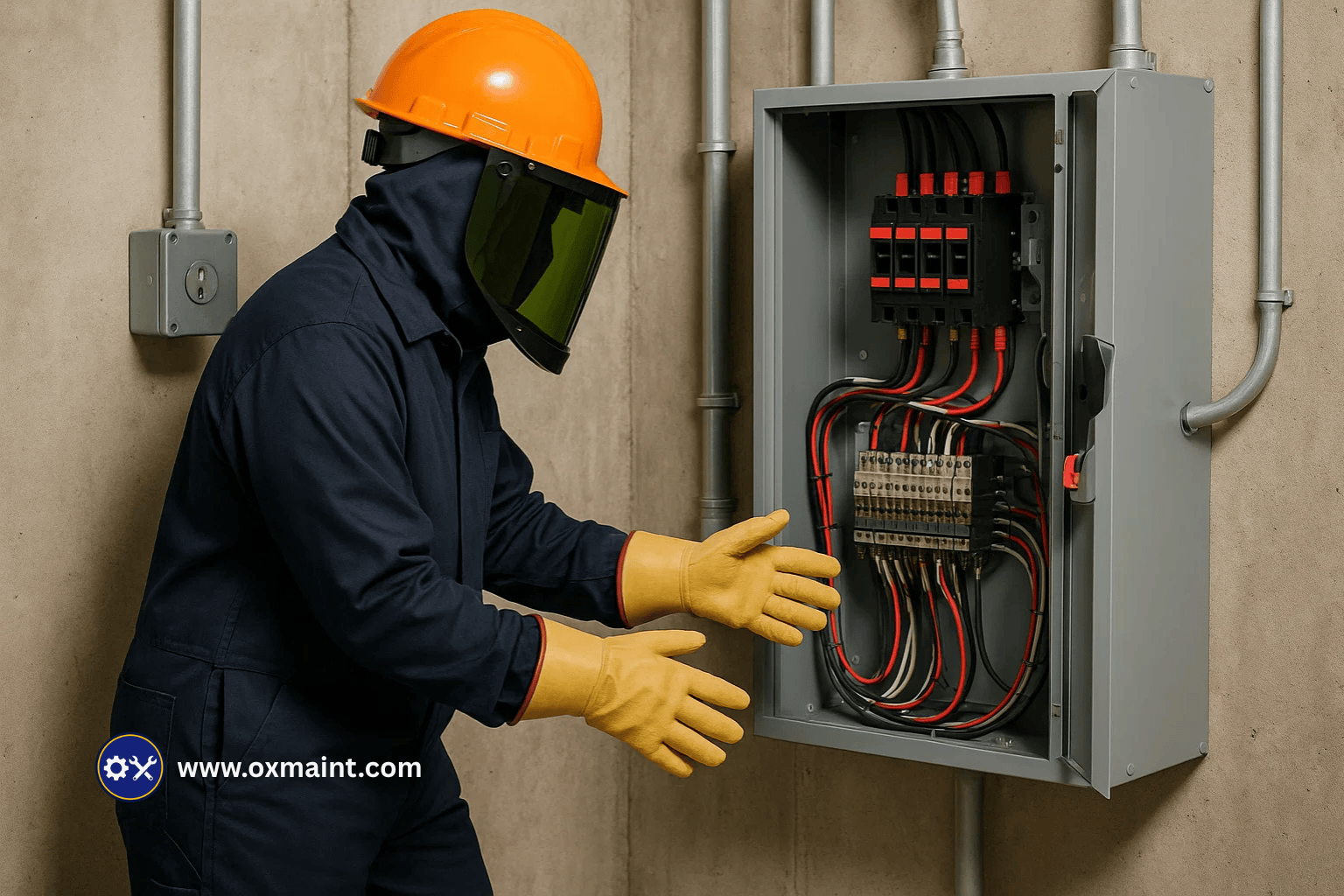
- CAT 2 4–8 cal/cm² 480V MCC cabinets · arc-rated clothing, balaclava, hard hat
- CAT 3 8–25 cal/cm² Medium-voltage switchgear · arc flash suit, hood, gloves
- CAT 4 25–40 cal/cm² High-voltage distribution · full 40 cal arc flash suit system
The arc flash study behind these labels must be reassessed at least every five years, or sooner whenever the electrical system changes — new equipment, a resized transformer, a modified switchgear lineup. Miss the renewal and every label on the floor is out of date. Book a demo to see arc flash study dates tracked per asset with five-year renewal alerts.
The Compliance Calendar
What Is Due, and How Often
OSHA rarely names a specific interval — it requires equipment be kept in safe condition and cites NFPA 70B and 70E as the benchmark when something fails. These are the intervals an auditor will expect to see documented. Every one becomes a recurring work order.
| Requirement | Interval | Standard |
|---|---|---|
| Arc flash hazard analysis | Every 5 years or on system change | NFPA 70E |
| Electrical safety training (qualified) | Every 3 years | NFPA 70E |
| Electrical Maintenance Program review | Documented, reviewed every 5 years | NFPA 70B |
| Infrared thermography scan | Annual; 6 months high-risk | NFPA 70B |
| Switchgear insulation & contact testing | Per NETA interval by equipment class | NETA MTS |
| Protective relay testing & calibration | De-energized PM cycle | NETA MTS |
| Arc-rated glove dielectric testing | Every 6 months | NFPA 70E |
| PPE visual inspection | Before each use | NFPA 70E / OSHA |
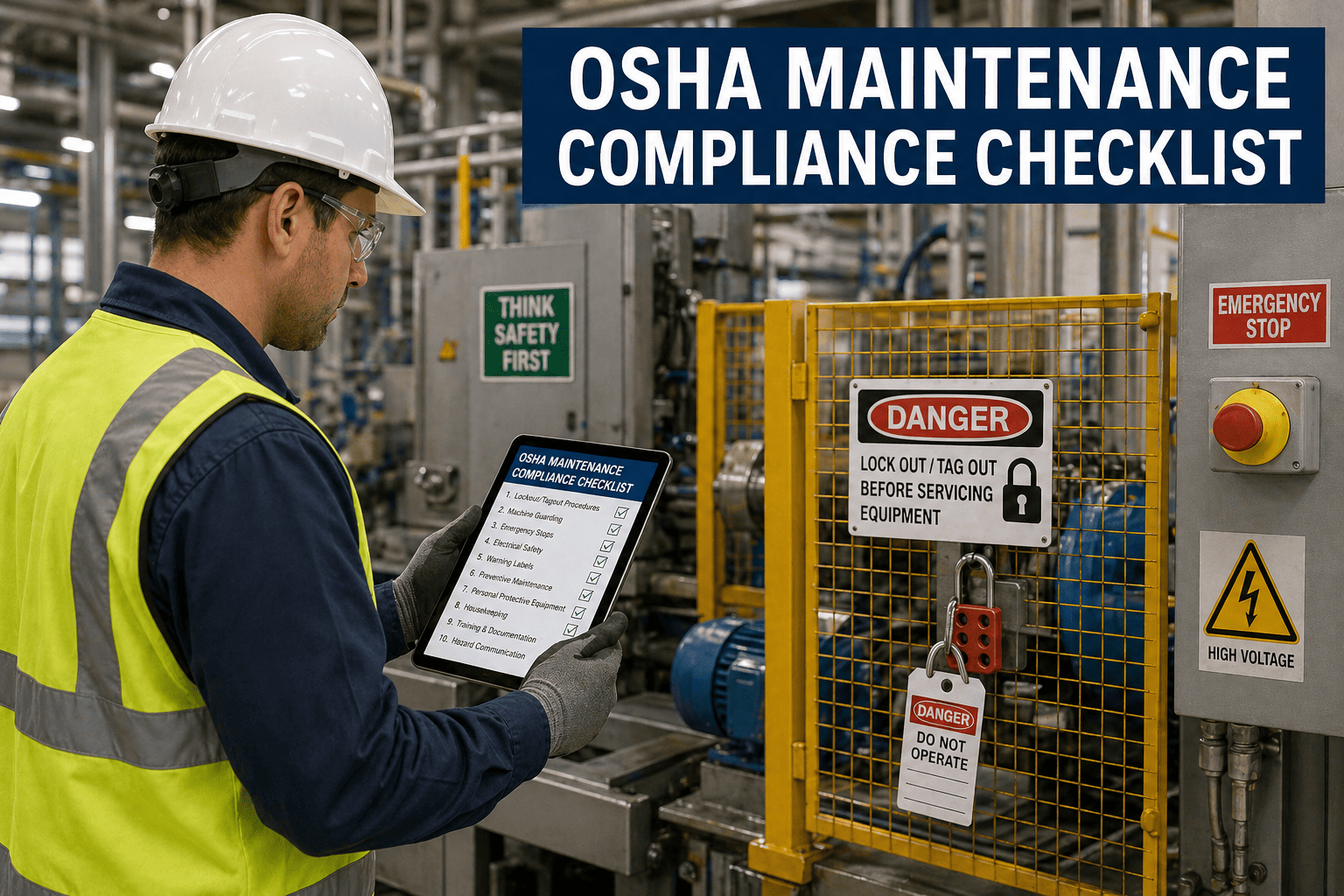
| LOTO procedure & audit | Annual periodic inspection | OSHA 1910.147 |
The Non-Negotiable Sequence
Establishing an Electrically Safe Work Condition
NFPA 70E's first priority is always to de-energize. OSHA 1910.269 and 1910.147 define the LOTO sequence that gets you there — and it must be performed in order, every time. This is the flow an EHS program has to enforce and document per work order.
- 1 Notify & Plan Affected employees notified before controls are applied. Authorized employee identifies all energy sources from the one-line.
- 2 Isolate & Lock De-energize and apply lockout devices substantial enough to resist removal without bolt cutters. Each device identifies the worker who applied it.
- 3 Verify Zero Energy Test for absence of voltage with a rated, pre-checked instrument. Verification of the de-energized state is the step that saves lives.
- 4 Ground & Work Apply safety grounds where required, then perform the work under the correct PPE category for any residual or adjacent hazard.
- 5 Restore & Notify Remove grounds and LOTO by the authorized employee only, notify affected employees, and confirm safe reenergization. Log the full record.
The Cost of the Gap
What Non-Compliance Actually Costs
The fine is never the real number. Beyond the citation sits the human cost, the downtime, the insurance consequence, and the reputational damage that follows a preventable incident.
-
300+
Electrocutions a Year
Plus roughly 4,000 electrical injuries annually in U.S. workplaces — most of them on energized equipment that should have been locked out.
-
Fatality
The Real Exposure
A single arc flash fatality triggers an OSHA investigation, citations, and litigation — the citation itself is the smallest line on the invoice.
-
5 yr
Study Expiry Risk
An arc flash study lapsed past its five-year renewal means every PPE label is unverified — an immediate finding in any audit.
-
Coverage
Insurance Impact
Insurers increasingly require documented thermography and maintenance programs. Gaps can raise premiums or void coverage entirely.
Audits Reward Documentation
The Difference Between a Finding and a Clean Audit Is a Record
When an OSHA inspector arrives after an incident, the question is not whether you meant to be safe — it is whether you can produce the arc flash study, the completed PMs, the LOTO logs, and the training records. A program that lives in binders and spreadsheets fails that test. One that lives in a CMMS answers it in seconds.
Oxmaint for EHS
How Oxmaint Runs an Electrical Safety Program
-
Study Tracking
Arc Flash Dates Per Asset
Every panel, MCC, and switchgear lineup carries its arc flash study date and PPE category. Oxmaint alerts you before the five-year renewal — and whenever a logged system change should trigger a re-study.
-
Recurring Compliance PM
Every Interval Auto-Scheduled
Thermography, glove dielectric testing, relay calibration, LOTO audits — each fires as a recurring work order on its NFPA or NETA cadence, assigned to the qualified technician, so nothing lapses unnoticed.
-
LOTO Records
Every Lockout Logged and Timestamped
The full sequence — notification, isolation, zero-energy verification, restoration — captured per work order with the authorized employee identified, building the LOTO history an annual audit requires.
-
PPE Evidence
Category Used, Attached to the Job
Log which PPE category was worn on each energized task and attach photos and checklists as evidence — the proof an inspector asks for after the fact.
-
Mobile & Offline
Field Teams Complete Checklists On Site
Technicians close switchgear and relay checklists on mobile, offline-capable in basements and substations. No paper, no lost records, no disputes when the audit comes.
-
One-Click Reports
Audit Packages on Demand
Completed PMs, overdue tasks, LOTO history, arc flash study status, and incident trends assembled into a compliance report in one click — ready for OSHA, insurers, or the board.
Frequently Asked
Power Plant Electrical Safety Questions
Does OSHA require compliance with NFPA 70E?
OSHA does not enforce NFPA 70E directly, but the two are complementary. OSHA's electrical standards in 1910 Subpart S and the General Duty Clause require a safe workplace; NFPA 70E provides the detailed method — arc flash assessment, PPE selection, safe-work procedures — that demonstrates compliance. In practice, OSHA cites against NFPA 70E and 70B as the recognized benchmark. Sign up for Oxmaint to build an NFPA-aligned electrical safety program with full documentation.
How often must an arc flash study be updated?
At least every five years, or sooner whenever the electrical system changes significantly — adding equipment, changing transformer sizes, or modifying a switchgear configuration. Plants with variable loads often update more frequently. A lapsed study means every PPE label on the floor is unverified.
What PPE category is required for 480V MCC work?
Typically PPE Category 2 (4–8 cal/cm²), meaning arc-rated clothing, balaclava, face shield, and hard hat — but the governing number is always the incident energy from your own arc flash study, not the voltage alone. The equipment label assigns the category. Book a demo to see the PPE category logged as evidence on every energized work order.
What does OSHA 1910.269 require for LOTO in a power plant?
Lockout and tagout devices may only be applied and removed by the authorized employees performing the work. Affected employees must be notified before controls are applied and after they are removed. Devices must resist removal without excessive force and identify the worker who applied them, and the de-energized state must be verified before work begins. Sign up for Oxmaint to enforce and log the full LOTO sequence per work order.
Assess · Document · Prove
Every Compliance Record You Cannot Find Is a Finding Waiting to Happen
The arc flash study, the thermography scan, the relay calibration, the LOTO log, the training record — an electrical safety program is only as strong as the evidence behind it. Oxmaint gives EHS managers one platform to schedule every NFPA and NETA interval, enforce the LOTO sequence, and produce an audit-ready package on demand.





.png)
