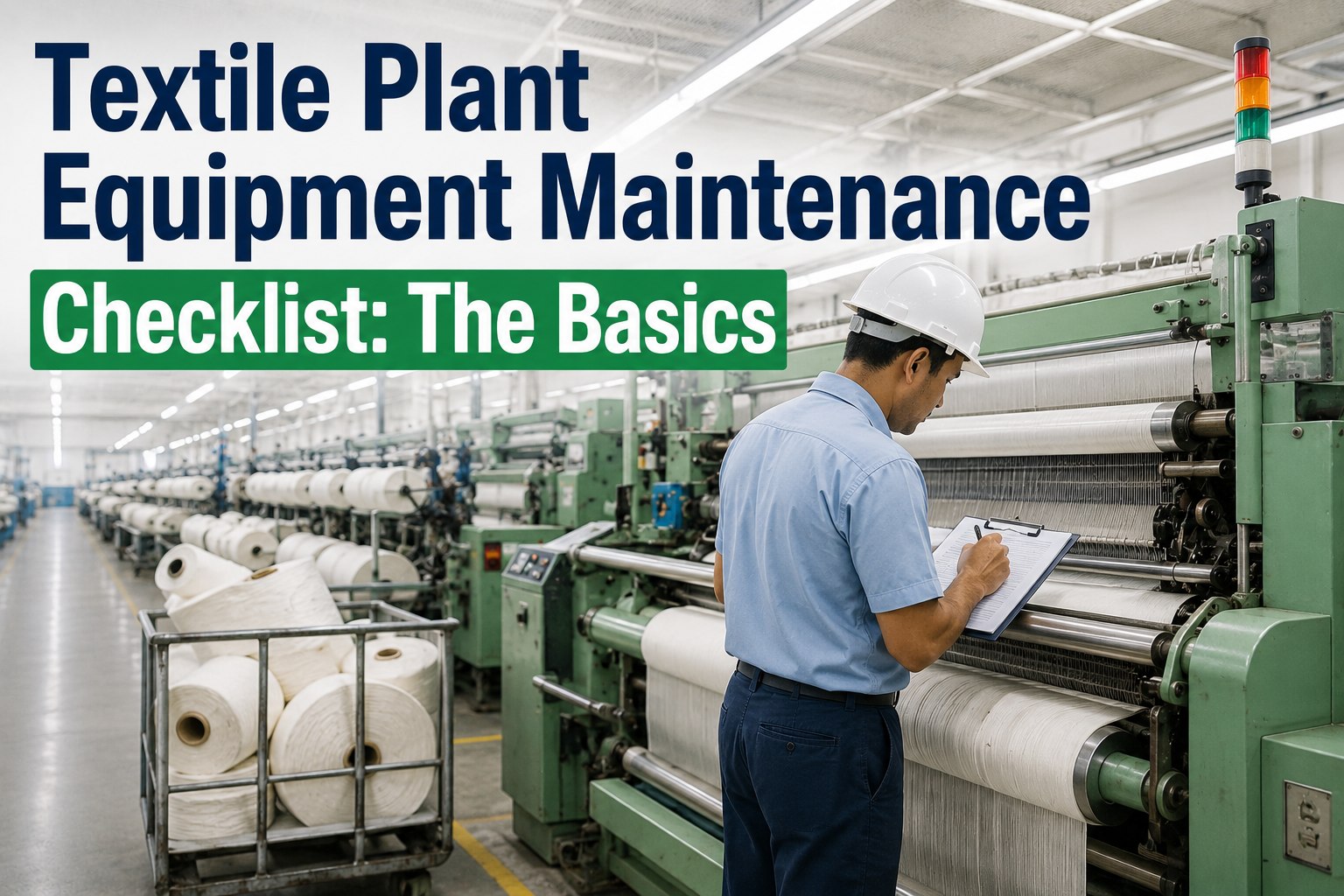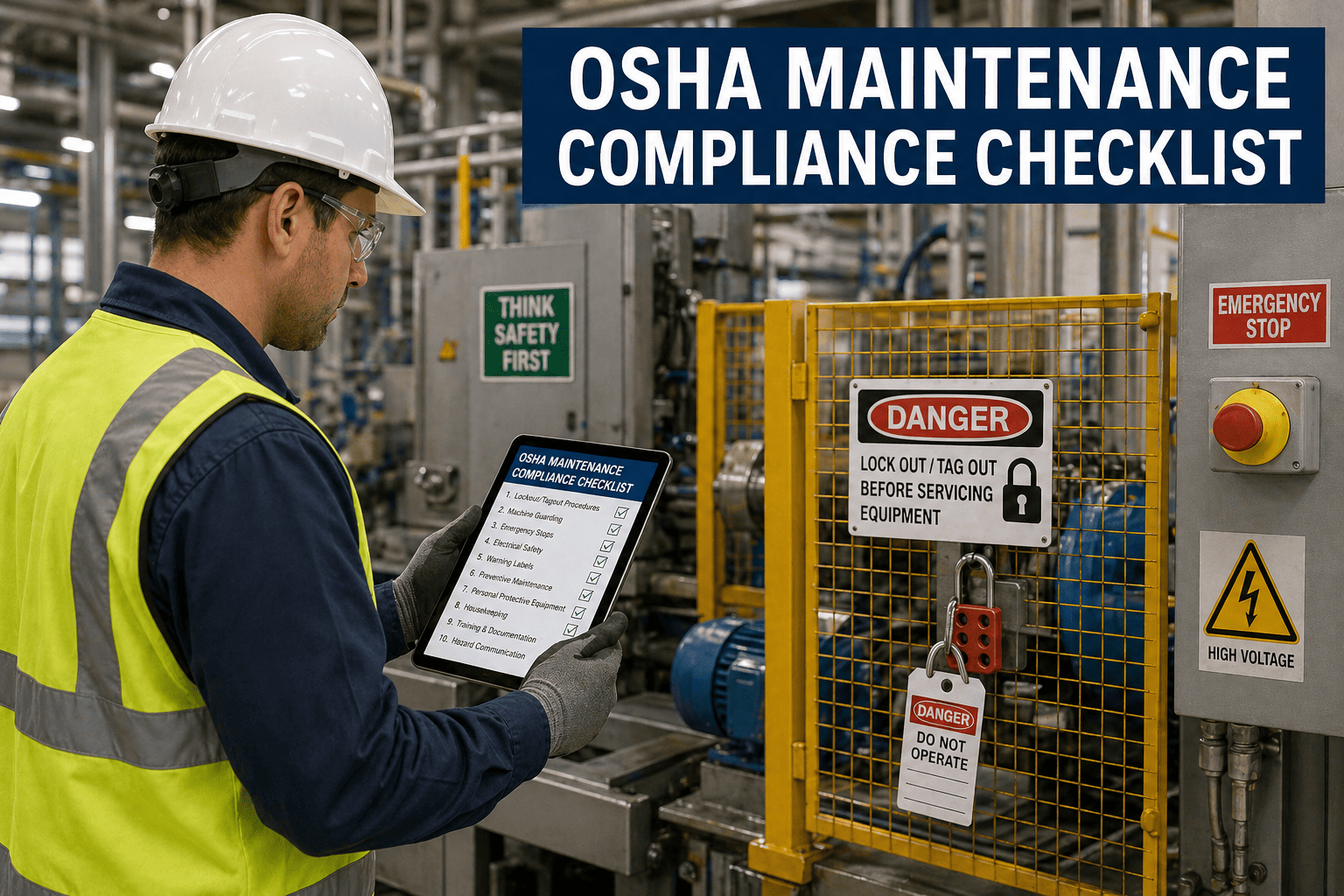
A textile plant is a hazard chain, not a hazard site. Cotton dust from the opening line drifts into the card room. A card room clearance issue becomes a fire in the blow room. A missed loom guard becomes a hand degloving in weaving. A dye kitchen chemical spill becomes a respiratory case three shifts later. Every one of these events is preceded by an inspection point that was on somebody's checklist — and skipped, or logged, or lost between shifts. Oxmaint is the maintenance management software textile plants use to turn every inspection into a scheduled digital work order, delivered to the technician's phone, with photo evidence against each item and automatic escalation on any fail. Start a free Oxmaint trial and put your safety inspection checklist on every technician's phone this week, or book a demo mapped to your spinning, weaving, dyeing and finishing lines.
Textile Plant · OSHA · Machine Guarding & Cotton Dust
Textile Plant Safety Inspection Checklist: Audit-Ready
Every inspection point that matters — visual condition, operating readings, safety devices, wear limits, and defensible pass/fail criteria — for opening, carding, spinning, weaving, knitting, dyeing, printing, and finishing. Built for the OSHA machine guarding, cotton dust, LOTO, HazCom, and noise standards that carry the highest citation weight in textile manufacturing.
-
$165,514
OSHA willful violation ceiling per instance, carried forward into 2026
-
$16,550
per serious violation — machine guarding is the most cited category in manufacturing
-
8 zones
inspection scope: opening, carding, spinning, weaving, knitting, dyeing, printing, finishing
-
Feb 1 – Apr 30
OSHA 300A summary posting window — the first thing an inspector looks for
The Zone Walk
Every Department, Every Hazard, Every Inspection Trigger
Textile safety inspections fail when a single checklist is applied uniformly across a plant that is not uniform. The blow room is a fire and dust hazard; the loom shed is a machine-guarding hazard; the dye house is a chemical and burn hazard. Each zone needs its own checklist scoped to its dominant risks — and one platform to bring them all into one audit-ready record. Below is the working map that anchors every inspection assigned in Oxmaint.
-
01
Opening & Blow Room
Cotton dust · fire · fibre nip points
Duct pressure, spark detection status, fire suppression readiness, bale opener guarding, magnetic separator function.
-
02
Carding & Drawing
High-speed rollers · pinch points · dust exposure
Card cover interlocks, roller clearances, dust extraction ΔP, cotton dust dosimetry sample dates.
-
03
Ring & Rotor Spinning
Spindles · high-speed rotation · noise >90 dBA
Spindle guards, doffer safety, ring-frame emergency stops, hearing conservation dosimetry, ergonomic reach checks.
-
04
Weaving Loom Shed
Warp/weft mechanism · shuttle · noise >100 dBA
Loom guards on all belts, pulleys and shafts, shuttle-eject cover, weft-break sensor, E-stop functional test.
-
05
Knitting
Needle bed · high cycle rate · oil mist
Needle-bed guards, feeder tension, cylinder LOTO points, oil-mist extraction, floor slip hazards.
-
06
Dye House & Kitchen
Chemical burns · scald · confined space
SDS at point of use, secondary containment, safety shower flow test, jet dyer entry permit, chemical label legibility.
-
07
Printing
Solvent exposure · fire · rotary drum nip
Flammable storage cabinet compliance, LEL monitoring in cure zone, drum-nip guard, ventilation face velocity.
-
08
Finishing & Stenter
Hot air · gas burners · high fabric tension
Stenter chain lubrication log, gas leak survey, chamber E-stop, entry gate interlock, fabric pin bar wear check.
Hazard × OSHA Standard
The Citation Matrix — What Inspectors Look For First
Machine guarding, LOTO, HazCom and cotton dust are the four standards that generate the majority of textile-plant citations. This is the working matrix — every dominant hazard, the OSHA standard it maps to, the inspection frequency an inspector expects to see documented, and the artifact Oxmaint stores as evidence.
| Hazard | OSHA Standard | Inspection Frequency | Evidence Artifact |
|---|---|---|---|
| Belts, pulleys, gears, shafts | 29 CFR 1910.212 — Machine guarding | Pre-shift + weekly formal | Photo-tagged guard check per asset |
| Sewing machine points of operation | 29 CFR 1910.212(a)(1) applied to light apparel | Daily pre-use | Operator sign-off per machine per shift |
| Energy isolation on servicing | 29 CFR 1910.147 — LOTO | Annual procedure inspection, per job | Per-asset LOTO checklist, lock log |
| Cotton dust exposure | 29 CFR 1910.1043 — Cotton dust | Sampling per part 1910.1043 schedule | Dosimetry results per area and job |
| Chemical labelling & SDS | 29 CFR 1910.1200 — HazCom (2024 GHS 7) | Daily label check + monthly inventory | Digital SDS registry with revision log |
| Noise exposure >85 dBA TWA | 29 CFR 1910.95 — Occupational noise | Annual audiometry, area survey biennial | Per-worker audiogram, area noise map |
| Fall & walking-working surfaces | 29 CFR 1910 Subpart D | Daily housekeeping walk | Daily housekeeping inspection log |
| Recordkeeping — 300, 300A, 301 | 29 CFR 1904 | Continuous; post 300A Feb 1 – Apr 30 | OSHA 300 log with posting confirmation |
The Cadence Wheel
How Often Every Inspection Runs
One frequency does not fit every hazard. Pre-shift catches condition drift the operator sees first; weekly catches wear the operator normalises to; monthly catches program-level gaps; annual proves the system is intact for the auditor. Oxmaint fires each interval automatically against the right asset and the right role — nobody has to remember what is due when.
-
Pre-Shift
Operator pre-use check — guards in place, E-stops functional, no unusual noise, no oil leak, PPE on. Sign-off blocks machine start-up.
-
Daily
Housekeeping walk — aisles clear, spills addressed, dust build-up in card room, extractor operating, 300A posted in window.
-
Weekly
Formal machine-guarding walk-through, dust extraction ΔP log, chemical inventory reconciliation, near-miss review.
-
Monthly
Safety-shower and eyewash flow test, fire extinguisher check, emergency lighting test, LOTO random audit.
-
Quarterly
Contractor competency review, PPE hazard reassessment on new processes, near-miss trend review by area.
-
Annual
Written LOTO procedure inspection, audiometry, cotton dust sampling schedule, full OSHA 300 log audit, safety programme review.
The Loom Shed Checklist
Sample Inspection Points — Weaving Line
This is what one line of a digital checklist looks like inside Oxmaint. Each item is a mandatory field with a clear pass/fail definition — no ambiguous "OK" answers — and a "fail" auto-creates a corrective-action work order routed to the maintenance planner with severity and due date.
All belt, pulley and gear guards in place and secured
PASS: guard fitted, no visible gap >6 mm, fasteners intact · FAIL: any guard missing, loose, or damaged
E-stop button functional test
PASS: press stops loom within 2 seconds, indicator illuminates · FAIL: any delay, non-illumination, or mechanical stiffness
Warp-stop and weft-break sensors operating
PASS: sensor stops loom on simulated break · FAIL: continues running or requires manual intervention
Noise level at operator position ≤ 90 dBA
PASS: reading within limit, dosimetry current · FAIL: exceeds limit, hearing conservation record not on file
No visible oil or lubricant leak from crank shaft area
PASS: crank case clean, drip tray dry · FAIL: any active leak, floor slip hazard present
Aisles around loom clear to 900 mm minimum
PASS: full walking width, no cones or waste bins in path · FAIL: obstruction, tripping hazard, egress blocked
Operator PPE — hearing protection, safety glasses, tied hair
PASS: all worn correctly, in date · FAIL: any missing, expired, or worn incorrectly
LOTO points labelled and lockable
PASS: all isolation points identified per asset LOTO procedure · FAIL: label missing, lockout point damaged
Where Paper Fails
The Inspection Was Done. The Reading Never Made It Anywhere.
A guard flagged on Tuesday's clipboard sits in the shift supervisor's tray until Friday. By then the shaft has taken a hand. This is the exact gap Oxmaint closes — a fail is a work order in the same second the technician taps it, escalated, timed, and assigned to a named owner. No paper, no delay, no lost readings.
Shift-to-Shift Continuity
The Handover Flow That Stops Findings From Vanishing
Half of textile safety issues are lost at shift change — the outgoing operator notices, mentions it verbally, the incoming operator forgets. Oxmaint enforces a structured handover: any inspection finding, any partial LOTO, any pending corrective action is a digital record that carries into the next shift automatically, with the incoming supervisor acknowledging receipt.
-
Outgoing Shift Log
Operator closes shift with a mandatory summary — open work orders, machines running degraded, safety findings raised. Nothing verbal.
-
Auto Package to Incoming
Every open item is packaged with photos, readings, and prior context — delivered to the incoming supervisor's device before shift start.
-
Acknowledgement & Ownership
Incoming supervisor acknowledges each item and reassigns ownership if needed. No item can be marked "handed over" without receipt.
-
Continuous Audit Trail
Every finding carries its full timeline across shifts — from first sighting to closure — filterable by area, asset or date range for any audit.
Built for Textile Plants
How Oxmaint Runs the Safety Inspection Programme
-
Mobile Checklists
Zone-Specific Templates for Every Department
Distinct checklists for opening, carding, spinning, weaving, knitting, dyeing, printing and finishing — each with mandatory fields, photo capture and pass/fail criteria the technician cannot bypass.
-
Auto Work Orders
Every Fail Becomes a Tracked Corrective Action
Any pass/fail item marked fail spawns a work order routed to the responsible planner with severity, due date and reference to the parent inspection — no findings quietly aging on a spreadsheet.
-
Photo Evidence
Every Reading, Every Defect, Time-Stamped
Photo, GPS tag and timestamp stored against every inspection point — the exact evidence chain OSHA inspectors and internal auditors ask for on a walkthrough.
-
LOTO Per Asset
Energy Isolation Steps Stored on the Equipment
Every card frame, loom, dye jet and stenter carries its own LOTO checklist. When a work order requires servicing, the permit pre-populates with the correct isolation sequence.
-
SDS & HazCom
Digital SDS Registry Accessible at Point of Use
Every dye, solvent, softener and finishing chemical has a current SDS in the registry — aligned to the 2024 HazCom rule (GHS 7) and accessible from any technician's phone.
-
OSHA 300 Ready
Recordable Log With Posting Reminders
The 300 log builds itself as incidents are logged. Automated reminders flag the Feb 1 – Apr 30 300A posting window and prompt for signed leadership review before the deadline.
Measured Outcomes
What Textile Plants Gain When Oxmaint Runs Inspections
-
100%
Inspection Completion Visibility
Every scheduled inspection is trackable — completed, overdue, or skipped — so nothing is a surprise at audit time.
-
0
Findings Lost at Shift Change
Digital handover packages carry every open finding across shifts with mandatory acknowledgement — no verbal transfers lost overnight.
-
Minutes
Not Days for Audit Retrieval
Twelve months of guard inspections, LOTO records, or SDS revisions produced in the exact filter an inspector asks for — in minutes.
-
$0
Free Forever Plan to Start
Compliance teams can start on the free forever plan, digitise a core checklist library, and scale into the full platform when scope grows.
Frequently Asked
Textile Plant Safety Inspection Questions
How often should a textile plant run formal machine-guarding inspections?
Pre-shift operator checks on every machine, a formal weekly walk-through by a supervisor across all belts, pulleys and shafts, and an annual documented review aligned to 29 CFR 1910.212. Any modification to a machine triggers a fresh inspection before restart. Start a free Oxmaint trial to fire pre-shift, weekly and annual guarding inspections automatically.
Does Oxmaint handle cotton dust dosimetry evidence for 29 CFR 1910.1043?
Yes. Sampling schedules, results by area and job, and follow-up actions are stored against the work area asset — the exact filter an OSHA compliance officer applies during a cotton dust inspection. Overdue sampling is escalated to the EHS lead.
Can technicians complete inspections from a phone without site Wi-Fi?
Yes. Inspections work offline in the loom shed or dye kitchen — photos, readings and pass/fail results are captured locally and sync automatically when the device reconnects. Nothing is written on paper. Book a demo to see offline inspection capture on your floor.
How does the platform handle the OSHA 300A posting requirement?
The 300 log builds automatically as incidents are logged and classified. Oxmaint issues an automated reminder for the Feb 1 to Apr 30 posting window and prompts for the required leadership sign-off — the exact record inspectors ask for in the first ten minutes of a visit.
Is there a free plan for smaller textile mills?
Yes. Oxmaint offers a free forever plan — enough to digitise a core inspection checklist library, run pre-shift and weekly walks across a mill, and store photo evidence per asset. Scale into the full platform when your inspection scope and asset count grow. Sign up for the free Oxmaint plan and stand up your first digital inspection today.
Inspect · Escalate · Evidence
Every Skipped Inspection Was One Shaft, One Loom, One Extractor Away From an Incident
The checklist above is the framework. Oxmaint is the maintenance management software that turns it into a scheduled, mobile-first, evidence-backed programme running every hour, in every zone, across every shift. Walk into your next OSHA inspection with the checklist done, the photos filed, and the corrective actions closed.