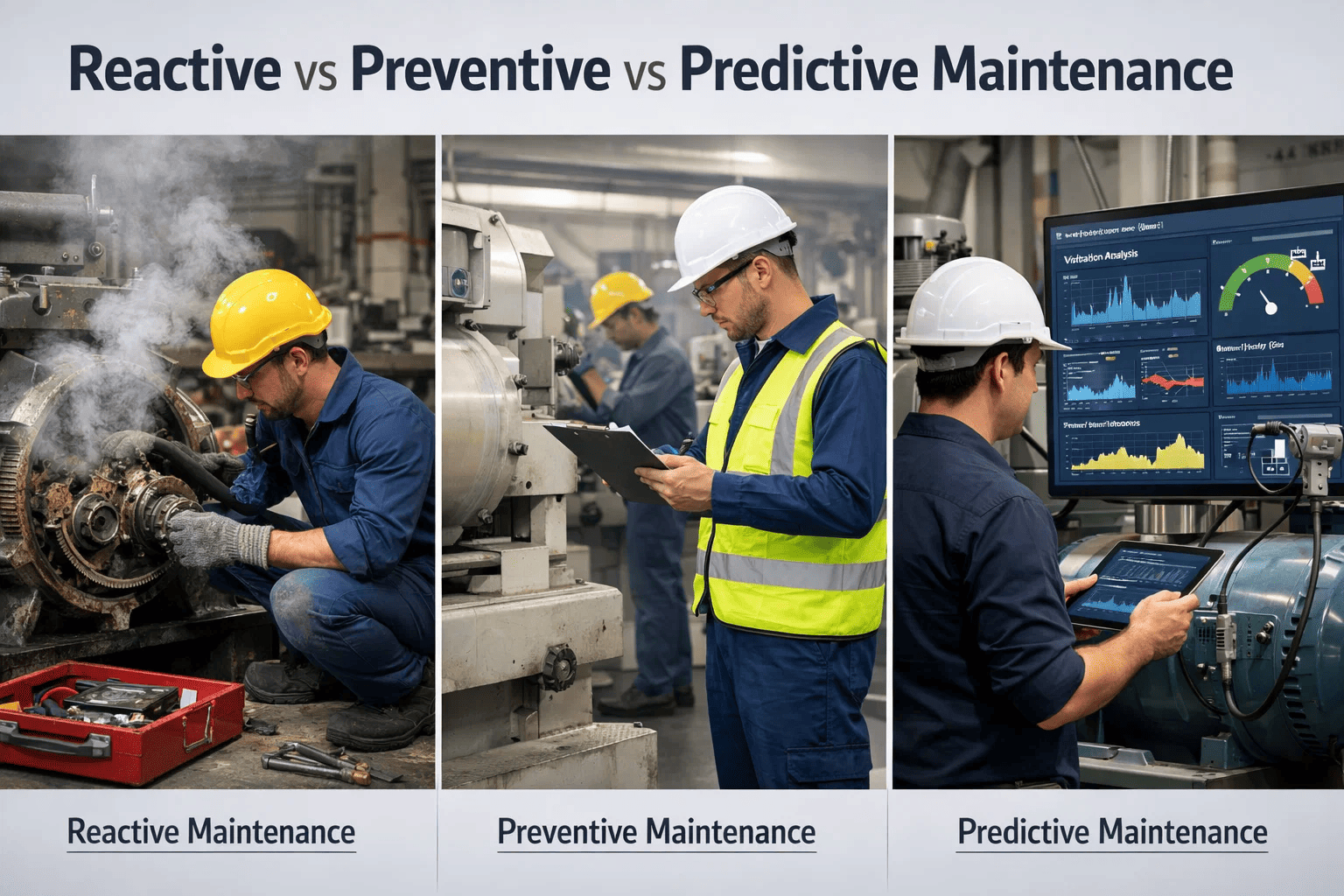
RCM vs PM vs PdM is the wrong framing — these aren't competing maintenance strategies, they're layers of a coherent reliability program, and most plants get the mix wrong by treating one as the answer to everything. Preventive maintenance (PM) saves 12–18% of operating costs by itself; RCM's asset-specific approach delivers 20–70% total maintenance cost reduction; and predictive maintenance (PdM) pushes asset life to 115–135% of rated life but only when each is deployed against the asset criticality tier it's designed for. Reactive maintenance still costs 4.8× more per event than planned work, so the real question isn't "which strategy" but "which strategy for which asset." Plants running predictive-heavy programs against high-criticality assets and PM against medium-criticality assets consistently report 52.7% less downtime and 78.5% fewer defects than reactive-dominant peers. Book a Demo to see OxMaint's mixed-strategy workflow — RCM analysis feeding PM schedules for medium-criticality and PdM triggers for high-criticality, all in one work-order queue.
Reliability Strategy · RCM · PM · PdM · CMMS 2026
RCM vs PM vs PdM: Choosing Your Maintenance Strategy
RCM, preventive, and predictive aren't competitors — they're a hierarchy. How to combine maintenance strategies for the best reliability per dollar, deployed by criticality tier in OxMaint.
4.8×
Reactive maintenance costs 4.8× more per event than the equivalent planned work
12–18%
Operating cost savings from PM alone, per U.S. Department of Energy O&M benchmarks
20–70%
Total maintenance cost reduction range from disciplined RCM implementation
115–145%
Asset life vs rated baseline achieved by PdM + RCM combined programs
The Strategy Hierarchy — RCM Sits on Top of PM and PdM
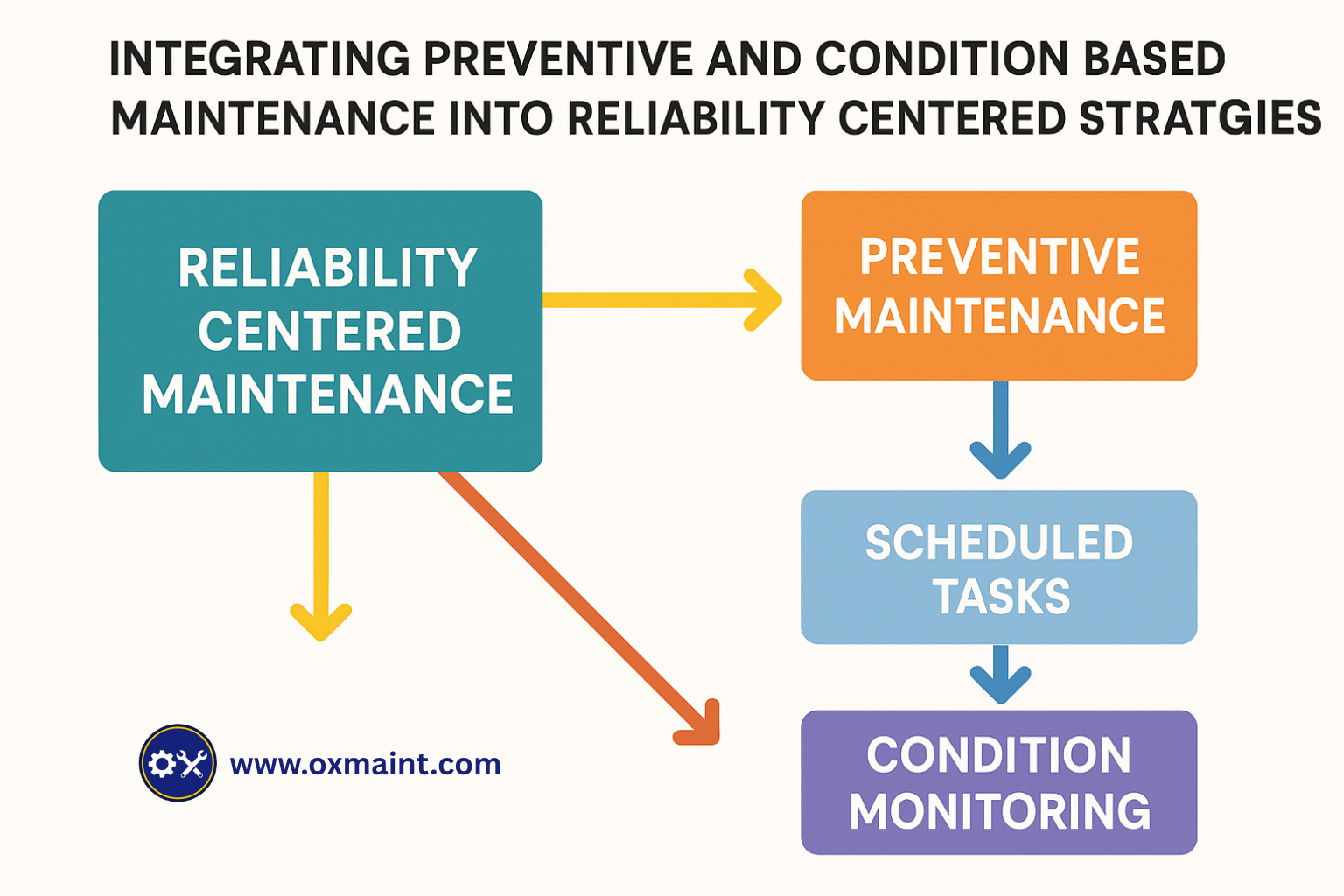
The common mistake is treating RCM, PM, and PdM as three separate strategies competing for the same asset. In reality, RCM is the methodology that decides whether a specific asset should run PM, PdM, run-to-failure, or a redesign. PM and PdM are execution modes; RCM is the selection framework above them. Start a free OxMaint workspace and load the strategy hierarchy against your first asset criticality tier in one sitting — the free plan includes RCM analysis, PM scheduling, and condition-monitoring triggers all in one platform.
RCM
Reliability Centered Maintenance — the framework that decides which strategy each asset uses. Analyzes failure modes and consequences, then selects the appropriate execution layer per asset.
↓ selects ↓
PM · Preventive
Time or usage-based schedules. Best for predictable wear patterns and medium-criticality assets where sensor ROI is unclear.
PdM · Predictive
Condition-triggered by sensor data. Best for high-criticality assets with detectable degradation patterns and high downtime cost.
RTF · Run-to-Failure
Deliberate reactive approach. Best for low-criticality, low-cost assets where PM/PdM investment exceeds prevented failure cost.
Side-by-Side Comparison — What Each Layer Actually Does
Here is the head-to-head on the dimensions that actually matter for asset strategy: trigger type, cost profile, asset life extension, best-fit criticality, and setup investment. All three layers coexist inside a mature RCM program — the question is which asset gets which. Book a live demo to see how the comparison applies to your specific asset mix — an OxMaint reliability engineer walks the strategy selection against your critical asset list during the call.
PM
Preventive Maintenance
TriggerCalendar / cycle count
Cost of maintenance2.5–3.5% of asset value
Asset life90–110% of rated life
Best-fit criticalityMedium — predictable wear
Setup effortLow — 60–90 days to value
WeaknessOver- or under-serviced assets
RCM
Reliability Centered Maintenance
TriggerAnalysis-selected task per FM
Cost of maintenance20–70% total cost reduction
Asset life125–145% of rated life
Best-fit criticalitySelects across all tiers
Setup effortHigh — FMEA + criticality workshops
WeaknessUpfront workshop investment
PdM
Predictive Maintenance
TriggerSensor threshold + AI baseline
Cost of maintenance1.8–2.8% of asset value
Asset life115–135% of rated life
Best-fit criticalityHigh — detectable degradation
Setup effortMedium — sensor + baseline learn
WeaknessSensor cost on low-criticality
The Strategy Selection Matrix — Criticality × Failure Pattern
The most defensible way to assign a strategy to an asset is a two-axis matrix — asset criticality on one axis, failure-pattern predictability on the other. Where a specific asset lands determines which layer of the hierarchy it belongs in. Sign up free and populate this matrix against your first plant asset list — OxMaint auto-suggests the recommended strategy per cell based on the asset criticality score and available sensor data.
RTF · Run-to-Failure
PM · Preventive
PdM · Predictive
RCM · Analysis-Selected
The Right Strategy Depends on the Asset — Not the Fashion.
Applying PdM to every asset is as wasteful as applying calendar PM to every asset. OxMaint deploys all four strategies (RTF, PM, PdM, RCM-selected) across your fleet based on criticality — one unified work order queue, three execution modes underneath.
The 4-Phase Migration Path — From Reactive to Mixed-Strategy
Migrating from a reactive-dominant program to a mixed-strategy RCM-led program is a 12–18 month journey in four phases. The mistake is trying to skip phases — teams that jump from reactive straight to predictive without the PM foundation almost always regress. Here is the proven sequence. Schedule a walkthrough to see where your program currently sits on this path and what Phase-2 or Phase-3 rollout looks like in OxMaint — the reliability engineer walks a phased plan against your critical asset list.
Phase 1
Reactive → Preventive
60–90 days
Build PM schedules on top 20% of assets by criticality. Move mean-time-to-planned above mean-time-to-emergency. Measurable downtime reduction inside first quarter.
Phase 2
PM Optimization
3–4 months
Refine intervals based on failure data. Cull over-serviced PMs; add missing coverage. Establish MTBF and MTTR baseline per asset class.
Phase 3
Condition Monitoring Rollout
4–6 months
Deploy vibration, temperature, current sensors on high-criticality assets. PdM triggers feed the same work order queue as PMs.
Phase 4
RCM Analysis & Mix-Optimization
Ongoing
FMEA-driven task selection per critical asset. RCM decides PM vs PdM vs RTF per failure mode. Continuous interval optimization.
Common Mixing Mistakes — And What to Do Instead
The five patterns below account for most reliability program stalls. Each represents a mismatch between the strategy chosen and the asset criticality it was applied to. Here's the diagnosis and the fix. Start free and OxMaint auto-flags these mismatches against your current PM library — the AI overlay shows which assets are being over-maintained by PM or under-monitored by missing PdM within your first month of data.
PdM on Every Asset
Sensor cost exceeds prevented failure cost on low-criticality assets. Fix: PdM only where failure cost × probability > sensor lifetime cost.
Calendar PM on Every Asset
Over-services healthy assets and misses drifting ones. Fix: PM on medium-criticality with predictable wear; PdM on high-criticality with detectable degradation.
Skipping PM Foundation to Jump to PdM
Alerts fire without process to close them. Fix: Complete Phase 1 + Phase 2 before Phase 3. PM discipline is the substrate.
RCM Analysis on the Whole Fleet
Workshop cost bankrupts the program before results land. Fix: RCM on top 10–20% by criticality. Standard PM libraries on the rest.
Run-to-Failure by Default (Not Design)
Assets fail unplanned because nobody decided the strategy. Fix: RTF is a chosen strategy, not a passive one. Document the decision per asset.
"
Our reliability team spent six months trying to roll out predictive maintenance across the whole fleet — the sensor bill was massive and the alerts landed in an inbox nobody watched. We restarted with OxMaint and rebuilt from the criticality matrix. Top-decile assets got PdM sensors and a live queue; middle-tier got refined PM schedules; low-criticality assets moved to documented run-to-failure. Six months later, unplanned downtime was down more than a third and the maintenance budget dropped 22%. The fix wasn't more technology. It was the right technology on the right asset.
Director of Reliability · Discrete Manufacturing · 340 assets across 2 plants · Southeastern USA
Frequently Asked Questions
Is RCM better than PM or PdM?
RCM isn't a competing execution strategy — it's the methodology that selects between PM, PdM, RTF, and redesign per asset. Mature programs use RCM to make the selection and PM/PdM to execute it. The three work together.
Should I deploy PdM on every asset?
No. Applying predictive monitoring to every asset is as wasteful as applying preventive schedules to every asset. Deploy PdM where downtime cost, failure severity, and detectable degradation together justify the sensor investment — typically the top 10–20% of assets by criticality.
Can we skip PM and go straight to PdM?
Not recommended. Predictive alerts require the PM foundation — a work-order process, technician response discipline, and asset-hierarchy accuracy. Teams that skip Phase 1 and 2 to jump to PdM almost always regress. Build PM first, then layer PdM.
How long does the migration take?
A proven 12–18 month timeline in four phases: PM foundation (Phase 1) delivers measurable downtime reduction in 60–90 days; PM optimization (Phase 2) adds another 3–4 months; condition monitoring rollout (Phase 3) takes 4–6 months; RCM analysis (Phase 4) is ongoing.
Does OxMaint support all four strategies (RTF, PM, PdM, RCM) simultaneously?
Yes. OxMaint manages RTF documented decisions, calendar/cycle-based PM schedules, sensor-triggered PdM work orders, and RCM analysis output all in one unified queue. Technicians see one list regardless of which strategy triggered the work.
What's the ROI of moving from reactive to mixed-strategy?
Plants that shift from reactive-dominant to PM + PdM report 52.7% less unplanned downtime and 78.5% fewer defects. Total maintenance cost drops from ~4% of asset value under reactive to 1.8–2.8% under PdM-inclusive programs.
Stop Choosing Between RCM, PM, and PdM. Use All Three.
OxMaint runs RCM analysis, PM scheduling, and PdM condition monitoring as one integrated program — with the strategy per asset driven by criticality, not fashion. One unified work order queue, three execution modes underneath, and the reliability outcome the mixed approach was designed to deliver.