Reliability-Centered Maintenance for integrated steel mills is no longer optional when a single unexpected trip on a blast furnace blower can wipe out $1.2M in lost production per day. RCM shifts maintenance from calendar guessing to engineered decisions anchored in failure modes, functional criticality, and documented consequence logic. OxMaint turns RCM findings into living CMMS rules — criticality tiers, PM libraries, and decision worksheets your planners actually use. Start with a Start Free Trial or book a demo with our reliability engineers today.
Stop firefighting. Engineer reliability into every asset from sinter plant to finishing line.
Calendar-based PM fails integrated mills because failure behavior varies wildly across coke ovens, BFs, BOFs, casters, and rolling lines. RCM classifies assets by criticality, identifies functional failures, and prescribes the right task — on-condition, restoration, discard, or run-to-failure — then writes it into the CMMS as living discipline.
When PM intervals are guesswork, the bill arrives at 3 a.m.
An integrated mill running at 90% utilization on a hot strip mill still loses roughly $50,000–$80,000 per hour of unplanned delay. Most of those losses trace back to assets on blanket time-based PM schedules that neither reflect failure modes nor asset criticality.
A 3.2 Mt/yr integrated plant spending $14M/yr on maintenance typically discovers 40–55% of preventive tasks are misaligned with actual failure modes during the first RCM study — tasks either performed too often, too late, or on the wrong failure characteristic.
The seven RCM gates that turn asset data into maintenance decisions
Per SAE JA1011, every RCM analysis answers seven questions in sequence. Skipping any gate produces a binder that gathers dust instead of PMs that prevent failure. OxMaint enforces the sequence inside the CMMS so the output is operational, not archival.
Functions defined
Document primary and secondary functions with performance standards for each asset — e.g., BF blower must deliver 7,200 m³/min at 4.2 bar, no leakage above 0.5%.
Functional failures
List every way the asset can fail to meet each function — total loss, partial loss, or performance drift outside spec.
Failure modes
Identify the specific physical cause of each functional failure — bearing seizure, refractory erosion, sensor drift, seal degradation, coil breakage.
Failure effects
Describe what happens when each mode occurs — production loss, safety event, environmental release, secondary damage, repair cost.
Consequence logic
Classify each failure consequence: safety, environmental, operational, or non-operational — the category drives the task-selection path.
Task selection
Assign on-condition, restoration, discard, failure-finding, or run-to-failure — chosen only after failure characteristic and consequence justify it.
Living in the CMMS
Each task becomes a scheduled PM with trigger, frequency, labor, parts, and documentation attached — continuously reviewed, not filed away.
Not every asset deserves the same maintenance investment
Criticality scoring ranks every asset by safety, environmental, production, and cost impact. OxMaint auto-classifies assets into tiers so PM frequency, inspection rigor, and spare-stock levels match the actual risk — not a uniform blanket.
S = safety severity (1–5) · E = environmental severity (1–5) · P = production impact (1–5) · C = cost impact (1–5) · W = weight factor per plant policy. Assets scoring 18+ are Tier A (critical), 10–17 Tier B (essential), below 10 Tier C (run-to-failure candidates).
Critical · CS ≥ 18
BF blowers, turbochargers, main mill motors, descaling pumps. Full RCM analysis, condition monitoring, 30-day PM review.
~12% of assetsEssential · CS 10–17
Conveyor drives, hydraulic power units, cooling-water pumps, furnace fans. Streamlined RCM, on-condition tasks, quarterly review.
~38% of assetsStandard · CS < 10
Lighting circuits, minor piping, non-critical instrumentation. Basic PM or run-to-failure with adequate spares, annual review.
~50% of assetsMatch the task to the failure — not the calendar
The RCM decision worksheet maps each failure mode to a task type only when the failure characteristic supports it. Age-related failures earn time-based PM; random failures earn condition monitoring; hidden failures earn failure-finding tasks.
| Failure characteristic | Asset example (integrated steel) | RCM task type | Typical interval |
|---|---|---|---|
| Clear age-reliability pattern | BF refractory wear, caster mold copper | Scheduled restoration / discard | 120K–800K tonnes cast |
| Detectable degradation signal | Mill motor bearing vibration, gearbox oil particulate | On-condition monitoring | Continuous / weekly sample |
| Random failure, no warning | Electronic card failure, instrument board | Run-to-failure + spares | On failure |
| Hidden failure w/ redundant backup | Standby hydraulic pump, backup cooling fan | Failure-finding task | 30–90 days |
| Safety / environmental consequence | CO gas valve, EAF dust-collection damper | Proactive + on-condition + override | Mandatory + condition-triggered |
A 3.2 Mt/yr mill, 1,847 assets, 14 months in
A Midwest integrated mill ran a full RCM program across sinter, BF, BOF, continuous caster, hot strip mill, and cold rolling finishing lines. Here is what disciplined RCM delivered when outputs lived inside the CMMS rather than on a shelf.
Asset register & criticality baseline
1,847 assets registered and scored. 221 classified Tier A, 702 Tier B, 924 Tier C. Eliminated 340 duplicate or orphan records inherited from legacy CMMS.
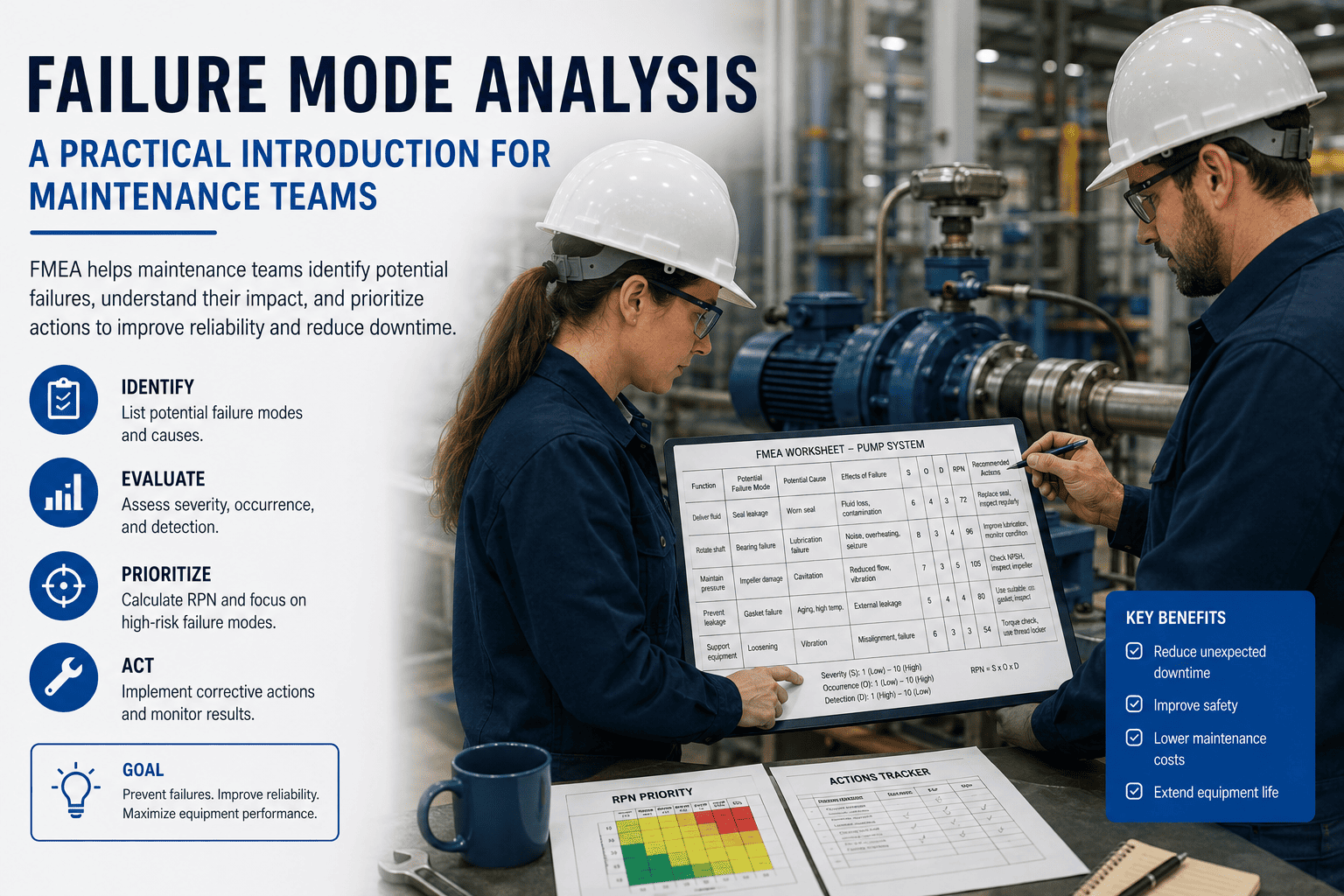
FMEA on Tier A & B assets
923 assets analyzed. 4,612 failure modes documented. 61% of existing PM tasks revised, 18% retired, 21% newly created — every change written directly into OxMaint.
Task library goes live
New PM library deployed. Vibration, thermography, oil analysis, and ultrasonic thickness routes scheduled from RCM outputs. Mean PM compliance rose from 71% to 94%.
Measured reliability uplift
MTBF up 38% on Tier A assets. Unplanned downtime down 22%. Maintenance spend as % of replacement-asset-value fell from 3.1% to 2.4%. Payback achieved in 9.4 months.
Turn your next RCM study into operational discipline
OxMaint keeps criticality tiers, failure-mode libraries, and RCM decision worksheets continuously active in the CMMS your planners already use — no binders, no spreadsheets, no drift.
RCM for integrated steel — the questions reliability leads ask
Practical answers for engineers running an RCM program inside a real plant with real downtime pressure.
How long does a full RCM rollout take for an integrated mill?
For a 1,500–2,000-asset integrated plant, expect 12–18 months end-to-end: 2 months for asset register and criticality, 4–6 months for FMEA on Tier A and B assets, 2–3 months for task-library deployment, and 3–4 months of measurement. OxMaint compresses the documentation phase by writing decisions directly into the CMMS as you analyze, eliminating the re-entry lag.
Do we need ISO 55001 certification to benefit from RCM?
No. RCM is a maintenance-decision methodology compliant with SAE JA1011, while ISO 55001 is an asset-management system standard. Many mills run RCM without formal ISO certification and still capture 20–35% downtime reductions. RCM does, however, satisfy a large portion of ISO 55001 asset-life-cycle requirements if you later pursue certification. You can Start Free Trial to map your existing PM library against JA1011 gates inside OxMaint.
Which assets should we analyze first?
Always start with Tier A — typically 10–15% of assets that carry 70–80% of production risk: blast furnace blowers and turbochargers, BOF vessel drives, continuous caster molds and segments, main rolling-mill motors, and descaling high-pressure pumps. These assets have the clearest failure modes, the highest downtime cost, and the fastest payback on analysis effort.
How does OxMaint keep RCM outputs from drifting back to firefighting?
Every PM task in OxMaint is linked back to its RCM decision record — the failure mode, consequence category, and task-selection logic that justified it. When a failure recurs, the system flags the task for review automatically. PM compliance, MTBF trend, and failure-mode recurrence are visible on a single dashboard, so drift is caught within days, not at the next annual audit.
Can RCM coexist with predictive maintenance sensors we already have?
Yes — RCM is what tells you which assets deserve PdM investment in the first place. Vibration, oil analysis, thermography, and ultrasonic sensors are task types selected when RCM identifies a detectable failure-characteristic signal. Without RCM, plants often instrument low-criticality assets while missing the failure modes that actually drive downtime. Book a walkthrough at Book a Demo to see the integration.
Engineer reliability where it pays — on the assets that move your tonnes
Deploy OxMaint and turn RCM findings into living CMMS rules across sinter, BF, BOF, caster, and finishing lines in weeks, not years.
Free 14-day trial · No credit card