Every hour of unplanned equipment downtime costs industrial facilities anywhere from $100,000 to over $2 million depending on the sector. The root cause is almost always the same: faults that developed silently between manual inspection rounds. Robotic predictive maintenance inspection systems eliminate this blind spot entirely. Autonomous robots equipped with thermal cameras, ultrasonic acoustic sensors, and AI-driven visual analysis now patrol facilities around the clock, detecting overheating bearings, compressed air leaks, corrosion, and dozens of other failure signatures weeks before catastrophic breakdown. When that sensor intelligence feeds directly into a Sign Up with CMMS like Oxmaint, every detected anomaly becomes a prioritized work order automatically, closing the loop between detection and repair without a single spreadsheet or email.
What Makes Multi-Sensor Robotic Inspection a Game-Changer
Traditional predictive maintenance relies on fixed IoT sensors bolted to individual assets or periodic manual rounds with handheld instruments. Both approaches have critical limitations. Fixed sensors cover only the assets they are attached to, leaving gaps across the facility. Manual rounds are infrequent, inconsistent, and put workers into hazardous zones. Autonomous inspection robots solve both problems at once, acting as mobile sensor platforms that collect thermal, acoustic, and visual data from hundreds of assets on every patrol. The data is consistent, timestamped, and ready for AI analysis the moment it is captured.
$1.4 Trillion
Annual losses from unplanned downtime across Fortune 500 companies alone. Robotic predictive inspection systems target the root cause: undetected equipment degradation between inspection cycles.
Thermal Imaging: Seeing Heat Before Failure Strikes
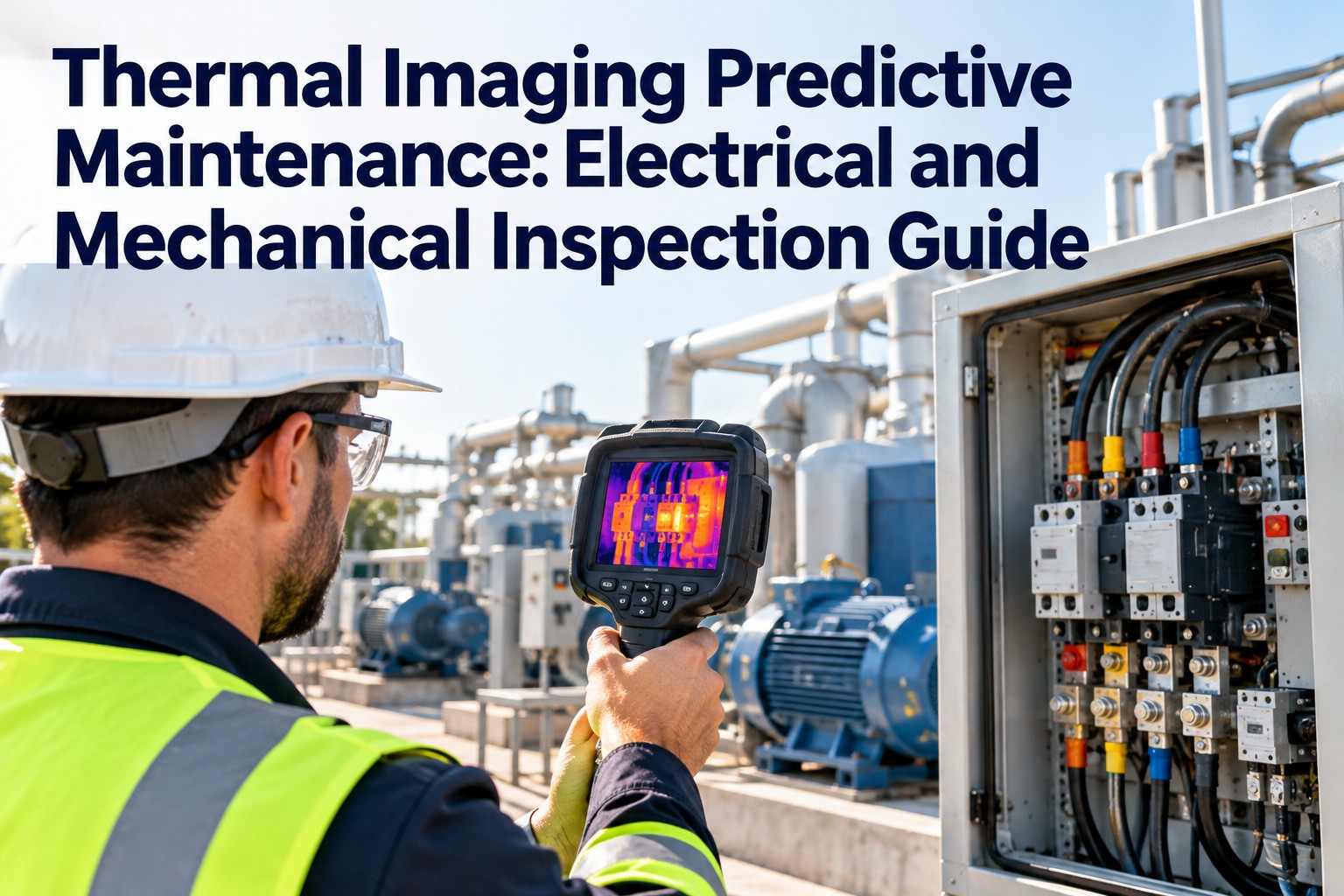
Infrared thermography is one of the most established predictive maintenance technologies, and mounting thermal cameras on autonomous robots multiplies their value exponentially. Instead of a technician scanning a handful of assets during a scheduled walkdown, a robot captures thermal profiles of every monitored asset on every round, building a rich historical baseline that AI algorithms use to spot deviations as small as two to three degrees Celsius.
Thermal Imaging Capabilities
Detection range: -40 C to 2000 C | Sensitivity: 0.02 C
Detects
Overheating bearings and motors
Loose or corroded electrical connections
Refractory and insulation degradation
Blocked heat exchangers and steam traps
Abnormal friction in rotating assemblies
How AI Enhances It
Compares current scans against historical thermal baselines
Tracks temperature trends over weeks and months
Auto-classifies anomalies by failure type and severity
Triggers work orders in Oxmaint when thresholds are crossed
Acoustic and Ultrasonic Sensing: Hearing What Humans Cannot
Many equipment failures broadcast their approach through sound long before any visible symptom appears. Bearing wear, compressed air leaks, partial electrical discharge, and cavitation in pumps all produce ultrasonic signatures in the 20 kHz to 100 kHz range, far above what human hearing can detect. Acoustic sensors mounted on inspection robots capture these signals continuously and feed them to AI models trained on thousands of known failure patterns to classify and localize each anomaly in real time.
Acoustic and Ultrasonic Capabilities
Frequency range: 20 kHz - 100 kHz | Leak location accuracy: within 30 cm
Detects
Compressed air, gas, and vacuum leaks
Early-stage bearing wear and lubrication failure
Partial discharge in electrical switchgear
Pump cavitation and valve blow-through
Mechanical looseness in rotating equipment
How AI Enhances It
Separates failure signals from ambient plant noise
Estimates leak severity and cost impact automatically
Maps acoustic anomalies to exact asset locations
Prioritizes alerts by financial impact in Oxmaint
AI-Powered Visual Analysis: Spotting What the Eye Misses
High-resolution cameras and LiDAR sensors on inspection robots capture detailed visual data that computer vision models analyze at the pixel level. These systems read analog gauges, detect corrosion progression, identify oil leaks, verify safety signage compliance, and flag physical damage, all without a human inspector ever entering the area. The consistency of robotic visual capture, same angle, same lighting, same distance every time, is what makes AI trend analysis so powerful compared to subjective human observation.
AI Visual Inspection Capabilities
Resolution: up to 4K at 60fps | Defect detection: sub-millimeter accuracy
Detects
Surface corrosion and crack propagation
Oil, coolant, and hydraulic fluid leaks
Gauge and display readings via OCR
Missing or displaced components
Safety and compliance deviations
How AI Enhances It
Compares images against known good-state baselines
Tracks corrosion growth rate over time
Reads gauges and logs values into CMMS automatically
Generates visual evidence attached to Oxmaint work orders
Every Sensor Alert Becomes a Work Order
Oxmaint CMMS connects directly with robotic inspection platforms so thermal hotspots, acoustic anomalies, and visual defects automatically generate prioritized maintenance tasks with full sensor data attached.
Where Manual Rounds Fall Short and Robots Excel
The gap between traditional inspection programs and robotic multi-modal systems is not incremental. It is a fundamental shift in how quickly, consistently, and safely condition data is captured and acted upon. Here is what that difference looks like in practice across the metrics that matter most to maintenance and reliability teams.
Inspection frequency
Monthly or quarterly
Daily or hourly
Data consistency
Varies by inspector
Identical every round
Hazardous area access
Requires permits and PPE
Autonomous, no human risk
Sensor modalities per round
Typically one specialist tool
Thermal + acoustic + visual simultaneously
CMMS integration
Manual data entry after rounds
Auto-generated work orders in real time
Early fault detection rate
30-40% of developing faults caught
95%+ with AI anomaly detection
Closing the Loop: From Sensor Data to Completed Repair
Raw inspection data is only valuable when it drives action. The most advanced robotic inspection programs fail to deliver ROI if sensor findings sit in a separate dashboard disconnected from maintenance workflows. That is why integration between your inspection robots and your Sign up with - CMMS platform is not optional but essential. Here is how the complete closed-loop workflow operates when robotic inspection feeds into Oxmaint.
1
Robot Patrols on Schedule
Autonomous inspection robots execute pre-programmed routes across the facility, capturing thermal images, acoustic readings, and high-resolution visuals at every monitoring checkpoint. Each data point is timestamped and geotagged to the specific asset.
2
AI Classifies Every Anomaly
Machine learning models analyze the multi-sensor data against historical baselines in real time. A thermal hotspot on a motor, an ultrasonic signature matching early bearing wear, or a visual indicator of oil seepage are each classified by type and scored by severity.
3
Oxmaint Creates the Work Order
Anomalies exceeding defined thresholds push directly into Oxmaint, generating prioritized work orders with the sensor data, AI classification, asset maintenance history, and recommended corrective actions all attached. No manual data entry required.
4
Technician Completes the Repair
Maintenance teams receive the work order on their mobile devices via Oxmaint, review the attached evidence, and execute the repair. All labor, parts, and completion data is tracked within the platform for full audit traceability.
5
Next Round Verifies the Fix
On subsequent patrols, the robot re-inspects the same asset. AI compares post-repair sensor readings against the pre-repair anomaly data to confirm the issue is resolved, automatically closing the work order in Oxmaint if validated.
Want to see this workflow running live? Schedule a personalized demo and we will walk through how Oxmaint automates the entire detection-to-repair pipeline for your facility.
Industries Where Robotic Inspection Delivers the Highest Impact
While autonomous inspection systems apply across every asset-intensive sector, certain industries gain outsized benefits due to the combination of hazardous environments, high-value equipment, and steep downtime costs. Here is how robotic predictive inspection adapts to the unique requirements of each.
Oil and Gas
Key assets: Pipelines, compressors, fired heaters, flare stacks, offshore platforms
Primary sensors: Thermal + acoustic + gas detection
Top detections: Hydrocarbon leaks, corrosion under insulation, bearing failure, fugitive emissions
Power Generation
Key assets: Turbines, boilers, transformers, switchgear, cooling towers
Primary sensors: Thermal + visual + vibration
Top detections: Electrical hotspots, insulation breakdown, steam leaks, blade erosion
Manufacturing
Key assets: Motors, conveyors, CNC machines, pumps, HVAC, packaging lines
Primary sensors: Acoustic + thermal + visual
Top detections: Belt misalignment, compressed air leaks, motor overheating, weld defects
Chemical and Pharma
Key assets: Reactors, heat exchangers, storage tanks, piping, HVAC
Primary sensors: Thermal + gas + visual
Top detections: Exothermic anomalies, seal leaks, vessel corrosion, compliance gaps
Mining and Metals
Key assets: Crushers, SAG mills, haul trucks, conveyors, grinding circuits
Primary sensors: Vibration + thermal + visual
Top detections: Crusher bearing failure, belt damage, drive motor overheating
Food and Beverage
Key assets: Refrigeration, boilers, packaging machines, clean-in-place systems
Primary sensors: Thermal + acoustic + visual
Top detections: Compressor faults, steam trap failures, hygiene compliance issues
Measurable Returns from Robotic Predictive Inspection Programs
The financial case for autonomous inspection is well documented across industries. Robotic systems consistently deliver measurable reductions in unplanned downtime, maintenance labor costs, and safety incidents while extending the useful life of critical equipment. Here are the numbers that maintenance leaders report after deployment.
40%
reduction in unplanned downtime through early fault detection across thermal, acoustic, and visual modalities
60%
fewer safety incidents by removing workers from hazardous inspection zones and automating confined space rounds
25-40%
lower overall maintenance costs compared to reactive and time-based maintenance strategies
12-18 mo
typical payback period, with 3 to 5 times return on investment over a five-year deployment
Calculate Your Savings Potential
Create a free Oxmaint account and our team will model the ROI specific to your facility, your equipment, and your current maintenance costs.
Getting Started: A Phased Deployment That Delivers Quick Wins
Implementing robotic predictive inspection does not require overhauling your entire maintenance program overnight. The most successful deployments follow a phased approach that starts with your most critical assets and expands based on proven results. Integrating with Oxmaint CMMS by Signing up from the pilot phase ensures that the automated inspection-to-action pipeline is validated before scaling facility-wide.
Phase 1: Assessment
Weeks 1-3
Rank assets by criticality and downtime cost. Map inspection routes. Define sensor requirements per asset. Architect the CMMS integration with Oxmaint so work orders flow from day one.
Phase 2: Pilot Deployment
Weeks 4-7
Commission the robot in your highest-value zone. Collect thermal, acoustic, and visual baselines across all monitored assets. Test the automated work order pipeline end to end.
Phase 3: Calibration
Weeks 8-10
Tune AI anomaly thresholds to reduce false positives. Refine work order priority rules. Train maintenance teams on the new Oxmaint workflow and mobile work order management.
Phase 4: Scale Facility-Wide
Week 11+
Expand routes to additional zones. Deploy more robots as needed. Leverage growing data to continuously improve AI model accuracy and predictive lead times.
Bridge the Gap Between Robotic Inspection and Maintenance Action
Your inspection robots generate powerful multi-sensor data. Oxmaint transforms that data into automated, prioritized work orders, tracks repairs to completion, and verifies fixes on the next robotic round. Build a truly closed-loop predictive maintenance program today.
Frequently Asked Questions
Which equipment types benefit most from robotic predictive inspection?
Rotating equipment like motors, pumps, and compressors delivers the fastest ROI because thermal and acoustic sensors catch bearing wear, misalignment, and lubrication issues weeks before failure. Electrical infrastructure including transformers, switchgear, and distribution panels also benefits enormously from automated thermal scanning. However, any asset with a measurable failure signature, whether heat, sound, or visual, is a candidate.
Sign up for Oxmaint to see how inspection findings map to work orders for every asset class.
How does robotic sensor data flow into a CMMS like Oxmaint?
Inspection robot platforms transmit classified anomaly data through APIs that connect directly to Oxmaint. When the AI detects a thermal hotspot exceeding a defined threshold or an acoustic signature matching a known failure pattern, Oxmaint automatically creates a work order with the severity level, sensor evidence, asset history, and recommended action. Maintenance teams receive the task on their mobile devices immediately, eliminating manual data re-entry and ensuring nothing is missed.
Can we deploy robotic inspection in older facilities without major infrastructure upgrades?
Yes. Modern inspection robots are built to navigate real-world industrial environments including stairs, ramps, uneven floors, and narrow aisles without any facility modifications. The primary technical requirement is network connectivity for data transmission, which most plants already have.
Book a demo to discuss how Oxmaint integrates with your existing plant infrastructure and maintenance workflows.
What is the typical timeline from deployment to measurable ROI?
Most facilities identify significant cost-saving anomalies within the first 30 days of robotic inspection. Common early wins include compressed air leaks costing thousands per month, overheating electrical connections headed toward failure, and bearing degradation detected weeks before breakdown. Full payback on the inspection investment typically occurs within 12 to 18 months, with returns compounding as AI models learn your facility-specific patterns.
Why combine thermal, acoustic, and visual inspection in a single robotic platform?
Different failure modes produce different signatures. A bearing beginning to fail may show a thermal hotspot and an acoustic anomaly but look visually normal. A corroded pipe may appear damaged visually but show no thermal signature yet. Combining all three modalities in a single round gives your maintenance team the most complete picture of asset health and dramatically reduces the chance of missing a developing fault.
Sign up for Oxmaint to centralize multi-modal inspection data in one maintenance platform.