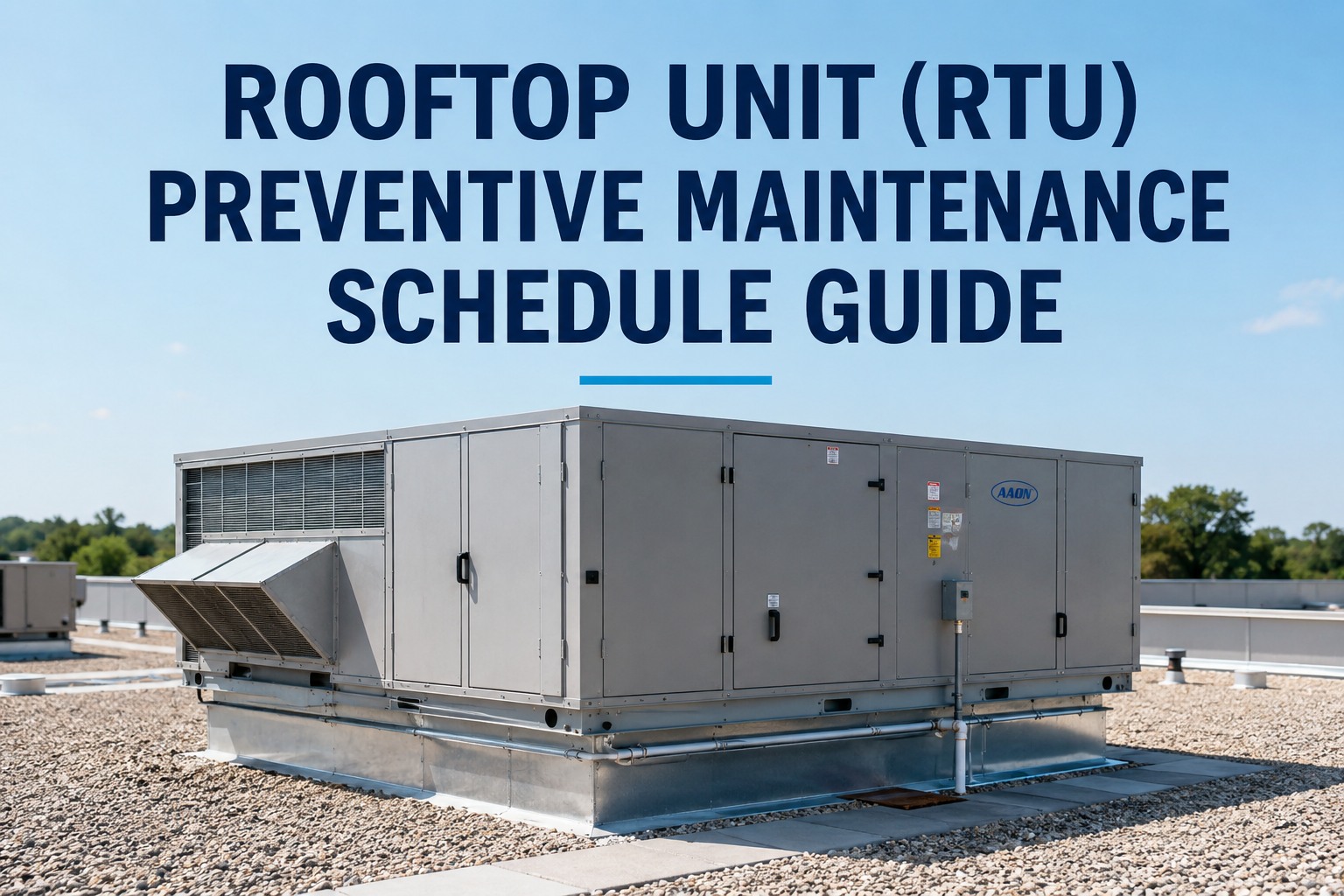
A commercial rooftop unit is arguably the most abused piece of HVAC equipment in modern building operations. It sits five stories up, blasted by UV, hammered by rain, iced over in winter, baking through summer, and — critically — completely out of sight. Occupants never see it. Facility managers rarely think about it. The BAS logs its runtime dutifully, but nobody actually looks at the logs until the day the compressor locks out during a July heat wave and the emergency service invoice hits $6,000. The pattern is universal because the incentive structure is upside down: RTUs are the highest-risk, lowest-attention HVAC assets in the building. A structured PM schedule flips that pattern — and this guide walks through the seasonal cadence, task-level detail, and CMMS scheduling model that keep rooftop fleets running through their full 15-20 year service life. Book a free demo to see RTU PM scheduling inside OxMaint.
Belt inspection & replacement
$50
$3,000-8,000 compressor burnout
160×
Condenser coil chemical cleaning
$300
$4,500 annual energy loss + comp stress
15×
Quarterly filter changes
$120
$2,000 frozen coil + labor
17×
Refrigerant charge verification
$180
$5,500 lost capacity + EPA penalty risk
30×
Condensate drain pan flush
$40
$2,800 ceiling water damage claim
70×
PM investment
Failure cost avoided
15-20
years expected RTU service life with structured PM vs 8-12 years under reactive maintenance
80%
of RTU compressor failures show detectable warning signs a proper PM inspection would catch
15-20%
cooling efficiency lost from a fouled condenser coil — recovered by a single annual cleaning
Why RTUs Fail — The Chain of Consequence
RTU failures almost never come out of nowhere. They come from a cascade — a small task skipped in month one becomes a compressor lockout in month nine. Understanding the chain is the first step in scheduling PM correctly, because each link in the chain is a task that PM prevents.
The Skipped-PM Failure Chain
Filter change skipped
Static pressure drop climbs steadily
Airflow drops across evaporator
Suction pressure falls below design
Evaporator ices, drain overflows
Water damage begins in ceiling
Compressor cycles under abnormal load
Bearing wear accelerates rapidly
Compressor burnout mid-summer
$3-8K replacement + emergency premium
The Six Systems Every RTU PM Must Cover
A rooftop unit is a packaged system — every component sits inside one cabinet on the roof — but the PM discipline required varies dramatically between subsystems. Filters and drain pans need attention monthly. Coils and belts move on a seasonal cadence. Refrigerant and electrical systems fall on quarterly and annual rhythms. A generic "check the RTU" work order misses this granularity. OxMaint's RTU asset template splits every unit into these six PM domains so nothing falls between the cracks.
01
Filters & Airflow
Air filters, static pressure taps, fan belt, blower wheel
Monthly / Quarterly
02
Coils & Heat Transfer
Condenser coil, evaporator coil, fin condition, drain pan
Quarterly / Annual
03
Refrigerant Circuit
Superheat, subcooling, sight glass, leak detection, EPA log
Quarterly / EPA 608
04
Electrical & Controls
Contactors, capacitors, amp draw, wiring, thermostat
Semi-Annual
05
Economizer & Dampers
Damper actuators, position sensors, OA/RA linkage, enthalpy
Semi-Annual
06
Cabinet & Curb
Panels, curb gasket seal, mounting hardware, weep holes
Annual
The 12-Month RTU PM Calendar
Effective rooftop PM is anchored to the shoulder seasons — the moments before peak cooling and peak heating demand hit. Get the pre-cooling package done in March, the pre-heating package done in September, and the year almost runs itself. The 12-month strip below shows how the tasks distribute across the calendar and where the natural workload peaks fall.
Annual PM Workload Distribution
Pre-Cooling Peak · Mar-Apr
Condenser cleaning, refrigerant verification, belt replacement, capacitor test, economizer calibration, filter change
Cooling Season · May-Aug
Monthly filter checks, drain pan flush, condensate biocide, condition monitoring, emergency response readiness
Pre-Heating Peak · Sep-Oct
Heat exchanger inspection, burner service, gas valve test, ignition system, CO check, fresh filter set for heating cycle
Filter Program: The Cheapest PM With Compounding Impact
Filter changes look trivial — a few minutes of technician time and a $15-40 filter — but they are the single most impactful PM task by frequency. A filter left in service too long doesn't just underperform: static pressure across the filter bank rises, blower motor amp draw climbs, evaporator airflow falls, and every downstream system starts working under stress it wasn't designed for. The filter loading curve below shows why the "change when dirty" approach almost always waits too long.
Weeks 1-6 · Safe
Airflow within spec, motor amp at baseline
Weeks 7-10 · Change window
ΔP rising 40-60%, energy cost climbing
Weeks 11+ · Damage zone
Motor stress, coil freeze risk, IAQ complaints
OxMaint fires the filter-change work order at the change window — not when static pressure has already crossed into the damage zone
Coil Cleaning: The Highest-ROI Rooftop Task
Annual condenser coil chemical cleaning is arguably the single most valuable maintenance action on any rooftop unit. Fouling is invisible from the ground — the coil looks fine — but a moderately dirty condenser costs 15-20% of cooling efficiency and raises discharge pressure enough to accelerate compressor wear noticeably. A two-hour cleaning that costs a few hundred dollars in labor and chemicals recovers thousands in annual energy and prevents thousands more in premature compressor replacement.
CLEAN COIL
Cooling capacity100%
Discharge pressureDesign spec
Compressor amp drawBaseline
Annual energy costRated
Compressor lifeFull 15-20 yrs
FOULED COIL
Cooling capacity80-85%
Discharge pressure+30-50 psi
Compressor amp draw+15-25%
Annual energy cost+18-25%
Compressor lifeShortened 30-40%
Chemical cleaning cost: $200-400 · Annual value recovered: $2,500-5,500 per RTU
Schedule Coil Cleaning Across Your Full Rooftop Fleet
OxMaint tracks the last cleaning date for every RTU asset, calculates due dates against seasonal readiness, and dispatches the work orders with the right technician, chemicals, and safety notes attached. See it live in a 30-minute walkthrough.
Belt Inspection: The $50 Part That Protects the $5,000 Compressor
Most commercial RTUs use belt-driven fans. When a belt slips, airflow drops. When a belt snaps, airflow stops, coils freeze or overheat, and the compressor takes the damage the belt failed to prevent. Belt condition assessment is a 5-minute task — but only if the technician actually does it, and only if the result is logged. The four condition states below define when to replace, and OxMaint captures the assessment against the RTU asset every visit.
Good
No cracks, correct tension, alignment true, less than 24 months in service
Next check: quarterly
Watch
Light glazing visible, tension marginal, 24-36 months in service, no visible cracks
Next check: monthly + stock spare
Replace Soon
Cracking visible, tension out of spec, glazing pronounced, over 36 months in service
Schedule replacement this cycle
Failed
Broken, missing, or unable to maintain tension after retightening
Emergency work order — do not run
Refrigerant Charge Verification & EPA 608 Compliance
A rooftop unit that is 10% low on refrigerant charge loses roughly 20% of its cooling capacity while the compressor works harder to compensate. The problem is that "low on charge" is invisible without proper measurement — no light comes on, no alarm sounds, and the RTU keeps running until an occupant reports warm supply air. Quarterly superheat and subcooling readings against the design baseline detect charge drift long before performance degrades noticeably, and every refrigerant addition must be logged per EPA Section 608 regulations.
Quarterly Refrigerant Reading Card
Suction pressure___ psig
Discharge pressure___ psig
Superheat___ °F
Subcooling___ °F
Outdoor ambient___ °F
Refrigerant added___ lb
EPA 608 Compliance
Log every refrigerant addition — type, quantity, date, technician certification
Systems with 50+ lb charge require detailed leak-rate documentation
Annual leak rate exceeding 30% requires repair within 30 days
OxMaint calculates rolling annual leak rate automatically per unit
The RTU PM Frequency Matrix at a Glance
The matrix below is the master reference — every major RTU task mapped to its correct frequency across monthly, quarterly, semi-annual, and annual intervals. OxMaint stores this matrix as the default template applied to every RTU asset on onboarding, then customizes it per unit based on runtime, environment, and load profile.
Air filter inspection & replacement
Condensate drain pan flush & biocide
Visual inspection & abnormal sound check
Refrigerant superheat / subcooling
Electrical connections torque check
Contactor & capacitor test
Economizer damper calibration
Condenser coil chemical cleaning
Evaporator coil deep clean
Heat exchanger integrity & CO test
Belt replacement (units > 5 yr)
Cabinet, curb seal & weep holes
M · Monthly · Q · Quarterly · SA · Semi-Annual · A · Annual
How OxMaint Runs This Across a Multi-Building Rooftop Fleet
A single RTU is manageable on a spreadsheet. Forty RTUs across eight buildings is not. Each unit has its own model, refrigerant type, install date, filter size, belt spec, and PM history — and each unit ages differently based on runtime and environment. OxMaint stores every RTU as an individual asset with all of these attributes, generates the correct PM work orders per unit at the correct frequency, and rolls the status up into a portfolio dashboard that shows exactly where attention is needed at any moment.
RTU-01
Building A · North
All PMs current
RTU-02
Building A · South
All PMs current
RTU-05
Building B · Roof
Filter due · 4 days
RTU-07
Building C · West
All PMs current
RTU-09
Building C · East
Coil clean overdue
RTU-12
Building D · Main
Belt watch · replace
RTU-14
Building E · Zone 1
All PMs current
RTU-16
Building F · Roof
Refrigerant reading due
PM current
Due soon
Overdue / action required
Expert Perspective · The Trend Data Is the Real Value
Every technician knows to check refrigerant pressures on an RTU. The difference between a shop that catches compressor failures early and a shop that reacts to them is not the skill of the person taking the reading — it is whether the reading gets logged, trended, and compared against last quarter. A single quarterly reading tells you almost nothing. Four quarters of readings tells you exactly whether the compressor is trending toward failure, which coil is fouling faster than expected, and which unit will need the next capital replacement. OxMaint is the mechanism that turns individual readings into that trend line. Once the trend data exists, the whole reactive-to-proactive shift happens almost by itself.
Log Every Reading
Refrigerant pressures, amp draws, superheat, subcooling — captured on the technician mobile device in OxMaint at the point of work.
Trend by Unit
Every reading rolls up to the RTU asset in OxMaint, showing 12+ months of history against the design baseline.
Act on Drift
When any reading drifts from baseline, OxMaint alerts before the failure — replacing crisis response with planned intervention.
Stop Discovering RTU Problems in July
Every RTU failure surprise happens because someone was managing the fleet from memory instead of a system. See what OxMaint — a maintenance management platform purpose-built for commercial HVAC — looks like against your actual rooftop portfolio.
Frequently Asked Questions
How often should commercial RTU filters actually be replaced?
The right interval depends on runtime, building use, and outdoor air quality — but the practical baseline is monthly inspection and replacement no later than the 6-10 week mark for standard MERV 8-13 filters. Restaurants and warehouses need more frequent changes than offices. OxMaint fires the filter-change work order per RTU based on the correct interval for that unit's load profile, not a one-size-fits-all quarterly reminder.
Why is annual condenser coil cleaning considered so important?
A fouled condenser coil costs 15-20% of cooling capacity and raises discharge pressure enough to stress the compressor significantly. A two-hour cleaning costing $200-400 in labor and chemicals recovers thousands in annual energy cost and extends compressor life by years. It is the highest-ROI single maintenance task on any rooftop unit, which is why OxMaint prioritizes it in every annual pre-cooling PM package.
When should RTU belts be replaced?
Belts should be inspected quarterly and replaced annually on units older than 5 years — regardless of visible condition. A $30-60 belt that fails under summer load causes a $3,000-8,000 compressor burnout when airflow stops. OxMaint tracks belt installation date per RTU and generates replacement work orders during pre-cooling and pre-heating season PM windows, so failures happen during scheduled maintenance rather than mid-August emergencies.
How does refrigerant charge verification meet EPA 608 requirements?
Quarterly superheat and subcooling readings against the design baseline detect charge drift early. Any refrigerant addition must be logged with type, quantity, date, and technician certification. Systems with 50+ pound charge require detailed leak-rate documentation, and systems exceeding a 30% annual leak rate must be repaired within 30 days. OxMaint captures every reading and addition at the point of work and calculates rolling annual leak rates automatically per unit.
Can OxMaint manage PM across a multi-building RTU fleet?
Yes. OxMaint is designed for multi-site portfolios. Each RTU is set up as an asset with its own PM schedule, specifications, service history, and compliance records. The portfolio dashboard shows PM completion rates, overdue tasks, and equipment health trending across all sites from one view. Technicians can be assigned to specific buildings or RTU groups, with work orders delivered to their mobile devices with checklist items, prior history, and equipment documentation pre-loaded.
What is the expected service life of a well-maintained commercial RTU?
Commercial RTUs have an expected service life of 15-20 years under a structured PM program. Units receiving only reactive maintenance typically fail economically at 8-12 years. The most critical factors in RTU longevity are consistent coil cleaning, refrigerant charge maintenance, electrical component replacement before failure, and cabinet and curb seal protection from water infiltration — all captured in the OxMaint PM template applied to every rooftop asset.