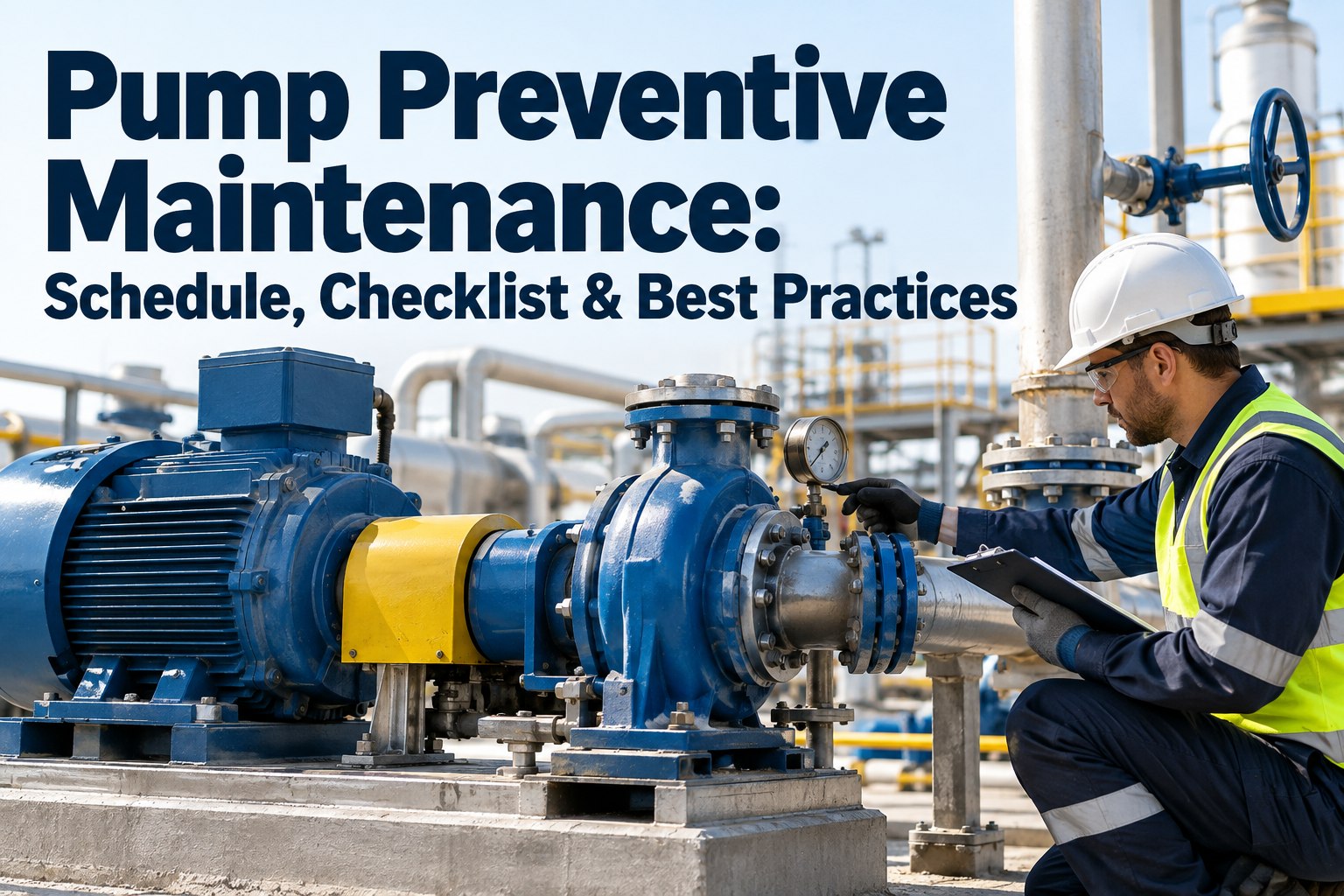
Pump preventive maintenance is one of the highest-ROI investments in any industrial facility. Pumps account for 20–25% of total energy consumption in most plants — and pump failures rank among the top three causes of unplanned downtime across manufacturing, water treatment, and oil and gas operations. A structured pump PM schedule with the right inspection checklist keeps these critical assets running reliably, extends their service life, and prevents the catastrophic failures that shut production lines for days.
Oxmaint schedules, assigns, and tracks every pump PM work order automatically — from vibration checks to seal inspections. See it in 30 minutes.
- Runtime-triggered pump PM work orders — no missed service windows
- Vibration and temperature monitoring integrated with IoT sensors
- Complete pump maintenance history for every asset, searchable instantly
Trusted by 1,000+ maintenance teams across manufacturing, utilities, and process industries.
What Is Pump Preventive Maintenance?
Pump preventive maintenance is a scheduled program of inspections, lubrication, seal checks, vibration analysis, and component replacement designed to prevent pump failures before they occur. It covers centrifugal pumps, submersible pumps, positive displacement pumps, and vacuum pumps — each with their own failure modes and inspection priorities.
The goal is to catch the early warning signs — rising bearing temperatures, abnormal vibration, mechanical seal weeping, cavitation noise — long before they escalate into catastrophic failure. Research from the Hydraulic Institute shows that 60–80% of pump failures are preventable with a proper PM program. The remaining 20–40% are addressable with condition monitoring tools like vibration sensors and thermal imaging, which integrate directly with platforms like Oxmaint's predictive maintenance module.
Pump PM Checklist: 6 Inspection Categories
These checklists are built into Oxmaint as digital PM templates — technicians complete them on mobile with photos, readings, and signatures. Or book a demo to see the full pump asset management workflow.
4 Pump Failure Modes That a PM Program Prevents
Bearing Failure (45% of Pump Failures)
Caused by inadequate lubrication, contamination, or misalignment. Gives 2–8 weeks of vibration warning before catastrophic failure. Monthly vibration checks catch it every time. Predictive maintenance tools automate the monitoring.
Mechanical Seal Failure (30% of Pump Failures)
Dry running, cavitation, and excessive heat destroy seal faces. Early signs — slight leakage increase, face discoloration — are visible at quarterly inspection. Catching it early means a $200 seal replacement versus a $2,000+ emergency shutdown.
Cavitation Damage
Cavitation erodes impellers and casings within months. It's caused by low suction pressure, incorrect pump sizing, or blocked strainers. A quarterly performance check — suction pressure vs. NPSH required — identifies it before impeller pitting becomes irreversible.
Shaft Misalignment
Thermal growth, piping stress, and loose baseplates cause misalignment after installation. It generates 3–5× higher bearing loads and destroys seals. Quarterly alignment checks with a laser alignment tool add 2–3 years to pump life in high-temperature systems.
How Oxmaint Manages Pump Reliability
Runtime-Based PM Scheduling
Connect pump run-hour meters to Oxmaint. PM work orders trigger automatically at 500, 1,000, or 2,000 hours — whichever interval your pump requires. No more calendar-date scheduling that ignores actual use.
Vibration & Temperature Integration
IoT sensors feed bearing temperature and vibration data to Oxmaint's predictive maintenance dashboard. When readings exceed baseline thresholds, PM work orders generate automatically — before the bearing fails.
QR-Scan Inspection Checklists
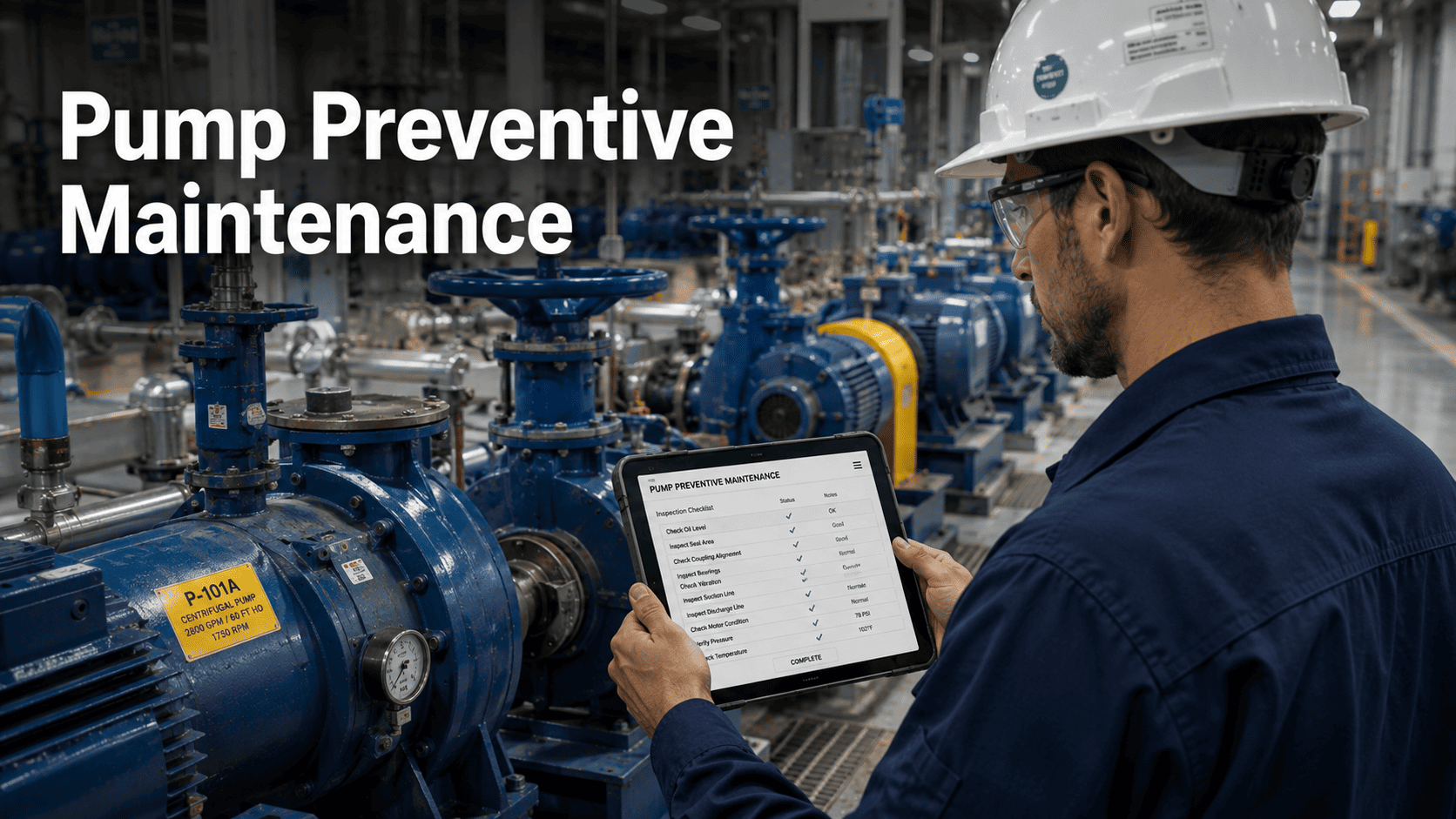
Technicians scan the pump QR code to open the inspection checklist on mobile — enter vibration readings, seal leakage rate, suction pressure, and attach photos. All data is timestamped and stored in the asset management record.
Full Pump Maintenance History
Every work order, inspection reading, seal replacement, bearing change, and alignment check builds a complete asset history. When a pump fails repeatedly, the history reveals why — enabling root cause resolution, not repeated repairs.
Parts Auto-Reorder for PM
When a pump PM is scheduled, Oxmaint checks inventory for seals, bearings, and lubricants. If stock is below threshold, it auto-generates a purchase request — so parts are on-site before the technician arrives. See parts and inventory management.
Compliance & Audit Documentation
Generate pump inspection reports for OSHA, ISO, or process safety reviews with one click. Every inspection reading, technician sign-off, and corrective action is captured and exportable without manual compilation.
Reactive vs. Preventive Pump Maintenance
| Factor | Reactive Pump Maintenance | Planned Pump PM Program |
|---|---|---|
| Repair Trigger | Catastrophic failure or production stop | Scheduled inspection or sensor alert |
| Downtime Duration | 24–72 hours unplanned | 2–4 hours scheduled off-peak |
| Repair Cost | Full replacement + emergency labor | Bearing or seal replacement only |
| Secondary Damage | Shaft, impeller, casing often damaged | Isolated to replaced component only |
| Asset Lifespan | 5–8 years average | 12–20 years with proper PM |
| Safety Risk | Process fluid leaks, pressure events | Controlled, planned maintenance window |
Pump PM ROI: The Numbers
Calculate your pump PM ROI with the Oxmaint ROI Calculator — or book a demo and we'll model it against your actual pump fleet.
Frequently Asked Questions
How often should industrial pumps be serviced?
Most industrial pumps require monthly visual inspections (lubrication, seal check, vibration listen), quarterly performance and alignment checks, and annual overhauls covering bearings, seals, impeller inspection, and full alignment. High-duty pumps in continuous process environments may need monthly vibration analysis. Runtime-hour-based scheduling is always more accurate than fixed calendar dates for heavily used pumps.
What causes most centrifugal pump failures?
Bearing failures account for approximately 45% of centrifugal pump failures, followed by mechanical seal failures at 30%. Both are largely preventable: bearing failures through proper lubrication and vibration monitoring, seal failures through correct installation, flush system maintenance, and avoiding dry running. Cavitation and misalignment account for most of the remaining failure modes.
What vibration levels indicate a pump bearing problem?
ISO 10816 defines vibration severity limits by machine class. For most centrifugal pumps, overall vibration velocity above 4.5 mm/s RMS indicates a warning condition; above 7.1 mm/s is alarm level. A sudden increase of 50% above the established baseline — regardless of absolute value — is a stronger signal than hitting an absolute threshold. Oxmaint's sensor integration flags both conditions automatically.
Can a CMMS track pump maintenance across multiple facilities?
Yes. Oxmaint manages pump assets across any number of sites from a single dashboard. Each pump has its own asset record with QR code, maintenance history, PM schedule, and attached documentation. The compliance dashboard shows which pumps across all facilities are overdue for PM — without requiring a site visit or spreadsheet consolidation.
Stop Reacting to Pump Failures
Schedule, Track, and Predict Every Pump PM — Automatically
Oxmaint gives your maintenance team runtime-triggered PM schedules, mobile inspection checklists, sensor-driven alerts, and a complete pump history — so bearing failures, seal leaks, and cavitation damage get caught before they shut your process down.
- Runtime-based PM scheduling — not calendar dates that ignore actual use
- Vibration and temperature sensor integration for predictive alerts
- Full pump maintenance history and audit-ready reports
1,000+ maintenance teams trust Oxmaint · Live and scheduling in days