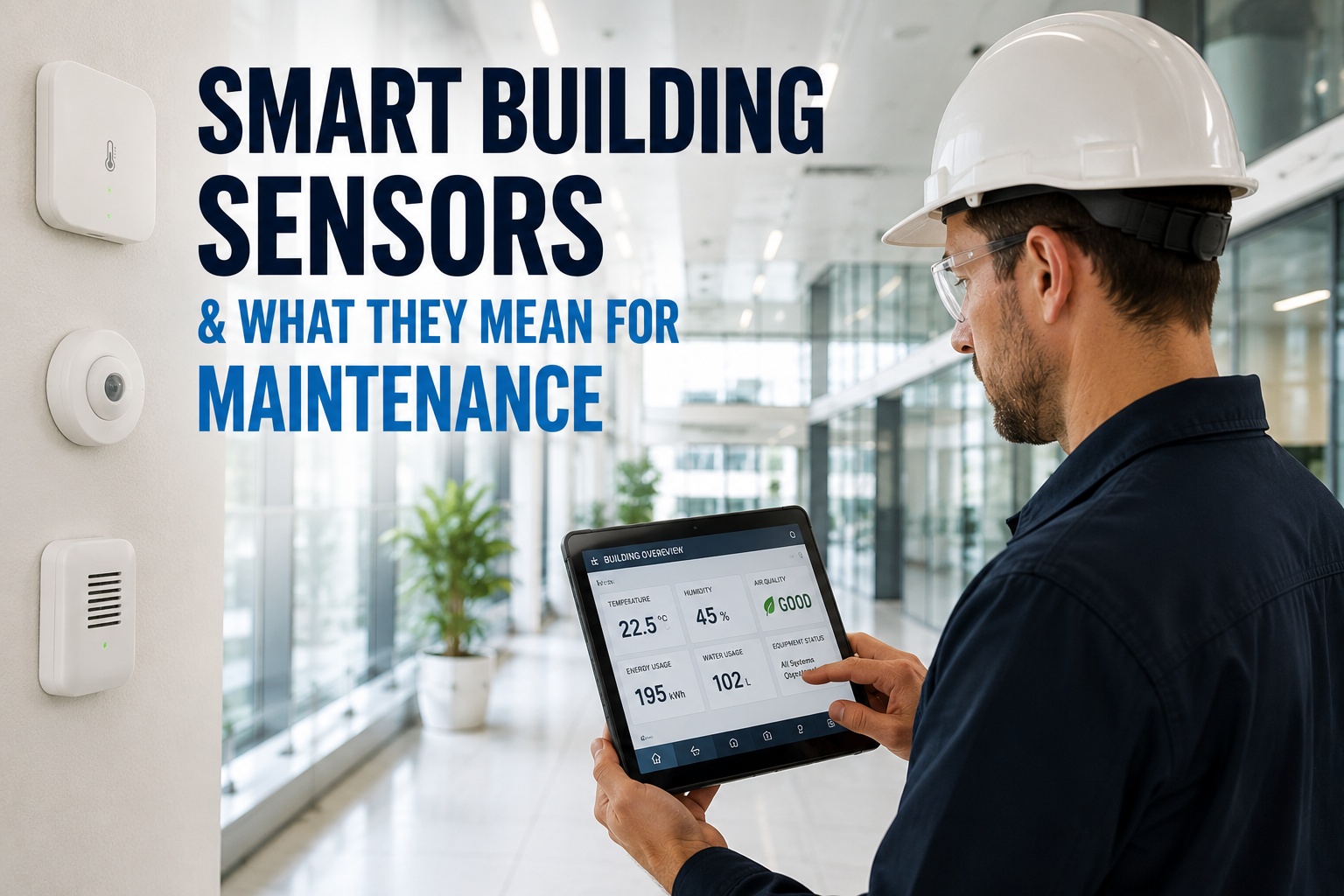
Smart building sensors are the foundation of modern building IoT, capturing real-time data on equipment vibration, temperature, energy use, and occupancy to enable predictive facility maintenance. When this sensor data flows directly into a CMMS workflow, facility teams shift from reactive, calendar-based maintenance to condition-based reliability—catching failures before they cause unplanned downtime. This guide breaks down how smart building maintenance works, which building IoT sensors matter most, and how integrating them into OxMaint turns raw building condition monitoring data into automated work orders. Ready to modernize your maintenance strategy? Start Free Trial and connect your connected building data today.
Is your smart building generating data—or driving maintenance action?
Over 70% of facility teams deploy IoT sensors but leave the data stranded in dashboards. OxMaint bridges the gap between intelligent building maintenance and actual work execution, turning building condition monitoring directly into automated work orders.
What smart building sensors actually monitor for maintenance
A connected building relies on specific sensor types to translate physical conditions into digital alerts. For smart building systems to deliver ROI, facility IoT must map directly to critical assets and trigger condition-based preventive maintenance.
Vibration & Acoustic Sensors
Mounted on motors, pumps, and HVAC drives, these detect bearing wear and imbalance. Catching a frequency shift early prevents catastrophic failure and can cut unplanned downtime by up to 45%.
Temperature & Thermal Sensors
Track electrical panel hotspots and chiller efficiency. A 10°C rise in a bearing housing signals lubrication failure; thermal imaging in switchgear prevents arc-flash incidents and costly outages.
Pressure & Flow Meters
Monitor chilled water loops, compressed air, and hydraulic lines. Drops in flow rate identify fouled heat exchangers or leaking valves before they impact building occupancy comfort.
Energy & Power Submeters
Flag asset degradation through rising energy consumption. If an air handler draws 15% more power for the same load, the fan belt or filter needs attention—smart facility maintenance at the circuit level.
Building automation vs. maintenance execution: why data stays stranded
Building Automation Systems (BAS) are excellent at controlling environments and generating alarms, but they are not maintenance platforms. Without a CMMS integration, smart building technology creates noise instead of action.
| Capability | Building Automation System (BAS) | OxMaint CMMS + IoT Integration |
|---|---|---|
| Alarm Handling | Buries alerts in a log; requires manual triage | Auto-generates prioritized work orders based on asset criticality |
| Maintenance Triggers | Calendar-based or runtime-only schedules | Condition-based triggers from actual sensor degradation |
| Asset History | Limited to control trends; no repair records | Full lifecycle history, parts used, and downtime costs per asset |
| Technician Dispatch | None; operators must call or page manually | Mobile dispatch with diagnostics, checklists, and parts pre-staged |
| Compliance Reporting | Raw data exports requiring heavy manual formatting | Audit-ready reports aligned with ISO 55000 asset management standards |
How to implement IoT facility management in 4 phases
Transitioning to intelligent building maintenance requires a structured rollout. Here is a proven timeline for facility teams moving from legacy reactive models to a connected building ecosystem.
Asset Hierarchy & Criticality Ranking
Map your facility's assets in OxMaint. Rank them by operational impact and failure frequency to determine which 20% of equipment warrants IoT sensors first—maximizing ROI on hardware spend.
Sensor Deployment & Integration
Install building IoT sensors on critical pumps, AHUs, and switchgear. Connect data streams via API into OxMaint to establish baseline operating profiles for each asset.
Condition-Based PM Triggers
Replace calendar-based preventive maintenance with dynamic triggers. When vibration exceeds ISO 10816 thresholds, OxMaint automatically generates a work order with diagnostics attached.
Predictive Analytics & Optimization
OxMaint's AI analyzes sensor trends to predict remaining useful life. Schedule interventions during planned downtime windows to eliminate reactive firefights and extend asset lifespan by 20-40%.
The cost of stranded data vs. smart facility maintenance
A 180-asset commercial facility spending $42,000 annually on reactive maintenance and downtime can see dramatic ROI by routing building condition monitoring data directly into a CMMS workflow.
Calendar-based PMs miss 60% of developing faults, leaving teams to react after occupancy complaints or failures occur.
Condition-based triggers reduce emergency work orders by 55% and cut parts spend by 22%, yielding an 8-month payback period.
Turn building IoT data into maintenance action with OxMaint
OxMaint is the AI-powered CMMS and EAM platform that bridges the gap between smart building sensors and maintenance execution. Here is how facility teams use OxMaint to scale intelligent building maintenance across their portfolio.
Alarm-to-Work-Order Automation
OxMaint ingests sensor alerts from any building automation system and auto-generates prioritized work orders. Eliminate manual triage and cut response times by up to 70%.
Condition-Based PM Triggers
Replace rigid calendar schedules with dynamic preventive maintenance. OxMaint triggers PMs based on actual asset condition, reducing unnecessary maintenance by 30%.
Predictive Maintenance Analytics
AI-driven trend analysis predicts equipment failures 2-4 weeks in advance. Plan interventions during off-hours and extend asset lifespan by 20-40%.
Spare Parts Auto-Reservation
When a predictive work order is generated, OxMaint automatically reserves the required spare parts from inventory, ensuring technicians have what they need without delays.
See OxMaint on your assets—book a 30-min demo
Discover how easy it is to connect your smart building sensors to an AI-powered CMMS that drives real maintenance action.
Smart building sensors & maintenance: your questions answered
What are smart building sensors for maintenance?
Smart building sensors are IoT devices that monitor physical conditions like vibration, temperature, pressure, and energy use on facility equipment. In a maintenance context, they feed data to a CMMS to trigger condition-based preventive maintenance, enabling teams to fix problems before failures occur rather than reacting to alarms.
How does IoT facility management improve maintenance?
IoT facility management improves maintenance by replacing calendar-based schedules with actual asset condition data. This reduces unnecessary preventive maintenance by 30%, cuts unplanned downtime by up to 45%, and extends equipment lifespan. Integrating IoT with a CMMS like OxMaint automates the workflow from sensor alert to completed work order.
Can OxMaint integrate with existing building automation systems?
Yes. OxMaint connects to existing building IoT sensors and BAS platforms via API to ingest alarm and trend data. You can Book a Demo to see exactly how OxMaint maps your current sensor data into automated, condition-based work orders without ripping out your existing infrastructure.
What is the difference between building automation and predictive maintenance?
Building automation focuses on controlling environments—setting temperatures, opening valves, and managing occupancy. Predictive facility maintenance uses the data generated by those systems to predict when equipment will fail and trigger maintenance interventions. OxMaint acts as the bridge, turning BAS data into predictive maintenance workflows.
How much does smart building maintenance software cost?
The cost of smart building maintenance software depends on portfolio size and sensor count, but most facility teams see ROI within 8-12 months through reduced downtime and labor savings. OxMaint offers a free 14-day trial so you can evaluate the platform's IoT integration and condition-based PM features before committing.
Ready to turn sensor data into maintenance action?
Join facility teams using OxMaint to cut unplanned downtime 30-50% and scale smart building maintenance across their portfolios.
Free 14-day trial · No credit card