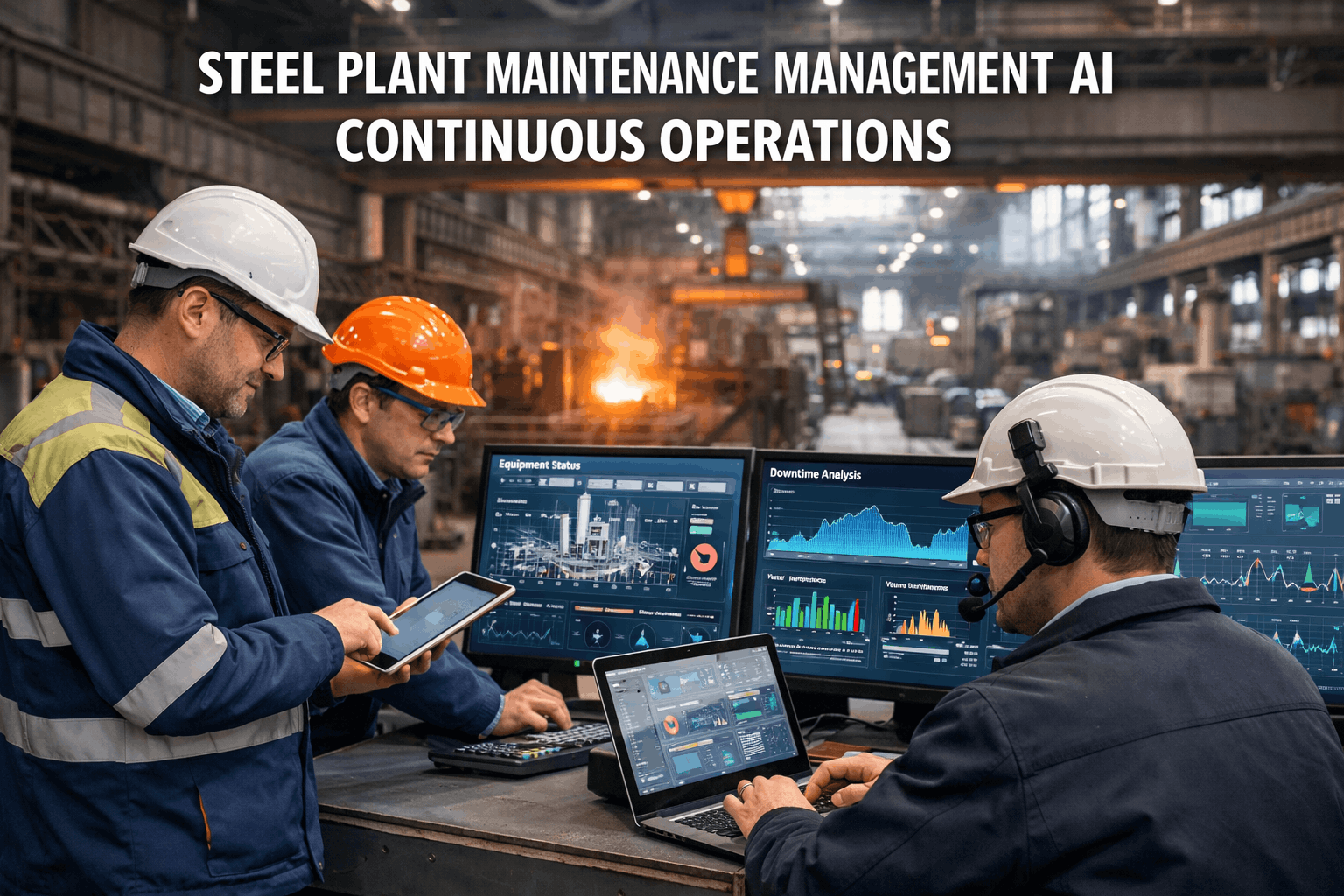
Any reliability engineer walking a steel plant floor knows the pattern. A rolling mill gearbox seizes at 3 AM. The teardown reveals a bearing surface scored by particulate contamination. The oil analysis history — if it existed at all — was buried in a technician's laptop three offices away. The bearing manufacturer voids the warranty because there is no documented lubrication trail. Downtime hits six figures per hour. And somewhere in the maintenance history, twelve months earlier, someone shortened a lube route by skipping one grease point on that gearbox because it was "hard to reach." That single decision cascaded through everything that followed. This guide is written for reliability engineers building the systematic lubrication management program that prevents exactly this scenario — grounded in ISO cleanliness targets, contamination control discipline, and the CMMS-based route management that keeps every lubrication point on every asset accounted for. Book a free demo to see OxMaint's lubrication management module applied to your plant.
Rolling element bearings
10% at normal fatigue life
Industrial gearboxes
Half wear, half overload
Hydraulic systems
75%+ contamination-driven
Primary root cause
Rotating engines
70% contamination-related
50% wear from contamination
50%
of rolling element bearing failures in heavy industry trace directly to lubrication or contamination
$280K
documented first-year savings when a mid-size mill moved from time-based to condition-based oil changes
2-20×
the acceptable particle count found in "new" oil delivered from bulk suppliers before filtration
The Lubrication Lifecycle — Six Stages, One Program
A world-class lubrication program is not a spreadsheet of grease intervals. It is a lifecycle that treats every drop of lubricant as a tracked asset from the moment it enters the plant gates until the moment it leaves as waste. Miss one stage in the lifecycle and the entire program loses integrity — new oil arrives dirty and goes into service dirty, sample results sit unread in inboxes, technicians make substitutions at the point of application that cross-contaminate reservoirs. The six stages below define the complete program that OxMaint operationalizes for a steel plant reliability team.
The Six Stages of a Reliability-Centered Lube Program
01
Selection
Right lubricant per asset based on load, speed, temperature, and OEM spec
02
Reception & Storage
COA verification, filtered transfer to labeled OilSafe containers in lube room
03
Handling & Application
Route-based dispensing with correct grade, correct volume, correct point
04
Contamination Control
Sealing, breather management, filtration at every transfer, ingress prevention
05
Analysis
Periodic sampling, ISO cleanliness measurement, trend analysis per asset
06
Disposal
Compliant waste-oil handling, volume reconciliation, environmental reporting
Every stage generates data. Every data point feeds the next lubrication decision. OxMaint stores all six lifecycle stages as tracked events per asset.
Lubricant Selection — The Application-Driven Decision Matrix
Steel plant equipment covers a wider lubricant application range than almost any other industrial environment. The rolling mill gearbox needs an EP gear oil that survives 1000+ psi tooth contact. The blast furnace auxiliary bearings need a high-temperature synthetic grease that will not carbonize. The hydraulic press needs a high-cleanliness fluid with anti-wear additives. Using the wrong lubricant is not just a warranty issue — it is a scheduled path to failure. The matrix below maps the most common steel plant equipment categories to their correct lubricant class.
Rolling mill main drive gearbox
EP gear oil · ISO VG 320-460
Extreme pressure additives, thermal stability
Condition-based sampling
Hydraulic press & forge systems
AW hydraulic oil · ISO VG 46-68
High cleanliness, anti-wear, low foaming
6-12 months + sampling
Continuous caster segment bearings
Synthetic high-temp grease NLGI 2
Water resistance, thermal endurance
Automated · continuous
Overhead crane wire ropes
Rope dressing / open gear compound
Penetration, adhesion, corrosion resistance
Quarterly application
Blast furnace auxiliary motor bearings
Synthetic polyurea grease NLGI 2-3
Extended service life at elevated temperature
Monthly regreasing
Coke oven pusher car chains
High-temperature chain oil
Drop point > 250°C, low volatility
Weekly application
Cooling water pump bearings
Water-resistant lithium complex grease
Water washout resistance, rust protection
Monthly regreasing
ISO 4406 Cleanliness Codes — The Universal Language of Reliability
Every serious lubrication program eventually converges on ISO 4406 as its shared vocabulary. The three-part code — for example 18/16/13 — describes the number of particles per milliliter at three critical size thresholds: ≥4 μm, ≥6 μm, and ≥14 μm. Reliability engineers use it to set target cleanliness levels per system, alarm thresholds per sample, and clear evidence of whether contamination is trending in the wrong direction. Once a plant standardizes on ISO 4406 targets, every argument about "is this oil clean enough" collapses into a data question with a numerical answer.
Particles ≥ 4 μm
Particles ≥ 6 μm
Particles ≥ 14 μm
Each code number roughly doubles when it goes up by one — a 19 is twice the contamination of an 18
Target ISO Codes for Steel Plant Systems
Servo valves & sensitive controls
16 / 14 / 11
Variable piston pumps
17 / 15 / 12
Hydraulic motors
18 / 16 / 13
Journal bearings
19 / 17 / 14
Industrial gearboxes
20 / 18 / 15
Low-pressure lube circuits
21 / 19 / 16
Contamination Control — Killing the 75% Failure Root Cause
Over 75% of hydraulic system failures trace back to contamination — dirt, water, or wear debris that entered somewhere in the lubricant's life. What makes contamination control so hard is that failures don't happen at the entry point. Contaminant enters at the breather during a shift change; the bearing fails four months later during peak production. Breaking that time-and-space link between cause and effect is what a mature contamination control program does. The five ingress points below account for the vast majority of contamination events in steel plant environments.
Where Contamination Actually Gets In
A
New Oil Delivery
Bulk shipments arrive at 2-20× the acceptable particle count. Filter to target ISO code before use.
B
Reservoir Breathers
Standard breathers admit airborne dust and moisture. Replace with desiccant / particulate breathers.
C
Shaft Seal Wear
Worn seals allow ingress of mill scale, cooling water, and process debris. Inspect quarterly.
D
Top-Up Transfer
Open funnels and shared jugs cross-contaminate. Use color-coded, sealed OilSafe containers only.
E
Internal Wear Debris
Component wear generates internal contamination. Kidney-loop filtration removes it continuously.
F
Water Ingress
Cooling water leaks into gearboxes are the single most common failure precursor. Trend water content monthly.
Turn Contamination Control Into a Tracked Program
OxMaint tracks target ISO codes per asset, logs every sample result against the trend line, and generates the corrective work orders when contamination signals appear. See it live in a 30-minute walkthrough against your plant assets.
Oil Analysis — The Predictive Intelligence Layer
Oil analysis converts a lubrication program from calendar-driven to condition-driven. Sending samples to a certified lab quarterly on hydraulic systems, gearboxes, and critical bearings surfaces exactly the wear metals, contamination signatures, and additive depletion patterns that predict where the next failure will occur. The parameters below define what a comprehensive oil analysis panel measures and what each result actually tells the reliability engineer.
Wear metals (Fe, Cu, Cr, Al)
Which component is wearing and how fast
Trend rise triggers root-cause investigation
Water content (Karl Fischer)
Cooling water or moisture ingress into oil
Above 500 ppm triggers seal inspection work order
Viscosity (40°C & 100°C)
Oxidation, fuel dilution, or wrong-oil contamination
Deviation > 10% flags for oil change
Particle count (ISO 4406)
Overall cleanliness against target code
Codes above target trigger filtration cycle
Additive elements (Zn, P, Ca)
Additive depletion or dilution
Depleted additives signal end of oil life
TAN / TBN (acid / base number)
Oxidation state, remaining service life
TAN rise beyond limit triggers oil change
Building the Lube Route — CMMS-Based Precision
Every reliability engineer eventually confronts the same reality: a steel plant contains hundreds of lubrication points, and a paper-based route sheet cannot survive the shift-change, promotion, and retirement cycles that erode institutional knowledge over five years. The lube route needs to live in the CMMS, tied to specific asset IDs, with the correct lubricant, correct volume, and correct interval attached to every point. Below is the structure OxMaint uses to represent a lube route as executable work.
01
Route Definition
Group lubrication points geographically or functionally into named routes — "Rolling Mill A Gearboxes", "Caster Segments 1-4", "Auxiliary Motors Zone 3"
02
Point-Level Specification
Every lube point tagged with asset ID, exact lubricant grade, volume in shots or ml, correct interval, and safety notes
03
Interval Triggers
Calendar-based, runtime-based, or condition-based triggers auto-generate the route work order to the assigned lube technician
04
Mobile Execution
Technician scans QR code at each point, confirms lubricant match, logs actual volume dispensed, notes any anomaly observed
05
Compliance & Audit
Every event logged against the asset history — auditable proof that the right lubricant reached the right point at the right time
Critical Tracking Events — The Digital Proof Chain
Bearing and gearbox manufacturers now increasingly require documented lubrication histories to honor warranty claims. Insurers evaluate lubrication documentation when assessing catastrophic failure claims. And plant leadership needs auditable evidence when a $2M gearbox seizure raises the "was PM being done" question during a root-cause investigation. Critical Tracking Events (CTEs) are the defined moments in the lubrication lifecycle where reliability records must be created — each captured automatically inside OxMaint against the relevant asset.
CTE 1
Lubricant Receiving
Manufacturer · Grade · Batch · COA · Timestamp
CTE 2
Storage Transfer
Lube room ID · Container ID · Filter level (ISO 4406) · Temperature
CTE 3
Route Assignment
Route ID · Technician ID · Points · Volume specification
CTE 4
Point Application
Asset · Volume actual · Lubricant match confirmed · Anomaly log
CTE 5
Sampling Event
Asset · Sample point · Volume · Lab ID · Chain of custody
CTE 6
Analysis Result
ISO code · Wear metals · Water · Viscosity · Trend delta
CTE 7
Corrective Action
Work order triggered · Filter change · Oil top-up · Seal replacement
CTE 8
Disposal / Reconciliation
Waste volume · Manifest ID · Compliance record · Environmental sign-off
Expert Perspective · What Separates a Mature Lube Program
We used to change hydraulic oil every six months across the whole plant — 48 systems, roughly 120,000 liters of oil a year on a calendar basis. When we started true condition-based oil analysis, we discovered that 70% of those systems had perfectly serviceable oil at the six-month mark. Fifteen percent actually needed changing at three months because of contamination we never knew existed. The first year of condition-based work saved us $280,000 in lubricant costs alone. But the real value came from catching failures early — we identified a cooling water leak into a caster gearbox three months before it would have caused a catastrophic seizure. The moisture trend was unmistakable once we had consecutive data points sitting inside the CMMS against that asset.
Route-Based, Not Person-Based
Lube routes stored in OxMaint against specific assets survive technician turnover, promotions, and shift changes that erode paper systems.
Condition, Not Calendar
Oil analysis trends replace fixed change intervals — reliability engineers act on data, not on the last time the calendar rolled over.
Every CTE, Every Time
The digital proof chain protects warranty claims, insurance positions, and the reliability engineer's own credibility when failures do occur.
Move Your Lube Program From Paper to Reliability Discipline
If your steel plant's lubrication management is still running on route sheets, whiteboards, and technician memory, you are carrying preventable failure risk into every shift. See what OxMaint — a maintenance management platform purpose-built for heavy industrial reliability — looks like applied to your equipment and lube routes.
Frequently Asked Questions
What is a lubrication management program for a steel plant?
It is a structured system that manages the full lifecycle of every lubricant in the plant — from selection and receiving through storage, application, contamination control, analysis, and disposal. OxMaint operationalizes each lifecycle stage as a tracked event against the specific asset, so reliability engineers replace spreadsheets and paper route sheets with a system that never misses a lubrication point or a sample interval.
How do I choose the right lubricant for steel plant equipment?
Lubricant selection is driven by application requirements — load, speed, temperature, and OEM specification. Rolling mill gearboxes typically require EP gear oils (ISO VG 320-460). Hydraulic presses need anti-wear hydraulic fluids (ISO VG 46-68). High-temperature bearings need synthetic polyurea greases. OxMaint stores the correct lubricant specification against every asset, so route work orders always dispatch with the right grade and volume attached.
What ISO 4406 cleanliness code should I target?
Target codes depend on the most sensitive component in the system. Servo valves need 16/14/11 or cleaner. Variable piston pumps need around 17/15/12. Hydraulic motors typically 18/16/13. Industrial gearboxes around 20/18/15. Every code number drop represents roughly half the contamination, so moving from 20 to 18 is a significant improvement. OxMaint stores target codes per asset and flags samples that exceed them.
How often should we run oil analysis in a steel plant?
Quarterly sampling is the standard baseline for critical hydraulic systems, gearboxes, and rotating equipment. Highly critical or high-risk assets — main mill drives, blast furnace auxiliaries, caster segment bearings — often move to monthly sampling once condition-based programs mature. OxMaint schedules sample events per asset, tracks chain of custody, and captures lab results against the trend line automatically.
How does a CMMS-based lube route work?
In OxMaint, a lube route is a named collection of lubrication points grouped geographically or functionally, with each point tied to a specific asset, lubricant grade, volume, and interval. The route auto-generates a mobile work order for the assigned technician on the trigger interval. At each point, the technician scans a QR code, confirms lubricant match, logs actual volume dispensed, and notes any observed anomaly. Every event stores against the asset history for compliance and trending.
Why is contamination control so critical for steel plant reliability?
Over 75% of hydraulic system failures and roughly 50% of rolling element bearing failures trace to contamination — dirt, water, or wear debris in the lubricant. Steel plant environments compound the challenge with mill scale, cooling water, and elevated temperatures. Contamination control means filtering new oil before use, using desiccant breathers, sealed transfer containers, and monitoring water content and ISO codes on every sample. OxMaint captures every contamination-control event as part of the CTE proof chain.