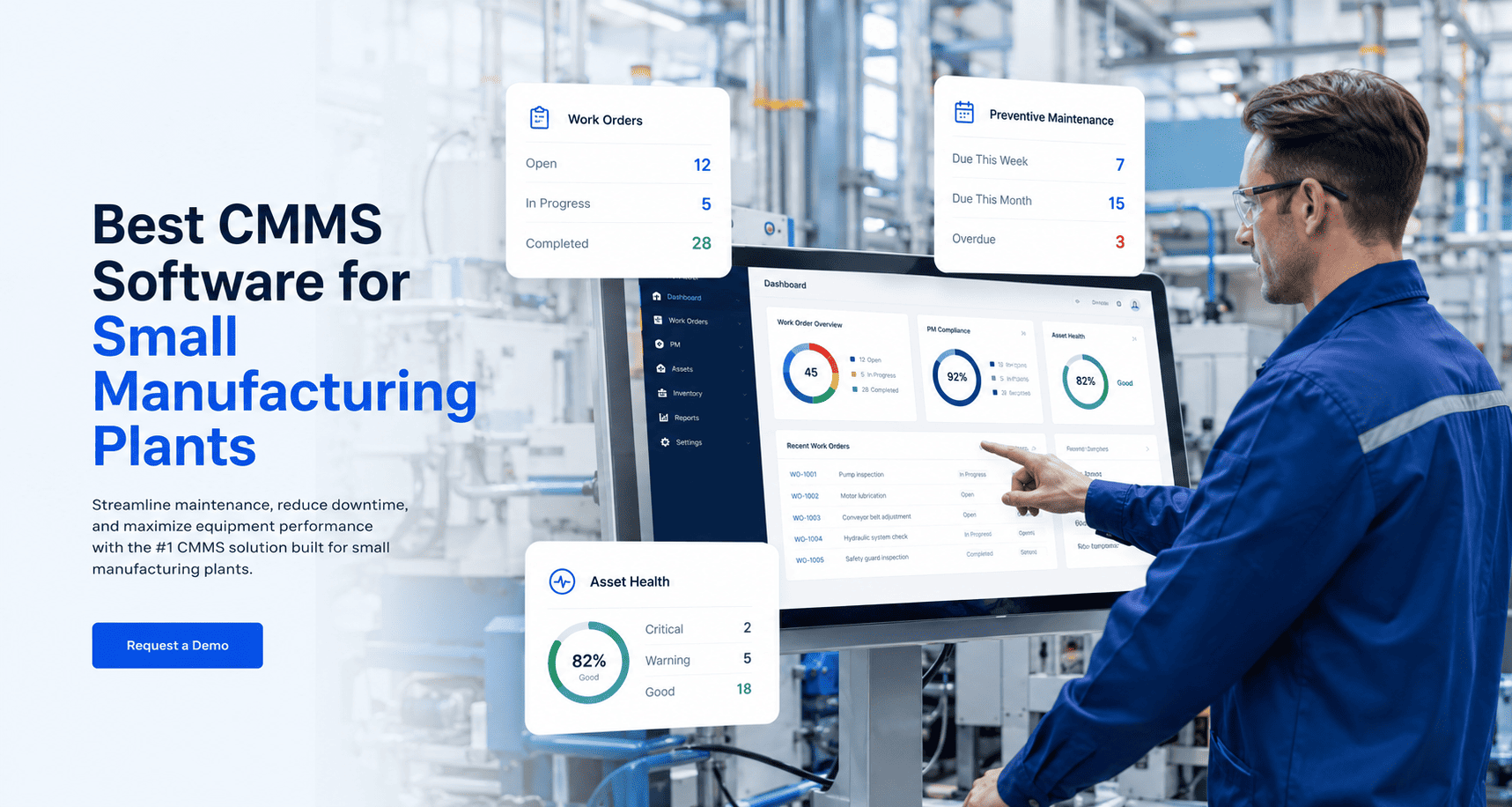
Small manufacturing plants lose an average of $260,000 per year to unplanned downtime — not because they lack skilled technicians, but because they lack the right system to keep maintenance organized, visible, and predictive. Choosing the best CMMS software for your plant is the single highest-ROI operational decision a plant manager can make in 2024. This guide cuts through the noise, shows you exactly what to look for, and explains why the right choice pays for itself within 90 days — start a free trial with Oxmaint to see your plant's maintenance gap in real time, or book a demo and walk through your specific asset structure with our team.
See how much cost you can eliminate from reactive maintenance in your facility.
- Real-time asset visibility across every machine and line
- Predictive failure alerts before breakdowns happen
- 5–10 year CapEx forecasting built into every asset record
Used by operations teams managing 10,000+ assets. Live in days, not months.
Why Small Plants Bleed Cash Without a CMMS
The Definition Small Plant Managers Actually Need
A Computerized Maintenance Management System (CMMS) is software that centralizes every aspect of your maintenance operation — work orders, asset records, preventive maintenance schedules, spare parts inventory, and compliance documentation — into one platform your entire team can access from any device. For small manufacturing plants, this replaces spreadsheets, paper work orders, and tribal knowledge with a live, searchable, auditable system.
The key distinction between a basic work order tool and a real CMMS is lifecycle intelligence. A proper CMMS like Oxmaint tracks not just what maintenance was done, but the condition of each asset over time, helping you forecast when equipment will need replacement and how much it will cost — giving plant managers a credible CapEx argument every budget cycle.
For small plants, the right CMMS is one that deploys in days, requires no IT team, runs on mobile, and scales from 50 to 5,000 assets without re-implementation — which is why teams that shift from reactive to planned maintenance see 40% lower repair costs — start a free trial to see how Oxmaint builds that shift into your workflow, or book a demo and we will walk through your specific asset structure.
8 Core CMMS Features Small Plants Must Evaluate
Every machine, line, and component tracked with health scores, not just names. Know which assets are degrading before they fail.
Calendar-based and meter-based PM triggers that auto-generate work orders. No missed intervals, no emergency scrambles.
Technicians complete, close, and document work orders from the shop floor on any smartphone. No transcription, no paper, no delays.
Rolling 5–10 year replacement cost projections per asset. Turn budget conversations from guesswork into board-ready reports.
Link parts to assets. Track stock levels, reorder points, and supplier lead times to eliminate emergency procurement.
Live compliance rates, MTBF, MTTR, and Overall Equipment Effectiveness data your operations director can act on daily.
Audit-ready inspection records, digital sign-offs, and compliance checklists built into every work order. OSHA, FDA, ISO ready.
Cloud-based deployment with guided setup. Small plants should be live within days, not months. No implementation partner needed.
The 6 Maintenance Problems Crushing Small Plant Margins
Small manufacturing plants run leaner than enterprise facilities, which means every unplanned breakdown hits harder, every compliance gap costs more, and every dollar of maintenance spend is scrutinized. The pain points below are not hypothetical — they are what your team is living every week without a structured CMMS. The good news: every one of them has a direct fix — start a free trial to experience this shift, or book a demo to see it on your own asset data.
When the only indicator of failure is the machine stopping, you are always reacting. Assets degrade for weeks before a breakdown — a CMMS makes that degradation visible and actionable.
Emergency repairs cost 4.8x more than planned ones. Plants running without PM schedules consistently allocate more than half their maintenance budget to reactive fire-fighting.
Without condition history and lifecycle data, equipment replacement requests look like guesses to the CFO. No data means no budget approval — and aging assets kept running past safe service life.
Paper-based maintenance records and disconnected spreadsheets make OSHA or ISO audits a multi-day scramble. Missing or incomplete records result in findings and fines.
When your most experienced tech retires or leaves, critical maintenance knowledge walks out the door. A CMMS captures procedures, failure history, and asset quirks in a searchable, permanent record.
Without parts linked to assets and PM schedules, plants either stock too much tying up working capital, or stock too little and face emergency procurement at 3x the normal cost.
How Oxmaint Solves Every Pain Point for Small Plants
Every asset gets a health score updated with each work order. Know which machines need attention before they become emergencies. Full hierarchy: Portfolio, Property, System, Asset, Component.
Set frequency once — calendar-based or meter-based — and Oxmaint auto-generates work orders, assigns technicians, and tracks completion rates in a live dashboard.
Technicians open, complete, and close work orders on smartphones with photo attachments, digital sign-offs, and parts consumption logged in real time. No paper, no lag.
Rolling 5–10 year replacement cost models built from actual asset condition data. Turn your next budget meeting into a data-backed conversation your CFO cannot dismiss.
GMP-compliant digital inspection forms, automatic audit trails, and on-demand compliance reports. Reduce OSHA and ISO audit prep from days to under 10 minutes.
Oxmaint deploys without an implementation partner, heavy IT involvement, or months of configuration. Most small plants are fully operational within 2 weeks of starting their free trial.
Reactive Maintenance vs. Planned Maintenance — The Real Comparison
| Metric | Reactive Maintenance | Planned Maintenance with CMMS |
|---|---|---|
| Repair Cost Per Incident | 4.8x average planned cost | Baseline — predictable and budgeted |
| Asset Visibility | None — failure is the first indicator | Live condition scoring per asset |
| Downtime Per Year | Unpredictable, often 800+ hours | Up to 45% reduction in unplanned stops |
| CapEx Planning | Budget guesswork, requests rejected | 5–10yr rolling models, CFO-ready data |
| Compliance Audit Prep | 3–5 days of document hunting | On-demand reports in under 10 minutes |
| Spare Parts Cost | Emergency procurement at 3x normal cost | Linked inventory with auto reorder points |
| Technician Productivity | 60–70% reactive fire-fighting | Structured PM schedule, clear priorities |
| Knowledge Retention | Locked in individuals' heads | Captured in permanent digital asset records |
What Small Plants Actually Achieve After CMMS Deployment
These are not projections. They are outcome benchmarks from plants that moved from spreadsheet-based or paper-based maintenance to a structured CMMS — and the numbers are consistent across plant sizes, industries, and geographies. Teams switching to structured CMMS see up to 40% lower breakdown costs — start a free trial to experience this shift, or book a demo to see it on your own asset data.
Frequently Asked Questions From Small Plant Managers
How much does CMMS software cost for a small manufacturing plant?
CMMS pricing for small plants typically ranges from $100 to $800 per month depending on asset count, user seats, and feature depth. The key question is not the monthly fee but the payback period. A plant spending $260,000 per year on unplanned downtime and paying $300/month for a CMMS that reduces that by 40% has a payback period measured in weeks, not years. Oxmaint offers a free trial with no credit card required — start your free trial here and see the impact on your specific asset base before committing.
How long does it take to implement CMMS software in a small plant?
With a cloud-based CMMS like Oxmaint, small plants with 50–500 assets can be fully operational in 1–2 weeks. The critical success factor is data sequencing: get your asset register clean first, then configure PM schedules, then roll out to technicians. Plants that try to do everything simultaneously are the ones that stall. The 75-day structured rollout framework Oxmaint provides has been validated across power plants, manufacturing facilities, and multi-site portfolios — book a demo to map your specific rollout timeline.
What are the biggest mistakes small plants make when buying CMMS software?
The three most common buying mistakes are: selecting a platform designed for enterprise-scale plants that requires 6 months of implementation; choosing based on the longest feature list rather than the fastest time to value; and underestimating the importance of mobile-first design for shop floor technicians who will never use a desktop application. A CMMS your technicians won't use is worse than no CMMS at all. Prioritize ease of adoption over feature volume when evaluating options for a plant under 1,000 assets.
Do small manufacturing plants need CMMS or is a spreadsheet good enough?
Spreadsheets break down the moment you have more than three technicians, more than 100 assets, or any compliance requirements. They cannot auto-schedule PMs, track part consumption, generate audit trails, or flag degrading asset health. The hidden cost of "free" spreadsheets is the operational risk they create — a single missed PM on a critical machine can cost more than a full year of CMMS subscription fees. The threshold for CMMS adoption is lower than most plant managers think: if you have more than 50 assets and at least one dedicated maintenance technician, a CMMS will pay for itself within 60 days.
Turn every asset into a predictable, trackable system with Oxmaint. See measurable results in the first 30 days — no heavy implementation required, works across multi-site portfolios.
- Real-time asset visibility across every machine and line
- Predictive failure alerts before breakdowns happen
- 5–10 year CapEx forecasting built into every asset record
Used by operations teams managing 10,000+ assets. Limited onboarding slots available this quarter.