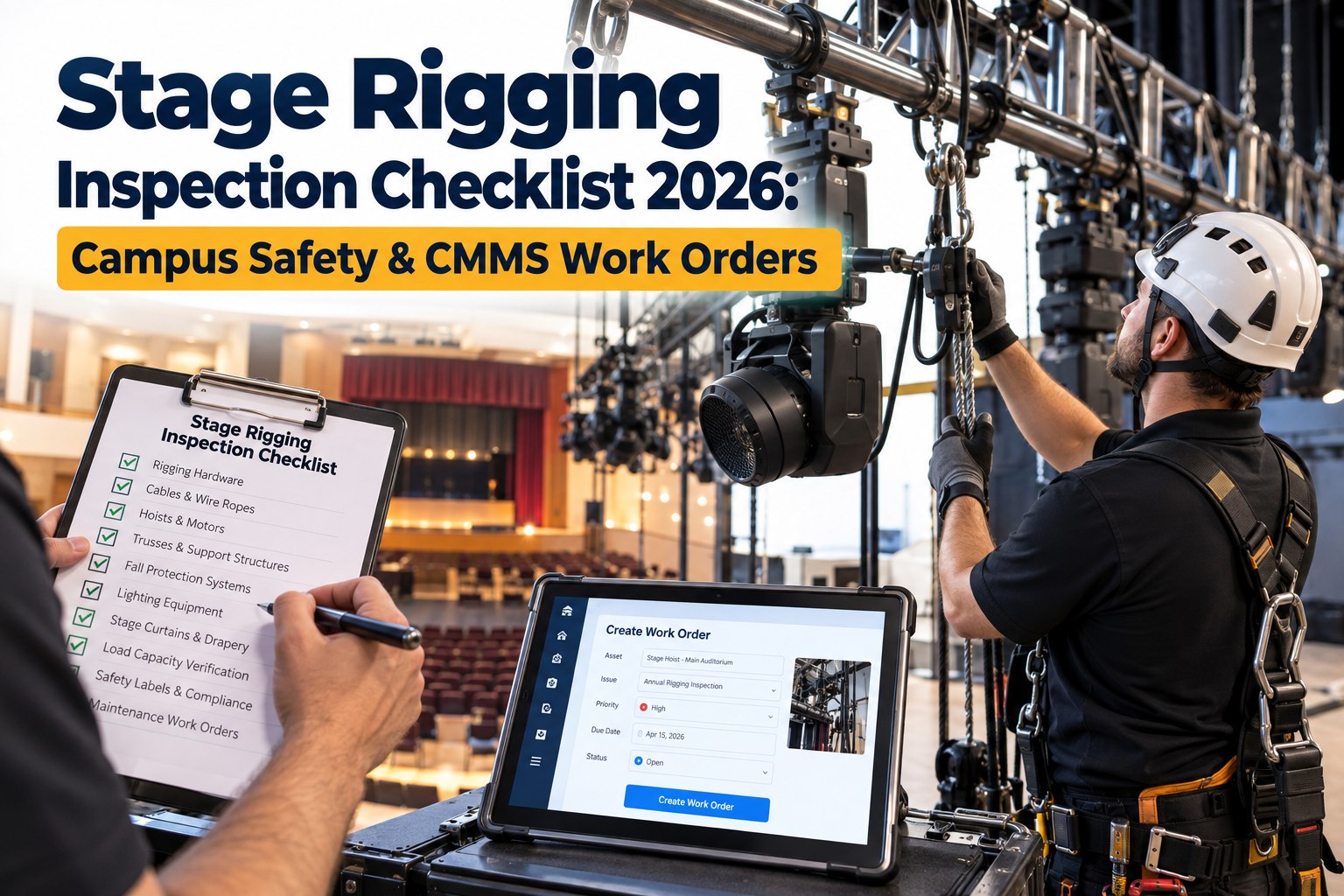
Campus stage rigging is the most dangerous equipment most facilities teams never think about — battens of lighting and scenery held over students by wire rope and counterweights. A frayed lift line doesn't announce itself; it's caught on inspection, or when something falls. That's why ANSI E1.4 and ESTA set annual qualified-person inspection as the baseline — and why findings must become tracked work, not a report in a drawer. This checklist walks the system component by component and shows how OXMAINT AI turns each finding into a scheduled work order.
Stage Rigging Inspection Checklist 2026: Campus Safety & CMMS Work Orders
An annual rigging inspection is only as good as the repairs that follow it — and too often the findings never become work. OXMAINT AI closes that gap: inspection findings become tracked issues, red-tag items become prioritized work orders, and closed work orders feed the preventive schedule. So a worn lift line flagged on the catwalk becomes assigned, corrective work — not a line item in a PDF nobody reopens.
Why Rigging Inspection Is Non-Negotiable
Overhead rigging is a life-safety system operated, on many campuses, by students and volunteers. ANSI E1.4 and ESTA guidance set the framework, and a qualified-person inspection is the baseline — but the real risk is the gap between finding a defect and fixing it. A report that never becomes work orders is a liability, not a safeguard.
Start free and connect inspection findings to work in OXMAINT AI.
- Findings live in a PDF report nobody reopens
- Red-tag items and routine notes blur together
- No link between a defect and whether it was repaired
- Last year's findings resurface, still open, next year
- No records ready when a safety officer or insurer asks
- Every finding logged against the specific rigging asset
- Red-tag items ranked and escalated automatically
- Each finding traceable to its corrective work order
- Open items carried forward until they're actually closed
- Audit-ready inspection history sitting on each line set
Walk the System Top to Bottom
A counterweight line set is a chain of components, and a failure anywhere puts the load at risk. Inspect it in a fixed order — from the grid down to the deck — so nothing is skipped. Here's the eight-zone path this checklist follows.
Book a demo to map this route onto your venue.
The Component-by-Component Checklist
Work each zone in turn. These are the high-value checks that catch the failures most likely to drop a load — always inspected by a qualified person, following the manufacturer's and ANSI E1.4 criteria.
Sign up free and log each check against the line set in OXMAINT AI.
- Sheaves turn freely; no cracks, wear grooves or wobble
- Bearings quiet; mounting bolts tight and secure
- Rope keepers intact so lines can't jump the sheave
- Alignment of loft blocks over their batten pick-points
- Broken wires, kinks, birdcaging or corrosion
- Flattening, abrasion or reduced diameter
- End terminations and swages secure and undamaged
- Any line meeting discard criteria red-tagged at once
- Straightness; no bends, cracks or corrosion
- Batten splice/spreader connections sound
- Lift-line clamps and trim chains secure
- Load within rated capacity, evenly distributed
- Arbor rods, spacer plates and top/bottom bolts secure
- Counterweight bricks retained; keeper/lock bar in place
- Arbor balanced to batten load
- Guide shoes/rollers riding the tracks cleanly
- Rope free of fraying, glazing, cuts or excessive wear
- Correct diameter and type for the system
- Tension and spliced connections sound
- Runs clear of pinch points and abrasion
- Rope locks hold securely and release cleanly
- Lock bodies undamaged; hardware tight
- Line-set index/labels legible and correct
- Rail area clear and accessible for the operator
- Loading gallery weights stored, not stacked loose
- No overloading of the loading bridge
- Bricks free of damage; consistent, known weight
- Storage racks secure and organized
- Grid, beams and supports free of damage or corrosion
- Guardrails and toe plates per OSHA edge-protection rules
- Access ladders, catwalks and gates sound
- Housekeeping — no loose tools or debris at height
A Red-Tag in a Report Is a Hazard Still Hanging Overhead.
The inspection finds the defect; only a work order fixes it. OXMAINT AI turns each finding into a prioritized, assigned work order tied to the line set — so a red-tag item is tracked to closure, not filed and forgotten.
Grade Every Finding by Severity
Not every finding carries the same urgency, but a load-bearing defect can never wait behind a cosmetic one. Grade each finding so the response matches the risk — and the most serious items take the line set out of service until repaired.
Sign up free and grade findings by severity in OXMAINT AI.
Severity calls and discard criteria are the qualified inspector's judgment against ANSI E1.4 and manufacturer guidance — this framework organizes the response, it does not replace professional assessment. When in doubt on a load-bearing component, take the set out of service.
From Finding to Corrective Work Order
This is the part that turns an inspection into safety. Here's how one finding moves through OXMAINT AI — from the catwalk to a closed work order tied to the line set. Book a demo to see this on your own rigging.
Inspection Cadence at a Glance
| Check | Typical cadence | Who |
|---|---|---|
| Full system inspection | Annual (baseline) | Qualified rigging inspector |
| Operational / pre-show checks | Before use / regularly | Trained house operator |
| Wire rope & blocks review | Part of annual + as noted | Qualified inspector |
| Post-incident inspection | After any event or overload | Qualified inspector |
| Repairs from findings | Per severity (red-tag first) | Tech or rigging vendor |
Cadence depends on usage, age, venue type and local requirements — annual qualified inspection is a widely-cited baseline, not a universal legal mandate. Set frequencies to your venue and jurisdiction, and schedule recurring inspections in your CMMS so none slips.
Frequently Asked Questions
Turn the Inspection Into Closed, Provable Work.
Run a qualified, component-by-component inspection, grade every finding by severity, and let each one become a tracked corrective work order tied to the line set — with OXMAINT AI, so what's found overhead actually gets fixed and recorded.

.png)

