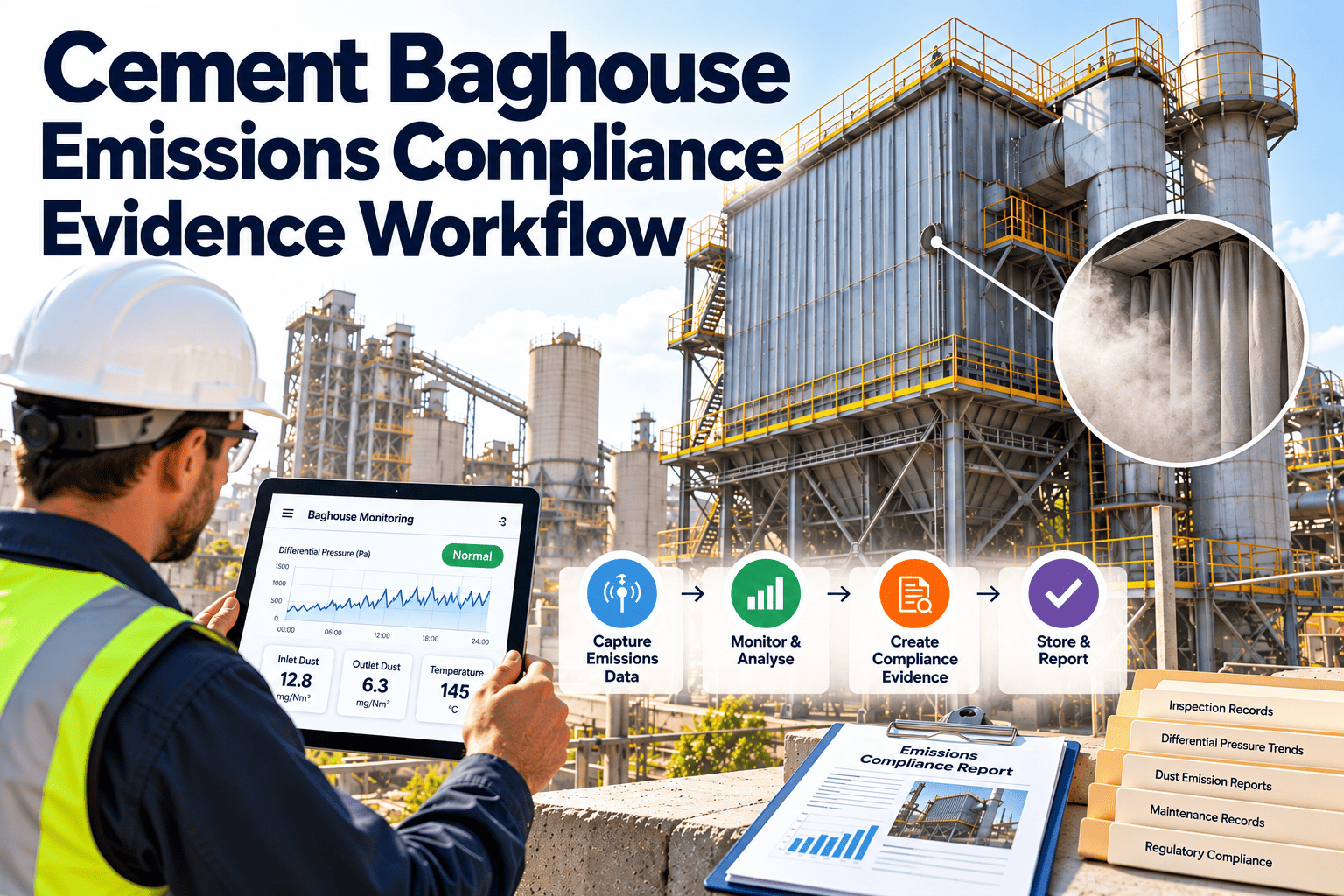
When a regulator or auditor asks how a cement baghouse was kept in compliance, the answer is rarely a single document. It is a trail that links an instrument reading to an alarm, the alarm to a response, the response to a repair, and the repair to proof that emissions returned to normal. Plants that build this trail as they work spend far less time reconstructing it later. This guide sets out an evidence workflow for baghouse emissions compliance and shows how Oxmaint cement plant maintenance software keeps the maintenance side of that trail complete and easy to produce.
Cement Baghouse Emissions Compliance Evidence Workflow
Compliance is proven by records, not intentions. Build one unbroken chain of evidence from every baghouse signal to every corrective action, so audits become a retrieval task instead of a reconstruction exercise.
Why baghouse evidence breaks down in practice
Most cement plants maintain their baghouses well enough. The weakness is usually in the paperwork around the work, which sits in different places and depends on individual memory.
Know which requirements apply to each baghouse
Start from your own permit. Requirements differ by country, region, source type, and kiln configuration, so treat the examples below as prompts for discussion with your environmental team, not as legal advice.
| Requirement type | Typical examples | Maintenance evidence it needs |
|---|---|---|
| Emission limits | Particulate limits expressed per tonne of clinker or per normal cubic metre, set in permits | Records showing baghouse condition was maintained between tests and monitoring results |
| Continuous monitoring | Opacity monitors, particulate monitoring systems, or bag leak detection systems | Calibration records, alarm logs, downtime records, and corrective actions for each alarm |
| Operating and maintenance plans | Written plans for operating the control device and responding to leaks | Proof that planned inspections were done and that the plan was followed |
| Stack testing | Periodic compliance tests under defined operating conditions | Pre-test inspection records and a clean maintenance history for the test period |
| Reporting | Deviation reports, excess emission summaries, annual compliance statements | Event timelines linking each deviation to cause, repair, and recovery |
| Record retention | Retention periods set by regulation or permit, often several years | Retrievable records for every asset, not only for the most recent year |
The evidence pack for a single baghouse
An evidence pack is the set of records an auditor would reasonably ask for. Define it once per baghouse and check that every item can be produced quickly.
Design and identity
- Asset record with compartments, fans, valves, and hoppers
- Bag type, supplier, batch, and installation date per compartment
- Permit conditions linked to the asset
- Operating and maintenance plan with revision history
Routine control
- Scheduled inspections with signed completion records
- Instrument calibration and verification results
- Differential pressure and cleaning system checks
- Training and competence records for inspectors
Events and response
- Alarm and deviation log with timestamps
- Corrective work orders with cause and parts used
- Verification readings after each repair
- Reports submitted and supporting calculations
Build the evidence trail while the work happens
Schedule baghouse inspections, capture findings on mobile, and keep every corrective action linked to the asset it affected. See how it works for your plant.
How one exceedance event should read on paper
A good record tells the story in order, with times. The example below is illustrative and shows the level of detail that makes an event easy to explain.
- Hour 0Alarm raisedLeak detector or opacity alarm triggers for the kiln baghouse. The control room acknowledges it and logs the time.
- Hour 1First responseOperator checks differential pressure, cleaning status, and recent process changes. A corrective work order is opened and given a priority.
- Hour 4Cause isolatedTechnician isolates the affected compartment, inspects bags and seals, and records the finding with photos.
- Hour 8Repair completedFailed bags or a seal are replaced from stores. Parts used, labour, and permit-to-work references are attached to the work order.
- Hour 10VerificationReadings return to the expected range and the alarm clears. The work order closes only after this check is recorded.
- Day 2Review and reportingThe environmental team reviews the event, decides whether it is reportable, and files the summary with the work order attached.
Scattered records versus an audit-ready trail
The same maintenance work can produce very different evidence. The difference lies in how records are connected and who can find them.
Scattered records
- Inspection sheets filed by date in several offices
- Alarm logs exported from the control system on request
- Repair details held in emails and handwritten notes
- Calibration certificates stored by instrument supplier
- Audit preparation takes days of searching and copying
- Gaps are discovered by the auditor, not by the plant
Audit-ready trail
- Every inspection tied to the baghouse asset record
- Alarm responses captured as work orders with timestamps
- Repair findings, parts, and photos stored on the job
- Calibrations scheduled and tracked with results attached
- Records produced by asset, date range, or event in minutes
- Overdue items visible to the team before an audit
What each monitoring signal can and cannot prove
Different instruments give different kinds of evidence. Knowing the limits of each one stops teams from relying on a signal that cannot support the conclusion they want to draw.
| Signal | What it shows well | What it cannot show | Supporting maintenance record |
|---|---|---|---|
| Differential pressure | Cleaning effectiveness and gradual media loading | Whether a small leak is present | Valve tests, impulse line checks, DP baselines |
| Opacity monitor | Visible changes in stack condition over time | Mass emissions or low-level leaks | Lens cleaning, calibration, alignment checks |
| Bag leak detector | Early indication of a developing leak by compartment or row | Compliance with a numeric limit by itself | Sensitivity checks, alarm log, response work orders |
| Stack test | Measured emissions during the test conditions | Condition of the baghouse on other days | Pre-test inspection and maintenance history |
| Inspection findings | Physical state of bags, cages, seals, and hoppers | Performance at operating load | Checklists, photos, and sign-off records |
Deciding whether an event is reportable
Reporting duties depend on your permit and regulator, so the decision belongs to the environmental team. Maintenance supports it by supplying accurate times and facts quickly.
Preparing the baghouse record for a stack test or outage
Test periods and planned shutdowns concentrate scrutiny and workload at the same time. A short preparation routine keeps both under control.
Before the event
- Complete overdue inspections and calibrations on the baghouse and its monitors.
- Inspect bags, cages, seals, and valves, and fix known defects before the test window.
- Confirm cleaning settings are the approved ones and record them.
- Check that parts for likely failures are in stores.
During the event
- Log operating conditions, DP, and any alarms with times.
- Record every adjustment and who authorised it.
- Keep the contractor and plant clocks aligned.
- Raise work orders for any defect found, even if minor.
After the event
- Attach test reports and calibration records to the asset.
- Review results against maintenance history for patterns.
- Close follow-up actions and note lessons for the next cycle.
- Reset any temporary settings and document the return to normal.
Who owns which piece of the evidence
Evidence quality depends on clear ownership. Agree roles once, write them into the procedure, and review them when staff change.
| Role | Owns | Evidence produced |
|---|---|---|
| Control room operator | First acknowledgement and logging of alarms | Alarm time, acknowledgement time, initial observations |
| Maintenance technician | Inspection, isolation, and repair | Findings, photos, parts used, completion sign-off |
| Maintenance planner | Scheduling, parts readiness, and backlog | Planned inspection compliance and overdue lists |
| Instrument technician | Calibration and verification of monitors | As-found and as-left results, certificates |
| Environmental engineer | Interpretation, reporting, and regulator contact | Deviation assessments and submitted reports |
| Plant manager | Resources and approval of limit changes | Documented approvals and review minutes |
Pre-audit readiness check for baghouse records
Run this check each quarter and again before an announced visit. Anything that cannot be produced within a few minutes is a gap worth closing.
Common traps in baghouse compliance records
These patterns appear again and again in audit findings. Each one is cheap to fix when it is spotted early and expensive to explain afterwards.
- Closing the job when the repair endsA repair is not finished until a reading shows the baghouse has recovered. Make verification a required closing step.
- Editing history to tidy itCorrections should be added as new entries with a reason, so the original record and the change are both visible.
- Relying on one person for retrievalIf only one engineer can find the records, the plant is exposed whenever that person is away.
- Skipping minor findingsSmall defects noted on rounds often precede a larger event. Record them as work, even when no action is urgent.
Measures that show whether evidence is improving
Track a handful of measures that describe record quality and response discipline. Review them with the environmental team each month.
How Oxmaint supports baghouse compliance records
Oxmaint is maintenance management software. It stores the inspection, calibration, and repair evidence behind compliance, and it works alongside your monitoring systems and environmental reporting tools rather than replacing them.
Baghouse compliance evidence FAQs
What records matter most for baghouse compliance?
Inspections, calibrations, alarm responses, and repair verification matter most. Check your permit for specific items and retention periods.
Does a CMMS replace emissions monitoring systems?
No. Monitoring systems measure emissions, while a CMMS records the maintenance that keeps the baghouse performing. Oxmaint holds that maintenance history beside each asset.
How should alarms be linked to maintenance?
Open a corrective work order for each relevant alarm and record cause, repair, and verification. Where no action is taken, record the reason.
How long should baghouse records be kept?
Follow your permit and local regulation, which often require several years. Keep records retrievable by asset for the full period.
What is a sensible first step?
Map one baghouse's evidence pack and find the gaps. Book a demo to set up schedules and work order routing.
Be ready for the next audit before it is announced
Give environmental, maintenance, and operations teams one connected record of baghouse inspections, alarms, repairs, and verification.