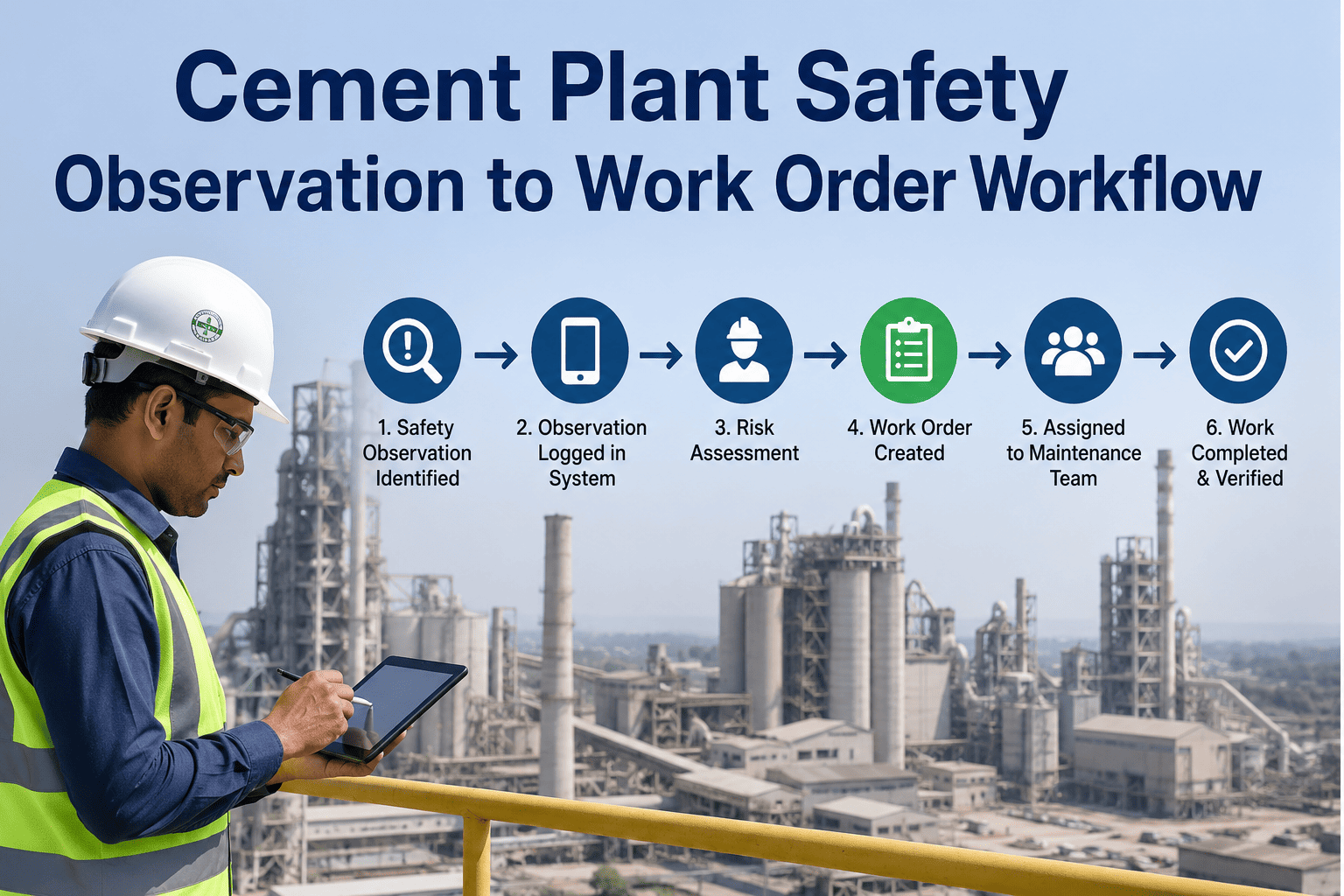
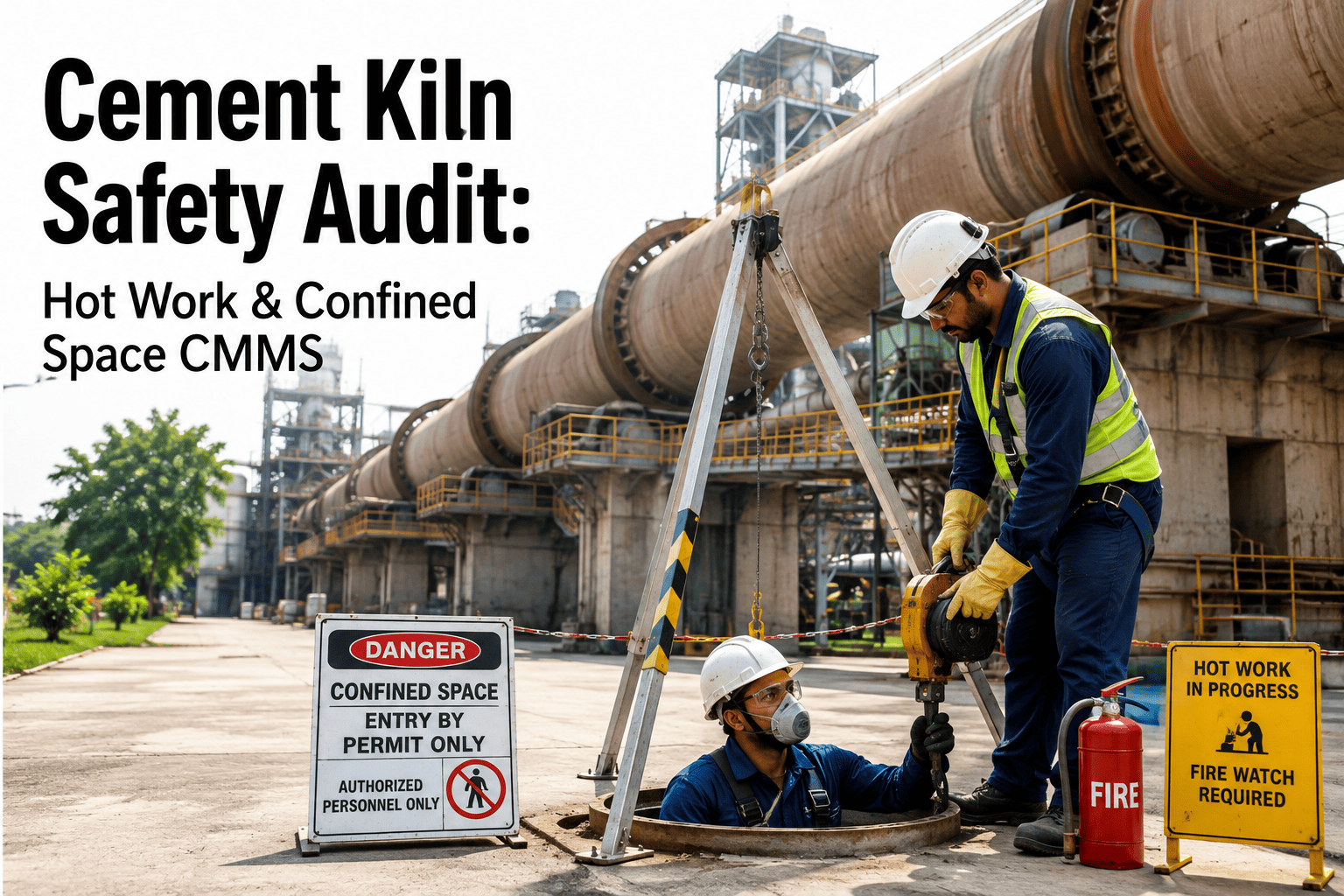
A loose handrail bolt near the kiln platform, a frayed conveyor guard, a faint oil sheen under a hot bearing — these are the warnings cement plants get before an incident, not after. The problem is rarely that nobody notices. It's that the observation gets written in a logbook, mentioned at shift handover, and then quietly forgotten while the shift changes three more times. Reporting a hazard only matters if it leads to a fix that someone can prove happened. OxMaint connects every field observation to a tracked work order so nothing gets lost between the report and the repair.
Hazard Reporting → Verified Fix
Turn Every Hazard Report Into a Tracked, Closed Work Order
Mobile hazard capture, automatic routing, and photo-verified closure — built so safety observations stop disappearing into paper logbooks.
The Real Cost of an Open Loop
Plants relying on logbooks and verbal handovers consistently underestimate how many hazards are reported but never actually verified as fixed.
40%+
of paper-logged hazards in legacy systems have no recorded closure date
5–7 days
typical delay between a verbal report and any maintenance action being taken
3x
more hazards get reported once technicians see their own reports actually get closed
The Journey From Field Report to Closed Hazard
A reliable workflow doesn't depend on someone remembering to follow up. Each stage moves automatically into the next, with a clear owner at every point.
A
Capture in the field
A technician photographs the hazard and submits it from a mobile device at the exact location, with no return trip to an office required.
B
Severity and routing applied
The system tags the report by severity and automatically routes it to the responsible maintenance team based on asset and location.
C
Work order assigned
A named technician receives the work order with a due date set according to severity, removing any ambiguity about ownership.
D
Closure verified with proof
A closing photo and supervisor sign-off are required before the work order can be marked complete, creating a permanent audit record.
A hazard report with no closure record is just a note nobody acted on. OxMaint requires photo-verified sign-off before any safety work order can be closed, so every report has a provable outcome.
Matching Urgency to Risk Level
Treating every hazard with the same urgency either overwhelms the maintenance team or causes serious risks to wait too long. A defined severity scale keeps response times consistent and defensible.
| Severity Level | Typical Example | Response Window | Who Gets Notified |
| Critical |
Exposed live wiring near a walkway |
Immediate, same shift |
Plant manager, instantly |
| High |
Missing guard on rotating equipment |
Within 24 hours |
Maintenance supervisor |
| Medium |
Worn handrail, slow oil leak |
Within 7 days |
Weekly safety review |
| Low |
Faded or missing warning signage |
Within 30 days |
Batched into next PM cycle |
Why Some Plants Get Far More Reports Than Others
The technology only works if people actually use it. Plants with consistently high reporting rates tend to share a few habits in common.
01
Visible closure
Technicians can see their own reported hazard marked resolved with a photo, which builds confidence that reporting is worth the time.
02
No blame attached
Observations are treated as a contribution to safety, never as a complaint against a shift or department.
03
Data reviewed weekly
Hazard trends are discussed in regular safety meetings instead of sitting unused in a dashboard nobody opens.
What Changes in the First 90 Days
Plants that move from paper-based reporting to a tracked digital workflow typically see the shift show up in the numbers well before the first quarterly safety review.
2–3x
Increase in reported hazards once technicians trust that reports actually get closed
60%
Reduction in average time between report and work order assignment
100%
Of closed hazards carry a photo and sign-off, versus partial records on paper
Pitfalls That Quietly Undermine a Reporting Program
Pitfall
Treating every hazard as equally urgent, which buries critical issues under a backlog of low-severity reports
Pitfall
Letting closures happen without photo proof, which quietly reintroduces the same trust gap paper logbooks had
Pitfall
Never reviewing recurring hazard locations, so the same guard or handrail gets temporarily patched instead of permanently fixed
Who Should Own Each Part of the Workflow
Field Technicians
Responsible for capturing the hazard accurately with a photo and clear description at the moment it's observed.
Maintenance Supervisors
Responsible for assigning the right technician and confirming the fix meets the required standard before sign-off.
Plant Safety Officer
Responsible for reviewing severity trends, escalation patterns, and recurring locations across the full plant.
Frequently Asked Questions
How long does it take a technician to log a hazard?
Under a minute in most cases — a photo, a short note, and a location tag. Plants that simplify the reporting step consistently see more hazards logged, since complicated forms quietly discourage people from bothering at all.
OxMaint's mobile capture is built around this principle.
Is a safety observation work order different from a normal maintenance request?
Yes. Safety observations carry severity tagging and audit-specific requirements like before-and-after photos and supervisor sign-off, which standard maintenance work orders don't always need. Both live in the same system but are tracked separately for compliance reporting.
Can corporate teams see hazard patterns across multiple plants?
Yes. Once observations are logged consistently, recurring patterns become visible — for example, the same conveyor section getting flagged repeatedly is usually a sign that a design fix is needed rather than another temporary repair.
Book a demo to see this cross-site view in action.
What happens if a critical hazard misses its response window?
Overdue critical and high-severity items trigger automatic escalation alerts to supervisors and plant managers, so nothing depends on someone happening to notice it's late. This automatic escalation is usually the single biggest gap in paper-based systems.
Will this hold up during a regulatory or ISO safety audit?
Generally, yes. A digital trail with timestamps, photos, and sign-offs is far easier to present to an auditor than a paper logbook, and it removes the risk of records being backfilled or misplaced right before an inspection.
Make Sure Every Reported Hazard Gets Fixed, Not Just Logged
Give your team a workflow that proves closure with a photo and a sign-off, from the moment a hazard is spotted to the moment it's resolved.