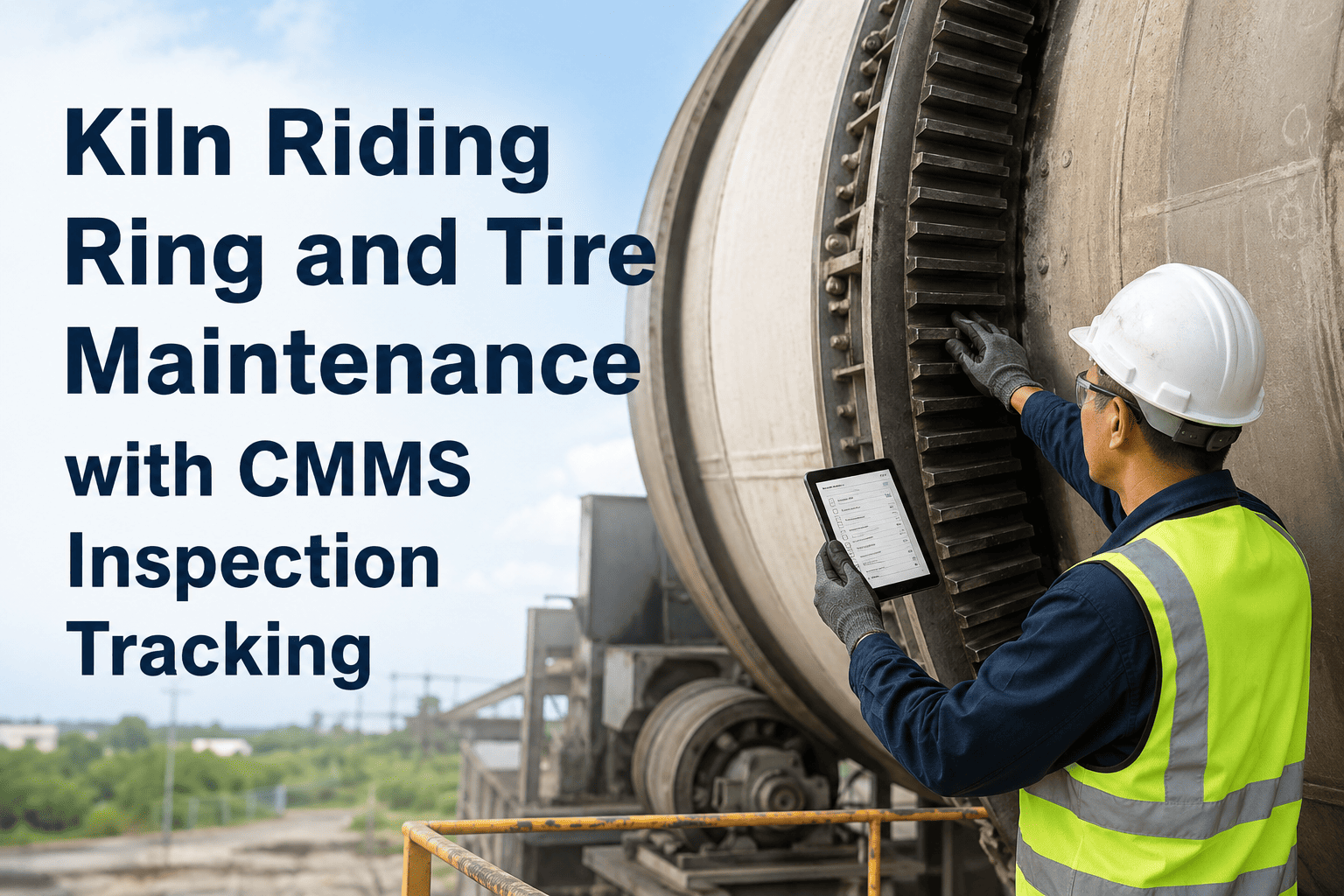
Riding ring wobble, ovality, and pad wear are the most consistently underestimated maintenance risks in any rotary kiln programme — not because they are hard to measure, but because measurement results traditionally end up in shutdown binders disconnected from any work order, trend chart, or replacement forecast. A kiln tyre migrating at 28mm per revolution looks like a number in a notebook; tracked in a CMMS against a 20mm tolerance, it becomes a work order with a 6-week parts lead time attached. Shell ovality above 0.5% of diameter silently crushes refractory brick and shortens lining campaigns by months — but only a CMMS holding consecutive ovality measurements across campaigns can show the rate of growth before the damage compounds. This page covers the mechanics of riding ring and tyre maintenance, the measurement parameters that matter, CMMS-enforced inspection workflows, and the documented cost of neglecting ring and pad condition until the shell deforms. Oxmaint structures tyre migration records, pad thickness logs, and ovality trending in a single asset record that turns shutdown measurement data into actionable maintenance schedules — book a demo to see a live kiln tyre asset configured in the platform.
Kiln Riding Ring & Tire Maintenance with CMMS Inspection Tracking
Tyre migration above 20mm/rev, ovality exceeding 0.5% of shell diameter, and worn pads are invisible until they destroy refractory and deform your shell. Here is how CMMS measurement records prevent the $400K+ failures that follow neglected ring programmes.
The Riding Ring System — How It Works and Why It Fails
The riding ring (also called the tyre) transfers the entire kiln weight — 1,000 to 2,000 tonnes per pier — to the support rollers beneath. It is a floating ring mounted over shell pad plates with a deliberate gap that allows thermal expansion. That gap is load-bearing in both directions: too tight and the shell cannot expand; too loose and the tyre migrates excessively, the shell ovalises, and refractory collapses.
Relative rotational movement between tyre and shell. Small migration distributes heat evenly. Excess migration means pad wear — the tyre floats on the shell, accelerating ovality and refractory stress. Measured by marking the tyre and shell, then logging displacement per revolution at each stop.
Elliptical deformation of the shell cross-section under the tyre. The shell cycles through the oval shape once per revolution, cyclically compressing and releasing refractory brick. At 0.5%, brick crush failure and joint opening are inevitable within weeks. Measured by laser or mechanical gauge at each tyre station during stops.
Shell pad plates fill the gap between the shell and the inside of the tyre. As they wear, the gap increases and migration rises. Worn pads also allow the tyre to knock against the shell, generating impact loads that crack refractory and fatigue the shell weld seams over time.
Axial movement of the kiln along its centreline. Controlled by thrust rollers at one tyre station. When axial float exceeds tolerance, thrust loads concentrate on one roller, accelerating bearing wear. CMMS axial position logging detects drift before the thrust bearing reaches overload.
What to Measure, When to Measure It, and What CMMS Records
A riding ring maintenance programme lives or dies on measurement consistency. Parameters measured at one shutdown and never compared to the previous stop are useless for trend detection. CMMS enforces the comparison automatically — flagging when the rate of change, not just the absolute value, crosses the intervention threshold.
| Parameter | Measurement Method | Frequency | CMMS Trend Action |
|---|---|---|---|
| Tyre migration rate | Mark method — chalk or paint on tyre and shell; measure displacement per revolution during operation | Monthly during operation; every stop | Alert when >20mm/rev; trend rate of increase across stops |
| Shell ovality at tyre stations | Laser survey or mechanical dial gauge at 8 points per cross-section during stop | Every kiln stop | Flag >0.3% diameter; critical alert at 0.5%; CMMS plots trend across campaigns |
| Pad plate thickness | Ultrasonic thickness measurement; physical measurement during stop with tyre lifted by temporary jacking | Every major stop (every 6–12 months) | Work order triggered when wear exceeds 50% of installed thickness; parts order generated with lead time |
| Tyre profile and roundness | Dial indicator measurement at 4 quadrants; compare max vs min diameter Every stop; detailed survey annually Flag when out-of-round exceeds 3mm; trend rate of ovality growth Axial float position Position measurement against fixed reference at thrust station | Weekly during operation; every stop | Alert when position approaches upper or lower tolerance limit Roller contact band width and position Visual and measurement during stop; contact pattern indicates roller skew and tyre wear Every stop Skew angle flag triggers roller alignment work order before axial thrust develops |
Oxmaint structures tyre migration, ovality, and pad thickness records against each tyre station asset. Campaign-to-campaign trending is automatic — no spreadsheet reconciliation, no disconnected shutdown binders. Every measurement either confirms normal or raises a work order.
Roller Skew and Alignment — The Hidden Driver of Tyre Wear
Roller skew is the most commonly missed root cause of accelerated tyre wear. A roller axis misaligned by even 0.1° from the kiln centreline creates axial thrust that loads the tyre asymmetrically, generating oval wear on one side while the other side remains unworn. Without CMMS baseline records from commissioning, technicians cannot calculate the drift rate — and corrections made without trend data are guesswork that often over-corrects and introduces thrust problems at the adjacent station.
Angular deviation of roller axis from kiln centreline. Above 0.3% of shell diameter it accelerates refractory wear and seal damage. CMMS trending identifies stations where skew is growing between campaigns — allowing correction before it translates into shell ovality.
The width of the wear band on the roller surface indicates load distribution. A narrow contact band (less than 60% of roller face width) concentrates hertzian contact stress, accelerating surface fatigue on both roller and tyre. Logging contact band width per station detects developing misalignment before vibration rises.
Bearing temperature rise at the thrust side of a roller station indicates axial overloading — often the first measurable signal that axial float has exceeded tolerance. CMMS continuous temperature logging with rate-of-change alerting catches a 3°C/week rise at week 3, not at week 7 when the failure window narrows.
The Financial Case for Structured Riding Ring Monitoring
Riding Ring and Tyre Maintenance — Key Questions
Oxmaint structures tyre migration, ovality, pad thickness, and roller contact data per station — automatically trending across campaigns and flagging drift before it costs you a refractory campaign. Stop logging measurements in binders that never drive a work order.