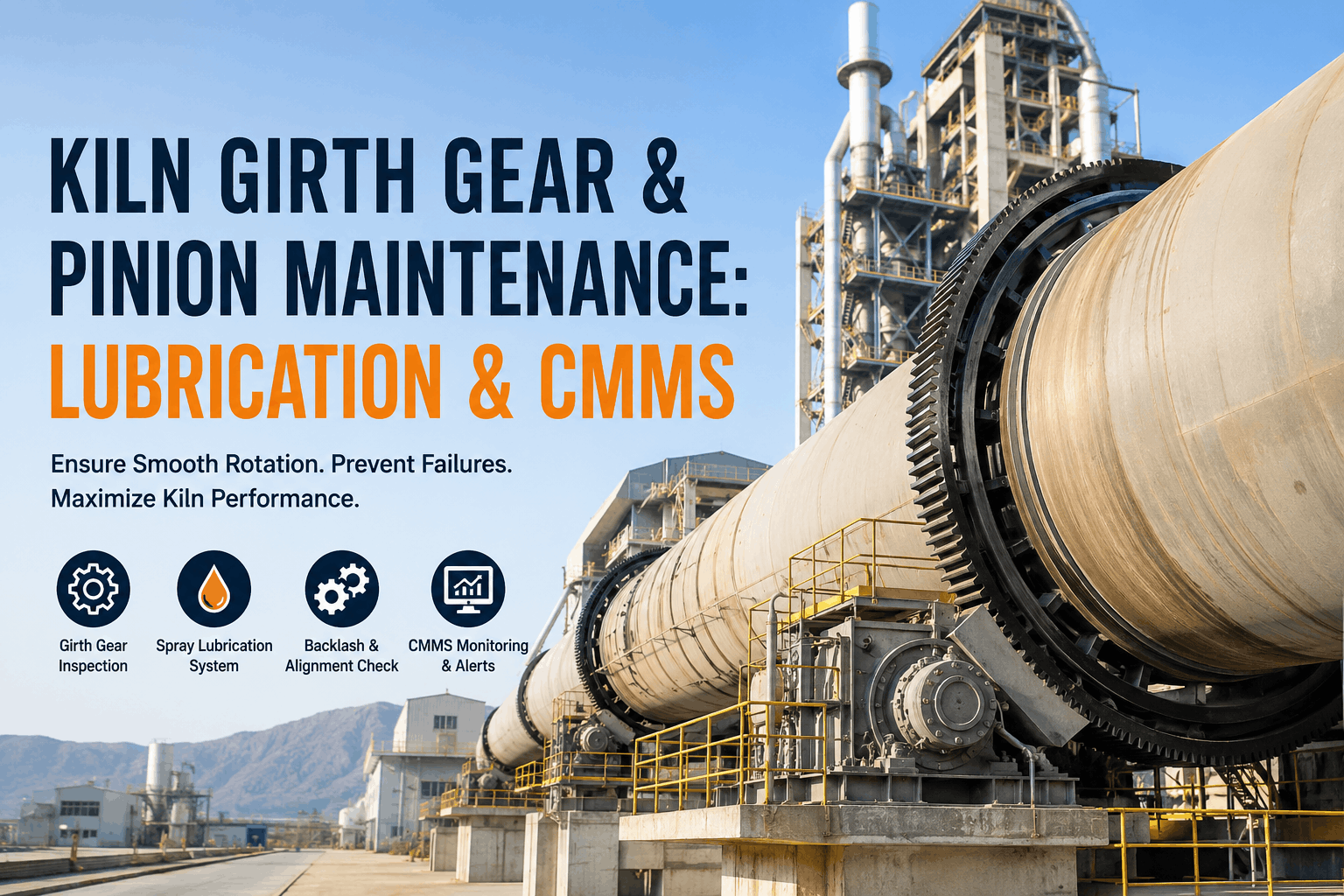
The girth gear is the single largest open gear drive in most industrial plants — and one of the most expensive single components to replace, with costs ranging from $200,000 to over $800,000 for a cement kiln girth gear including installation and downtime. Yet the failure modes that destroy girth gears — progressive backlash growth from wear, lubricant film breakdown, asymmetric wear patterns from pinion misalignment, and fatigue cracking at tooth roots — all develop over months and are entirely detectable with a structured monthly preventive maintenance programme. A girth gear that receives consistent monthly backlash measurements, lubrication audits, wear pattern assessments, and alignment checks will typically achieve 15–25 years of service life. One that is managed reactively rarely lasts 8. This girth gear monthly PM checklist gives rotating equipment engineers, kiln supervisors, and maintenance planners a complete, CMMS-trackable inspection framework covering backlash measurement methodology, spray lubrication system verification, tooth wear pattern scoring, pinion alignment assessment, and documentation standards — backed by the industry standards that govern open gear drive maintenance in cement, mining, and mineral processing operations. Sign Up Free on Oxmaint to digitise your girth gear PM records and build a full campaign history of backlash trends, wear scores, and lubrication audit data across every kiln in your plant.
Girth gear replacement is a six-figure capital event that gives you months of warning — if you are measuring the right parameters every month. Oxmaint captures backlash readings, wear pattern scores, and lubrication audit results by gear segment, automatically flagging the trends that predict failure before the tooth root cracks.
Typical design backlash range at installation for cement kiln girth gears.
3× New Value
Maximum Allowable Backlash
When backlash reaches 3× the new gear value, tooth thickness is critically reduced. Engineering review required.
60–180 sec
Spray Cycle Interval
Typical spray lubrication cycle for open gear drives. Verify against OEM specification for your gear module and speed.
15–25 yrs
Design Service Life
Achievable with consistent monthly PM. Reactively managed girth gears average 8–12 years to critical wear.
Phase 01 — Backlash Measurement
Monthly Girth Gear Backlash Measurement Procedure
Backlash — the clearance between meshing tooth flanks — is the primary quantitative indicator of girth gear wear. Every millimetre of backlash growth represents material lost from the tooth flanks of the girth gear and pinion combined. Measuring backlash correctly, consistently, and at the same reference positions every month is the foundation of any girth gear PM programme. Without trended backlash data, tooth thickness loss is invisible until the gear is already in the danger zone.
Backlash Growth Action Level Framework
0.25–0.40mm
New / As-Built
Establish baseline. Log as campaign start datum.
▶
0.40–1.5× new
Normal Wear
Monitor monthly. Trend direction is key indicator.
▶
1.5–2× new
Watch Zone
Increase frequency to fortnightly. Engineering review.
Backlash Measurement ChecklistAGMA 9005 / ISO 1328
Phase 02 — Spray Lubrication System Verification
Open Gear Spray Lubrication Audit Checklist
The spray lubrication system for a girth gear is not a set-and-forget installation. Spray nozzles clog, timers drift, heating systems fail in cold environments, and lubricant grades are inadvertently changed during routine procurement. Any of these failures can remove the protective lubricant film from the gear mesh within hours, causing rapid metal-to-metal contact and initiating the wear cycle that ends in gear replacement. A monthly lubrication audit takes under 30 minutes and is the single highest-value maintenance task for girth gear life extension.
Spray Nozzles
Flow pattern coverage — full tooth width
No clogged or misdirected nozzles
Spray directed at gear mesh entry point
No drip accumulation on guard floor
Pump and Timer
Cycle time matches OEM specification
Pump pressure within rated range
No air in supply line (prime check)
Pump motor amp draw within normal range
Lubricant Supply
Tank level above minimum marker
Lubricant grade matches specification
No water or contamination visible
Heating element functional (cold climates)
Gear Guard / Enclosure
Guard seals intact — no lubricant throw-off
Drain clear — no pooled lubricant
No dust or process material ingress
Inspection ports accessible and sealed
Spray Lubrication System ChecklistAGMA 9005-F16 / ISO 6743-6
Phase 03 — Wear Pattern and Tooth Condition Assessment
Girth Gear Tooth Wear Pattern Scoring and Root Crack Inspection
Tooth wear pattern analysis is the most information-rich inspection task in the girth gear PM programme. The pattern of wear on the tooth flank reveals the load distribution across the full gear face width — and load distribution problems are caused by pinion misalignment, gear eccentricity, and foundation deflection. Identifying the wear pattern type allows the root cause to be corrected before it accelerates into tooth root cracking and catastrophic fracture.
Common Wear Pattern Types and Root Causes
Uniform Full-Face Wear
Correct alignment. Normal wear distribution. No corrective action required.
Normal
Edge Loading — Drive Side
Pinion axial misalignment. Gear face not parallel. Requires pinion realignment at next shutdown.
Action Required
Centre Band Wear
Gear or pinion crowning mismatch. Foundation deflection. Check gear mounting and pinion shaft deflection.
Investigate
Pitting — Pitch Line
Lubricant film breakdown at pitch line. Hertzian fatigue. Review lubrication system immediately.
Critical
Tooth Wear Pattern and Condition ChecklistAGMA 1010 / ISO 10825
Phase 04 — Pinion Alignment and Foundation Check
Pinion Alignment, Root Clearance, and Foundation Integrity
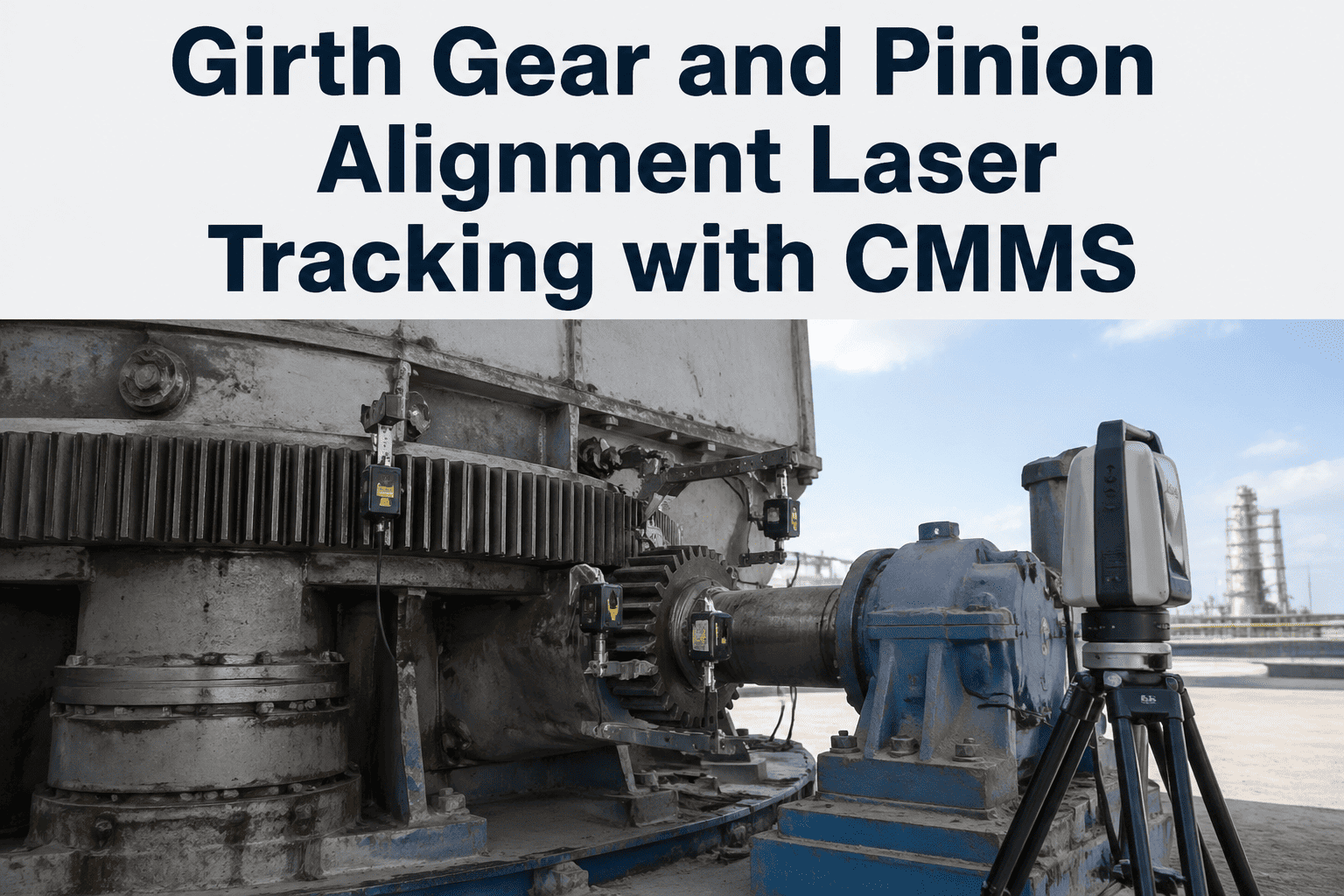
Pinion misalignment is the root cause of most non-uniform girth gear wear patterns and the primary driver of premature gear replacement. Even a seemingly minor misalignment — 0.1mm over the full face width — doubles the contact stress on the loaded side of the tooth, reducing gear life by 40–60%. Monthly root clearance measurement and foundation anchor bolt checking are the lowest-cost, highest-impact alignment verification tasks available without a full kiln shutdown.
Alignment and Foundation ChecklistAGMA 9005 / ISO 1328-1
Monthly PM data for a girth gear — backlash readings, spray lubrication audit results, wear pattern scores, root clearance measurements — only delivers value when it is structured, trended, and acted on. Oxmaint builds the complete girth gear PM history that turns monthly data points into a predictive maintenance programme that protects your six-figure capital investment.
What is the correct method for measuring girth gear backlash on a rotary kiln?
Lock the pinion shaft against rotation using a brake or mechanical stop. Place a dial indicator tangentially against the girth gear tooth flank at one of the four permanent reference positions marked around the gear circumference. Gently rock the girth gear back and forth by hand or with a lever and record the total dial indicator travel — this is the backlash value. Take three readings per position and average them. Always measure at the same reference positions each month to enable valid trend comparison. Sign Up Free to record and trend backlash data in Oxmaint.
How often should girth gear spray lubrication system be inspected and what are the key checks?
The spray lubrication system should be audited monthly as a minimum. The five key checks are: manual trigger and visual confirmation that all nozzles are flowing with correct spray pattern, timer setting verification against OEM specification, tank level and lubricant grade confirmation from drum label, gear guard interior inspection for lubricant accumulation or metallic debris, and pinion bearing temperature measurement. Any nozzle failure must be corrected within 48 hours. Book a Demo to see how Oxmaint manages lubrication audit scheduling.
What does an edge loading wear pattern on a girth gear tooth indicate?
Edge loading — where wear is concentrated on one side of the tooth face width rather than distributed evenly — is the primary indicator of pinion axial misalignment. The pinion face is not parallel to the girth gear face, causing the contact stress to concentrate on the loaded edge rather than distributing evenly. This doubles contact stress on the loaded side, reducing gear life by 40–60%. Root clearance measurement at both ends of the pinion face width will confirm and quantify the misalignment.
When should a girth gear replacement be planned based on backlash measurement?
Replacement planning should begin when backlash reaches 2× the original new gear value — this gives sufficient lead time for procurement, which typically takes 6–18 months for a custom-manufactured girth gear. When backlash reaches 3× the new value, tooth thickness is critically reduced and an engineering-driven shutdown timeline is required. Projecting the date at which backlash will reach 3× new value, based on the current wear rate from CMMS data, is the most reliable way to set a shutdown planning date.
What CMMS records should be created from a monthly girth gear PM inspection?
Each monthly PM should generate a CMMS record containing: backlash readings at all four reference positions with averages and growth rate calculation, spray nozzle status and cycle timer settings, lubricant tank level and grade confirmation, tooth wear pattern classification and any thickness measurements taken, root clearance readings at both pinion ends, bearing temperatures, foundation anchor bolt check status, and any anomalies with photos. All records must be linked to the gear asset ID and accumulated operating hours at the time of measurement. Sign Up Free to build this structure in Oxmaint.
Every Measurement Position. Every Month. Every Backlash Reading, Wear Score, and Lubrication Audit — Tracked and Trended in Oxmaint.
Oxmaint's CMMS puts your complete girth gear monthly PM checklist on your maintenance team's phones, captures backlash readings at all four reference positions, calculates growth rates automatically, tracks wear pattern scores by gear segment, logs spray lubrication audit results, and projects replacement timelines from current wear rate data. Stop managing your most expensive rotating component on instinct. Start managing it on data.