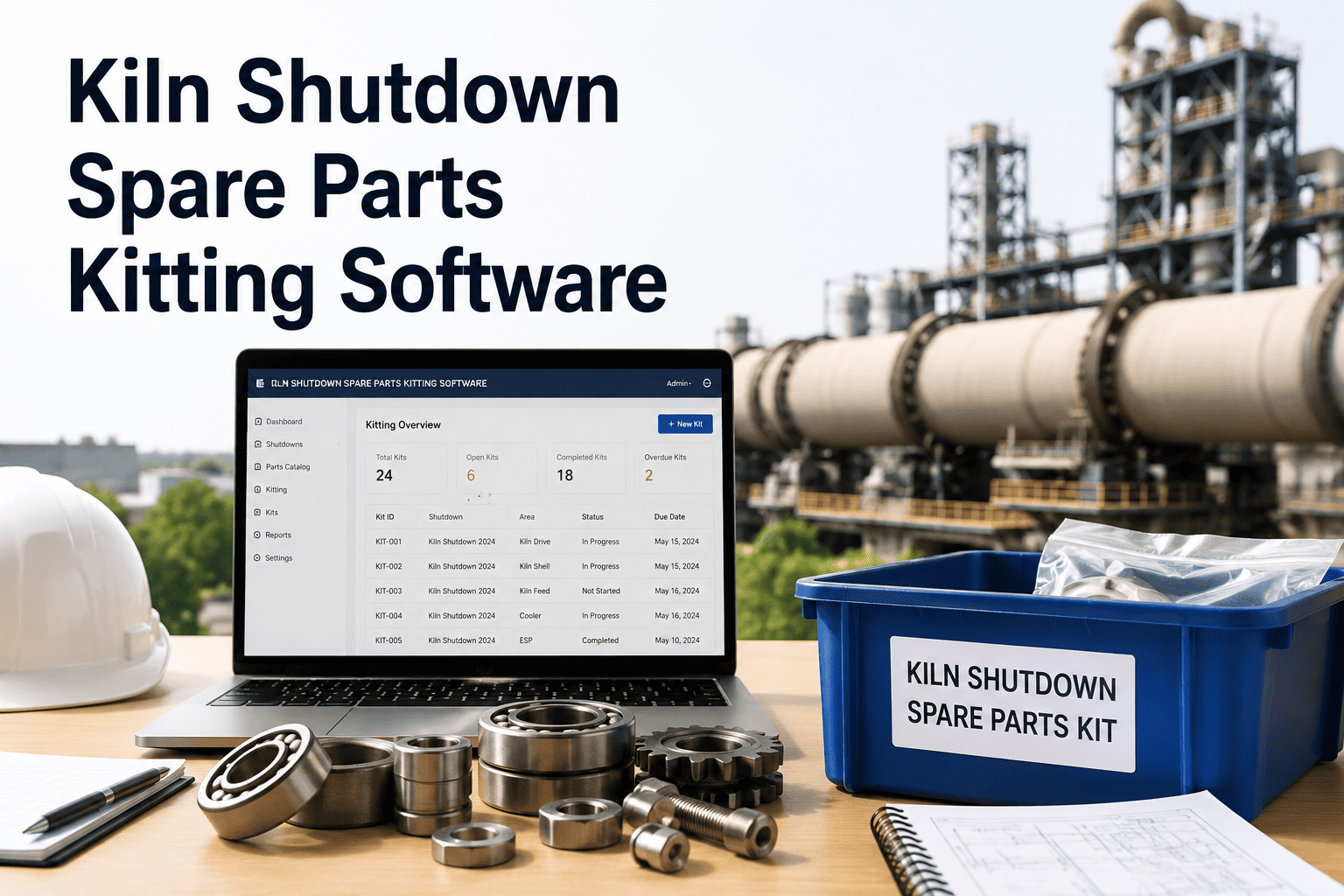
A kiln shutdown that starts with a frozen scope costs a fraction of what a scope-creep shutdown does — yet most plants still walk into a planned stop with unconfirmed work packs, unstaged parts, and contractors who learned about the job two days before. The pre-shutdown freeze window — 24 hours, 12 hours, and 6 hours before kiln stop — is where shutdown success or failure is decided. Every hour of unplanned downtime on a rotary kiln typically costs between $15,000 and $60,000 in lost production. This checklist locks down scope, work packs, parts staging, contractor assignments, and CMMS sign-off at each critical gate so your team walks into every kiln stop fully prepared. Manage your kiln shutdown planning digitally in Oxmaint or book a session with our shutdown planning team.
Why the Freeze Window Matters
The Cost of a Late Scope Change
68%
of kiln shutdowns that overrun were caused by scope added after the freeze gate
2.4×
average cost multiplier when a part is expedited during shutdown vs pre-staged
$42K
average cost per unplanned extra day on a cement kiln shutdown
83%
of scope overruns are preventable with a hard freeze gate and work pack sign-off
Timeline Overview
The 3-Gate Pre-Shutdown Freeze Timeline
T − 24 Hours
Scope Freeze & Work Pack Lock
All maintenance work orders finalised in CMMS
No new work added without written approval
Work packs issued to all crew leads
Contractor mobilisation confirmed
T − 12 Hours
Parts Staging & Resource Lock
All critical parts physically staged at work fronts
Tools, scaffolding, and lifting gear confirmed
Safety permits pre-drafted and ready for issue
Shutdown coordinator briefing completed
T − 6 Hours
Final Gate — Go / No-Go
All crew on-site and briefed
Critical path sequence confirmed
Control room and operations aligned
CMMS shutdown work order activated
Plan Every Kiln Shutdown Gate in One System
Oxmaint's shutdown planning module tracks scope freeze status, parts staging, work pack sign-off, and contractor lock-in across all three gates — with real-time visibility for the shutdown coordinator and plant manager.
Complete Pre-Shutdown Checklist
Kiln Pre-Shutdown Freeze Checklist — All Three Gates
Scope Freeze
All maintenance work orders for this shutdown finalised in CMMS — work order numbers confirmed and printed on work packs
Scope freeze formally declared by Shutdown Coordinator — written freeze notice issued to all department heads
Any scope change request after freeze requires written approval from Plant Manager — verbal additions not accepted
Carry-forward jobs from previous shutdown reviewed — confirm each is included in CMMS or formally deferred with reason
Inspection-triggered corrective jobs from last daily rounds reviewed — confirm any urgent defects are included in scope
Work Pack Preparation
Work pack prepared for every work order — includes task description, drawings, parts list, LOTO procedure reference, and PPE requirements
Critical path jobs identified and marked — critical path sequence documented in shutdown schedule
Work packs distributed to crew leads with acknowledgement sign-off — no crew lead begins work without a signed work pack
Job hazard analysis (JHA) completed for all high-risk tasks — reviewed by Safety Officer and attached to work pack
Permit-to-work (PTW) templates pre-drafted for confined space, hot work, and LOTO tasks — ready for issue at shutdown start
Contractor Lock-In
All contractors confirmed on-site arrival time — no contractor assumed to be available without written confirmation
Contractor scope of work document signed by contractor supervisor — includes deliverables, manhours, and completion sign-off requirements
Contractor induction and site access requirements confirmed — all personnel with valid induction records in CMMS
Specialist equipment contractors (alignment, NDT, thermography) confirmed with equipment list — confirm calibration certificates valid
Parts & Materials Staging
All critical parts physically pulled from stores and staged at designated shutdown staging area — parts list verified against work orders
Refractory bricks, castable, and anchor hardware staged and quantity-verified — confirm no shortfall against work pack quantities
Spare bearings, seals, and lubrication products staged — confirm correct part numbers against equipment records in CMMS
Any parts on back-order or transit confirmed with ETA — if ETA is after shutdown start, escalate to Plant Manager immediately
Consumables (welding rods, gaskets, fasteners, lubricants) staged in sufficient quantity — surplus 10–15% buffer confirmed
Tools, Equipment & Access
Scaffolding erection confirmed complete or scheduled — scaffold inspection tag issued and valid before shutdown start
Crane and lifting equipment confirmed available and inspected — lift plans approved for all critical picks
Specialised tools (hydraulic pullers, alignment tools, torque equipment) confirmed on-site and in working order
Temporary lighting and ventilation for confined space and refractory work confirmed staged and tested
Communication plan confirmed — radios issued, channel assignments made, emergency contact list distributed to all crew leads
Shutdown Coordinator Briefing
Full shutdown coordinator briefing conducted with all crew leads — critical path, interfaces, and escalation contacts reviewed
Shutdown schedule published to all stakeholders in CMMS — access confirmed for operations, maintenance, and safety teams
Interface points between parallel work streams documented — no two teams working on the same equipment without coordinator sign-off
Escalation procedure confirmed — define who makes the call on scope additions, extra time, or contractor call-out during the shutdown
Operations & Process Alignment
Operations team confirmed kiln cool-down sequence initiated — kiln temperature reduction schedule confirmed and communicated
Feed system and fuel shutdown sequence confirmed with control room — all interlock bypasses logged and approved
Kiln entry temperature target confirmed — refractory and confined space entry not permitted until shell reaches safe entry temperature
Adjacent process units (cooler, preheater, raw mill) shutdown sequence confirmed and coordinated with respective area teams
Safety & Permit Readiness
LOTO master isolation register completed for kiln and all associated drives — isolation point list reviewed by Safety Officer
First aid and emergency response resources confirmed on-site for shutdown duration — first aider per shift confirmed
Gas monitoring equipment confirmed on-site, calibrated, and assigned to confined space entry tasks
Rescue plan for confined space entry confirmed — rescue team, equipment, and communication protocol reviewed with all crew
CMMS Final Sign-off
Shutdown work order activated in CMMS — status changed to In Progress; all child work orders linked and visible
Final Go / No-Go decision documented in CMMS by Plant Manager — timestamp and authorisation recorded
All three gate checklists (24 hr, 12 hr, 6 hr) completed and signed off in CMMS — no gate skipped or fast-tracked without approval
Shutdown start time communicated to all teams — CMMS notification sent to all assigned personnel
Comparison
Planned vs Unplanned Kiln Shutdowns — The Real Cost Gap
| Factor |
Planned (Freeze Gate Followed) |
Unplanned / Scope-Creep Shutdown |
| Average shutdown duration |
On target or under |
20–40% longer than planned |
| Parts availability at start |
100% pre-staged |
Emergency procurement mid-shutdown |
| Contractor readiness |
On-site at shutdown start |
Mobilisation delays of 4–12 hours |
| Safety incident rate |
Significantly lower |
3× higher — rushed work, poor planning |
| Post-shutdown CMMS completeness |
Full records, all WOs closed |
Incomplete records, missing sign-offs |
| Cost vs budget |
Within 5–10% of budget |
50–200% over budget common |
Frequently Asked Questions
Kiln Pre-Shutdown Planning — Common Questions
What does "scope freeze" mean in a kiln shutdown context?
Scope freeze is the formal point — typically 24 hours before shutdown — when no new work orders can be added without written approval from the Plant Manager. It ensures that parts are staged for known jobs and contractor hours are matched to confirmed scope. Any work identified after the freeze is deferred to the next planned stop unless it is a safety-critical emergency.
Manage freeze gates digitally in Oxmaint.
Why are there three separate gate checks at 24, 12, and 6 hours?
Each gate addresses a different risk: the 24-hour gate locks scope and issues work packs; the 12-hour gate confirms physical readiness (parts, tools, access); the 6-hour gate aligns operations, safety, and CMMS for the actual stop. Collapsing all three into a single pre-shutdown meeting is the most common planning failure — critical gaps discovered at the 6-hour gate have no time to resolve.
Book a shutdown planning consultation.
How should CMMS be used during the pre-shutdown freeze window?
CMMS should be the single source of truth for all shutdown work orders, parts reservations, contractor assignments, and gate sign-offs. Each gate check should be closed in CMMS with a timestamped sign-off by the responsible person. This creates an audit trail of shutdown readiness and is essential for post-shutdown analysis and regulatory compliance.
What is the most common cause of kiln shutdown overrun?
Parts unavailability is the leading cause of shutdown overrun — accounting for over 40% of unplanned extensions. The second most common cause is scope added after the freeze gate. Both are directly prevented by a structured 24/12/6-hour freeze process with hard gates enforced in CMMS.
Start preventing shutdown overruns with Oxmaint.
Never Walk Into a Kiln Shutdown Unprepared Again
Oxmaint's shutdown planning module enforces your 24/12/6-hour gate process with digital work pack sign-off, parts staging verification, contractor lock-in, and CMMS-linked go/no-go approval — so every shutdown starts on time, on scope, and on budget.