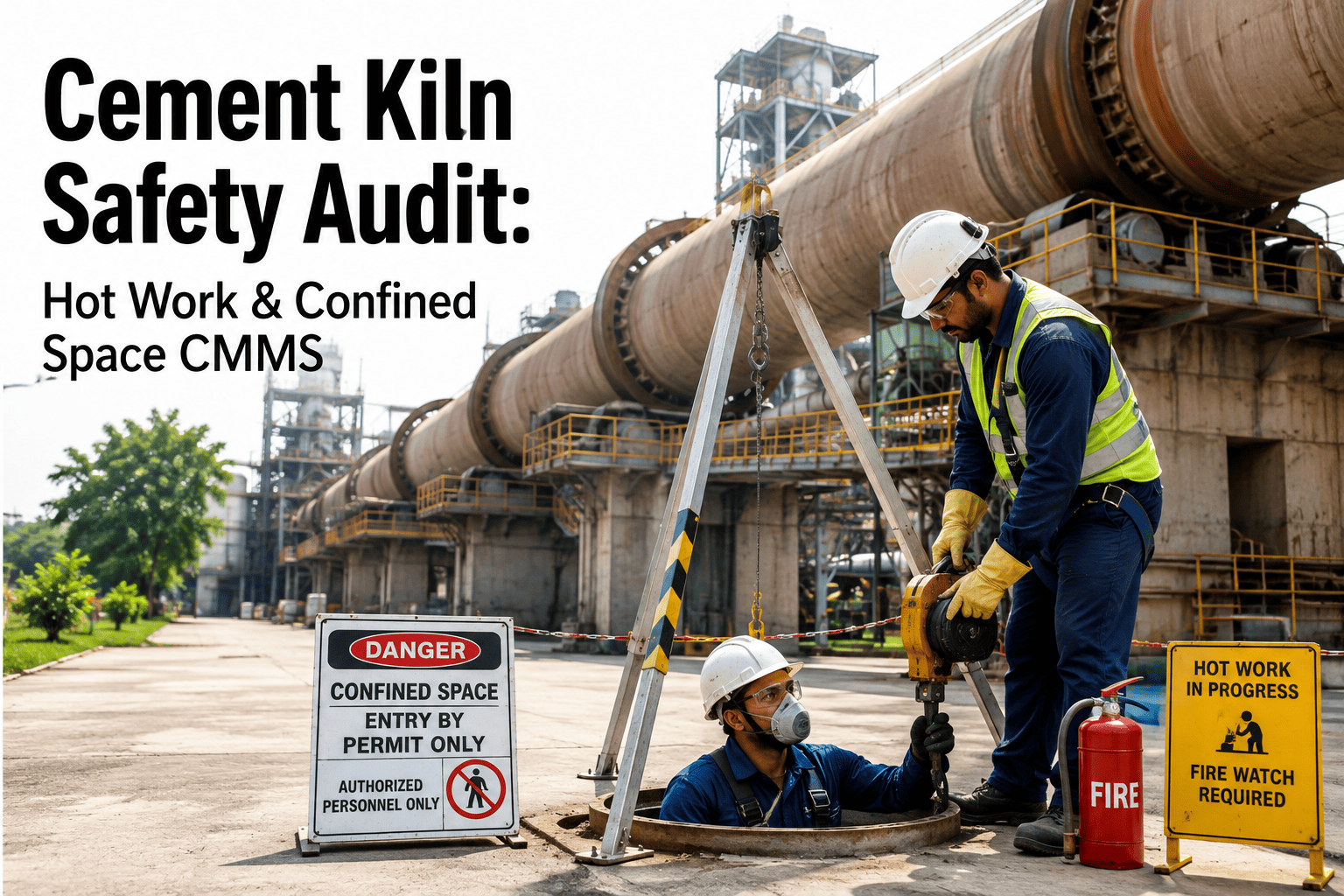
Bringing a rotary kiln back online after a shutdown is where most refractory failures, alignment damage, and mechanical incidents occur. The heat-up and commissioning phase is not a formality — it is a precision process where rushing a refractory cure by even a few degrees per hour can cause catastrophic brick spalling, forcing another immediate shutdown. A poorly verified alignment after tyre or bearing work will damage shell, pads, and rides within the first 24 hours of operation. This checklist covers every step of kiln post-shutdown commissioning — refractory cure schedule verification, mechanical alignment sign-off, instrument and interlock verification, heat-up ramp control, and CMMS handover — so your plant restarts with confidence and runs reliably through the next planned stop. Manage your kiln commissioning checklist digitally in Oxmaint or book a walkthrough with our maintenance engineering team.
Why This Phase Is Critical
The Most Dangerous Phase of Any Kiln Cycle
R
Refractory Failure
Rapid heat-up causes thermal shock and brick spalling — the leading cause of unplanned re-shutdown within 72 hours of restart
Trigger: Exceeding 40°C/hr ramp rate during cure
A
Alignment Damage
Unverified tyre or support roller alignment after bearing work causes progressive shell and pad wear — detectable only after damage is done
Trigger: Skipping post-work alignment survey
I
Instrument Failure
Re-energised instruments with incorrect calibration or configuration give false readings — kiln runs outside safe parameters without operator awareness
Trigger: No instrument verification after recommission
L
LOTO Residual Hazard
Unreleased isolation during re-energisation causes electrical faults, unexpected drive engagement, or hydraulic pressure release injuring workers
Trigger: Incomplete LOTO sign-off before start
Commissioning Phases
5 Phases of Kiln Post-Shutdown Commissioning
01
Mechanical Sign-off
Alignment, torque, guards
→
02
LOTO Release
All isolations cleared
→
03
Instrument Verification
Sensors, interlocks, alarms
→
04
Refractory Cure
Controlled heat-up ramp
→
05
CMMS Handover
Sign-off, close WOs, notes
Track Every Commissioning Phase Digitally
Oxmaint's commissioning checklist module ensures mechanical sign-off, LOTO release, instrument verification, and heat-up ramp records are all captured in one system — with mandatory approvals before each phase unlocks.
Complete Commissioning Checklist
Kiln Post-Shutdown Commissioning — Full Checklist
Phase 01
Mechanical Sign-off & Alignment Verification
All work orders for mechanical work confirmed closed in CMMS — no open corrective actions remain before commissioning begins
Support roller alignment survey completed — contact pattern, skew angles, and thrust loads measured and recorded for all stations
Tyre-to-shell pad clearance verified after any shell, tyre, or pad replacement — measurement recorded per station
Girth gear-to-pinion backlash measured and recorded — compare against allowable range; adjust pinion if outside tolerance
All girth gear segment joint bolts torqued to specification — torque values recorded per bolt group in CMMS
All bearing housing bolts, tyre retaining rings, and drive couplings torque-verified — no assumed torque from installation only
All guards reinstalled and secured — a guard inspection sign-off required before any mechanical rotation or drive test
Kiln rotated manually or on auxiliary drive for minimum 2 full revolutions — confirm no mechanical obstruction before main drive start
Phase 02
LOTO Release & Re-energisation
All personnel confirmed clear of isolation zones before any lock removal — site check by Shutdown Coordinator required
Each personal lock removed by the individual who applied it — no proxy lock removal permitted without formal LOTO override procedure
LOTO master isolation register updated in CMMS — every isolation point marked as released with name and timestamp
Re-energisation sequence followed in reverse isolation order — electrical supply restored before mechanical drives; hydraulic and pneumatic last
All affected personnel notified of re-energisation completion via CMMS notification — no verbal-only notification accepted
Post-energisation checks completed — confirm no voltage faults, tripped breakers, or pressure anomalies before proceeding
Phase 03
Instrument & Interlock Verification
Shell temperature scanner verified — perform test scan on ambient shell; confirm reading matches reference thermometer within ±5°C
Bearing temperature sensors verified at all stations — check loop integrity and confirm readings display correctly on control panel
Kiln speed tachometer verified — confirm signal to DCS matches physical speed during slow rotation test
Thrust position switch or sensor verified — manually simulate thrust limit and confirm alarm and trip activate correctly
Drive overload protection and emergency stop tested — confirm main drive E-stop trips drive and activates auxiliary drive changeover
Lubrication system interlocks tested — confirm kiln main drive cannot start if lube oil pressure is below trip setpoint
All instrument and interlock test results recorded in CMMS against relevant work orders — failed tests must be resolved before heat-up begins
Phase 04
Refractory Cure & Heat-Up Ramp
Confirm refractory cure schedule approved by refractory supplier — use supplier-specified ramp rates; do not apply generic rates without approval
Kiln rotation confirmed on auxiliary or slow rotation drive before any heat is introduced — rotation must be continuous during entire heat-up
Initial drying phase completed — hold at 100–120°C for minimum period specified in cure schedule to drive off free moisture from castable and new bricks
Heat-up ramp rate controlled and logged — do not exceed 40°C per hour for standard refractory or supplier-specified limit if lower
Hold temperatures (soak points) observed as per cure schedule — each soak point recorded with start time, target temperature, and completion sign-off
Shell temperature monitored continuously during heat-up — operator to perform full shell scan every 60 minutes; log readings in CMMS
No production feed introduced until shell and process temperatures reach the minimum commissioning threshold defined in the heat-up schedule
First production feed introduction at reduced rate — confirm flame shape, burning zone temperature, and draft are stable before increasing to normal feed rate
Phase 05
CMMS Handover & Documentation Close-out
All shutdown work orders closed in CMMS with actual hours, materials used, and work completion description — no work order left in open status
Any defects found during commissioning but deferred to next shutdown raised as new work orders in CMMS — scope and parts requirement documented
Refractory condition notes recorded — location, extent, and type of any new damage observed during heat-up added to equipment history in CMMS
Alignment survey results, torque records, and backlash measurements attached to equipment records — provides baseline for next shutdown comparison
Shutdown duration, total manhours, parts cost, and lessons learned documented in CMMS shutdown record — available for post-shutdown review
Operations team formally notified of handover from maintenance — signed handover record in CMMS with both maintenance and operations sign-off
Heat-Up Ramp Reference
Standard Refractory Cure Schedule Reference
| Phase |
Temperature Range |
Max Ramp Rate |
Minimum Hold Time |
Purpose |
| Free moisture drying |
Ambient → 120°C |
20°C / hr |
4–8 hours at 120°C |
Drive off surface and capillary moisture |
| Chemically bound water |
120°C → 350°C |
30°C / hr |
4–6 hours at 350°C |
Release chemically bound water from castable |
| Sintering ramp |
350°C → 900°C |
40°C / hr |
2–4 hours at 900°C |
Initial sintering of new refractory |
| Full operating temp |
900°C → Process Temp |
50°C / hr max |
Per supplier schedule |
Final commissioning ramp to production |
Always obtain and follow the specific cure schedule from your refractory supplier. Generic rates above are indicative only — new castable installations and gunite repairs may require slower rates.
Frequently Asked Questions
Post-Shutdown Commissioning — Common Questions
How long does a standard kiln refractory cure and heat-up take?
A full refractory cure from cold to operating temperature typically takes 48 to 96 hours depending on the extent of new lining, castable volume, and supplier specification. Plants that attempt to accelerate this window risk brick spalling and a second unplanned shutdown. For partial repairs with limited castable, some suppliers allow an accelerated 24–36 hour schedule.
Log your heat-up ramp data in Oxmaint.
Can the kiln rotate during heat-up or must it be stationary?
The kiln must rotate continuously during heat-up — typically on auxiliary drive at slow speed. Stationary heat-up causes uneven thermal expansion, differential brick loading, and permanent shell deformation. Continuous slow rotation distributes heat evenly across the refractory and shell and is a non-negotiable requirement for all heat-up schedules.
Discuss your commissioning process with our team.
What is checked during instrument verification before kiln start?
Instrument verification covers shell temperature scanning accuracy, bearing temperature sensor loop integrity, kiln speed tachometer output, thrust position alarms, drive interlocks, and lubrication system trip points. Every instrument that could prevent a failure or trigger an emergency stop must be tested and confirmed functional before heat-up begins.
How should commissioning records be managed in CMMS?
Each commissioning phase should have a linked work order or task in CMMS with mandatory sign-off fields. Heat-up ramp logs, alignment survey results, torque records, and instrument test results should all be attached to the shutdown work order so they are permanently linked to the asset history. This record is critical for warranty claims and future maintenance planning.
Start your Oxmaint free trial.
Commission Every Kiln Restart With Full Confidence
Oxmaint's post-shutdown commissioning module enforces every phase — mechanical sign-off, LOTO release, instrument verification, refractory heat-up logging, and CMMS handover — with phase-gated approvals so no kiln restarts until every check is complete and documented.