Cement kiln safety audits cover the three highest-risk maintenance activities in heavy industry: hot work near 1,400°C refractory surfaces, confined space entry into a vessel designed to be gas-tight, and high-temperature exposure during shutdown campaigns. A defensible audit program does not rely on clipboards and tribal knowledge — it runs on a CMMS that issues, routes, and archives every permit with time-stamped accountability. Plants that digitize kiln safety workflows typically cut permit-cycle time by 40–60% and close 90%+ of audit findings before the next campaign. You can Start Free Trial to pilot the workflow on your next kiln shutdown.
Is your kiln shutdown audit-ready — or one permit gap from a recordable incident?
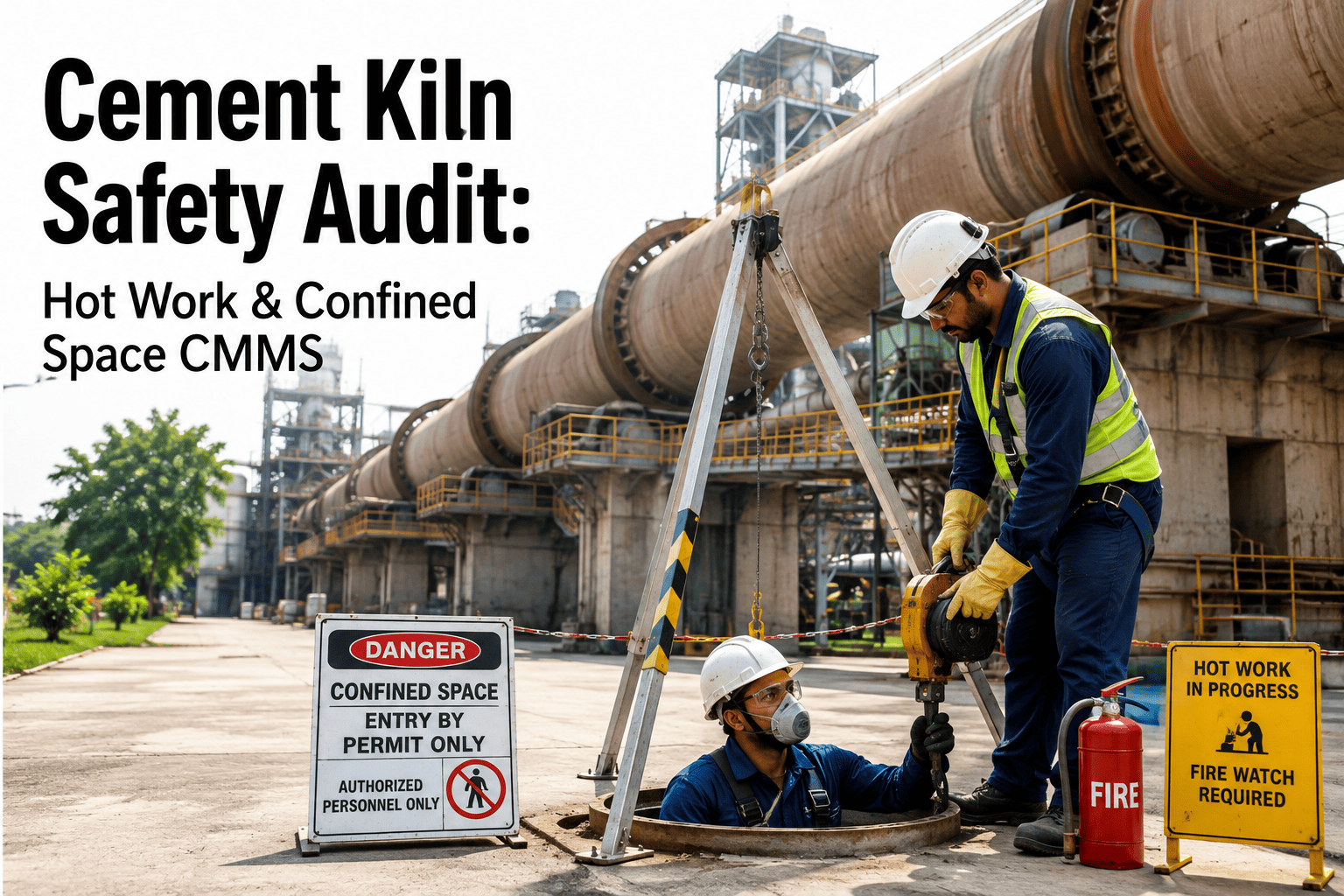
Hot work and confined space entry inside a cement kiln carry compounded risk: 1,400°C refractory, pyrolysis gases, and zero rescue visibility. A CMMS-driven audit program digitizes permits, locks isolation sequences, and produces a defensible trail for every campaign.
Why cement kiln maintenance is a top-tier hazard
A preheater kiln runs at 1,350–1,500°C, rotates at 3–5 RPM, and contains refractory linings that can spall without warning. During a shutdown, crews simultaneously cut, weld, and enter a vessel that was never designed for human occupancy — making audit discipline non-negotiable.
Hot work permit workflow near the kiln
Hot work within 10 meters of a kiln shell or cooler housing demands a permit-to-work (PTW) chain that links gas tests, fire watch, and isolation verification. The CMMS workflow below mirrors OSHA 29 CFR 1910.252 and NFPA 51B — each step is time-stamped and bypassed.
Permit initiation & hazard screening
- Combustible material cleared within 11 m radius (NFPA 51B)
- Kiln shell temperature verified <50°C at work zone
- Gas test: O₂ 19.5–23.5%, LEL <10%, CO <25 ppm
- Fire blanket and charged hose staged at point of work
Energy isolation & lockout-tagout
- Kiln drive locked out at motor breaker and auxiliary drive
- Fuel supply (coal/petcoke) double-block-and-bleed verified
- ID fan isolated and impeller pinned against rotation
- LOTO log photographed and attached to permit in CMMS
Active work & fire watch
- Dedicated fire watch present for full duration, no other duties
- Continuous atmospheric monitoring with audible alarm
- Permit re-validated every 4 hours or shift change
- Hot work stopped if shell temp rises >5°C during task
Post-work monitoring & sign-off
- Fire watch maintained 60 min after last spark (NFPA 51B)
- Work area inspected for smoldering refractory or debris
- Permit digitally signed by issuer, performer, and safety lead
- Permit archived 5 years for OSHA audit defensibility
Kiln internal entry — the confined space protocol
Kiln-shell and preheater-cyclone entry is a permit-required confined space under OSHA 1910.146. The table below maps every control layer a defensible audit must verify before, during, and after entry.
| Control Layer | Requirement | CMMS Verification | Risk if Skipped |
|---|---|---|---|
| Atmospheric testing | O₂ 19.5–23.5%, LEL <10%, CO <25 ppm, H₂S <10 ppm | Gas monitor reading uploaded before entry permit unlocks | Acute toxic exposure; flash fire from residual coal dust |
| Isolation & LOTO | Kiln rotation locked; fuel, air, and feed lines blinded | LOTO checklist must reach 100% — permit blocks otherwise | Catastrophic rotation or material engulfment |
| Entry attendant | Dedicated attendant outside, constant voice/visual contact | Attendant badge-in required; system logs dwell time | Delayed rescue; mortality rises 50% after 6 min unsupported |
| Rescue plan | On-site rescue team, tripod, SCBA, 4-gas monitor staged | Rescue equipment QR-scanned and verified ready | OSHA willful violation; fatality risk if entrant collapses |
| Refractory stability | Loose ring checked; unstable sections barred from entry | Refractory inspection form linked to entry permit | Refractory collapse onto entrants — multiple-fatality scenario |
| Temperature & heat stress | Shell interior <50°C; work-rest cycles per ACGIH TLV | Temperature reading time-stamped to permit | Heat exhaustion, cardiac event, PPE degradation |
A 72-hour kiln shutdown, audited end-to-end
- Single 4-stage preheater kiln, 3,200 tpd clinker
- 72-hour campaign: refractory patch + cooler grate replacement
- 34 hot-work permits, 9 confined-space entries, 6 contractors
- Prior audit: 14 open findings, 3 repeated from previous year
- Permit cycle cut from 95 min to 38 min average (−60%)
- Zero permit overrides; 100% LOTO verification before entry
- All 14 prior findings closed before shutdown T-0
- Audit package exported in one PDF — 5-year retention built in
What the kiln safety CMMS must do
Digital permit-to-work
Hot-work and confined-space permits generated from templates, routed to approvers, and locked until every prerequisite field is complete and uploaded.
LOTO enforcement
Isolation checklists with QR-scanned lock points; the confined-space entry permit will not unlock until LOTO reaches 100% completion.
Real-time gas logging
Wireless 4-gas monitors push O₂, LEL, CO, and H₂S readings to the permit record every 60 seconds — no manual transcription, no gaps.
Audit trail & analytics
Every approval, override attempt, and gas-test failure time-stamped and exportable. Trend dashboards surface repeat findings across campaigns.
Contractor qualification
Contractor safety records, training expiry, and insurance linked to each permit — expired credentials block permit issuance automatically.
Escalation & rescue triggers
If gas readings breach thresholds or an attendant badge-out is missed, the CMMS escalates to the control room and pages the on-site rescue team within 30 seconds.
Make your next kiln shutdown the safest one on record
Deploy a CMMS that treats every hot-work and confined-space permit as a defensible, auditable record — not a piece of paper.
Cement kiln safety audit — common questions
How often should a cement kiln safety audit be performed?
A full kiln safety audit should run before every major shutdown campaign (typically 2–4 times per year) and as a standalone annual review covering permit-to-work records, LOTO procedures, confined-space rescue plans, and contractor qualifications. Between audits, the CMMS continuously verifies compliance in real time — so the annual audit becomes a confirmation, not a discovery exercise.
What temperature must the kiln reach before confined-space entry is permitted?
The internal shell temperature must be verified at 50°C or below at the work zone before any permit-required confined-space entry is authorized. Even after cool-down, refractory hot spots can persist for 12–24 hours, so continuous temperature monitoring during entry is mandatory, and work-rest cycles must follow ACGIH heat-stress TLVs. You can Book a Demo to see the temperature-verification workflow.
How does a CMMS prevent permit bypass during a rushed shutdown?
The CMMS enforces sequential logic: a hot-work permit cannot be issued until gas-test results are uploaded, LOTO reaches 100%, and the fire watch is badged in. Any attempt to override a step is logged with user ID and timestamp, and repeated override attempts trigger an automatic escalation to the plant safety lead — making bypass visibly more costly than compliance.
What records must be retained after a kiln hot-work or confined-space permit closes?
OSHA requires permit records to be retained for one year minimum, but defensible programs retain them for five years to cover statute-of-limitations windows and insurance audits. The CMMS archives each permit — including gas readings, LOTO verification, attendant logs, and closeout signatures — in a tamper-evident, exportable format that satisfies OSHA, NFPA 51B, and corporate audit requirements.
Can the CMMS integrate with our existing gas monitors and access control?
Yes — most industrial 4-gas monitors with Bluetooth or Wi-Fi connectivity can push readings directly to the CMMS permit record at 60-second intervals. Access-control badging systems integrate so that attendant presence, contractor credentials, and training expiry are verified in real time without manual data entry.
Build a defensible kiln safety program in 14 days
Digitize hot-work permits, confined-space entry, and LOTO verification on a platform built for cement-plant shutdowns.
Free 14-day trial · No credit card