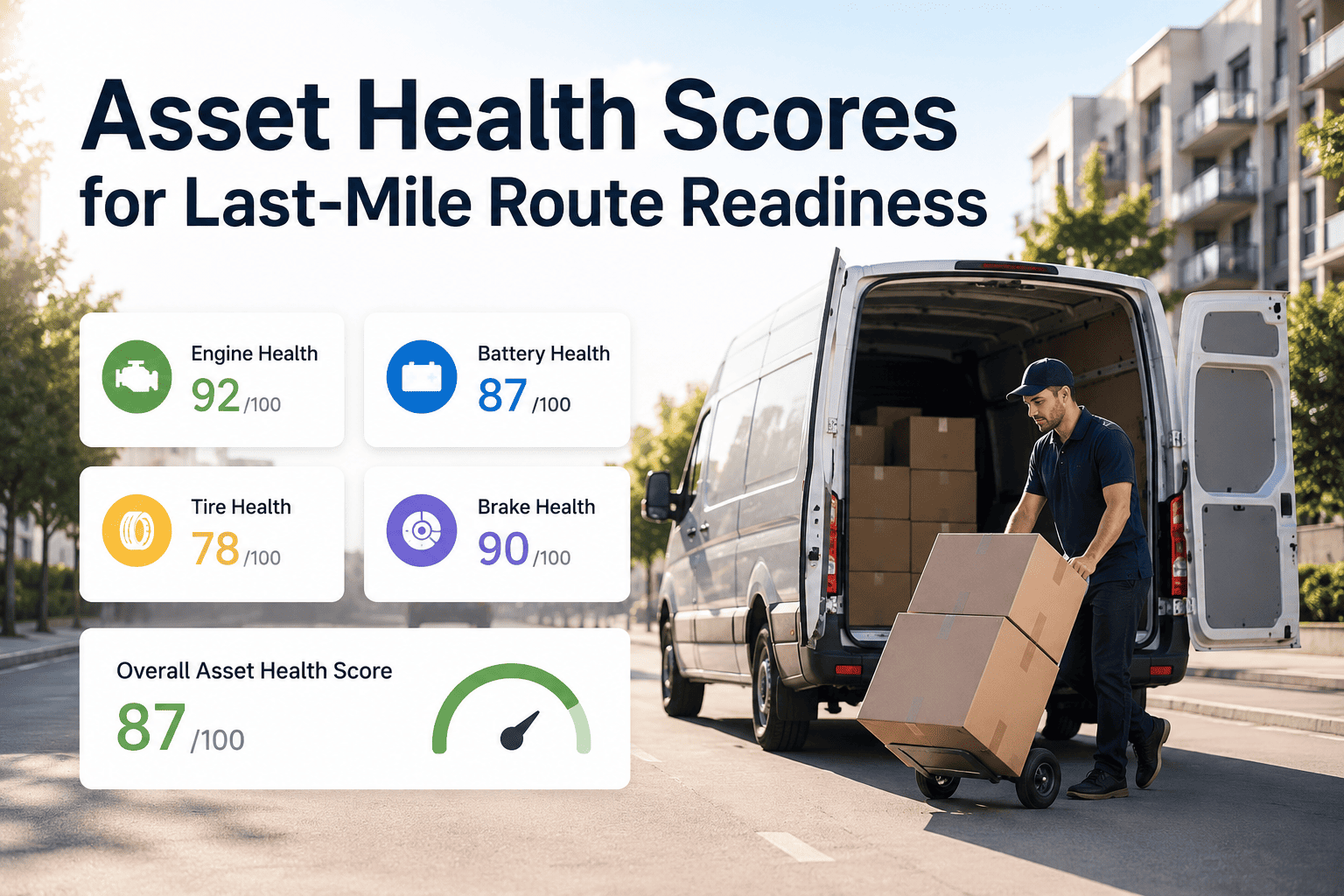
At 06:00 the dispatch board lights up in rows of Ready, Caution, and Workshop, and the Caution row is what turns a normal morning into a fire drill. Three vans on the screen look fine on the lot, drove fine yesterday, and still shouldn't be sent on a full route today — and without a number telling dispatch which assets are actually ready, that decision lives in someone's gut and tends to break around stop twenty-seven on a busy parcel run. Asset health scores turn that morning check into a defensible number with a recommended action attached, before any keys come off the board. This page walks through how OxMaint scores fleet vehicles and hub equipment for last-mile route readiness, what feeds each score, and how dispatchers see the live board inside OxMaint.
Customer SLA Protection
Asset Health Scores for Last-Mile Route Readiness
One composite number per asset, recalculated continuously, tied to a clear dispatch action. The 06:00 board stops being a guess and starts being a plan — for vans, reefers, sortation, and every piece of hub equipment that decides whether the customer gets the parcel on time.
Sample asset score · Van 12
87/100
06080100
Dispatch action: Ready · Full route assigned
The 06:00 dispatch board, by the numbers
Every vehicle and key hub asset gets one number before the first van rolls. The dispatcher sees the whole depot at a glance instead of forty separate sensor dashboards — and every status carries a specific action, not a vague flag to investigate later.
Asset
Score
Status
Dispatcher action
Van 12
94
Ready
Full route assigned
Van 23
91
Ready
Full route assigned
Van 47
73
Caution
Brake pad check before dispatch
Van 58
42
Workshop
Held back, work order open
Reefer R-7
88
Ready
Cold-chain route assigned
Conveyor C-2
68
Caution
Bearing inspection at lunch
What goes into one composite score
Five signal categories feed each score, weighted by their historical impact on route readiness. Weights are tuned per asset class so a reefer's compressor signature isn't measured against a transmission's standard, and so a scanner downtime carries the right weight on the hub side.
See a live dispatch board built from your depot's data
Bring last week's telematics export and we'll show the score every van would have carried at 06:00 — and which ones would have been pulled before the first cascade.
Three score bands, three exact actions
The score isn't a number sitting on a dashboard — it's tied to a specific action so dispatch knows what to do without re-checking forty sensors first. Bands are tunable per depot and asset class.
Ready
80 - 100
All component scores within tolerance, no anomalies flagged in the last 24 hours of telemetry, inspection clean.
Dispatch on full load
Caution
60 - 79
Specific component flagged with a named check. Route assigned only after the check is completed or the load shortened.
Targeted check or trimmed route
Workshop
0 - 59
Held back from dispatch entirely. Work order generated, part reserved from stock, repair slot booked automatically.
Pull off rotation, repair first
Vehicles and hub equipment, scored on one board
A scanner failure at sortation can wreck a delivery window just as fast as a van breakdown on route 7. Both belong on the same dispatch view, and the same scoring engine covers what rolls and what sorts.
Fleet vehicles scored
Delivery vans & cargo vans
Refrigerated reefers & cold-chain vans
Parcel trucks & box trucks
Electric & hybrid last-mile fleets
Cargo bikes & instrumented micro-mobility
Hub & depot equipment scored
Sortation conveyors & tilt-tray sorters
Package scanners & dimensioners
Loading dock levelers & restraints
Label printers & thermal printheads
EV charging infrastructure & depot HVAC
How one asset's score moves through a single day
The score isn't locked at 06:00 — it recalculates as new telemetry arrives. A van that started Ready can drift into Caution mid-shift, and dispatch sees the change in time to act, not after the breakdown call.
06:00
87
Dispatch — Ready, full route assigned, no anomalies in last 24 hours
09:14
85
Normal telemetry, stop 18 of 47, light score drift within Ready band
11:32
71
Rear-axle vibration anomaly detected, score drops into Caution, dispatcher pinged
11:34
71
Remaining route reviewed, nearby swap van considered, driver continues with shortened load
14:05
58
Score crosses Workshop threshold — work order opened automatically for tonight's slot
The turnkey AI bundle behind every score
The scoring engine runs on a pre-configured NVIDIA AI server that ships to your depot ready to rack. Power and Ethernet are the only setup the dispatcher needs to worry about on the day it arrives — the AI is live the same shift.
What ships ready-racked
Pre-configured NVIDIA AI inference server
OxMaint scoring models pre-loaded for last-mile
Telematics, OBD-II, and hub IoT adaptors
Sub-second score recalculation at the edge
What we wire onsite
Depot network, cabling, and ISP uplinks
Vehicle telematics + hub sensor integration
Dispatcher and shop technician training
24×7 remote monitoring & model tuning
1000+clients on OxMaint
99.9%platform uptime
6-12 wkorder to live
What the score is actually protecting
The score's job is keeping the cascade from starting. One pulled van at 06:00 prevents a chain that ends in marketplace penalties, redelivery cost, and customer lifetime value walking out the door for good.
Without scoring
Direct cost per van down$8,160
SLA penalties per cascade$2,856
Customer LTV per churn$12K-$40K
Multi-van morning failure$290K / week
VS
With OxMaint scoring
At-risk assets caught at 06:00100%
Unplanned breakdowns reduced60%
On-time delivery improvement18-24%
ROI window for 10+ van fleet5-8 months
Move dispatch from gut feel to a scored decision
Walk through a live board on a 30-minute call, or start scoring your fleet today and see the first board this week.
Expert Review
"The point of a health score isn't the number — it's that the morning argument disappears. Without one, somebody at dispatch is rationalising why this van is fine and somebody at maintenance is rationalising why it's not, and the customer pays for whoever lost the argument. A single score with a recommended action settles it before the keys come off the board. That's where last-mile SLA protection actually lives."
Reviewed by a Head of Last-Mile Operations, 15+ years running depot dispatch and fleet maintenance across parcel and grocery delivery networks.
Frequently asked questions
How quickly is an asset health score available after we connect OxMaint?
Initial scores are available within 48 hours of OBD or sensor connection using baseline readings, so dispatchers can begin using the board the same week the hardware lands at the depot. The model's accuracy tightens over the first 30 to 60 days as it builds per-asset baselines from the fleet's specific routes, stop counts, and operating patterns. Fleets that import 6 to 12 months of historical maintenance records at go-live see meaningfully higher baseline accuracy on day one. See live scoring inside
OxMaint.
Does the score work for mixed-OEM fleets running different telematics providers?
Yes — OxMaint normalises inputs from OBD-II adaptors, ELD devices, and the major telematics providers like Samsara, Geotab, and Verizon Connect into one unified score per asset. The model reads the underlying signals rather than a single provider's API, so a depot running three different telematics platforms still sees one consistent dispatch board across the whole fleet. Hardware swaps are not required for vehicles already instrumented, and lightweight dongles are installed only where no telematics exist.
Walk through compatibility in a call.
Can the score cover hub equipment too, not just vehicles?
Yes — the same scoring engine covers sortation conveyors, package scanners, dock levelers, label printers, EV charging stations, and other depot equipment that affects last-mile readiness. Hub assets use different signal categories than vehicles, but they roll into the same dispatch board so a degraded conveyor doesn't blindside operations the morning after a sortation issue went unflagged. That's especially valuable for depots where one piece of hub equipment can bottleneck the entire morning load-out.
Explore hub coverage in the platform.
How are the three score bands (Ready, Caution, Workshop) configured?
The default bands are 80-100 Ready, 60-79 Caution, and 0-59 Workshop, calibrated against multivariate failure patterns the model has learned across thousands of vehicles. Thresholds are tunable per asset class — a reefer's tolerance for component drift differs from a standard parcel van — and per depot, since urban-stop intensity is not the same as suburban-route intensity. Most fleets keep the defaults for the first quarter and tune once enough data has accumulated to justify a shift.
Discuss tuning in a setup call.
What happens if an asset's score drops mid-route, after it's already left the depot?
The score recalculates continuously, so a degradation event that crosses the Caution threshold mid-route triggers a real-time dispatcher alert with the exact signal that drove the drop. Dispatch can then decide to shorten the route, route the driver to the nearest swap vehicle, or finish the day and pull the asset overnight depending on severity and remaining stops. The change is logged into the asset's history so the same pattern is recognised faster the next time it appears on this or a similar vehicle.
See in-route alerts in OxMaint.
Stop dispatching on guesses
One composite number per asset, recalculated continuously, tied to a clear dispatch action. The 06:00 board becomes a plan instead of a fire drill.