Delivery Fleet Work Order Management Software to Automate Maintenance Workflows
By Alex Jordan on March 22, 2026
A delivery fleet work order that takes 4 days to move from fault detection to completed repair is not a maintenance problem — it is a workflow problem. The fault was detected. The repair was eventually done. What was lost in between was 4 days of elevated breakdown risk, a driver who may have flagged the issue three times before anyone acted, a parts order that arrived a day after the technician needed it, and a compliance record that exists only as a note in someone's email. Manual work order management is the operational gap that sits between a fleet that knows something is wrong and a fleet that has actually fixed it. OxMaint closes that gap with automated work order generation, real-time technician assignment, closed-loop parts tracking, and a digital audit trail that builds itself — from the moment a sensor fires to the moment the vehicle is back on the road.
OxMaint — Fleet Work Order Management
From Fault Detection to Closed Repair in Minutes — Not Days.
Automated work order generation, technician assignment, parts tracking, and closed-loop repair workflows for delivery fleets of every size.
The Work Order Lifecycle Problem: Where Time and Money Disappear
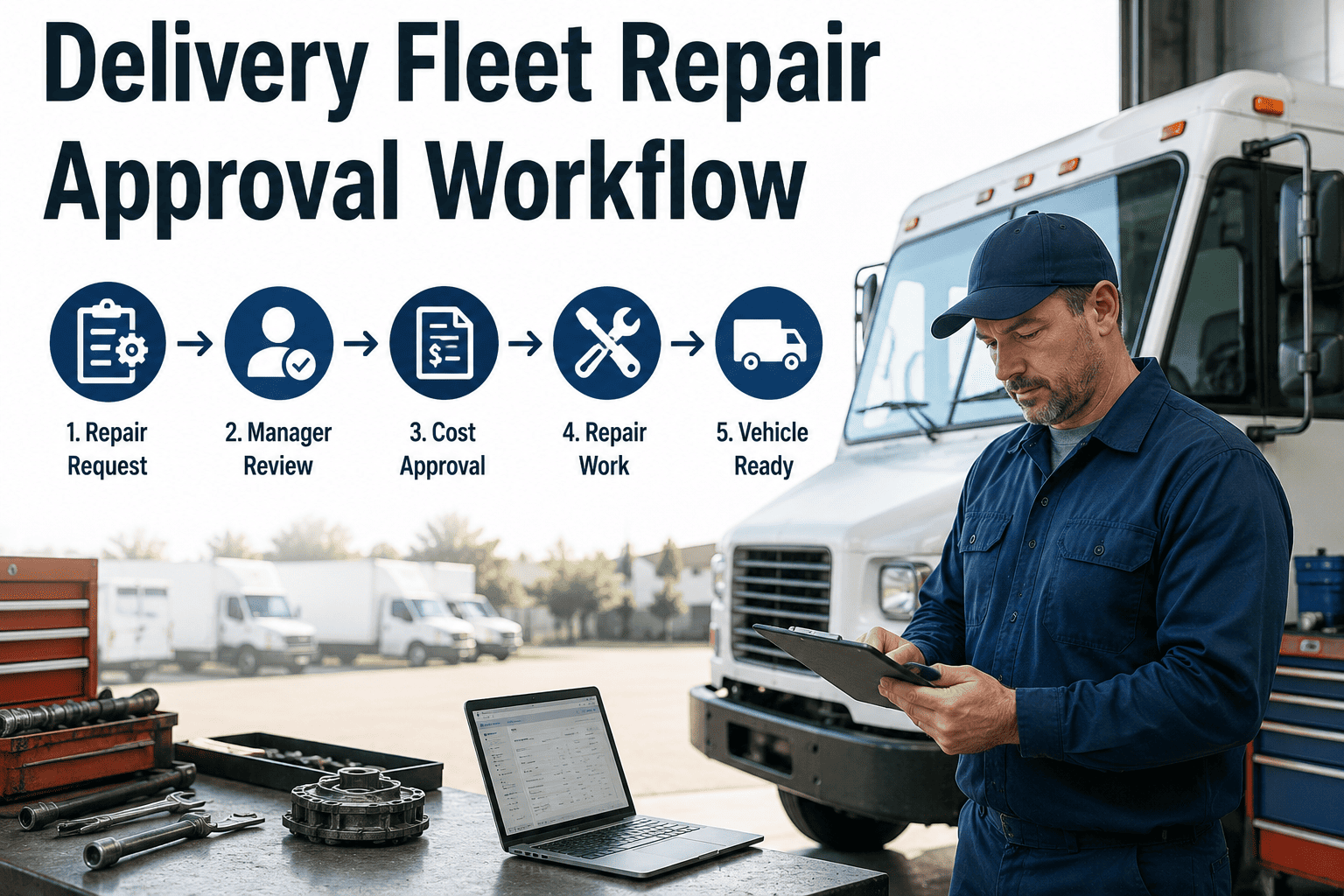
A manual work order process fails at every handoff. The driver reports a fault on paper or verbally. The report sits until a supervisor sees it. A work order is created — sometimes with full information, often without part numbers, component details, or vehicle history. A technician is assigned, but parts may not be in stock. Parts are ordered — sometimes at emergency pricing. The repair is done, but the completion record is a signature on a clipboard. The compliance documentation is an afterthought. At each stage, time is lost, information degrades, and the vehicle remains at elevated failure risk. OxMaint replaces every manual handoff with an automated workflow that carries complete information from detection to closure without human intervention at each step.
Work Order Lifecycle — Manual vs OxMaint Automated
Manual Process
1
Fault Detected
Day 0
▼ Driver report waits in queue
2
Work Order Created
Day 1–2
▼ Often missing part/history data
3
Parts Sourced
Day 2–3
▼ Emergency order at 2.4× cost
4
Repair Completed
Day 3–5
▼ Paper record filed — may be lost
5
Record Closed
Day 4–6
Total gap: 4–6 days Compliance record: incomplete
VS
OxMaint Automated
1
Fault Detected
T = 0
▼ AI auto-generates work order instantly
2
Work Order + Technician Assigned
T + 2 min
▼ Parts availability checked automatically
3
Parts Reserved or PO Raised
T + 5 min
▼ Technician completes on mobile app
4
Repair Completed + Photo Signed
Planned slot
▼ Record auto-closed with full audit trail
5
Compliance Record Auto-Built
Immediate
Total gap: Hours, not days Compliance record: complete & exportable
Auto Work Order Generation: The Engine That Removes Human Delay
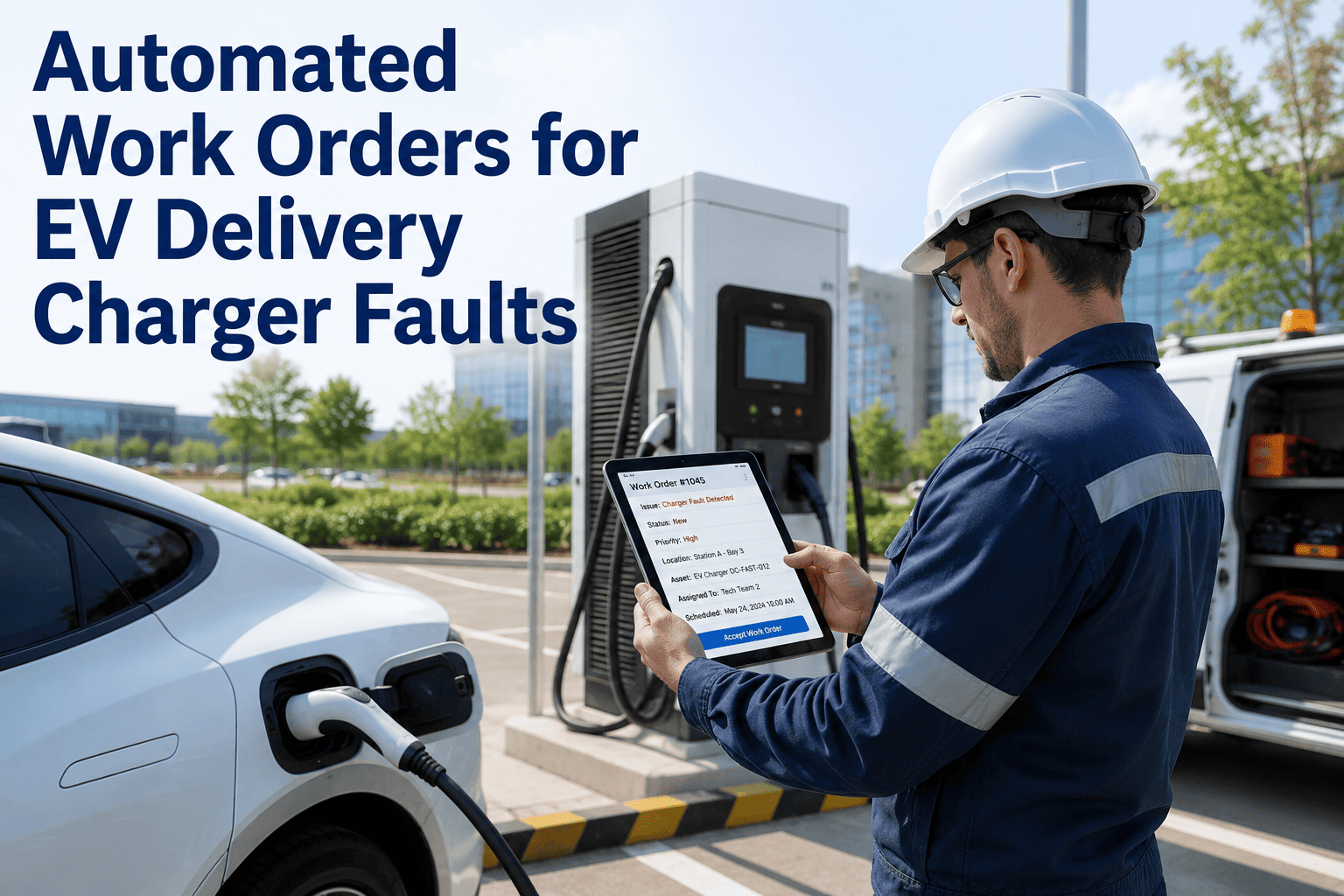
The most expensive moment in any manual maintenance workflow is the pause between a fault being detected and a work order being created. In a reactive fleet, that pause averages 18–36 hours. In a fleet running OxMaint's AI prediction engine connected to OBD sensor data, that pause is eliminated entirely. When sensor data identifies a degradation pattern that precedes a known failure mode — brake wear trending toward threshold, battery charge efficiency declining, DPF load building — a fully-populated work order is generated automatically. The technician receives it on their mobile. The parts team receives the inventory check. The compliance system logs the event. Nobody waits for anyone to notice the fault and manually translate it into a task. Fleet managers who want to see this workflow operating against their own vehicle data can book a 30-minute live demo and the OxMaint team will walk through the auto-generation engine with examples from your specific vehicle types and route profiles.
Where Repair Time Is Lost in Manual vs Automated Workflows
Manual Workflow — 100% of Repair Cycle Time
Detection wait 36%
Parts sourcing 24%
Actual repair 20%
Admin & close 20%
OxMaint Workflow — 100% of Repair Cycle Time
Actual repair 70%
Parts & prep 20%
Admin (auto) 10%
Eliminating the detection wait and parts sourcing delay alone reduces cycle time by 70% — before any improvement to the actual repair process.
Technician Assignment and Workshop Scheduling: The Right Person, the Right Time
An auto-generated work order that sits unassigned is only marginally better than no work order at all. OxMaint's technician assignment engine looks at available workshop capacity, technician certification for the required repair type, current workload distribution, and the vehicle's next scheduled dispatch slot — and assigns the right technician to the right repair window automatically. For fleet operations running multiple depots or shift patterns, the assignment engine balances workload across locations and shifts, preventing the common scenario where one technician is overloaded while another has capacity sitting unused three bays away. For manufacturing-connected delivery operations where SAP manages workforce and asset data, OxMaint's bidirectional SAP integration means work order assignments, technician time logs, and completion records sync automatically with no double entry.
Live Work Order Board — Example: 8-Vehicle Fleet, Morning Snapshot
Open 3
VAN-03
Brake pad wear — 74% health
Medium
Auto-generated · 06:14
VAN-07
Battery efficiency below threshold
High
Auto-generated · 06:14
VAN-05
DPF load at 82% — schedule regen
Low
Auto-generated · 05:58
In Progress 2
VAN-01
Engine oil pressure sensor — repair
High
Tech: J. Marsh · Est. 11:30
VAN-06
Tyre swap — front axle
Medium
Tech: R. Osei · Est. 10:45
Awaiting Parts 1
VAN-02
Starter motor replacement
High
PO raised · ETA tomorrow 09:00
Closed Today 2
VAN-04
Brake fluid flush — completed
✓ Signed off 07:42 · Photo evidenced
VAN-08
Alternator belt replacement
✓ Signed off 08:15 · Photo evidenced
Stop Managing Work Orders on Paper. Start Closing Them in Hours.
Auto-generation, technician assignment, parts tracking, and compliance records — all in one closed-loop workflow.
Parts Tracking and Inventory Automation: Ending the Emergency Order Cycle
The single most common cause of extended repair cycle time is parts unavailability. A technician arrives to perform a repair, the required component is not in stock, an emergency order is placed at 2.4× the planned procurement cost, the vehicle sits for another 24–48 hours, and the cycle time doubles. OxMaint's parts tracking engine connects directly to inventory at the moment a work order is generated. If the required part is in stock, it is reserved against the work order immediately — preventing it from being consumed by a lower-priority repair. If it is not in stock, a purchase order is triggered automatically with enough lead time to receive the part before the scheduled repair date. Fleet operations directors who have deployed OxMaint consistently report the same finding: within 60 days, the emergency parts procurement rate drops by 70–80%, and the parts availability rate at planned repair time exceeds 95%.
Parts Management — Before vs After OxMaint (60-Vehicle Fleet, Annual)
Emergency parts orders
Before
147/yr
After
31/yr
Emergency parts cost premium
Before
$58,400/yr
After
$11,700/yr
Parts availability at repair time
Before
62%
After
96%
Avg repair cycle time
Before
4.2 days
After
1.2 days
Annual saving on emergency parts procurement alone: $46,700 — before counting the labour and downtime cost of delayed repairs.
Technology Integration: How AI, OBD, SAP, and PLC Feed the Work Order Engine
A work order management system is only as intelligent as the inputs feeding it. OxMaint's auto-generation engine connects to five technology sources that each contribute a different layer of information — so that every work order that reaches a technician carries the full context of the fault, the vehicle's history, the required repair procedure, and the parts needed, without requiring any of that information to be gathered manually.
OBD
On-Board Diagnostics
Continuous vehicle sensor data — engine, brakes, battery, transmission, tyres, exhaust — feeds the AI prediction engine. When degradation patterns trigger a prediction, the work order is populated with the exact component, fault code, and vehicle history automatically. No driver report required.
Triggers: ~70% of all predictive work orders
AI
AI Predictive Engine
Multivariate failure pattern recognition identifies degradation 2–4 weeks before failure. Each prediction generates a work order with confidence score, estimated time to failure, recommended repair procedure, and required parts — without human interpretation at any stage.
Work order accuracy: 87–92% for major failure types
SAP
SAP ERP Integration
Bidirectional sync with SAP PM, MM, and WM modules. Work orders created in OxMaint appear in SAP automatically. Parts consumption updates SAP inventory. Asset records stay aligned across both systems. Especially relevant for US, Canadian, Australian, and European manufacturing-connected delivery operations where SAP is standard infrastructure.
Eliminates double entry across maintenance and ERP systems
PLC
PLC Shop Floor Integration
For delivery operations connected to manufacturing facilities, OxMaint integrates with Siemens, Allen-Bradley, and Mitsubishi PLCs. Machine fault codes and status changes on the shop floor trigger work orders in the same system as fleet repairs — giving maintenance managers a single work order queue across production equipment and delivery vehicles.
Single queue: fleet and plant maintenance in one platform
CAM
AI Camera Vision
Pre-departure camera inspection flags visual anomalies — tyre damage, fluid leaks, body impact, unsecured loads — and creates a timestamped work order automatically. Any visual defect that meets the maintenance threshold becomes a work order before the vehicle leaves the depot. Paper tick-sheets are replaced with a photo-evidenced, time-stamped digital record.
100% vehicle coverage — work orders raised in <90 sec per vehicle
TWIN
AI Digital Twin
Virtual vehicle replicas simulate the impact of pending work orders against route schedules — helping fleet managers decide whether a vehicle with an open work order can safely complete a route before the repair, or whether it should be held. The digital twin also allows testing of new PM intervals on virtual vehicles before applying them to the live fleet.
Routing simulation prevents 40% of over-routing failures
Closed-Loop Compliance: Records That Build Without Manual Input
A closed-loop work order is not complete when the repair is done. It is complete when the compliance record is created, the asset history is updated, the parts consumption is logged, and the vehicle health model receives the repair confirmation. In a manual system, each of these downstream steps requires a human action — and in practice, many of them never happen. In OxMaint, all four happen automatically when the technician signs off the work order on their mobile device and submits the photo evidence. The compliance record is created in the format required by FMCSA Part 396, DVSA O-licence standards, NHVL Chain of Responsibility obligations, or German StVZO §29 requirements — depending on your configured compliance profile. The asset history is updated. The parts log is closed. The health model receives the repair confirmation and recalculates the vehicle's health score. Nothing is left incomplete.
What a Closed Work Order Automatically Creates in OxMaint
Timestamped compliance record
Auto-formatted for DOT, DVSA, NHVL, or StVZO as configured
Photo-evidenced repair documentation
Technician-signed with before/after images attached to the vehicle record
Parts consumption log
Inventory automatically decremented and reorder triggered if buffer level reached
Vehicle health model updated
AI prediction engine receives repair confirmation and recalculates health score
SAP asset record synced
Maintenance event written to SAP PM automatically — no double entry required
Technician time log closed
Labour hours recorded against the work order for cost tracking and scheduling analysis
Fleet manager dashboard updated
Vehicle moves from pending repair to active fleet — dispatch team notified immediately
Audit-ready export available
Full work order history exportable on demand — no manual assembly before inspections
10 Key Takeaways for Fleet Operations Managers
01
The detection-to-repair gap in a manual work order system averages 4 days. In that window, the vehicle remains at elevated failure risk, the driver continues to operate a degrading asset, and the organisation accumulates liability it does not know it has.
02
68% of manual work orders contain missing information — no part numbers, incomplete vehicle history, or absent fault codes — that forces the technician to investigate before they can repair. Auto-generated work orders eliminate this information gap entirely.
03
OBD integration connects every vehicle's sensor data stream to the work order engine. Fault detection, work order creation, technician assignment, and parts check happen in under 2 minutes — automatically, without any human in the loop between detection and action.
04
Emergency parts procurement costs 2.4× the planned rate. On a 60-vehicle fleet, shifting from reactive to predictive parts ordering saves over $46,000 per year — from the parts premium line alone, before touching labour or downtime cost.
05
A Kanban-style live work order board gives fleet managers real-time visibility into every open, in-progress, and awaiting-parts repair — replacing the daily status calls and manual status updates that consume workshop management time in reactive operations.
06
SAP bidirectional integration means work orders, parts consumption, and asset records stay aligned across the maintenance platform and the ERP system automatically. The double-entry overhead that affects every fleet operation running both systems is eliminated from day one.
07
AI camera pre-departure inspection creates work orders from visual defects in under 90 seconds per vehicle — replacing paper tick-sheets with photo-evidenced, timestamped digital records that meet DVSA, DOT, and NHVL compliance requirements automatically.
08
Closed-loop work orders automatically update compliance records, vehicle health models, parts inventory, SAP asset records, and technician time logs when a technician signs off on their mobile device. Nothing downstream requires a separate manual action.
09
The digital twin layer allows fleet managers to simulate the impact of pending work orders against route schedules before committing — preventing the premature failures that result from over-routing vehicles with open maintenance items.
10
A fleet that closes work orders 3.4× faster than the industry average does not just save repair cost — it increases fleet availability, improves on-time delivery rates, and builds a complete compliance audit trail as a by-product of normal operations.
Frequently Asked Questions
Q1How does OxMaint auto-generate work orders — does it require driver input?
No driver input required. The AI engine reads OBD sensor data and auto-generates work orders when degradation patterns trigger a prediction — vehicle ID, component, repair procedure, and parts list all pre-populated. Driver mobile reports and PLC fault codes are secondary sources that feed the same queue. Book a demo to see the auto-generation engine against your vehicle types.
Q2Can OxMaint integrate with our existing telematics provider and SAP system simultaneously?
Yes — both run simultaneously from the same deployment. Telematics (Samsara, Geotab, Verizon Connect) connects via API; SAP PM/MM syncs bidirectionally. Compatibility is confirmed at no cost during onboarding.
Q3How does the technician assignment engine handle multi-depot and multi-shift operations?
The engine balances capacity, certification, workload, depot location, and dispatch schedule simultaneously. Multi-depot: assigned to the right tech at the right location. Multi-shift: distributed by urgency and next-dispatch time automatically.
Q4What happens to compliance records when a technician signs off a work order on mobile?
Mobile sign-off instantly creates: timestamped compliance record (DOT/DVSA/NHVL/StVZO), photo evidence attached, parts log updated, SAP asset written, health model recalculated, fleet dashboard updated. No manual admin steps. Full export on demand.
Q5What is the deployment timeline for a 30-vehicle fleet?
Fully live within 2–3 weeks. Week 1: OBD installed, asset register loaded, SAP configured. Week 2: workshop onboarded, compliance templates set. Week 3: go-live — auto work orders active, predictions generating within 10–14 days. Start your free trial — deployment support included from day one.
Stop Managing Work Orders on Paper.
OxMaint auto-generates, assigns, tracks, and closes every repair workflow — from sensor alert to compliance record.