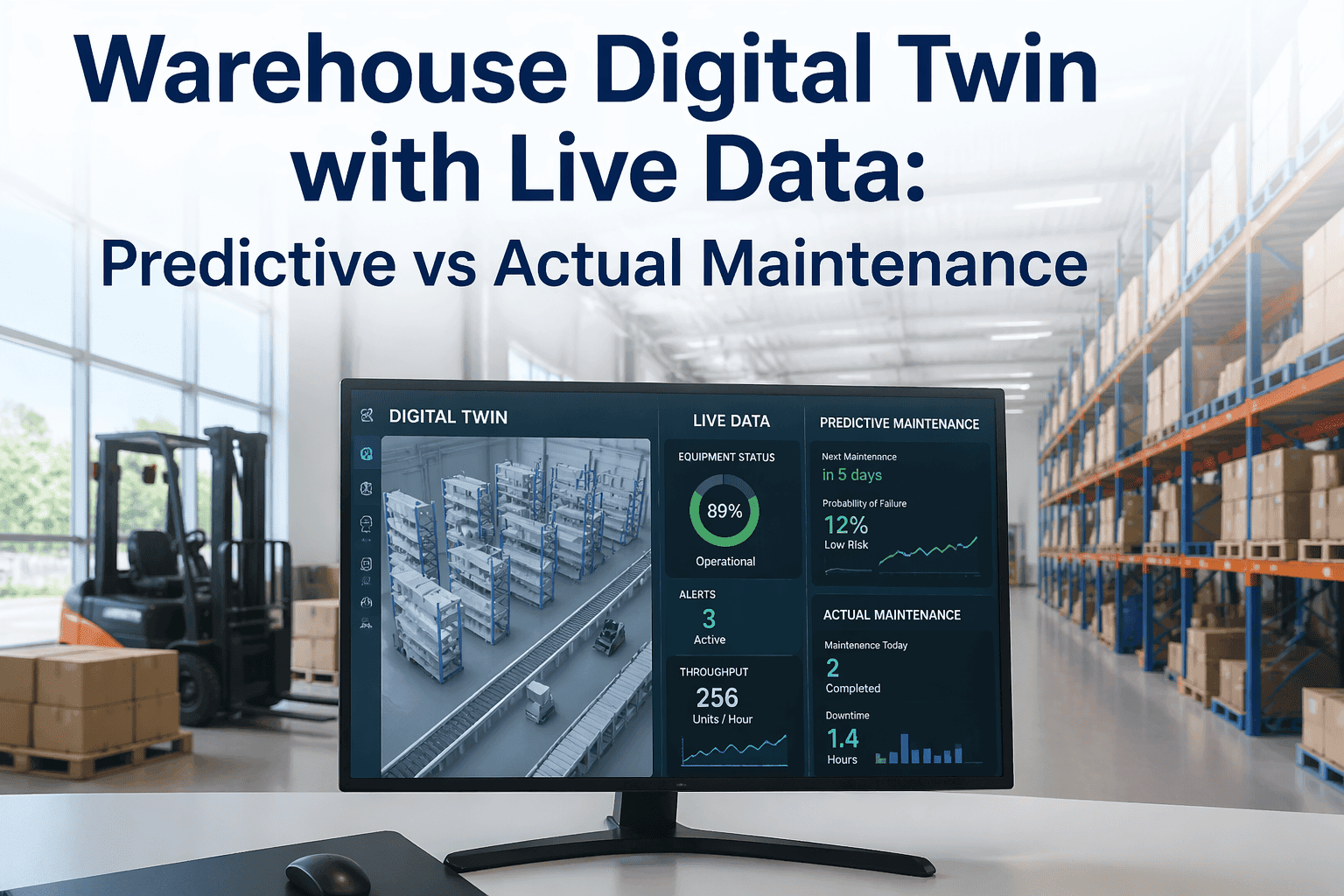
Digital Twin Technology for Delivery Fleet Management to Simulate Predict and Optimize
By Alex Jordan on March 23, 2026
A delivery fleet director making a maintenance decision today — extending a PM interval, reassigning a vehicle to a harder route, deferring a repair by two weeks — is making that decision against incomplete information. The physical fleet provides data about what has already happened. What it cannot provide is a reliable answer to what will happen if the decision is made. Digital twin technology closes that gap by creating a virtual replica of every vehicle in the fleet, mirroring its real-time sensor data, accumulating its complete operational history, and running the proposed decision against the virtual model before committing it to the physical asset. The result is a shift from decisions made on experience and intuition to decisions validated against a continuously updated simulation of each vehicle's actual condition. For fleet operations directors managing 20 to 200 vehicles across the USA, UK, Canada, Germany, Australia, and UAE, digital twin technology is the analytical layer that transforms fleet management from reactive cost control into evidence-based operational strategy.
OxMaint · Digital Twin · Delivery Fleet Management
Simulate Every Fleet Decision Before You Make It. Know the Outcome Before the Route Runs.
Virtual vehicle models that mirror real sensor data — test maintenance scenarios, predict fleet-wide failures, and optimise resource allocation without risking a live asset.
Digital twin + ML identifies failures weeks before they occur — not hours.
40%
Less PM Trial-and-Error
Test interval changes on virtual vehicles first. No live fleet risk.
87%
Prediction Accuracy
Major failure types predicted correctly within 60 days of deployment.
$280
Planned vs $700+ Reactive
Digital twin enables the planned repair. Reactive breakdown costs 2.5× more.
What a Fleet Digital Twin Actually Is
A digital twin is not a dashboard or a report. It is a continuously updated virtual model of a physical asset — in this case, a delivery vehicle — that receives the same sensor data as the physical vehicle in real time, accumulates a complete operational history of every route, repair, load event, and environmental condition, and uses that history to simulate future states of the asset under different operational scenarios. OxMaint creates a digital twin for every vehicle connected via OBD integration from the first day of data collection. The twin is not built once — it updates every time new sensor data arrives, every time a work order is completed, and every time the vehicle's operating conditions change. For fleet managers who have wondered whether a specific vehicle can safely handle a new contract route, or whether a PM interval can be extended for a lower-cycle vehicle, or whether deferring a repair by two weeks carries acceptable risk, the digital twin provides a data-based answer to each question before the decision is made. OxMaint builds digital twins for every vehicle in your fleet from day one of OBD connection — start free and see your fleet's virtual models within 48 hours.
PHYSICAL VEHICLE vs DIGITAL TWIN — HOW THEY CONNECT
Physical Vehicle
Engine, brakes, battery operating in real world
OBD sensors stream live diagnostics
Driver completes routes, accumulates wear
Maintenance events recorded at completion
Cannot be tested without operational risk
Real-time sync
Digital Twin
Virtual replica — same data, no physical risk
Continuously updated from live sensor stream
Simulates future wear under any route scenario
Tests PM intervals before applying to real vehicle
Predicts failure probability with confidence score
5 Ways Fleet Directors Use Digital Twins to Make Better Decisions
The digital twin is useful only in proportion to the decisions it informs. Fleet directors who deploy OxMaint's digital twin integration use it across five decision categories — each representing a situation where acting on virtual simulation data produces a materially better outcome than acting on historical averages or professional judgement alone. The common thread across all five is that the digital twin shifts the cost of a wrong decision from the physical fleet to a virtual model where errors are free. Book a demo to see which of these five applications is most relevant to your fleet's current operational challenges.
01
PM Interval Optimisation Without Live Vehicle Risk
Test a proposed change to a PM interval — say, extending brake service from 7,200km to 8,500km for a low-cycle suburban route — on the digital twin before applying it. The simulation runs the vehicle through projected future usage and calculates the failure probability at the extended interval. If the risk is acceptable, the change is applied. If not, it is rejected before any real vehicle was exposed to it.
Outcome: Optimised intervals. Zero trial-and-error on live fleet.
02
Route Reassignment Impact Assessment
Before reassigning a vehicle from a suburban 20-stop route to an urban 80-stop route, run the reassignment through the digital twin. The simulation calculates the accelerated wear rate on the new route, projects the revised PM frequency required, and flags whether the vehicle's current component condition can safely absorb the higher operational intensity — or whether a pre-reassignment service is warranted.
Outcome: No premature failures from uninformed reassignment decisions.
03
Repair Deferral Risk Quantification
A technician identifies a brake component that is worn but not yet at the service threshold. The question is whether it can safely run for another two weeks until the next planned workshop slot. The digital twin runs the vehicle's projected routes against the component's current wear model and returns a failure probability estimate — not a judgement call, a statistical assessment based on the vehicle's own history and the planned route intensity.
Outcome: Deferrals based on data. Unnecessary urgent repairs eliminated.
04
Fleet-Level Failure Cascade Prediction
At the fleet level, digital twins run simultaneously across every vehicle, identifying which vehicles are approaching failure thresholds in the same time window — enabling the maintenance manager to see potential capacity constraints weeks in advance. If five vehicles are projected to need workshop time in the same fortnight, the schedule can be staggered before it becomes a capacity problem that disrupts route coverage.
Outcome: Workshop capacity planned 3–4 weeks ahead. No bunching.
05
New Vehicle Type Onboarding and Baseline Building
When a new vehicle type enters the fleet — an EV model, a heavier payload variant, a vehicle for a new route profile — the digital twin builds a baseline from the manufacturer's specifications, supplemented by data from similar vehicles in the fleet. The system begins generating health predictions and PM recommendations from day one, rather than waiting months for sufficient operational history to accumulate from the physical vehicle alone.
Outcome: New vehicles protected from day one, not from month six.
Test Every Fleet Decision Virtually Before It Costs You Anything Physically.
OxMaint builds a digital twin for every vehicle from day one of OBD connection — no extra hardware required.
Digital Twin With OBD, SAP, PLC, and AI Camera Integration
A digital twin is only as accurate as the data feeding it. OxMaint's digital twin integrates with four additional technology layers — each contributing a data dimension that improves the precision of the vehicle model and the reliability of its predictions. OBD provides the continuous sensor stream that keeps the twin updated in real time. SAP ensures enterprise asset records stay aligned with twin-generated maintenance events without double entry. PLC integration feeds depot charging and production infrastructure data — essential for EV fleets and manufacturing-connected delivery operations. AI camera vision adds the visual wear data layer that OBD sensors cannot capture, feeding defect images into the twin's component state model. All four integration layers connect through a single OxMaint deployment — the twin becomes more accurate as each layer is added.
Integration
What It Feeds Into the Twin
Twin Accuracy Impact
OBD
Real-time engine, brake, battery, transmission, tyre, and DPF sensor data. Continuous stream — twin updates with every route.
Primary — 70% of twin inputs
AI Camera
Visual component state — tyre sidewall condition, brake disc surface, panel damage, fluid leak evidence. Adds what sensors cannot see.
Closes 12% of prediction gaps
SAP
Historical maintenance records, asset lifecycle data, parts consumption history. Bidirectional — twin events write back to SAP PM/MM automatically.
Enterprise record alignment — zero lag
PLC
Depot charging sessions, charge cycle efficiency, EV battery health per cell. Feeds twin's battery degradation model for EV and hybrid vehicles.
Critical for EV fleet twin accuracy
Before and After: Operational Decisions With and Without Digital Twin
The value of a digital twin is most clearly visible in the decisions it changes — not the catastrophic failures it prevents, but the dozens of smaller operational choices made each week that collectively determine whether a fleet runs at 78% availability or 97% availability. These are six decision scenarios that every fleet manager faces regularly, and the outcome difference between making them without a twin and with one.
Scenario
Without Digital Twin
With OxMaint Digital Twin
Extend a PM interval
Guesswork based on mileage rules. Risk unknown until the vehicle either holds or fails.
Simulation returns failure probability at proposed interval. Decision made with confidence score.
Reassign to harder route
Assessed visually or by experience. Accelerated wear not quantified before the move.
Twin simulates new route wear rate. Revised PM frequency calculated. Pre-service flagged if needed.
Defer a minor repair
Driver says it feels fine. Deferred. Sometimes correct — sometimes a breakdown in two weeks.
Digital twin models failure probability over deferral period. Deferral approved or overridden by data.
Add a new vehicle type
No PM baseline. First failures teach you the right intervals — expensively.
Twin built from specs and fleet comparables. PM recommendations from day one.
Plan workshop capacity
Reactive. Workshop overloads when multiple vehicles fail in the same week.
Fleet-wide twin shows upcoming repair demand 3–4 weeks out. Schedule before the crunch.
EV battery degradation
Calendar-based checks. Battery failure discovered at dispatch or mid-route.
PLC charge data feeds twin. Battery health trend visible weeks before range impairment.
Deployment: From Zero to Full Digital Twin Coverage
Digital twin deployment does not require a separate implementation project. OxMaint builds virtual models for every vehicle from the moment OBD integration begins collecting data. The twin starts with a baseline model built from the vehicle's specifications and any historical maintenance data imported at go-live — and immediately begins refining that model as live sensor data arrives. The more data the twin accumulates, the more accurate its predictions become. Most fleets achieve meaningful prediction accuracy within 30–45 days of go-live and see their first confirmed digital twin-predicted repair — completed before a breakdown would have occurred — within 45 days of deployment. Book a 30-minute demo to see a deployment plan mapped to your fleet size and vehicle types.
DEPLOYMENT TIMELINE — 30-VEHICLE FLEET
Week 1
Foundation
Asset register and vehicle profiles loaded
12 months maintenance history imported
OBD adapters fitted — 30 vehicles in one day
Week 2
Twin Models Active
Digital twin built per vehicle from OBD + history
SAP and PLC integration configured
Health dashboard live for all vehicles
Day 30
First Predictions
ML anomaly detection producing alerts
First simulation-validated repair decisions
PM interval recommendations per vehicle
Day 60–90
Full Accuracy
87%+ prediction accuracy for major failures
Fleet-level capacity planning active
ROI visible against pre-deployment baseline
The ROI of Digital Twin: What It Costs vs What It Saves
The financial case for fleet digital twin technology does not rest on a single benefit — it compounds across every decision it improves. Prevented breakdowns, optimised PM intervals, eliminated unnecessary repairs, accurate deferral decisions, and early workshop capacity planning each contribute a measurable saving. On a 30-vehicle last mile fleet, the combined annual value typically exceeds the platform cost by 6 to 8 times. The calculation below uses conservative assumptions — 50% breakdown reduction rather than the 60% achievable with full AI prediction, and no credit for SLA penalty avoidance or contract retention. Even at those conservative figures, the payback period is under six months. Book a demo to get a personalised ROI estimate calculated against your fleet's current breakdown frequency and maintenance spend.
30-VEHICLE FLEET · ANNUAL ROI BREAKDOWN
Prevented breakdowns
50% reduction · 30 vans
$129,600
PM interval optimisation
Over-servicing eliminated
$21,600
Emergency parts premium
Planned procurement enabled
$14,400
Labour efficiency gain
Planned vs reactive ratio
$7,800
OxMaint platform cost (30 vehicles)
$28,800/yr
Annual value delivered
$173,400/yr
6.0×
ROI
year one return
<6 mo
Payback
platform cost recovered
97%
Fleet availability
up from ~79% reactive
45 days
First prediction
confirmed prevented repair
Frequently Asked Questions
Q1
Does OxMaint's digital twin require any hardware beyond OBD?
No. The digital twin is built from OBD sensor data, which connects via a plug-and-play adapter. Existing telematics providers (Samsara, Geotab, Verizon Connect) connect via API. AI camera feeds and PLC data can be added as optional layers — each improves twin accuracy but none is required to start.
Q2
How does the digital twin handle a vehicle that moves between depots or route types?
The twin updates automatically as route and usage data changes. When a vehicle moves to a harder route, the twin recalibrates wear rate projections within 7–14 days based on the new operating pattern. Historical wear data from the previous route is retained but weighted to the current profile — no reset, no lost history.
Q3
Can the digital twin integrate with SAP for enterprise asset lifecycle management?
Yes — OxMaint integrates bidirectionally with SAP PM, MM, and WM. Digital twin-generated maintenance events, predictions, and work orders write to SAP automatically. Asset lifecycle records in SAP reflect the twin's real-time health model without any manual data entry. Book a demo to confirm compatibility with your SAP version.
Q4
Does the digital twin work for EV and hybrid delivery vans?
Yes — EV twins have dedicated monitoring profiles including battery state-of-health per cell group, charge cycle efficiency, and thermal management performance. PLC integration with depot charging feeds charge session data directly into the EV twin's battery model, enabling range impairment prediction weeks ahead of any driver-visible symptom.
Q5
What is the minimum fleet size for digital twin to deliver meaningful ROI?
Fleets of 10 or more vehicles see measurable ROI within 5–8 months. At 10 vehicles averaging 2 breakdowns per month, a 60% reduction from digital twin-informed maintenance saves enough to recover platform cost within the year. The 20–50 vehicle range consistently delivers the fastest payback — typically 4–6 months. Start your free trial to begin building digital twins across your fleet today.
Stop Making Fleet Decisions Blind. Build the Virtual Fleet First.
Digital twin for every vehicle. Predictions 2–4 weeks ahead. Decisions backed by simulation, not guesswork.