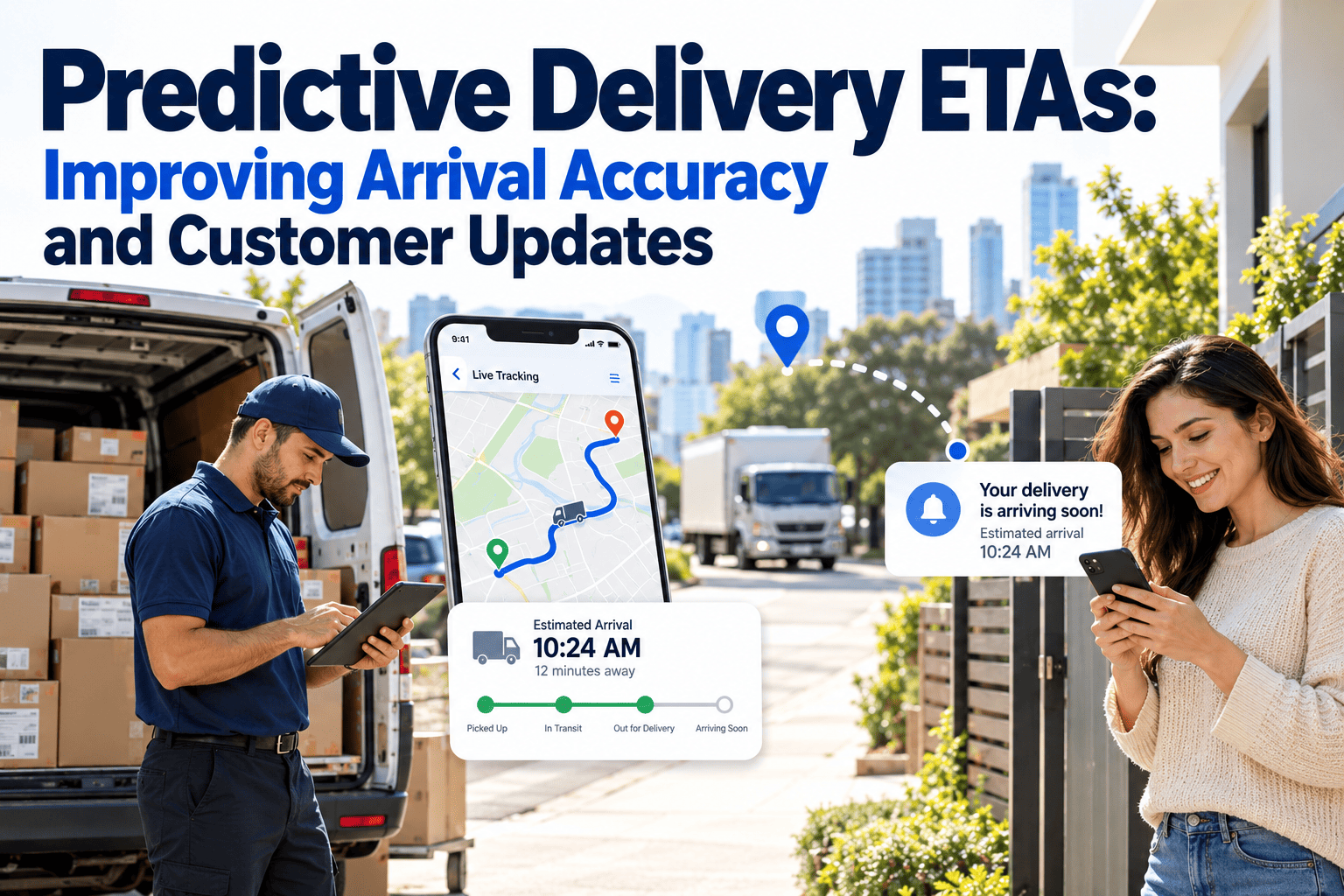
Few things damage a delivery brand faster than an arrival time that turns out to be wrong. A late driver is forgivable when the customer knew in advance; a late driver after a confident promise is not. Predictive ETAs replace static estimates with models that learn from traffic, service time, and route progress. This guide covers the data and models behind accurate ETAs, how to measure them, and how to share them with customers, along with the vehicle reliability work, managed in fleet maintenance software, that keeps estimates credible.
Predictive Delivery ETAs: Improving Arrival Accuracy and Customer Updates
Move from guessed arrival times to predictions customers can trust, with the data, measurement, and communication practices that make them work.
Why Inaccurate ETAs Are Expensive
An inaccurate ETA is not just a customer experience problem. It spreads cost across the operation.
Static ETA Versus Predictive ETA
| Aspect | Static estimate | Predictive ETA |
|---|---|---|
| Basis | Planned route at dispatch time | Live position, traffic, and remaining stops |
| Service time | One flat average | Learned by stop type and customer |
| Updates | Rarely changed after the morning | Recalculated continuously |
| Uncertainty | Hidden behind a single time | Shown as a range that narrows |
| Customer view | Time slot or vague day | Live window with change alerts |
The core difference
A static estimate answers where the plan said the driver would be. A predictive ETA answers where the driver will actually be, given everything that has happened since.
The Data Layers Behind an Accurate Prediction
Data quality is the quiet limit
- Poor address geocoding places stops in the wrong spot and distorts every downstream estimate.
- Missing stop-completion scans hide when a driver actually finished.
- Unreliable location updates make the model guess where the vehicle is.
- Inconsistent service-time records teach the model the wrong lesson.
How Prediction Models Typically Work
Vendors describe their methods differently, but most combine a few ideas. Ask which ones are in use and how they were validated on data like yours.
- Travel-time estimation from historical speeds by road segment and time of day.
- Live adjustment using current traffic and the vehicle's actual progress.
- Stop-duration models that learn from past dwell times.
- Cascading logic so a delay at one stop shifts every later arrival.
- Confidence ranges that widen when conditions are uncertain.
Questions to ask any ETA provider
- How is accuracy measured, and over which time horizon?
- Does the model learn from our own stops or only generic data?
- How does it behave with sparse or noisy location data?
- Can it explain why an estimate changed?
Accurate ETAs Start With Vehicles That Stay on the Road
Breakdowns and unplanned repairs break every prediction. Track inspections, repairs, and preventive schedules in one place.
Measuring ETA Accuracy the Right Way
A single accuracy number hides more than it reveals. Define the measure, then track it by horizon and segment.
| Measure | What it shows | Why it matters |
|---|---|---|
| Share within window | Stops arriving inside the communicated range | Closest to customer experience. |
| Average error by horizon | Difference between predicted and actual at set times before arrival | Shows whether late predictions are reliable. |
| Early arrival rate | Arrivals before the window opens | Early can be as disruptive as late. |
| Estimate churn | How often ETAs change materially | Constant changes erode trust. |
| Error by zone or stop type | Where prediction is weakest | Guides data and model improvement. |
Set your own target
Choose a target based on your promise format and customer expectations, such as the share of arrivals inside a communicated window, and review it regularly against actual results rather than a published benchmark.
Sharing ETAs With Customers Without Overpromising
Communication principles
- Show ranges that narrow instead of one exact minute that is often wrong.
- Notify only when a change matters to the customer.
- Give customers a simple way to reschedule or leave access instructions.
- Keep messages consistent across email, text, and tracking pages.
Common Reasons ETAs Drift
Planning side
- Service times set too low
- Overloaded routes
- Late vehicle departure from the depot
- Poor stop sequencing
Road side
- Traffic not reflected in the model
- Access delays at buildings
- Breakdowns and vehicle faults
- Weather and temporary closures
Data side
- Bad geocoding
- Missing scans
- Weak location signal
- Inconsistent driver app use
An ETA Maturity Path
- Stage 1: Static windowA day or broad slot set at order time.
- Stage 2: Planned ETATimes taken from the route plan with limited updates.
- Stage 3: Live trackingCustomers see location, but estimates stay fairly simple.
- Stage 4: Predictive ETAModels recalculate using traffic, stop behavior, and progress.
- Stage 5: Closed loopResults feed back to planning, capacity, and maintenance decisions.
Where Oxmaint Fits in ETA Reliability
Oxmaint is not an ETA engine. It supports the maintenance side, because a vehicle fault is one of the least predictable causes of a missed arrival.
- Preventive maintenance schedules reduce the chance of unexpected breakdowns during routes.
- Mobile inspections record defects before departure and create work orders quickly.
- Corrective maintenance workflows track repairs and return vehicles to service.
- Asset history helps identify vehicles with repeat issues that threaten reliability.
- Inventory management supports faster repairs through parts availability.
- Dashboards show downtime and maintenance trends across the fleet.
ETA Improvement Checklist
- Addresses validated and geocoded
- Stop-completion scans enforced
- Service times learned by stop type
- Accuracy defined and tracked by horizon
- Customer messages tied to meaningful changes
- Estimate ranges narrow as arrival nears
- Delay causes categorized and reviewed
- Vehicle readiness confirmed before dispatch
Frequently Asked Questions
What is a predictive delivery ETA?
It is an arrival estimate that updates using live position, traffic, and learned stop behavior rather than a fixed plan.
What data improves ETA accuracy most?
Clean addresses, reliable location signals, accurate stop-completion scans, and real service-time history.
Should customers see an exact time or a window?
A narrowing window is usually safer and more honest than a single minute that changes repeatedly.
Can maintenance software help delivery ETAs?
It reduces breakdown-driven delays. You can start with Oxmaint to organize fleet maintenance.
Where can I see the maintenance workflow?
A short walkthrough covers inspections and work orders. You can book a demo to review it.
Building Customer Trust Beyond the Number
An accurate estimate matters, but trust also comes from honesty about uncertainty and speed in correcting it.
Principles for customer communication
- Explain that arrival times can change and say how customers will be told.
- Avoid sending notifications for tiny shifts that do not change the customer's plan.
- Offer clear options when a delay becomes significant, such as rescheduling or alternative handling.
- Use plain language and consistent wording across all channels.
Handling bad news well
- Notify before the window is missed, not after.
- State the new range and the reason in one short message.
- Give customers a quick way to respond.
- Record outcomes so service teams see the same information drivers do.
Reducing Support Contacts With Better Visibility
Where-is-my-order contacts are a visible cost of poor ETAs. Better visibility reduces them, but only if it is accurate.
What customers want to know
- When will the driver arrive, and how sure is that estimate?
- Is there anything I need to do, such as provide access?
- Who do I contact if my plans change?
- Was the delivery completed, and where is the proof?
What operations should track
- Volume of status inquiries per delivery and which events trigger them.
- Inquiries received after an ETA changed versus before.
- Failed attempts caused by absent customers who had short notice.
- Complaint themes related to timing or communication.
Handling Edge Cases That Break Predictions
Models perform well on ordinary days and struggle with unusual ones. Plan for the edge cases.
Typical edge cases
- Severe weather, road closures, and events that change traffic patterns.
- Vehicle faults, tire changes, and roadside repairs.
- Large or complex deliveries that take much longer than normal.
- Driver breaks, shift changes, and handovers between drivers.
- Missing location data in tunnels, rural gaps, or device failures.
Responses to consider
- Widen the displayed range when uncertainty is high.
- Fall back to the planned estimate when live data is missing.
- Give dispatchers manual override with a recorded reason.
- Review edge-case misses monthly and adjust model inputs.
Governance and Continuous Improvement
ETA programs degrade without ownership. Treat the model and its inputs as a managed process.
Responsibilities
- Assign an owner for ETA accuracy across planning, driver app, and customer messaging.
- Review accuracy by zone, driver group, and time of day, not only fleet-wide.
- Hold short monthly reviews of the largest misses and their causes.
- Update service times when building types, product mix, or process changes.
Choosing and Evaluating ETA Technology
Vendors describe ETA features in similar terms, so ask for specifics and test them on your own deliveries.
What to look for
- Predictions that update from live position and are not locked at dispatch time.
- Learning from your own stop history, not only generic models.
- Confidence ranges with clear logic for when they widen or narrow.
- Integration with your driver app, routing, and customer messaging tools.
- Reports that compare predicted and actual arrivals by horizon and zone.
How to test
- Run a trial on real routes and record predictions at set times before arrival.
- Compare results against your current estimate method.
- Include difficult zones and peak days in the trial.
- Check how the system behaves when location data is missing.
ETA Design for Different Delivery Models
The right ETA experience depends on the service you sell. A single pattern does not fit every operation.
Scheduled window delivery
- Present a committed window and update it only when the commitment is at risk.
- Use predictions mainly to protect the window and warn early.
On-demand and same-day delivery
- Show a live, narrowing estimate from the moment of dispatch.
- Expect more frequent updates and design messages to avoid fatigue.
Business and dock delivery
- Share expected arrival with receiving teams so dock staff can prepare.
- Include check-in and unloading time in the estimate, not only arrival.
Team Roles and Workflow for ETA Quality
Accuracy improves when roles are clear, because causes of error sit in different teams.
Who owns what
- Planners own service-time and sequencing assumptions.
- Drivers own accurate stop scans and status updates.
- Operations owns depot departure times and load readiness.
- Maintenance owns vehicle availability and breakdown prevention.
- Customer service owns message quality and feedback from customers.
Understanding ETA Error: Early, Late, and Wide
Not all inaccuracy is equal. Separating types of error shows where to focus improvement.
Types of error
- Late arrivals cause missed plans and are the most visible failure.
- Early arrivals can be just as disruptive when nobody is ready to receive.
- Windows that are too wide technically succeed but give customers little value.
- Windows that change repeatedly erode trust even when the final arrival is on time.
How to respond
- Track each error type separately instead of using a single score.
- Set separate goals for lateness and for how narrow the window is.
- Review customer feedback alongside the numbers to see which errors matter most.
Questions to Ask Before Launching Customer ETAs
A short readiness review reduces the chance of promoting estimates the operation cannot meet.
Readiness questions
- Is location data reliable enough across all zones and vehicles?
- Are drivers scanning stops consistently and on time?
- Do dispatchers and customer service see the same information customers see?
- Is there a plan for sending delay notices before windows are missed?
- Who responds when customers reply to messages?
Closing Thoughts on Predictive ETAs
Predictive ETAs reward operations that treat accuracy as a shared goal across planning, drivers, maintenance, and customer service.
Priorities to carry forward
- Fix data quality before expecting model improvements.
- Show customers honest ranges and update them only when it matters.
- Measure accuracy by horizon, zone, and error type.
- Reduce avoidable delays such as breakdowns through preventive maintenance.
Practical Tips for Operations Teams
Small operational habits improve ETA accuracy without new software.
Habits that help
- Start routes on time, since late departure shifts every later estimate.
- Load vehicles in stop order so drivers do not search for parcels.
- Review the worst missed arrivals each week and name the cause.
- Fix addresses that repeatedly fail rather than working around them.
- Check vehicle condition before dispatch to avoid mid-route breakdowns.
Make Every Arrival Promise Easier to Keep
Reduce surprise downtime with preventive maintenance, mobile inspections, and clear repair tracking for every vehicle.