Best Quadruped Robots for Delivery Hub and Warehouse Inspection 2026
By Alice Walker on February 12, 2026
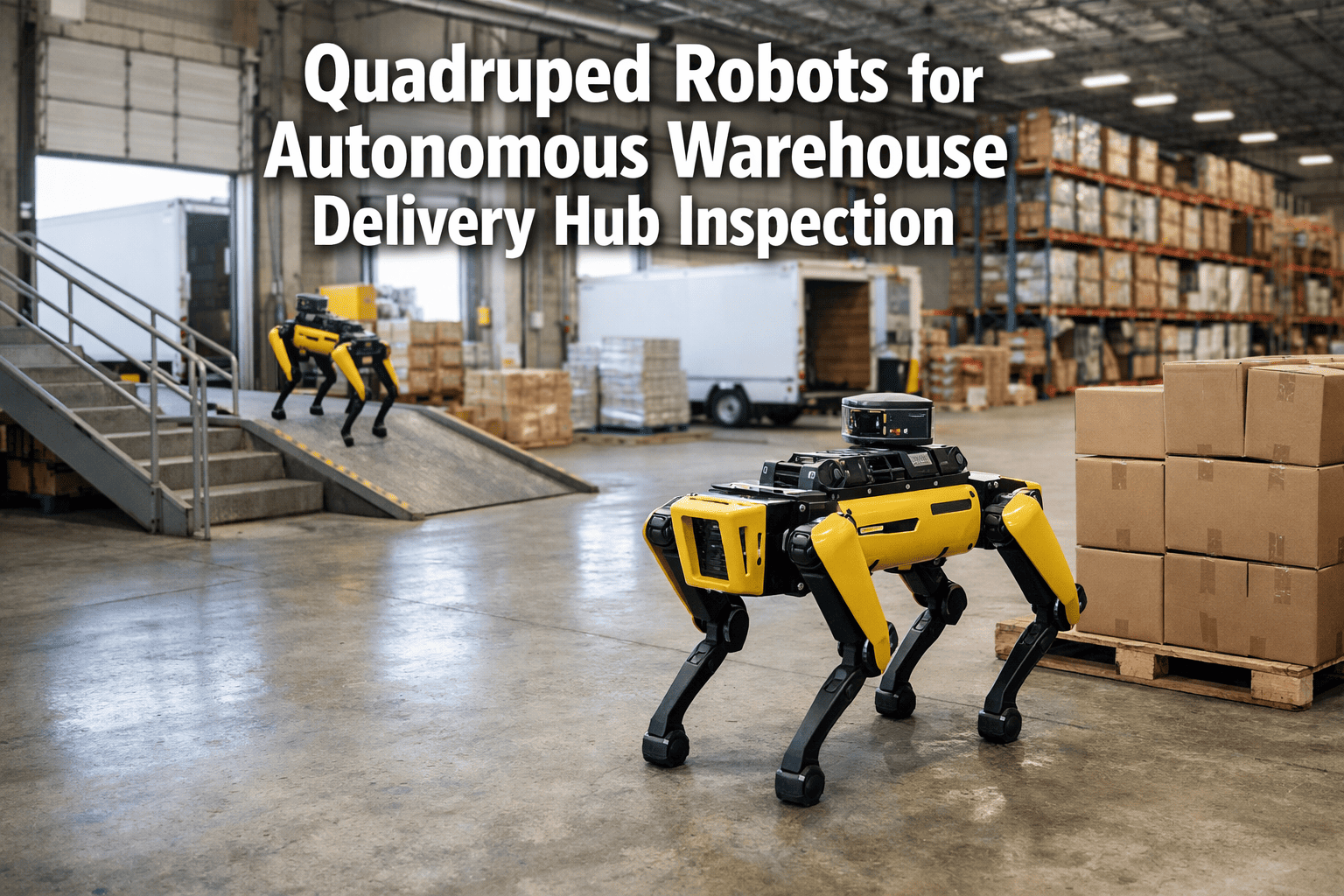
Quadruped robots are reshaping how delivery hubs and warehouses handle inspections—navigating stairs, uneven floors, tight aisles, and hazardous zones that wheeled drones simply can't reach. In 2026, a new generation of four-legged inspection robots combines LiDAR mapping, thermal imaging, autonomous patrol routines, and direct CMMS integration to deliver continuous facility monitoring without disrupting operations. Whether you're managing a last-mile delivery hub, cold storage warehouse, or high-bay distribution center, quadruped robots eliminate blind spots and turn reactive inspections into predictive maintenance. Schedule a consultation to explore how quadruped inspection robots integrate with your maintenance workflows.
Why Quadruped Robots for Delivery Hub and Warehouse Inspection
Distribution centers and delivery hubs operate around the clock with minimal downtime windows. Traditional manual inspections are slow, inconsistent, and put workers in environments with heavy machinery, temperature extremes, and elevated platforms. Quadruped robots solve these challenges with all-terrain mobility, repeatable inspection routes, and sensor payloads that detect problems humans miss—from thermal hotspots on conveyor motors to gas leaks in loading docks.
The Case for Quadruped Inspection Robots in 2026
55%
Reduction in manual inspection labor costs when quadruped robots handle routine facility patrols autonomously
24/7
Continuous autonomous inspection coverage across shifts—no fatigue, no missed checkpoints, consistent data every patrol
3x
More defects detected per inspection cycle compared to manual walkthroughs—thermal, visual, acoustic, and gas anomalies
$4.7B
Projected warehouse robotics market by 2028—quadruped inspection robots are the fastest-growing segment
Ready to Automate Your Warehouse Inspections — Join leading logistics operators using quadruped robots integrated with CMMS to catch problems before they cause downtime.
Top Quadruped Robots for Warehouse Inspection in 2026
The quadruped inspection market has matured rapidly, with several platforms now offering enterprise-grade reliability for warehouse and delivery hub environments. Here's how the leading robots compare across the capabilities that matter most for facility inspection teams.
2026 Quadruped Robot ComparisonRanked by warehouse inspection capability
#1
Boston Dynamics Spot
Industry standard for autonomous facility inspection
The most proven platform for warehouse and industrial inspection. Extensive API ecosystem makes CMMS integration straightforward. Spot's autonomous mission system (Autowalk) allows repeatable patrols with thermal, acoustic, and visual data collection. The Spot Arm adds valve reading and door-opening capabilities for delivery hub environments.
#2
ANYbotics ANYmal X
Purpose-built for hazardous and ATEX-rated environments
Best choice for warehouses with hazardous zones, chemical storage, or cold chain operations. ATEX certification allows operation in explosive atmospheres. Self-docking for autonomous charging enables true 24/7 operations. ANYmal's inspection data platform offers direct integration with maintenance management systems.
#3
Unitree B2
High-performance quadruped at an accessible price point
The best value option for large warehouse operations. Exceptional payload capacity (40 kg) allows heavy sensor suites or small cargo. Fastest ground speed in its class. ROS2 compatibility enables custom inspection payloads and CMMS integrations. Ideal for teams with in-house robotics expertise who want maximum flexibility.
#4
Ghost Robotics Vision 60
Ruggedized quadruped for extreme warehouse conditions
Weight~51 kg
Runtime~180 min
Payload10 kg
Speed3.0 m/s
Longest Battery LifeAll-Weather IP67Sealed Leg ActuatorsModular Payload BayEdge Computing Onboard
Longest runtime in its class at ~3 hours per charge—ideal for large distribution centers requiring extended patrol routes. Fully sealed actuators handle wet loading docks, freezer environments, and dusty warehouse floors. Modular payload system accepts thermal, LiDAR, acoustic, and gas detection sensors.
#5
Xiaomi CyberDog 2
Entry-level quadruped for light-duty warehouse monitoring
Best entry point for teams exploring quadruped inspection. Compact size navigates narrow warehouse aisles easily. Built-in sensors handle basic visual patrol and anomaly detection. Limited payload and runtime make it best suited for smaller facilities or proof-of-concept deployments before scaling to heavier platforms.
See how quadruped robots feed inspection data into CMMS. Book a demo to see real-time defect-to-work-order automation for warehouse environments.
Key Inspection Capabilities for Warehouse Environments
Not all quadruped robots are created equal for warehouse inspection. The features below represent the critical capabilities that separate effective facility inspection platforms from general-purpose quadrupeds—each directly impacts maintenance outcomes and CMMS data quality.
Essential Inspection Capabilities
Thermal Anomaly Detection
Identify overheating motors, electrical hotspots, HVAC failures, and insulation gaps in real-time. Thermal data auto-generates work orders in CMMS when temperature thresholds are exceeded on conveyor systems, panel boards, or dock equipment.
3D LiDAR Facility Mapping
Build and maintain digital twins of your warehouse layout. Detect structural changes, rack displacement, floor damage, and clearance violations. Compare scans over time to identify gradual degradation before it impacts operations or safety.
Acoustic Monitoring
Detect bearing failures, belt slippage, compressor issues, and air leaks through ultrasonic and acoustic analysis. Sound signatures are baselined per asset, with deviations triggering maintenance alerts and CMMS work orders automatically.
Visual Defect Recognition
AI-powered cameras detect cracks, corrosion, leaks, label damage, and safety hazard conditions. Computer vision algorithms trained on warehouse-specific defects deliver consistent detection accuracy across every patrol cycle.
Gas and Air Quality Sensing
Monitor for refrigerant leaks, CO levels in loading docks, ammonia in cold storage, and VOCs in chemical warehouses. Continuous air quality data feeds into safety compliance records and triggers immediate alerts for hazardous conditions.
Gauge and Meter Reading
Automatically read analog gauges, digital displays, and indicator lights across the facility. Eliminate manual rounds for pressure, temperature, and flow readings. Data logs directly into asset records for trend analysis and compliance.
Quadruped vs. Other Inspection Methods
Understanding how quadruped robots compare with traditional manual inspections and aerial drone alternatives helps warehouse operators choose the right approach—or the right combination—for their specific facility requirements.
Inspection Method Comparison
Manual Inspection
Inconsistent data quality
Limited to work hours
Hazardous area access risks
High ongoing labor costs
Subjective defect assessment
Coverage
Aerial Drones
Good for overhead/roof inspection
Limited flight time (~25 min)
Cannot navigate tight spaces
No ground-level contact sensors
Noise disrupts operations
Coverage
Quadruped Robots
All-terrain: stairs, ramps, docks
90-180 min runtime per charge
Navigates aisles and tight spaces
Multi-sensor: thermal, LiDAR, gas
Silent operation, no disruption
Coverage
Connect Your Inspection Robots to Oxmaint CMMS
Oxmaint integrates with quadruped robot platforms to automatically convert inspection findings into work orders, track asset health trends, and maintain complete compliance documentation—all in one platform.
Use this detailed comparison to evaluate which quadruped robot best fits your warehouse inspection requirements, CMMS integration needs, and budget constraints.
2026 Quadruped Robot Feature Matrix
Feature
Spot
ANYmal X
Unitree B2
Vision 60
CyberDog 2
Autonomous Patrol
✅ Autowalk
✅ Mission Planner
⚠️ Custom Dev
⚠️ Custom Dev
❌ Manual
Thermal Camera
✅ FLIR Option
✅ Built-in
⚠️ Add-on
⚠️ Add-on
❌ Not Available
CMMS API
✅ REST API
✅ Cloud API
⚠️ ROS2 Bridge
⚠️ ROS2 Bridge
⚠️ Limited
Stair Climbing
✅ Standard
✅ Standard
✅ Standard
✅ Standard
✅ Standard
ATEX/Hazardous
❌ Not Rated
✅ Zone 1
❌ Not Rated
❌ Not Rated
❌ Not Rated
Self-Charging
✅ Dock Option
✅ Built-in
❌ Manual
❌ Manual
❌ Manual
IP Rating
IP54
IP67
IP67
IP67
IP44
Price Range
$75K–$150K
$200K+
$30K–$60K
$100K+
$3K–$5K
✅ Native support ⚠️ Available with configuration ❌ Not available. Prices are approximate and vary by configuration.
ROI of Quadruped Inspection Integration
Quadruped inspection robot investments deliver returns through reduced manual inspection labor, earlier defect detection, extended equipment lifespans, and streamlined compliance processes. The financial impact accelerates when inspection data flows directly into CMMS for automated work order generation.
Documented Integration BenefitsBased on warehouse and delivery hub deployment data
38%
Reduction in equipment unplanned downtime
55%
Reduction in manual inspection labor hours
3x
More defects caught per inspection cycle
6:1
Typical ROI within first 18 months
Calculate your inspection automation savings. Create a free Oxmaint account and our team will model the ROI for your facility.
Deploying quadruped inspection robots in warehouse environments requires careful planning across robot configuration, facility mapping, CMMS integration, and team adoption. A phased approach delivers quick wins with basic patrols while building toward fully autonomous inspection-to-work-order workflows.
Typical Deployment Roadmap
Week 1-2
Site Assessment
Facility walkthrough and mappingInspection point identificationRobot platform selection
Week 3-5
Robot Configuration
Patrol route programmingSensor payload calibrationCMMS API integration setup
Week 6-7
Pilot Deployment
Supervised patrol runsWork order automation testingTeam training and handoff
Week 8+
Full Autonomy
24/7 autonomous patrolsPredictive analytics activationCoverage expansion across facility
We went from two technicians spending 6 hours daily on manual walkthroughs to a single Spot robot completing the same inspection route in 45 minutes—with better data, full thermal coverage, and every finding automatically logged as a CMMS work order. The ROI was undeniable within three months.
— Distribution Center Operations Manager
Automate Your Warehouse Inspections with Quadruped Robots + Oxmaint
Your warehouse inspection program deserves better than clipboards and inconsistent manual rounds. Oxmaint connects with leading quadruped robot platforms to automatically convert inspection findings into prioritized work orders, track asset degradation trends, and keep your compliance documentation audit-ready—all from one platform.
Which Quadruped Robot Is Best for a Standard Delivery Hub or Warehouse
For most standard warehouse and delivery hub environments, Boston Dynamics Spot offers the best balance of proven reliability, autonomous patrol capabilities, and CMMS integration readiness. If budget is a primary concern and you have in-house robotics expertise, the Unitree B2 provides exceptional value. For facilities with hazardous zones or cold storage, the ANYmal X's ATEX certification and IP67 rating make it the clear choice. Schedule a consultation to discuss which platform fits your facility.
How Quadruped Robot Inspections Integrate with CMMS
Quadruped robots with API access (Spot, ANYmal) can push inspection data directly into Oxmaint via REST APIs. When the robot detects a thermal anomaly, visual defect, or acoustic irregularity, the system automatically creates a work order with the defect location, sensor data, images, and recommended corrective action. ROS2-based robots (Unitree B2, Vision 60) integrate through middleware bridges. Sign up for a free account to explore robot-to-CMMS integration.
Can Quadruped Robots Navigate Your Warehouse Safely Around Workers and Forklifts
Yes. All enterprise-grade quadruped robots include obstacle detection and avoidance using LiDAR, depth cameras, and proximity sensors. They detect and navigate around workers, forklifts, pallets, and other dynamic obstacles in real-time. Most facilities schedule primary patrol routes during off-peak hours, but the robots operate safely during active operations as well.
Typical Payback Period for a Quadruped Inspection Robot
Most facilities see full ROI within 12-18 months, driven by reduced manual inspection labor (typically 55% reduction), earlier defect detection preventing costly failures, and improved compliance efficiency. Large distribution centers with high-value equipment and strict regulatory requirements often see payback in under 12 months. The ROI accelerates further when robot inspection data feeds directly into CMMS for automated maintenance scheduling.
Do You Need a Dedicated Robotics Team to Operate These Robots
Not necessarily. Platforms like Spot and ANYmal are designed for non-robotics professionals. After initial setup and route programming (typically handled during deployment), facility maintenance teams manage daily operations through simple tablet interfaces. The robot-to-CMMS integration means inspection findings flow automatically into existing maintenance workflows—no robotics expertise required for ongoing operations. Book a demo to see how simple the operator interface is.