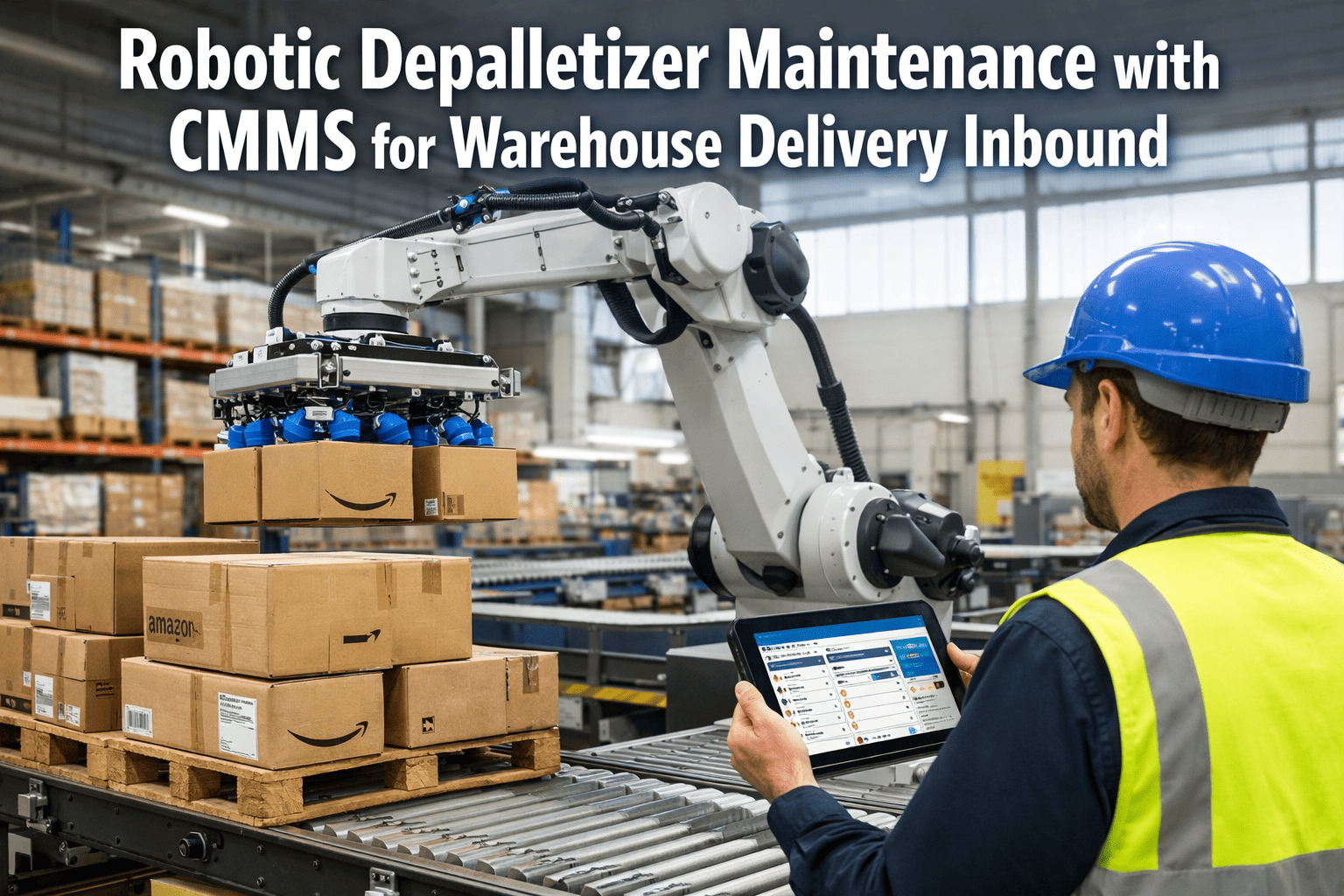
At 6:14 AM on a Monday receiving shift, a robotic depalletizer's vacuum cup releases a 30-pound case mid-lift. The case tumbles onto the infeed conveyor, jams the belt, triggers a downstream sortation fault, and freezes the entire inbound line before a single technician has finished their coffee. The cause: a tiny rubber lip seal that had quietly degraded past 750,000 cycles — exactly 250,000 cycles past when it should have been swapped. Depalletizers have become the first point of failure in modern inbound pipelines, and the maintenance of their vision systems, suction cups, and integrated conveyors now determines whether trucks unload on schedule or back up to the yard. Start tracking depalletizer PM intervals on OxMaint or see how CMMS scheduling closes this gap in a 30-minute walkthrough.
Article / Inbound Automation Maintenance
Robotic Depalletizer Maintenance with CMMS for Warehouse Delivery Inbound
Robotic depalletizers are now the first point of failure in automated inbound pipelines. CMMS-driven maintenance of vision systems, suction cups, and conveyors keeps depalletizers at 99%+ uptime during peak receiving — turning a fragile bottleneck into a reliable throughput engine.
Planned vs Unplanned Maintenance
Planned suction cup swap
8 min
Emergency cup failure stop
45–90 min
Robot arm peak failure idle
6–24 hr
The Receiving Dock Reality
Why Depalletizers Fail First — and Hurt Everything Downstream
Inbound automation is the newest frontier in warehouse ROI. But every automated inbound line shares a structural weakness: the depalletizer is the chokepoint. It handles the rawest, most unpredictable input — pallets arriving with mixed SKUs, damaged wrap, uneven stacking, and reflective packaging — and one EOAT failure starves every downstream process simultaneously.
68%
of industrial robot failures trace directly to skipped or incomplete preventive maintenance — not manufacturer defects, not overuse, but missed intervals.
3–5x
downtime multiplier when cascade effects are measured — one depalletizer stop idles sortation, putaway, and inbound staging in sequence.
$80K
emergency repair spend possible per unplanned robot arm failure, before factoring lost shift throughput or overtime recovery.
95–97%
availability benchmark that structured CMMS-driven PM programs hit, compared with 82–87% for reactive or calendar-only maintenance.
Anatomy of Risk
The Four Subsystems That Bring Depalletizers Down
A depalletizer is not one machine — it is four tightly integrated subsystems that each fail in distinct ways. Your CMMS strategy must treat them as separate maintenance entities with independent schedules, not as one generic asset.
Subsystem 01
Highest wear rate
End-of-Arm Tooling (Suction Cups & Vacuum Generators)
Rubber lip seals degrade in predictable cycle windows. Compressed air contamination destroys cup elasticity. Loose EOAT mounting bolts cause micro-misalignment that multiplies force on the cup rim. Vacuum leak-down rate is the single most sensitive leading indicator of an imminent drop event.
Leak-down rate rising
Cycle count > 500K
Visible lip cracking
Grip re-tries climbing
Subsystem 02
Highest complexity
Vision System (3D Imaging, Cameras, AI Perception)
Dust on camera lenses degrades confidence scores. Drift in structured-light calibration causes mis-pick locations. Firmware mismatches between the vision module and the robot controller produce pick-location errors that look like mechanical faults. Poor lighting conditions in receiving areas amplify every one of these problems.
Confidence scores dropping
HITL calls rising
Calibration drift
Firmware mismatch
Subsystem 03
Highest collateral impact
Robot Arm (Servos, Reducers, Encoders, Brakes)
Depleted reducer grease causes gear overheating with $5,000–$15,000 per-axis repair cost. Backup battery failure wipes calibration and costs 8–16 production hours to restore. Cable harness flex-fatigue produces intermittent alarms that resist diagnosis. Encoder drift silently pushes parts out of tolerance.
Reducer temperature
Brake holding test fail
Encoder drift
Cable fretting
Subsystem 04
Highest cascade risk
Integrated Conveyors & Pallet Infeed
Pallet infeed roller bearings fail under repetitive loaded-pallet weight. Outfeed belt tension drift causes case spacing errors that cascade into sortation jams. Photo-eye sensors collect receiving-area dust and misread pallet presence. Belt tracking misalignment produces slow product damage that hides until claims arrive.
Bearing vibration
Belt tension decay
Sensor read failures
Tracking drift
Operations Teams
Your Depalletizer Has Four Clocks Running. Track Them in One Place.
OxMaint lets receiving ops teams schedule PM by cycle count, operating hours, or calendar, then attach photo evidence, assign technicians by skill, and trigger work orders automatically when leak-down rates or confidence scores cross threshold. Stop chasing spreadsheets — start running structured maintenance that keeps inbound moving.
PM Intervals
The Cycle-Based Maintenance Schedule Your CMMS Should Run
Calendar-based PM fails on depalletizers because throughput varies wildly between peak and off-peak receiving days. Cycle-based intervals align maintenance with actual wear. Here is the schedule a CMMS should auto-generate and enforce for every depalletizer in your facility.
| Interval |
Subsystem |
Task |
Who |
Leading Indicator Tracked |
| Each shift |
EOAT |
Visual cup inspection, wipe down, loose-bolt check |
Operator |
Visible crack, bolt torque |
| Weekly |
Vision |
Camera lens cleaning, confidence score review |
Operator |
HITL call rate, confidence avg |
| Weekly / 250 hr |
Robot arm |
Controller air filter inspect, brake holding test |
Technician |
Thermal alarms, brake drop |
| Monthly |
EOAT |
Vacuum leak-down rate test vs baseline |
Technician |
Leak-down time trend |
| 500K cycles |
EOAT |
Replace suction cups and lip seals — scheduled 8 min swap |
Technician |
Cycle counter |
| Quarterly |
Conveyors |
Bearing lubrication, belt tension, tracking alignment |
Technician |
Vibration, tension decay |
| 2,000 hr |
Robot arm |
Joint encoder verification, cable harness inspection |
Technician |
Encoder drift, cable fret |
| Annual |
All subsystems |
Reducer grease change, battery swap, safety re-validation |
OEM or certified tech |
Grease condition, battery V |
Scroll horizontally on smaller screens to see the full schedule
Before vs After CMMS
The Receiving Shift That Used to Cost You — and the One That Doesn't
The operational difference between reactive and CMMS-driven depalletizer maintenance is not philosophical. It shows up on the receiving schedule every morning. Here is the same inbound line running the same Monday shift under two different maintenance models.
Without CMMS — Reactive Maintenance
Monday Receiving, Option A
06:14
Suction cup fails mid-lift. Case drops, conveyor jams.
06:18
Operator pages supervisor. Supervisor pages maintenance.
06:35
Tech arrives. No spare cup on hand. Parts runner dispatched.
07:22
Cup replaced. Downstream conveyor jam cleared manually.
07:45
Line restarts. Two trucks delayed. One damage claim filed.
91 minutes lost, cascading delay, emergency parts premium, damage claim
With OxMaint — Scheduled PM
Monday Receiving, Option B
Fri
Cycle counter hits 495K. CMMS auto-generates work order.
Sat
Tech assigned based on certification and shift availability.
Sun
Cup swapped during planned 8-minute break in operations.
06:00
Monday line starts. Fresh EOAT. Leak-down test passes.
07:45
Line still running at full rate. Trucks unloading on schedule.
Zero unplanned downtime, parts pre-staged, technician scheduled, trucks on time
The CMMS Advantage
Six Things a Good CMMS Automates for Depalletizer Teams
A structured CMMS is not a digital clipboard. For depalletizer maintenance specifically, it replaces six separate manual processes that typically live in spreadsheets, email threads, and tribal knowledge — and consolidates them into one tracked, audited workflow.
01
Cycle Count Tracking
Reads cycle counters from the robot controller and auto-triggers work orders when EOAT components approach their wear threshold — before the cup actually fails.
02
Spare Parts Pre-Staging
Reserves replacement cups, seals, and filters from inventory when work orders are generated — so the tech walks up to the cell with the right part, not an order form.
03
Skill-Based Assignment
Matches work orders to technicians with vision calibration, robot programming, or pneumatic certification — instead of whoever happens to be on shift.
04
Leak-Down Trend Capture
Logs monthly leak-down test results and flags trend degradation before leak-down breaches the action threshold — turning a point measurement into a predictive signal.
05
Downtime Root-Cause History
Every incident is tagged to subsystem, failure mode, and root cause. After 60 days, patterns surface that no individual technician would ever see across shifts.
06
Audit-Ready Documentation
Safety re-validation, IEC 62061 compliance records, and OEM maintenance sign-offs live in one queryable place — not in binders that get lost between auditor visits.
Measure the Right Things
The Five KPIs That Tell You a Depalletizer Program Is Healthy
Most warehouses measure depalletizer performance with throughput alone. That misses the early signals. Here are the five leading indicators reliability teams track in CMMS dashboards — each of which bends weeks before throughput does.
>99%
Target Availability
Measured as actual running time vs scheduled running time across the inbound shift window
<2%
Pick Failure Rate
Dropped, mispicked, or re-attempted cases as a share of total picks — rising rate predicts EOAT degradation
>95%
Vision Confidence
Average confidence score across picks — drop below target signals calibration, lighting, or firmware issue
100%
PM Compliance
Share of scheduled PMs completed on time — every missed interval compounds the failure probability curve
<30 min
MTTR
Mean time to repair for depalletizer incidents — with pre-staged spares and skill-matched assignment, 30 min is achievable
Common Questions
Depalletizer Maintenance — Questions Operations Leaders Ask
How often should we replace depalletizer suction cups?
Replace vacuum cups every 500,000 cycles or when monthly leak-down rate tests show degradation versus baseline — whichever comes first. Calendar-based schedules miss the actual wear signal.
See how OxMaint automates cycle tracking.
Can one CMMS handle both the depalletizer and the conveyors it feeds?
Yes — and it should. Treating them as one integrated asset group surfaces cascade failures early. The conveyor's bearing vibration often precedes the depalletizer's case-drop event by weeks if tracked together.
Do we need specialized technicians for robot-arm maintenance?
For reducer grease, encoder calibration, and safety re-validation, yes. For daily inspections, cup swaps, and vision cleaning, a trained in-house technician is sufficient. A CMMS routes each task type to the right skill level automatically.
What is the real ROI of structured PM on a depalletizer?
Facilities with structured CMMS-driven programs report 95–97% availability versus 82–87% for reactive models. On a high-volume inbound line, that uptime gap alone typically pays for the maintenance system within the first quarter.
Book a demo to model your numbers.
How do we start without overhauling the whole maintenance program?
Start with one depalletizer. Migrate its PM schedule, spare parts list, and incident history into the CMMS. Measure 60 days of availability. Then scale to the rest of the automation stack using the proven baseline.
Inbound Reliability Starts Here
Make the Depalletizer the Most Reliable Machine in Your Warehouse — Not the Most Fragile
OxMaint gives inbound operations and reliability teams cycle-based PM scheduling, photo-documented inspections, technician skill matching, and leading-indicator dashboards built specifically for automated receiving equipment. Your depalletizer should be the throughput engine of your inbound line — not its weakest point.