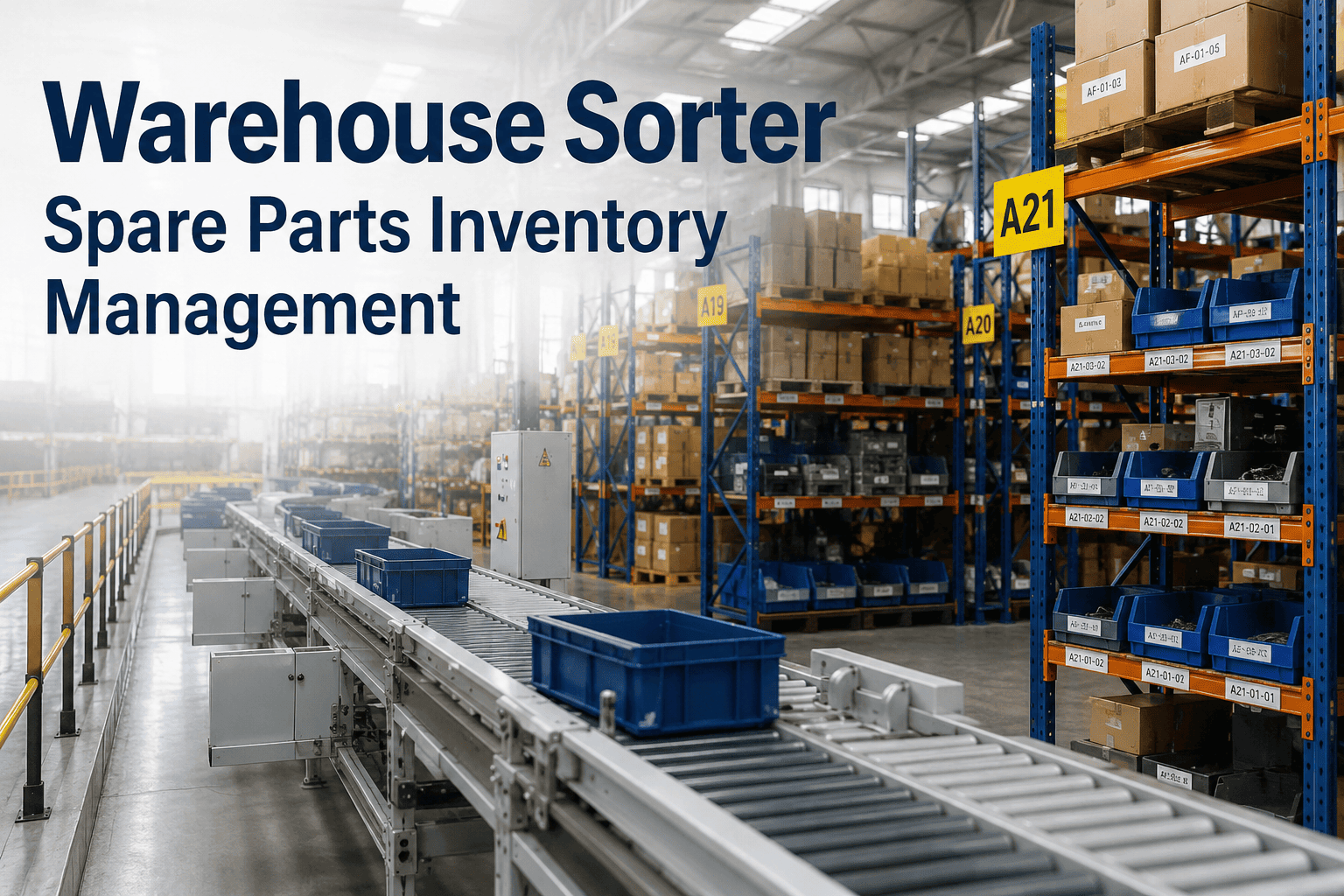
The spare diverter module that would have brought your sorter back in twenty minutes is sitting in a warehouse halfway around the world, on a sixteen-week lead time, while cartons back up behind a dead divert lane and trucks idle at the dock. Or the opposite trap: $2 million in spares on your shelves, 60% of it untouched in two years, capital frozen in parts you may never use. Both failures share one root cause — no system connecting part criticality, usage history, lead time, and reorder logic. Distribution centers lose $10K to $25K per hour when a sorter goes down, and emergency parts orders cost three to five times the planned price. OxMaint.ai ties every spare directly to the asset that consumes it, the work order that pulls it, and the reorder trigger that replaces it. Book a demo to see OxMaint right-size your sorter spares inventory.
Inventory & Parts Management · Warehouse Automation Maintenance
Stock the Right Sorter Part. Skip the Wrong $50,000.
OxMaint connects sorter spare parts to asset criticality, real usage data, and automated reorder points — so the vital part is always on the shelf and the dead stock never gets ordered in the first place.
Understock
3–5×
emergency order premium when a vital part isn't on the shelf
Overstock
60%
of spares value sitting dead for 2+ years, freezing working capital
One Dead Divert Lane, One Building Running as a Pile of Parts
A sorter is rarely a single point that fails quietly. When the variable-frequency drive on a merge trips and won't reset, the belt stops, cartons accumulate, and within minutes the problem stops being about one drive. The cost lives downstream — in the throughput it gates and the labor it idles.
Minute 0
The Part Fails
A drive motor, photo-eye, or diverter shoe fails. Equipment failure causes roughly 42% of unplanned warehouse downtime, with motors, drives, and bearings squarely in that category.
Minute 5
The Line Backs Up
Cartons queue behind the stopped divert. Pickers upstream run out of room; packers downstream run out of totes. A building designed to run as one machine fragments.
Hour 1
Cut-Offs Slip
Orders miss dispatch windows. At $10K–$25K per hour of DC downtime, the meter is running on idle labor, expedited freight, and SLA penalties — not the repair bill.
Hour 3
The Spare Isn't There
The replacement part is on a multi-week lead time or buried unlabeled in a "secret stash" closet. The 20-minute swap becomes a three-hour outage — or a multi-day wait.
The Real Number
One leading retailer addressing cross-belt sorter failures with proactive monitoring saved over $250,000 annually per location — most of it during peak season, when every hour of sorter downtime translates directly into missed orders and burned labor. The repair was never the expensive part. The expensive part was not having the right spare staged and the right work order ready when the failure hit. Inventory that is connected to asset criticality and work-order consumption turns that three-hour outage back into a twenty-minute swap.
The Sorter Spares That Earn Their Shelf Space
Not every part deserves stocking, and not every critical part is expensive. A sorter spares program prioritizes by what stops the line and what takes weeks to source — not by what feels safe to hoard. Here is how the core components rank.
Vital · Stock Always
Diverter Modules
Pusher arms, swing arms, and pop-up wheels are the mechanism that takes a package off the main line. A single-point failure on a critical lane halts that route. Long lead times make one complete module per critical lane a standing requirement.
Vital · Stock Always
Drive Motors & VFDs
Inlet and drive motors plus the variable-frequency drive of the common family. When the drive trips and won't reset, the whole zone stops. Match installed V/Hz or servo type and keep the heaviest-loaded gearbox spared too.
Essential · Min-Max
Belts & Chain Segments
Belt wear is among the top causes of unplanned stoppages. A cracked belt mid-peak is a classic reactive fix. Hold a complete replacement belt segment or chain module on a min-max trigger reviewed quarterly.
Essential · Min-Max
Sensors & Photo-Eyes
Primary photo-eyes and imagers drive divert accuracy; lens contamination alone causes a large share of mis-sort events. Stock spare imagers and universal mounts for fast repositioning without re-engineering.
Essential · Min-Max
PLC I/O & Controls
A spare PLC I/O module and a network switch configured offline keep a controls fault from becoming a full-day outage. Pre-configured spares cut the diagnose-and-source time that dominates electrical downtime.
Desirable · Source Reactively
Bearings & Fasteners
Sealed bearings, rollers, and standard hardware are low-value and usually fast to source. Bulk-order for economy, set a simple reorder point, and accept reactive sourcing where lead time allows — don't tie up capital here.
Right Part. Right Quantity. Right Time.
OxMaint scores every sorter spare by criticality and usage, sets the min-max and safety stock from real data, and triggers the reorder before you run out — without burying capital in parts that never move. Connect inventory to work orders, PM schedules, and procurement in one system.
How OxMaint Sizes Every Spare: ABC Meets VED
Before you can set a stocking level, you need to know what each part is worth — not just its price, but the cost of not having it. OxMaint applies the two-axis method reliability teams trust, then does the math automatically across your whole catalog.
| Value (down) / Criticality (across) |
V — Vital
(line stops) |
E — Essential
(temporary disruption) |
D — Desirable
(minimal impact) |
| A — High value |
Drive motors, VFDs
Min 1 unit, lead-time buffer |
Imagers, controllers
Standard min-max, quarterly review |
Spare gearbox
Review vs. on-demand sourcing |
| B — Moderate value |
Diverter modules, belts
Safety stock, demand review |
Photo-eyes, sensors
Auto-replenish min-max |
Guards, covers
Quarterly review |
| C — Low value |
Critical fasteners
Simple reorder point, bulk |
Bearings, rollers
Annual review, low safety stock |
Standard hardware
Run-to-stockout acceptable |
The KPIs That Tell You Your Inventory Is Working
A spares program is only as good as the numbers it moves. OxMaint surfaces these on a live dashboard so you catch a reorder point set too low before it becomes an emergency freight bill.
<5%
Stockout Rate
The primary service-failure signal. Above 5% means vital parts are regularly unavailable when needed. OxMaint tracks it by part class so A-class stockouts surface first.
2–4×
Annual Inventory Turns
MRO parts typically turn 2–4 times a year. Turns below 1.5 flag dead stock that should be reviewed for disposal instead of sitting on the shelf consuming carrying cost.
3–5×
Emergency Order Cost
Rush orders cost three to five times planned procurement. A high emergency-order rate means reorder points are set too low or not triggering — OxMaint catches the pattern.
15–30%
Carrying Cost Cut
Organizations that connect criticality, usage, and reorder logic reduce inventory carrying costs 15–30% while cutting stockout-driven downtime 20–40% at the same time.
From Reactive Stash to Connected Inventory
The toolbox hoard and the secret-stash closet exist because the storeroom was never connected to the work that consumes parts. OxMaint closes that loop end to end.
1
Map Parts to Assets
Every spare is linked to the sorter, lane, and component it serves. You see exactly which equipment consumes which part — the asset-to-parts mapping that gut-feel inventory and standalone spreadsheets never provide.
2
Score Criticality & Usage
OxMaint pulls real consumption from closed work orders and applies ABC/VED scoring automatically across the whole catalog — no manual review of tens of thousands of line items by hand.
3
Set Min-Max & Reorder Points
Reorder point, safety stock, and maximum level are calculated from actual usage and supplier lead time — the three numbers at the operational core of any working spares system.
4
Auto-Trigger Procurement
When stock hits the reorder point, OxMaint raises the purchase order automatically — before a part runs out, not after a line stops. Multi-site visibility lets you transfer a spare between hubs instead of expediting freight.
5
Pre-Stage for Every Work Order
When a PM or repair work order is generated, the required parts are reserved and staged. The technician arrives to find the part pulled and waiting — no parts hunt, no return trip, no sorter down longer than the actual repair.
Frequently Asked Questions
How does OxMaint decide which sorter parts we should actually stock?
OxMaint applies a combined ABC value and VED criticality analysis across your entire parts catalog, using real consumption data pulled from your closed work orders rather than guesswork. Vital parts that stop a line and carry long lead times — like diverter modules and drive VFDs — are flagged to always stock, while low-value, fast-to-source items like standard fasteners are set to reorder simply or source reactively. The scoring runs automatically across tens of thousands of line items, which is effectively impossible to do by hand.
Start a free trial to see your own catalog scored.
We already overstock to be safe. Why change anything?
Overstocking feels safe but it quietly freezes capital — in many warehouses 60% of spares value hasn't moved in two years, tying up money that could fund new equipment while still leaving gaps in the parts that actually matter. The problem is that "better to have it" stocking and true criticality rarely line up: you can hold a fortune in slow-moving C-class parts and still be missing the one vital diverter module. OxMaint right-sizes both directions at once, typically cutting carrying costs 15–30% while reducing stockout-driven downtime 20–40%.
Does OxMaint connect spare parts to our maintenance work orders?
Yes — that connection is the entire point. Every part is mapped to the assets that consume it, so when a PM or repair work order is generated the required spares are automatically reserved and staged for the technician. Closing the work order draws those parts down from inventory and updates usage history, which in turn refines future reorder points. This closed loop between asset, work order, and stockroom is what replaces the disconnected spreadsheets and hoarded "secret stash" closets that cause both stockouts and dead stock.
Can it manage spares across multiple hubs or fulfillment centers?
It can. OxMaint provides real-time stock visibility across all your locations, so when one hub needs a vital part you can transfer it from a sister site instead of paying three-to-five-times premium for expedited freight. Automated low-stock alerts fire per location, and the criticality scoring accounts for which sites run which sorter models. For distributed networks facing peak-season spikes, this multi-site view is often where the largest savings appear.
Book a demo to see multi-hub inventory in action.
How quickly do we see results after setting up inventory in OxMaint?
The first wins come fast because the highest-impact fixes are usually the most visible: surfacing dead stock for disposal and correcting reorder points that were triggering emergency orders both show up within the first review cycle. As more work orders close and real usage data accumulates, the min-max levels and safety stock keep tightening, so accuracy improves continuously over the first few months. Most teams find the dashboard pays for itself the first time it prevents a single peak-season sorter stockout, given the $10K–$25K-per-hour cost of downtime.
Never Lose a Peak Wave to a Missing Part Again
OxMaint ties every sorter spare to asset criticality, real usage, and automated reorder logic — keeping the vital part on the shelf, the dead stock off your books, and the right part staged for every work order. Set up in days, on the data your maintenance team already produces.
Criticality Scoring
Min-Max Automation
Reorder Triggers
Multi-Hub Visibility