WMS & CMMS Integration for Smart Warehouse Automation
By Johnson on April 13, 2026
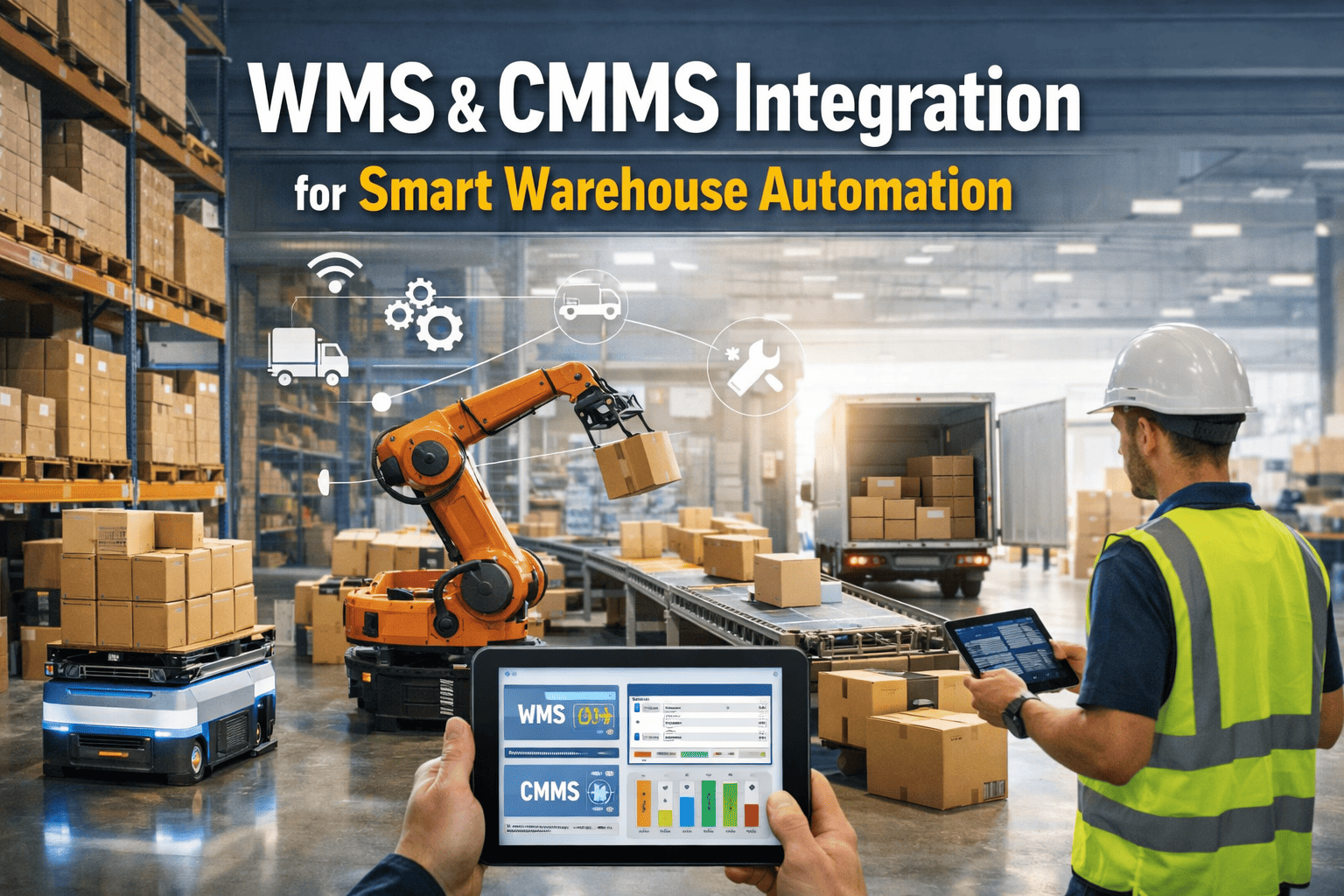
When a warehouse's WMS knows exactly where every pallet is but has no idea why the conveyor keeps failing at 2am, you don't have a smart warehouse — you have two systems talking past each other. Connect OxMaint CMMS to your WMS today and close the gap between inventory intelligence and equipment reliability, or book a live demo to see the integration in action across a real distribution centre.
Case Study / Warehouse Automation
WMS & CMMS Integration: How a Distribution Centre Eliminated Equipment Downtime During Peak Fulfilment
A mid-size 3PL operating four distribution centres reduced unplanned equipment downtime by 41%, cut emergency maintenance spend by $380K in Year 1, and achieved same-day SLA fulfilment at 97.3% — by connecting their WMS order data directly to OxMaint predictive maintenance workflows.
41%
Reduction in unplanned equipment downtime — Year 1
$380KEmergency maintenance savings
97.3%Same-day SLA achievement
4 DCsIntegrated on one platform
9 moPayback period
The Core Problem
Two Systems Running Blind to Each Other
Most warehouse operators have invested heavily in a WMS to manage inventory flow — but their maintenance operations are still managed in isolation. The result is a structural blindspot: the WMS knows that 2,400 orders need to ship today, but the CMMS doesn't know that peak load starts at 6am — so maintenance schedules conveyors at 5:30am, halting fulfilment in its busiest window.
WMS Knows
Order volume by hour
Peak fulfilment windows
Which equipment is in active use
Inventory movement patterns
SLA deadlines by shipment
Data Silo
✕
$250K+/hr
avg. cost of unplanned downtime
CMMS Knows
Equipment health & wear data
Maintenance history & schedules
Spare parts inventory levels
Technician availability
Failure probability scores
Without integration, neither system can make intelligent decisions. Maintenance gets scheduled at the worst possible moment. Equipment fails during peak windows. SLAs are missed. And nobody can trace exactly why — because the two data sources were never connected.
Stop Running Your WMS and CMMS as Separate Islands
OxMaint integrates with your existing WMS to align maintenance scheduling with fulfilment demand — protecting SLAs and eliminating the maintenance-window guesswork that costs operations teams thousands per incident.
Operator TypeMid-size 3PL — 4 distribution centres across 3 states
Facility Size180,000–240,000 sq ft per DC — e-commerce and FMCG mix
WMS in UseCloud-based WMS managing 14,000+ SKUs across all 4 DCs
Equipment FleetConveyors, sortation systems, dock levellers, HVAC, 38 forklifts
Prior MaintenanceReactive model — email-based work orders, contractor invoices in spreadsheets
Integration GoalAlign maintenance scheduling with WMS fulfilment demand data to protect SLAs
The Pain Points That Triggered Action
$47K
Average cost per conveyor failure during peak window — emergency labour, missed SLAs, and expediting fees combined
8.3 hrs
Average time from equipment failure to work order assignment — operating without a connected CMMS
23%
Of SLA failures attributed directly to equipment downtime — traced retrospectively in post-incident analysis
How Integration Works
What WMS + CMMS Integration Actually Enables
The integration between OxMaint and a WMS is not a simple data sync — it creates a bidirectional intelligence loop. WMS fulfilment data shapes when and how maintenance happens. CMMS equipment health data shapes how the WMS routes work away from at-risk equipment. Together, they create a self-correcting operational system.
01
Demand-Aware Maintenance Scheduling
OxMaint reads WMS order volume forecasts for the next 48 hours. PM tasks are automatically rescheduled away from peak fulfilment windows — conveyor PMs move to overnight low-volume slots, not morning peak hours. Zero manual coordination required.
02
Equipment Health Alerts to WMS
When OxMaint detects an early failure signal on a sorter or conveyor segment, it pushes a flag to the WMS. The WMS automatically reroutes order picking to alternative paths — fulfilment continues while maintenance is dispatched before failure occurs.
03
Spare Parts Linked to Order Demand
OxMaint's spare parts inventory is tied to WMS demand peaks. If a high-volume period is approaching and a critical conveyor component is below threshold, an automatic reorder is triggered — ensuring parts are on-hand before failure risk is elevated by load intensity.
04
Fulfilment Impact Scoring for Work Orders
Every maintenance work order is scored for fulfilment impact — P1 (blocks active pick zones), P2 (affects throughput), P3 (no immediate fulfilment impact). This prioritisation pulls directly from WMS live order data, ensuring the highest-impact issues are always resolved first.
Year 1 Results
What Changed in 12 Months
Metric
Before Integration
After Integration (Year 1)
Impact
Unplanned downtime events
34 incidents across 4 DCs
20 incidents — 41% reduction
$212,000 saved
Emergency maintenance callouts
11.2 per month chain-wide
4.7 per month — 58% reduction
$168,000 saved
Mean time to work order assignment
8.3 hours average
22 minutes — automated routing
Zero manual triage
PM completion rate
61% — untracked, reactive-dominated
94% — demand-aware scheduling
+33 percentage points
Same-day SLA fulfilment
89.4% — downtime-driven misses
97.3% — equipment failures de-risked
+7.9pp — client retention impact
Total Year 1 documented saving
$380,000
Technical Implementation
How the Integration is Deployed — 60 Days, No IT Project
The most common question operations leaders ask: "How long will this take to integrate?" OxMaint connects to WMS platforms via REST API, with pre-built connectors for major WMS vendors. The full integration — including data mapping, workflow configuration, and team training — is completed in 60 days with no IT department involvement required.
Days 1–14
Asset Registry & WMS Connection
All equipment entered into OxMaint with WMS location codes mapped to CMMS asset IDs. API connection established — WMS order volume data begins flowing into OxMaint demand engine.
Days 15–30
Workflow Configuration
Maintenance scheduling rules defined around WMS peak windows. Fulfilment impact scoring logic configured per equipment class. Spare parts thresholds linked to demand forecast triggers.
Days 31–45
Team Onboarding & First PM Cycle
Maintenance technicians trained on OxMaint mobile app. First demand-aware PM schedule executed. WMS team briefed on how equipment health flags appear in their dashboard.
Days 46–60
Optimisation & Reporting Setup
Dashboard configured for operations director — real-time view of equipment health, PM completion rate, and SLA risk by DC. Automated weekly digest activated for facilities and operations leads.
Predictive Intelligence
AI-Driven Predictive Maintenance Inside the Integration
Failure Probability Scoring
OxMaint's AI engine assigns a failure probability score (0–100) to every critical asset, updated continuously from maintenance history, sensor data, and usage intensity fed by the WMS. Assets crossing 70/100 trigger proactive work orders — before any symptom is visible.
IoT Sensor Integration
Temperature, vibration, and pressure sensors on conveyors, motors, and HVAC units feed real-time data into OxMaint. When readings deviate from baseline, the system cross-references WMS load data to determine urgency — a motor running hot during peak load is a P1 alert, not a P3 observation.
Spare Parts Intelligence
Predictive failure scores trigger automatic spare parts reorder when failure probability exceeds threshold and on-hand stock is below the minimum-for-repair level. Parts arrive before the failure, not after the emergency callout.
Multi-DC Portfolio View
Operations directors see a live heat map of all four DCs — green for healthy operations, amber for equipment approaching threshold, red for active P1 issues. Cross-DC maintenance patterns are identified to predict failures at facilities before the pattern repeats.
FAQ
Frequently Asked Questions
Book a demo to walk through the connection process for your specific WMS.
OxMaint reads order volume forecasts, active fulfilment windows, equipment utilisation by zone, and SLA deadline data. This informs when maintenance is scheduled, how work orders are prioritised, and which spare parts need to be pre-positioned ahead of demand peaks. Start your free trial to see the data mapping in practice.
OxMaint manages all warehouse equipment classes — conveyors, sortation systems, dock levellers, HVAC, forklifts, AGVs, compressors, and racking infrastructure. Every asset class can be integrated with WMS location and activity data for demand-aware maintenance scheduling.
The 3PL in this case study reached full payback in 9 months — driven primarily by emergency callout reduction and SLA improvement. Most warehouse operations see measurable ROI within the first 90 days from reduced reactive maintenance spend alone. Integration complexity and existing equipment age affect the exact timeline.
Yes — OxMaint's multi-site dashboard gives operations directors a single view across all distribution centres, with WMS data mapped per location. Each DC maintains its own demand-aware maintenance schedule while the central team sees cross-DC health patterns and cost benchmarks.
Your WMS and CMMS Should Work as One System — Not Two
OxMaint integrates with your existing WMS to deliver demand-aware maintenance scheduling, predictive failure alerts, and fulfilment-impact-scored work orders — all from a single platform that protects SLAs, reduces emergency spend, and gives you portfolio-level visibility across every DC you operate.