AI-Driven Maintenance Budget Forecasting for Universities
By Jamie lanister on April 11, 2026
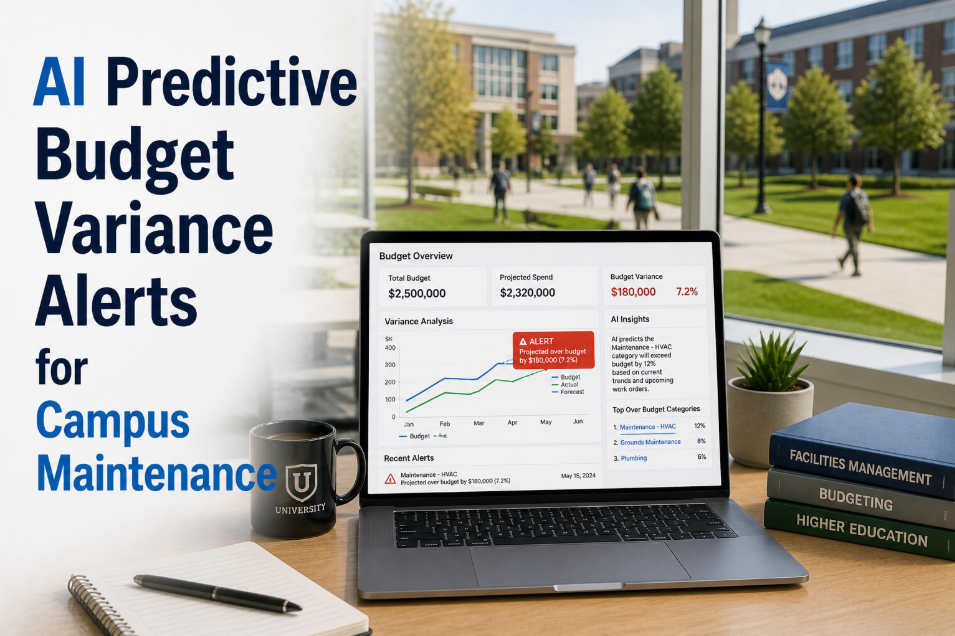
A facilities director at a private university in Boston submitted her annual maintenance budget request in October 2022 the same way she had for the previous eight years: she added 6% to last year's actual spending, flagged two aging HVAC units as likely replacements, and hoped the CFO would approve it. She got 80% of what she asked for. In March, one of the HVAC units she hadn't budgeted for failed — a $94,000 emergency chiller replacement that consumed the entire contingency reserve and required an emergency board reallocation. The following year, she deployed OxMaint AI budget forecasting. The AI analysed 6 years of maintenance records, asset age profiles, and failure history across all 28 campus buildings — and produced a forecast that predicted the failing chiller 11 months before it failed, with a confidence interval the CFO described as the first maintenance budget request she had ever trusted completely. The university funded the planned replacement at $62,000 instead of the emergency replacement at $94,000. OxMaint AI maintenance budget forecasting converts your historical work order data into forward-looking capital plans that finance teams approve — book a demo to see your campus asset data modelled.
AI Budget Forecasting — Submit Maintenance Budgets CFOs Actually Approve
Asset lifecycle analysis · Failure probability modelling · Capital replacement scheduling · 5-year forecast — all in OxMaint
Difference between a planned chiller replacement ($62K) and an emergency replacement ($94K) — same asset, different timing
6%
The average university maintenance budget increase applied annually — regardless of asset age, PM compliance, or failure risk
11 mo
How far in advance OxMaint AI predicted the failing chiller that the university's facilities director had not budgeted for
Why Campus Maintenance Budgets Are Always Wrong — The Structural Problem
Most campus maintenance budgets are built from three inputs: last year's actual spending, a percentage increase assumption, and the facilities director's best guess about what will break next. All three are backward-looking. None of them account for the forward-looking reality of how a campus asset portfolio ages. OxMaint AI forecasting changes all three inputs from guesswork to evidence.
Campus Maintenance Budget Composition — Where AI Forecasting Changes Each Component
Planned PM
Known PM Cost
AI-forecast from PM schedules
Predicted Reactive
Reactive Estimate
AI failure probability model
Capital Replacements
Capital Planning
Asset lifecycle threshold analysis
Contingency
Reserve Fund
AI reduces this from 20% to 8%
AI Total Forecast
Final Budget
CFO-ready with confidence interval
OxMaint AI replaces percentage-increase guessing with asset-based evidence — each budget component justified by data, not experience
AI Budget Forecasting — OxMaint
Stop Adding 6% to Last Year's Budget. Start Submitting a Forecast Your CFO Will Fund.
OxMaint AI analyses 5+ years of maintenance history and asset age profiles to produce a capital budget forecast with supporting evidence for every line item — not a spreadsheet with a percentage assumption.
How OxMaint AI Generates the Campus Maintenance Budget Forecast
OxMaint's budget forecasting AI uses four data streams that are already in your CMMS — no manual data preparation required. The forecast generates automatically from the work order, asset, and PM data that OxMaint is already collecting during normal operations.
OxMaint AI Budget Forecast — Four Data Inputs, One Capital Plan
Asset Age & Lifecycle
Each asset's age mapped against OEM lifespan
Assets past 80% of design life flagged for capital
Replacement cost indexed to current pricing
5-year replacement schedule by asset class
Repair Cost Trajectory
Annual repair cost per asset tracked from WO data
Inflection point — repair exceeds replacement flagged
Cost trend projected forward 3 years per asset
High-cost assets ranked for prioritized review
Failure Probability
AI failure model per asset type — HVAC, elec, plumbing
Probability score — low / medium / high / critical
Failure cost estimate — planned vs emergency comparison
Confidence interval shown per forecast line item
Budget Forecast Accuracy — OxMaint AI vs Traditional Methods
Traditional maintenance budget methods produce estimates that deviate from actual spending by 25–40%. AI-based forecasting with 5 years of CMMS data reduces that deviation to under 8% — close enough that CFOs can treat the maintenance budget request as a plan rather than a contingency. OxMaint's forecast accuracy improves every year as the AI learns from each building's actual performance data.
Budget Method
Data Basis
Accuracy vs Actual
CFO Confidence
Percentage increase (6%)
Last year's spending
±35% deviation — wide miss
Low — request cut routinely
Facilities director estimate
Experience + intuition
±22% deviation — moderate
Medium — partial approval
Asset age spreadsheet
Manual asset list
±18% deviation — better
Medium — with caveats
OxMaint AI (Year 1)
1 year CMMS history
±14% deviation — good
High — evidence-backed
OxMaint AI (Year 3+)
3+ years of asset data
±7% deviation — excellent
Very high — CFO approved
"Our CFO told me it was the first maintenance budget she had ever trusted completely. She didn't make a single cut. Every line item had data behind it — asset age, repair history, failure probability. We saved $32,000 by replacing the chiller planned instead of emergency. That saving alone paid for OxMaint for four years."
Campus maintenance budgets have four major cost categories — each with a different planning horizon and different AI forecast methodology. OxMaint forecasts all four simultaneously in one capital plan output.
HVAC & Mechanical
Highest Capital Cost
Chiller and boiler replacement — 15–25yr lifecycle
AHU, RTU, and fan coil unit PM cost
Refrigerant regulatory replacement cycles
Controls and BAS system upgrade forecast
Energy efficiency investment ROI calculation
Building Envelope
Longest Planning Horizon
Roof replacement — 20–30yr lifecycle
Window and glazing replacement by building age
Masonry pointing and facade maintenance
Waterproofing below-grade — failure prediction
ADA accessibility upgrade capital scheduling
Electrical Systems
Compliance-Driven Cost
Switchgear and panel replacement — age-based
Emergency generator load bank test cost
Fire alarm system upgrade to current code
EV charging infrastructure investment phasing
LED lighting retrofit campus-wide schedule
Plumbing & Life Safety
Regulatory-Required
Pipe replacement schedule — material age-based
Backflow preventer testing and replacement
Sprinkler head replacement schedule by zone
Elevator compliance upgrade capital plan
Lab and fume hood compliance cost forecast
Technology: How OxMaint AI Budget Forecasting Works
OxMaint AI budget forecasting is not a separate module you configure separately — it is generated automatically from the work order, asset, and PM data the platform collects during normal operations. The forecast improves every year as more data accumulates.
AI Digital Twin — Asset Lifecycle Modelling per Building
OxMaint builds a digital twin of every campus building's asset portfolio — modelling each asset's age, repair history, and failure probability simultaneously. The AI identifies the point at which accumulated repair cost exceeds planned replacement cost and schedules the replacement in the capital forecast before the asset reaches failure. Buildings can be compared against each other for capital prioritisation.
IoT Integration — Predictive Data Feeds Budget Model
OxMaint IoT sensor data — HVAC runtime hours, vibration levels, temperature anomalies — feeds the AI budget forecast model in real time. When a chiller begins showing elevated vibration readings 18 months before its planned replacement, the AI advances the replacement in the capital forecast and generates the cost update for the next budget cycle automatically.
SAP / Finance Integration — Budget to Ledger Automatically
OxMaint budget forecast exports in formats compatible with SAP, Workday Financials, and Ellucian Banner — so the capital plan the AI generates populates directly into the university's budget request system without manual data transfer. When the budget is approved and spending begins, actual work order costs post back to OxMaint automatically to close the feedback loop for next year's forecast.
AI Camera Vision — Condition Assessment for Capital Decision
OxMaint AI camera vision processes inspection photos — roof, facade, mechanical equipment — and classifies condition against a deterioration scale. Condition scores feed the capital forecast model, advancing replacement timelines for assets deteriorating faster than expected. This converts qualitative inspection observations into quantitative budget inputs that CFOs can evaluate against other capital priorities.
Deferred Maintenance FCI — Facilities Condition Index Dashboard
OxMaint calculates the Facilities Condition Index (FCI) for each campus building automatically — the ratio of deferred maintenance cost to asset replacement value. FCI is the metric university boards and accreditation bodies use to assess campus infrastructure investment adequacy. OxMaint makes FCI a real-time metric, not an annual consultant engagement costing $200,000+.
5-Year Capital Plan — Board-Ready Report Output
OxMaint generates a 5-year capital maintenance plan as a board-ready PDF report — showing projected spending by year, by building, and by asset category with AI confidence intervals on each projection. The report includes the planned vs emergency cost comparison for every identified capital need — quantifying the financial benefit of funding on time versus deferring until failure.
±7%
AI forecast accuracy vs actual spend — year 3+ on OxMaint data
32%
Cost saving per replacement — planned timing vs emergency response
11 mo
Advance warning on failing equipment — before budget cycle closes
100%
Of AI forecast line items backed by CMMS data — no gut estimates
Frequently Asked Questions
OxMaint can generate a useful forecast from 1 year of work order data, though accuracy improves significantly with 3+ years. Even in year one, the asset age and lifecycle analysis produces a capital replacement schedule that is more defensible than a percentage-increase estimate. Forecast accuracy typically reaches ±7% by year three.
Yes — OxMaint calculates FCI automatically using work order cost data and asset replacement values stored in the system. FCI is displayed per building on the campus dashboard and updated in real time as work orders close. No annual consultant engagement required for what has traditionally been a $150,000–$200,000 facility assessment.
Yes — OxMaint generates a 5-year capital maintenance plan as a formatted PDF with projected spending by year, building, and asset category. Each line item includes the AI confidence interval, the planned cost, and the estimated emergency replacement cost to quantify the financial case for on-time funding.
OxMaint exports in formats compatible with SAP, Workday Financials, Ellucian Banner, and Oracle Campus Solutions. Budget line items populate directly into the university's budget request system without manual data re-entry. Approved budget amounts flow back into OxMaint for actual vs forecast tracking throughout the fiscal year.
OxMaint tracks cumulative repair cost per asset from work order history. When the 5-year repair cost projection exceeds the current replacement cost estimate for an asset, OxMaint flags the asset as a capital replacement candidate and adds it to the next budget cycle's capital plan with the cost comparison displayed for the budget submission.
AI Budget Forecasting — OxMaint
The CFO Will Fund It If You Can Prove It. OxMaint Gives You the Proof.