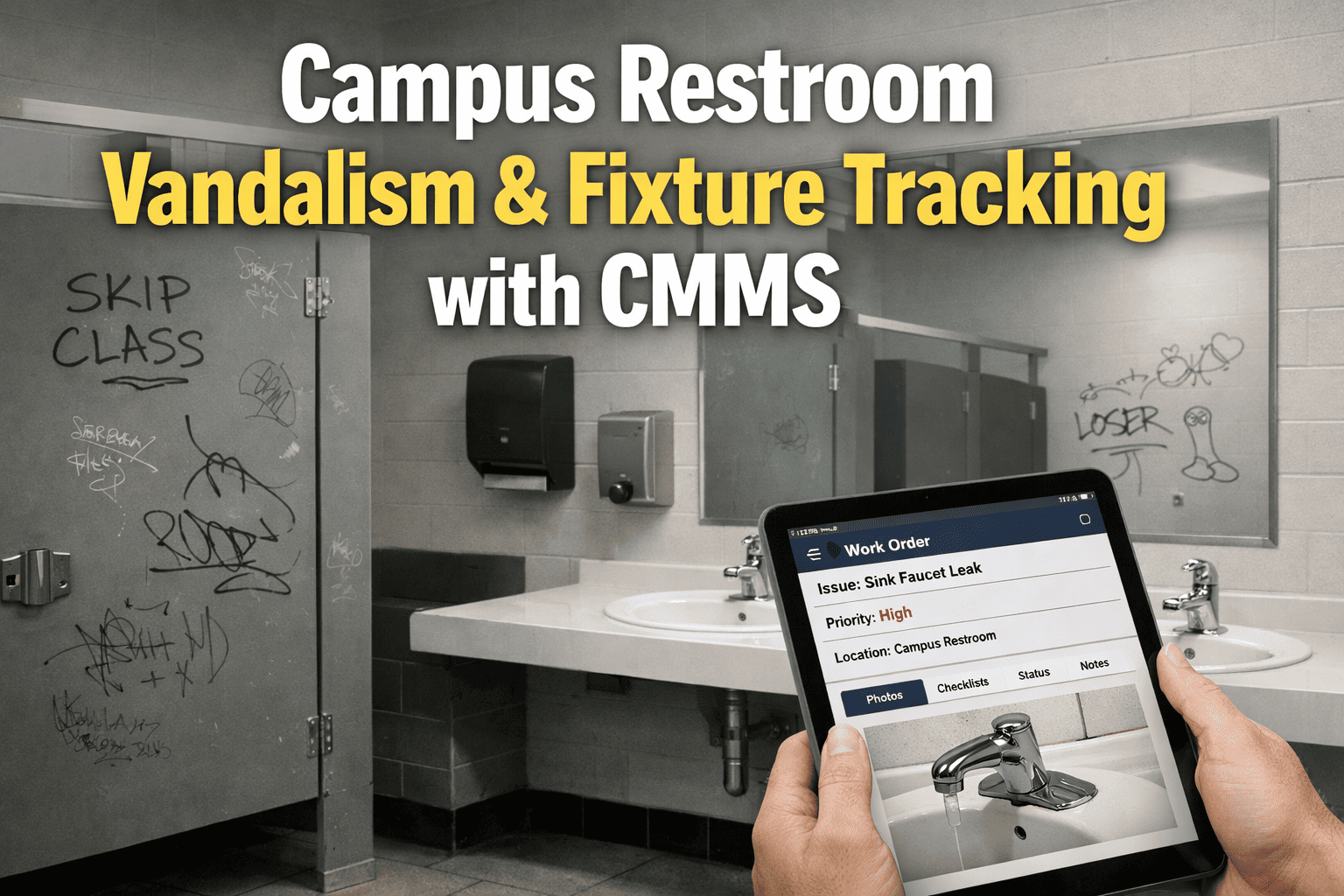
A facilities manager at a mid-size university in the Midwest was spending $140,000 per year on restroom vandalism repairs — but had no systematic way to determine whether the damage was concentrated at specific locations, occurring at predictable times, or being driven by a small number of repeat incidents at the same fixtures. When her team finally analysed three years of paper work order records, they discovered that 23% of the total vandalism repair cost was attributable to eight specific restroom locations that each averaged more than twelve repair events per year — fixtures, partitions, and dispensers repeatedly damaged at the same locations without any intervention response that addressed the concentration pattern. Repairing vandalism without analysing the pattern is the most expensive way to manage a predictable problem. CMMS damage pattern tracking — logging every vandalism work order against the specific location, fixture type, and damage category — converts an opaque repair cost into an addressable operations intelligence question: where is the damage concentrated, how much does each location cost, and what intervention would reduce the repeat rate? Sign in to OxMaint to configure vandalism and damage tracking against specific campus locations and fixture assets, or book a demo to see how OxMaint identifies vandalism hotspots, quantifies location-specific repair costs, and gives campus security and facilities the pattern data needed to reduce repeat incidents.
Campus Vandalism Tracking · Restroom Damage Analytics · Hotspot Identification · OxMaint CMMS
23% of Your Vandalism Budget Is Going to 8 Locations. OxMaint Finds Them. Pattern Data That Turns Reactive Repair into Targeted Prevention.
OxMaint campus vandalism tracking logs every damage work order against a specific location, fixture asset, and damage category — building the pattern data that identifies repeat hotspots, quantifies cost by location, and gives campus security and facilities the evidence needed to deploy prevention resources where they will have the greatest impact.
23%
of campus vandalism repair cost typically attributable to under 10% of locations — the hotspot concentration that is invisible without location-specific CMMS tracking
$140K
average annual campus restroom vandalism repair cost at a mid-size university — a cost that pattern analysis typically reduces by 30–40% through targeted prevention at identified hotspots
3 days
average time a vandalism-damaged fixture remains unrepaired without CMMS work order tracking — creating additional damage risk and occupant dissatisfaction while the repair waits in the backlog
23%
Nearly a quarter of campus vandalism repair cost concentrates at a small number of repeat-incident locations — but this concentration is invisible without location-specific work order tracking. When vandalism work orders are logged generically as "restroom repair" without being attributed to a specific building, floor, and fixture, the cost data cannot be analysed by location. When it cannot be analysed by location, the repeat pattern cannot be identified. When the repeat pattern cannot be identified, prevention resources cannot be targeted — and the same locations continue generating repair costs that compound year over year without any systematic response. OxMaint vandalism tracking closes this gap by requiring location-specific asset attribution on every damage work order — building the location-level cost and frequency data that turns reactive repair into targeted prevention.
Four Vandalism Tracking Domains OxMaint Manages for Campus Facilities
LOC — Location Attribution
Location-Specific Damage Work Order Attribution and Hotspot Identification
The fundamental requirement for vandalism pattern analysis is that every damage work order is attributed to a specific location — not just a building, but a specific restroom, a specific floor, and where possible a specific fixture or partition. OxMaint campus asset hierarchy allows damage work orders to be logged against a restroom asset record with a linked location in the building model — so the work order data automatically populates the location-level cost and frequency reports that identify hotspots. When a facilities manager asks "which restrooms have the highest vandalism repair cost this semester," OxMaint answers with a ranked location report produced in seconds from work order data that has been attributed to specific locations since the first incident was logged. The same analysis that took weeks to produce from paper records becomes a live dashboard query that any facilities coordinator can run at any time.
Sign in to OxMaint to configure location-specific asset attribution for your campus restroom and facility damage tracking.
Key Location Attribution Data OxMaint Captures
Building and floor location — specific restroom identifier per work order
Fixture asset link — damaged fixture registered as discrete asset with repair history
Damage category — fixture, partition, dispenser, door hardware, or surface category
Repair cost — parts and labour cost recorded per incident per location
Incident timestamp — date and time of damage discovery for temporal pattern analysis
Location Attribution Failures OxMaint Prevents
Generic work order — damage logged as "restroom repair" without specific location
No fixture link — repair cost not attributable to specific asset for fixture-level analysis
Missing timestamp — incident discovery time not recorded, preventing temporal pattern analysis
PTTN — Pattern Analytics
Damage Pattern Analysis — Temporal, Spatial, and Category Concentration
Location attribution is the foundation of pattern analysis — but the analysis itself requires visualising the work order data across three dimensions simultaneously: where damage is occurring (spatial concentration), when it is occurring (temporal pattern), and what is being damaged (category concentration). OxMaint damage pattern analytics present all three dimensions in a unified dashboard — showing facilities directors and campus security the specific restrooms with the highest repair frequency, the days of week and times of day when damage discovery is most concentrated, and the fixture and surface categories that are most frequently targeted. This three-dimensional pattern picture provides the evidence base for targeted prevention — additional camera coverage at spatial hotspots, enhanced security presence during temporal peaks, and hardened fixture specifications in high-frequency damage categories.
Book a demo to see vandalism pattern analytics in OxMaint for campus facilities management.
Key Pattern Dimensions OxMaint Analyses
Spatial concentration — cost and frequency ranked by building and specific restroom location
Temporal concentration — damage discovery frequency by day of week and time band
Category concentration — which fixture and surface types are most frequently damaged
Cost per incident trend — average repair cost increasing or decreasing at hotspot locations
Pattern Analysis Limitations Without OxMaint
Paper work orders — no queryable database for pattern analysis across large incident volumes
Generic location records — spatial analysis impossible without location-specific attribution
Manual aggregation — days-long effort to produce a location cost ranking from paper records
RSPD — Repair Response Tracking
Vandalism Repair Response Time and Backlog Management
Damaged fixtures left unrepaired create a compounding problem — a broken paper towel dispenser is an occupant experience failure for every user until it is repaired, and a damaged partition that remains visible signals that vandalism has no prompt consequence, which is associated with increased incident rates at the same location. OxMaint vandalism repair work order tracking measures the time from damage discovery to repair completion for every incident — providing the response time data that facilities directors need to evaluate whether their repair prioritisation is consistent with the cost and severity of each incident type. Locations where repair times consistently exceed 3 days generate alerts to the facilities supervisor, and the overall response time trend by damage category is tracked on the campus facilities performance dashboard.
Sign in to OxMaint to configure vandalism repair response time tracking and priority classification for your campus.
Key Repair Response Metrics OxMaint Tracks
Discovery-to-assignment time — lag from damage report to technician assignment
Assignment-to-completion time — active repair timeline from assignment to work order close
Backlog accumulation — open vandalism work orders by location and age
Repeat incident velocity — time between consecutive incidents at the same location
Response Failures OxMaint Tracking Identifies
Extended repair backlog — specific location with consistently high repair completion times
Rapid repeat incidents — same location recurring within days of prior repair closure
No priority classification — life-safety damage (broken glass, sharp edges) in standard queue
PREV — Prevention Intelligence
Campus Security Integration and Prevention Resource Deployment Data
OxMaint vandalism pattern data is most valuable when it is shared with campus security — allowing security leadership to make camera deployment, patrol scheduling, and deterrence resource decisions based on quantified incident patterns rather than anecdotal reports. OxMaint generates vandalism pattern summary reports formatted for security operations briefings — showing the top 10 hotspot locations by incident frequency and repair cost, the temporal window when incidents are most concentrated, and the year-over-year trend at each hotspot that indicates whether security interventions at that location are having measurable effect. The integration of OxMaint damage data with campus security camera system records allows facilities and security to correlate repair cost hotspots with camera coverage gaps — identifying specific locations where camera installation investment would be supported by quantified vandalism cost reduction potential.
Book a demo to see security integration and prevention reporting in OxMaint for campus facilities.
Key Prevention Intelligence OxMaint Generates
Top 10 hotspot report — location-ranked by frequency and cost for security briefing
Camera coverage gap analysis — hotspot locations without current camera coverage flagged
Intervention effectiveness tracking — incident rate before and after security intervention per location
Seasonal pattern analysis — academic calendar correlation with damage rate by location
Prevention Intelligence Gaps Without OxMaint
No hotspot quantification — security cannot justify camera investment without cost data
Intervention effectiveness unknown — no before-after comparison without work order data
Seasonal blindness — academic calendar damage correlation invisible without timestamped records
OxMaint Campus CMMS · Vandalism Tracking & Pattern Analytics
Stop Repairing the Same Eight Locations Every Month Without Knowing They Are the Same Eight Locations. OxMaint Makes the Pattern Visible — and the Prevention Targeted.
Location-specific damage attribution. Three-dimensional pattern analytics. Repair response tracking. Security integration reporting. OxMaint turns campus vandalism from an opaque repair cost into a solvable pattern problem.
Three Technologies That Make Campus Vandalism Pattern Analysis Actionable
How OxMaint Converts Damage Work Orders Into Prevention Intelligence
Technology · AI Analytics
Automated Hotspot Detection and Alert
OxMaint AI monitors damage work order frequency by location and generates automatic hotspot alerts when a specific restroom or facility location exceeds a configurable incident threshold within a rolling time window. A restroom that generates its third vandalism work order within 30 days produces an automatic alert to the facilities director and campus security — triggering a coordinated prevention assessment before the location accumulates further cost.
Alert trigger: Configurable threshold — e.g. 3 incidents per location per 30-day window
Technology · Camera Integration
AI Camera Vision — Depot Entry Condition Detection
OxMaint integrates with campus security camera systems to cross-reference damage hotspot locations with camera coverage maps — identifying hotspot restrooms and facilities without camera coverage and quantifying the vandalism cost that represents the prevention ROI case for camera installation. The integration allows campus security to prioritise camera deployment using vandalism cost data rather than assumption about where cameras would be most effective.
Output: Camera investment ROI estimate based on quantified vandalism cost at uncovered hotspots
Technology · Mobile Reporting
In-Field Damage Reporting with Photo and Location Capture
OxMaint mobile app enables custodial staff, security officers, and any campus community member to report damage at the point of discovery — with the specific location pre-populated from the device's GPS or QR code scan, photo capture of the damage condition, and automatic work order creation. Mobile reporting at discovery eliminates the 3-day average gap between damage occurrence and work order creation that currently distorts campus damage pattern data.
Impact: Discovery-to-work-order gap reduced from 3 days to under 5 minutes with mobile reporting
Campus Damage Category Risk Register — Where Pattern Tracking Delivers the Most Prevention Value
High Cost · High Frequency
Restroom Partitions and Stall Hardware
Partition damage — graffiti, forced door hardware, and panel destruction — generates the highest cumulative repair cost in campus restroom vandalism programmes. OxMaint tracks damage by specific stall location within a restroom, identifying which stalls are repeatedly targeted for more durable hardware specification or enhanced deterrence.
High Cost · High Frequency
Soap and Paper Dispensers
Dispenser theft and destruction is the highest-frequency vandalism category on most campuses — and the most prevention-responsive when robust commercial dispensers replace standard institutional units at identified hotspots. OxMaint dispenser damage records by location support the specification upgrade investment case for top-cost locations.
Safety Priority
Mirror and Glass Damage
Mirror and glass damage creates immediate safety hazard requiring priority repair response — sharp edges and glass fragments pose injury risk to subsequent occupants. OxMaint priority classification for glass damage generates P1 work orders that bypass standard repair queues regardless of the location's overall incident history.
Moderate Cost · Trackable
Graffiti — Surface and Fixture
Graffiti damage generates moderate repair cost per incident but very high incident volume at certain campus locations. OxMaint temporal pattern analysis for graffiti incidents identifies specific time windows — often Friday and Saturday evenings — when deterrence presence would reduce incident rates most effectively.
Moderate Cost · Preventable
Plumbing Fixture Tampering
Intentional toilet and sink overflow events are low-frequency but very high-cost incidents that consistently occur at the same campus locations. OxMaint identifies the specific restrooms with overflow incident history — supporting the case for anti-tamper fixtures at repeat locations.
Asset Theft · Security Priority
Fixture and Hardware Theft
Faucet handles, soap dispensers, paper towel dispensers, and accessible grab bars are targeted for theft in low-surveillance restrooms. OxMaint theft incident tracking by location identifies which facilities lack adequate visual access or camera coverage — the primary factor in theft target selection.
Campus Vandalism Tracking — OxMaint Data Capture by Damage Category
Documented Outcomes — Campuses Using OxMaint for Vandalism Pattern Tracking
34%
average annual vandalism repair cost reduction at campuses using OxMaint hotspot analysis to target prevention resources at identified high-frequency locations
5 min
time to produce a location-ranked vandalism cost and frequency report from OxMaint — vs. weeks of manual paper work order analysis to produce the same output
$48K
average annual vandalism cost reduction at mid-size campuses from targeted camera installation at OxMaint-identified hotspot locations with no prior camera coverage
23%
of campus vandalism cost concentrates at under 10% of locations — the hotspot that targeted prevention resources can address before the pattern repeats
3 days
average time a vandalism-damaged fixture remains visible before repair — the occupant experience and behavioural signal that extends incident rates at the same location
34%
average annual vandalism cost reduction from pattern-targeted prevention — the quantifiable return on CMMS damage tracking investment
$140K
average annual campus restroom vandalism cost — a budget line that pattern-targeted prevention and faster repair response can reduce by $48K–56K annually
You are spending $140,000 per year on vandalism repairs and attributing none of it to specific locations. OxMaint shows you which eight locations are consuming 23% of that budget — and what targeted prevention would cost to reduce the repeat rate.
Location-specific attribution. Pattern analytics. Hotspot alerts. Security integration reporting. OxMaint makes campus vandalism a data problem with a targeted solution — not an opaque cost that compounds annually without visibility.
The first time I ran the OxMaint vandalism hotspot report, I was genuinely surprised. Our top 10 locations — 10 restrooms out of 340 on campus — had generated $38,000 in repair costs in the prior 12 months. I brought that report to our Director of Campus Safety. Within 60 days we had cameras covering 7 of those 10 locations. Our total vandalism repair spend in the next 12 months dropped by $41,000. The cameras paid for themselves in the first semester and have continued paying back ever since.
— Director of Facilities Management, Mid-Size University · Wisconsin · 340 restrooms tracked in OxMaint · user since 2022
Frequently Asked Questions — Campus Vandalism Tracking and Pattern Analysis with CMMS
How does OxMaint attribute vandalism work orders to specific restroom locations and fixtures?
Every campus restroom is registered in OxMaint as a discrete location asset in the building hierarchy — with individual fixture and partition assets linked to that location record. When a vandalism work order is created, the technician or reporter selects the specific restroom and fixture from the asset register, automatically attributing the repair cost and incident data to that location.
Sign in to OxMaint to configure your campus restroom and facility asset hierarchy.
How does OxMaint generate a vandalism cost and frequency report by campus location?
OxMaint AI natural language search or the dedicated facilities analytics dashboard can produce a location-ranked vandalism report in under 5 minutes — showing incident frequency, total repair cost, average cost per incident, and trend direction for each campus location over any selected time period. The report can be exported as PDF or Excel for security briefings and budget presentations.
Can OxMaint integrate with campus security camera systems to correlate hotspots with coverage gaps?
Yes. OxMaint integrates with campus security camera management systems to overlay vandalism hotspot locations with camera coverage maps — identifying the specific high-cost damage locations that lack camera coverage. This integration produces the quantified ROI case for camera installation investment that facilities and security leadership can present to capital planning committees.
Book a demo to see security camera integration in OxMaint.
How can custodial staff report vandalism damage at point of discovery using OxMaint?
OxMaint mobile app allows any campus staff member to report damage at the point of discovery — scanning a QR code posted in each restroom to pre-populate the location, capturing a photo of the damage, selecting the damage category, and submitting a work order that appears in the maintenance queue immediately. The entire reporting process takes under 90 seconds and eliminates the 3-day average gap between damage discovery and work order creation.
Does OxMaint track whether security interventions at vandalism hotspots are reducing incident rates?
Yes. OxMaint tracks incident frequency and repair cost by location before and after any documented security intervention — camera installation, increased patrol frequency, or lighting upgrade — providing the before-after comparison that demonstrates intervention effectiveness and supports continued security investment at high-impact locations.
The Same Eight Restrooms Are Being Repaired Twelve Times a Year. OxMaint Finds Them in 5 Minutes — So You Can Fix the Pattern, Not Just the Fixture.
Location-specific damage attribution. Hotspot detection. Pattern analytics. Security integration. OxMaint turns campus vandalism from an opaque $140,000 annual cost into a targeted prevention programme that delivers measurable repair cost reduction year over year.