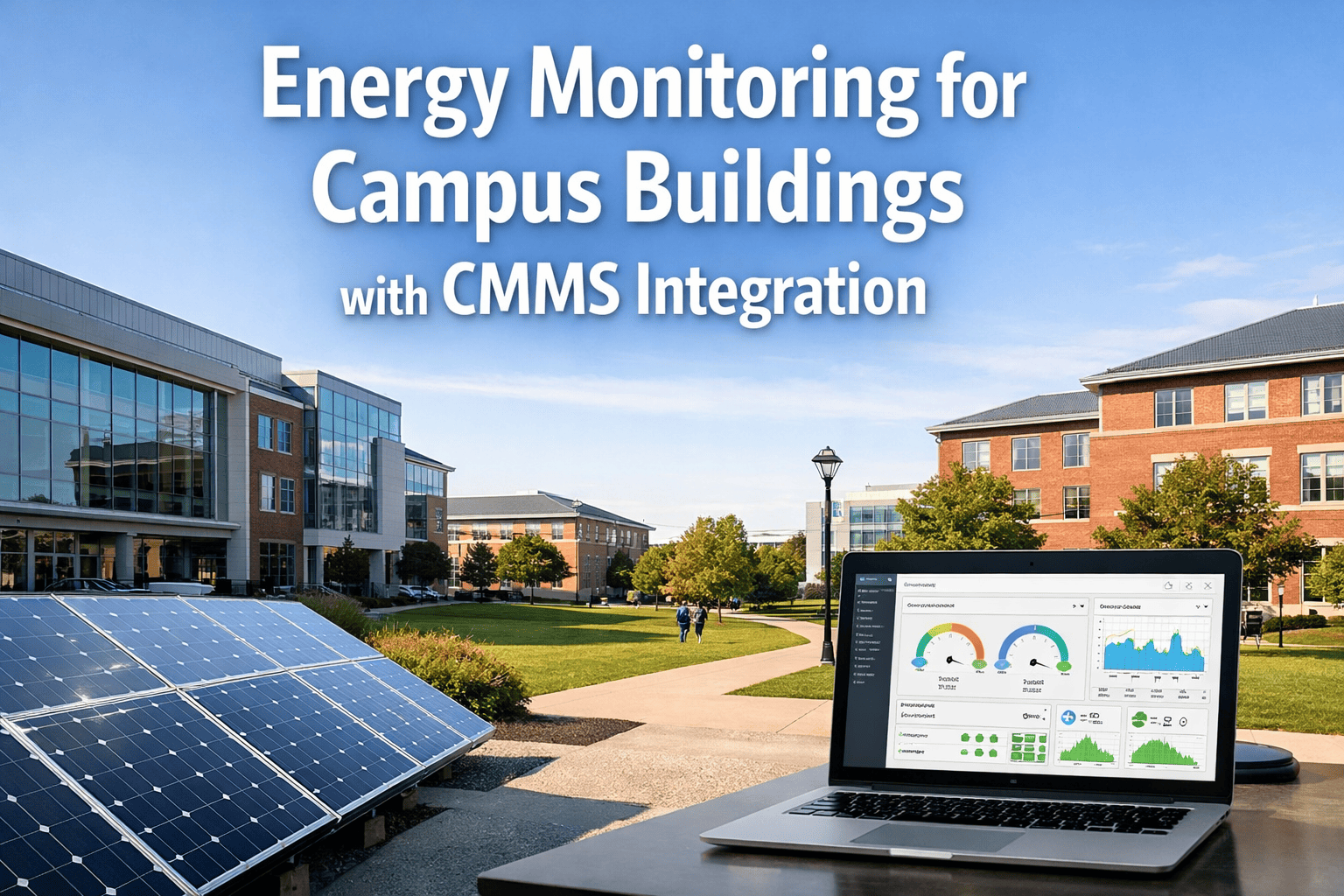
How AI and Machine Learning Optimize School Building Energy Performance
By Jamie lanister on March 28, 2026
A school building that consumes 23% more energy than it should is not usually the result of broken equipment — it is the result of HVAC systems running to fixed schedules that were set when the building was first commissioned and never adjusted, lighting that stays on in unoccupied classrooms because nobody ever programmed the occupancy sensors correctly, and heating setbacks that do not account for the actual thermal mass of the building structure. Artificial intelligence and machine learning change the equation fundamentally: instead of fixed schedules, AI analyses real-time occupancy data, weather forecasts, and historical consumption patterns to make continuous micro-adjustments that reduce energy waste without affecting comfort or learning environments. OxMaint connects AI energy intelligence to the CMMS maintenance platform — so that every AI-identified energy anomaly generates a maintenance work order, every equipment fault that wastes energy is tracked to resolution, and every efficiency improvement is documented in a building energy record that school boards can use to justify smart building investment.
OxMaint · School Energy Intelligence · AI Building Performance Optimisation
Every Energy Anomaly Detected. Every System Optimised. Every Saving Documented.
AI and machine learning-powered energy optimisation for school buildings — occupancy prediction, HVAC scheduling, lighting control, anomaly detection, and CMMS-integrated maintenance work orders that close the loop between insight and action.
Average reduction in school energy costs achievable with AI-optimised HVAC scheduling vs fixed-schedule BMS control
34%
Of school energy waste occurs during unoccupied periods when HVAC and lighting are not demand-adjusted to actual occupancy
8×
Faster energy anomaly detection with AI vs manual monthly bill review — anomalies caught in hours, not weeks
$180K
Average annual energy saving per school district from AI-driven occupancy prediction and system scheduling optimisation
How AI Energy Anomaly Detection and CMMS Integration Works: Four Steps to Optimised and Documented
AI identifies that a rooftop HVAC unit is consuming 34% more energy than its peer units in the same building — but that insight only converts to a saving when it generates a maintenance work order, gets investigated, and is resolved. OxMaint connects AI energy analysis directly to the maintenance work order system. Start free and see your first AI energy anomaly report within 14 days of sensor connection.
MOBILE REPORTING WORKFLOW — 4 STEPS FROM DETECTION TO CLOSED RECORD
Step
Action
Data Captured
What OxMaint Does
Time
01
AI detects energy anomaly or opportunity
HVAC unit overconsumption, lighting baseline deviation, unoccupied zone running, setpoint drift — from AI engine or manual observation
Timestamps anomaly. Compares to building baseline and peer performance. Assigns severity tier automatically.
Auto
02
Anomaly logged and photo evidence captured
Equipment ID, consumption deviation, expected vs actual, contributing system — AI evidence log or manual maintenance photo
Cross-checks maintenance history for prior similar events. Flags recurrence pattern. Attaches to equipment record.
Routes P1 to maintenance team immediately. P2 to energy manager. P3 to scheduling queue.
10 sec
04
Work order raised and saving tracked
Technician sign-off, equipment repair or schedule adjustment, kWh saving estimate logged, comparison to pre-intervention baseline
Seals energy record. Updates AI model. Calculates post-intervention saving. Adds to district energy dashboard.
15 sec
Works offline — reports queue locally and sync when connectivity returns. Timestamp applied at submission.
Energy Anomaly Framework: Three Efficiency Tiers, Three Response Paths
A compressor fault that is causing a rooftop unit to run continuously and a lighting schedule that is 15 minutes behind the school's actual start time require completely different responses. OxMaint routes every AI energy anomaly automatically based on impact size and urgency. Book a demo to see the AI energy framework integrated with your BMS and CMMS.
RESPONSE FRAMEWORK — THREE TIERS, AUTOMATED ESCALATION
P1
Energy Anomaly — System Fault, Immediate Investigation
Significant energy consumption deviation indicating equipment fault. Potential wasted spend exceeding £/$/$ threshold per day. Immediate investigation and maintenance work order required.
Examples
HVAC unit running continuously · Compressor not cycling · Heating and cooling simultaneously · Building consuming 40%+ above baseline · Major circuit fault
Alert time<2 hrs
System actionInvestigate immediately
WO priorityP1
P2
Efficiency Deviation — Optimise Before Next Schedule Cycle
Energy consumption above optimised baseline but below fault threshold. Scheduling adjustment or minor maintenance will recover efficiency. Energy manager alerted for optimisation review.
Examples
Setpoint drift 3°C+ · Zone running unoccupied 60+ min · Lighting schedule offset · Chiller running in winter · Hot water tank cycling outside hours
Alert time<24 hrs
System actionSchedule adjustment
WO priorityP2
P3
Optimisation Opportunity — Schedule at Next Review Cycle
AI has identified a potential efficiency improvement below immediate threshold. Scheduling review or preventive maintenance at next window will improve performance.
Examples
HVAC pre-heat 15 min early · Lighting 5% above lux target · Minor setpoint optimisation · Filter efficiency decline · Demand response opportunity
Alert timeWeekly summary
System actionFully operational
WO priorityP3
Biggest School Energy Waste Categories: Where AI Optimisation Delivers the Highest Return
Six consumption categories account for 90%+ of addressable energy waste in school buildings. AI analysis consistently reveals that the highest-value optimisation opportunities are in unoccupied-period HVAC and lighting — where fixed BMS schedules fail to match actual building occupancy. OxMaint + AI energy analysis identifies your district's top saving opportunities within 14 days.
SCHOOL ENERGY WASTE CATEGORY — % OF ADDRESSABLE CONSUMPTION · AI ANALYSIS OF SCHOOL BUILDING DATA 2024–25
Category
Share of Reports
Freq.
% P1
Action
HVAC Unoccupied Period
34%
45% P1
AI occupancy-based scheduling
Lighting Unoccupied Period
22%
28% P1
Occupancy sensor calibration + AI
HVAC Setpoint Drift
16%
35% P1
BMS setpoint drift detection
Equipment Standby Waste
14%
12% P1
Smart power-down scheduling
Hot Water Timing
8%
18% P1
Demand-based heating schedule
Refrigeration Inefficiency
6%
22% P1
Compressor cycling optimisation
Unoccupied-period HVAC waste accounts for 34% of addressable consumption — a school that reduces HVAC runtime by 90 minutes per day during unoccupied periods recovers an estimated $12,000–$18,000 per year in energy cost per building.
From AI Energy Insight to Documented Saving: The Full Optimisation Lifecycle
An AI alert that identifies a saving but does not generate a work order is an insight without an outcome. OxMaint closes the loop — from AI anomaly detection through maintenance response, BMS adjustment, and documented saving record. Start free — closed-loop AI energy optimisation from first sensor connection.
INCIDENT LIFECYCLE — FROM REPORT TO CLOSED COMPLIANCE RECORD
Stage
P1 Critical
P2 Scheduled
P3 Routine
Who Receives
01
AI Detects Anomaly
Immediate — AI engine alert
<24 hrs — threshold crossed
Weekly summary — opportunity
Energy manager + BMS dashboard
02
Alert Fired
Push notification — facilities team
Energy manager email alert
Weekly digest notification
Energy manager · Facilities director
03
Work Order Raised
Auto-generated P1 within 2 hrs
P2 optimisation WO — same day
P3 scheduled — next review
Maintenance technician mobile app
04
Investigation / Adjustment
On-site diagnosis + repair — same day
BMS or schedule adjustment — same day
Optimisation at next PM window
Technician or BMS engineer
05
Saving Verified
Post-repair kWh comparison — 7 days
7-day pre/post consumption comparison
Next bill cycle comparison
Energy manager — saving logged
06
Record Sealed
Full audit trail — saving quantified
Saving documented — exportable
Optimisation record — archived
Energy manager board dashboard
Technology Integration: AI Engine, IoT Smart Meters, Digital Twin, BMS, SAP, and Predictive PM
Energy optimisation without continuous data is guesswork. OxMaint integrates with the full technology stack — from smart meters and IoT sensors through AI engines and BMS controllers — to create a continuous energy intelligence loop that generates maintenance work orders from real consumption data. Connect all energy technology layers through OxMaint.
HOW EACH TECHNOLOGY ENHANCES THE AE PROGRAMME
AI Engine
Machine Learning Energy Analysis
AI engine analyses smart meter data, weather forecasts, occupancy patterns, and historical consumption to predict and identify energy waste — generating ranked saving opportunities with estimated £/$/ impact.
Ranked saving opportunities with estimated cost impact per building
IoT Smart Meters
Sub-Metering and Circuit Monitoring
Sub-circuit smart meters monitor HVAC, lighting, DHW, and plug loads at zone level — providing the granular data that AI needs to isolate anomalies at equipment level rather than building level.
Equipment-level anomaly detection — not just building-level bills
Digital Twin
Virtual Building Energy Modelling
Digital twin models building thermal mass, glazing, occupancy patterns, and weather data — predicting optimal pre-heat and pre-cool times that reduce morning energy demand peaks by 15–25%.
OxMaint AI recommendations write directly to the BMS — HVAC setpoints, lighting schedules, and DHW timing adjusted automatically based on AI analysis, with every change logged as a work order.
AI recommendations write to BMS — full change log in CMMS
Predictive PM
Energy-Driven PM Scheduling
Degrading HVAC performance (rising kWh per °C of heating demand), lamp lumen depreciation, and insulation degradation are detected by AI and trigger predictive PM work orders before fault-level failure occurs.
Energy performance degradation triggers PM before fault occurs
SAP / ERP
Energy Cost and Saving Reporting
Every optimisation work order writes pre/post consumption, saving estimate, and technician time to SAP — district-level energy saving reports exportable for board presentations and LEED/BREEAM documentation.
District energy saving report exportable for board and certification
"In the first year after connecting OxMaint AI to our BMS, we identified 14 energy anomalies that we would never have found by reviewing monthly bills. The largest was a heating and cooling system running simultaneously across two linked zones — it had been happening for eight months. Fixing it saved $47,000 in the first year alone. The OxMaint dashboard paid for itself in the first month.",
Energy and Sustainability Manager
Highgate Learning Trust — 8 Secondary Schools · London, England
Frequently Asked Questions
Q1How does OxMaint AI energy analysis differ from a standard BMS energy report?
A BMS energy report shows what a system consumed. OxMaint AI compares actual consumption against predicted consumption based on occupancy, weather, and historical data — identifying the specific deviations that represent real saving opportunities, not just raw usage numbers. Book a demo to see AI energy analysis in action.
Q2What data does OxMaint AI need to identify energy saving opportunities?
OxMaint AI works with smart meter interval data (15-minute), BMS setpoint and runtime logs, occupancy schedule data, and weather API data. The minimum viable dataset is 30 days of interval meter data — AI models improve in accuracy over the first 90 days of operation.
Q3Can OxMaint AI recommendations be applied automatically to the BMS or do they require manual approval?
Both modes are available. Automated application is available for low-risk adjustments (lighting schedules, unoccupied setbacks). High-impact changes (cooling setpoint, ventilation rate) require energy manager approval before BMS application — with full change log in OxMaint.
Q4How does OxMaint track and report energy savings to school boards and government bodies?
Every AI optimisation work order generates a pre/post consumption comparison report. OxMaint aggregates these reports at district level into a rolling energy saving dashboard exportable in formats compatible with LEED, BREEAM, DEC, and government sustainability reporting requirements.
Q5Does OxMaint AI work with older BMS systems that lack API connectivity?
Yes. Where direct BMS integration is not available, OxMaint works with smart meter interval data alone — AI analysis identifies building-level anomalies and generates recommendations that facility managers implement manually in the BMS. Direct integration improves automation but is not required. Start your free trial.
Q6What is the typical payback period for AI energy optimisation in school buildings?
Districts typically see a 9–14 month payback on AI energy optimisation investment — combining the cost of smart meter installation, software subscription, and implementation against the first-year energy saving. Buildings with older BMS systems and unreviewed schedules typically return savings faster.
Every Anomaly Detected. Every System Optimised. Every Saving Documented for Your Board.
AI-powered school energy optimisation connected to CMMS maintenance — deployed and generating insights within 14 days.